Tag Archives: JFK

NASA gets big boost to its manned program

Human beings were put on this Earth to explore.

We’ve sought new worlds on our own planet. We’ve committed to seeking new worlds “out there,” beyond our worldly confines.

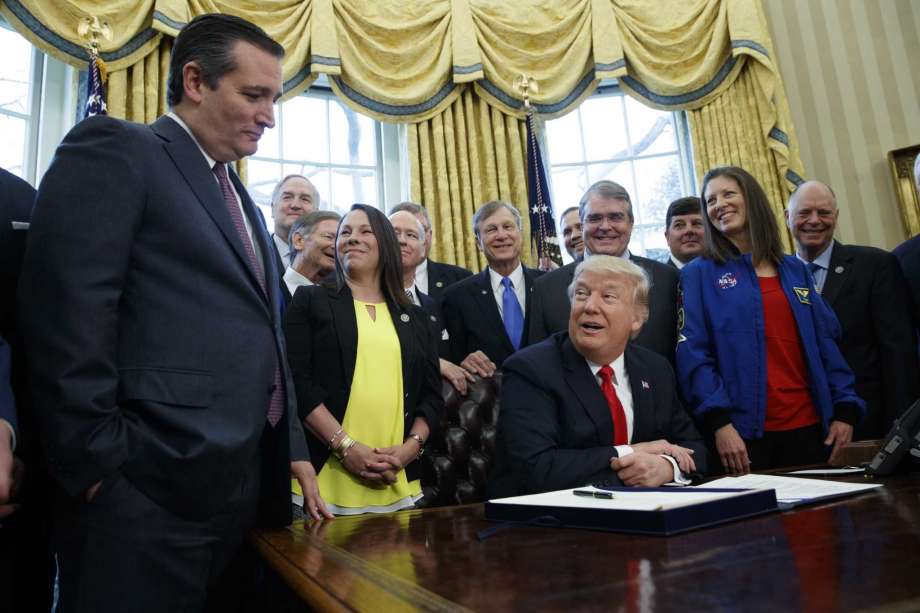
To that end, Donald J. Trump has signed into law a bill that commits $19.5 billion to NASA with the aim of launching human beings into deep space, possibly for exploration of Mars.

Oh, how I want to live long enough to see that day.

The president signed the bill into law in a ceremony at the White House surrounded by astronauts and politicians. It was a jovial affair that — I’m sorry to say — got overshadowed this week by the rancorous and raucous debate over overhauling the nation’s health care insurance system.

The NASA appropriation is worth the money, the effort, the emotional capital and the anxiousness that goes along with what many of hope will transpire: a mission to Mars.

“For almost six decades, NASA’s work has inspired millions and millions of Americans to imagine distant worlds and a better future right here on Earth,” Trump said during the signing ceremony. “I’m delighted to sign this bill. It’s been a long time since a bill like this has been signed, reaffirming our commitment to the core mission of NASA: human space exploration, space science and technology.”

As the Albany (N.Y.) Times-Union reported, “The measure amends current law to add human exploration of the red planet as a goal for the agency. It supports use of the International Space Station through at least 2024, along with private sector companies partnering with NASA to deliver cargo and experiments, among other steps.”

I was among the Americans disappointed when NASA grounded its shuttle fleet. We now are sending Americans into space aboard Russian rockets. I’m trying to imagine how Presidents Kennedy and Johnson would feel about that idea, given their own commitment to the space program and the defeating the then-Soviet Union in the race to the moon … which we won!

Space exploration isn’t a “frill.” It ought to be part of our political DNA. It’s already ingrained in human beings’ desire to reach beyond our grasp.

I spent many mornings with my late mother waiting for Mercury and Gemini space flights to launch. Then came the Apollo program. Our nerves were shot as we waited for astronauts to return home walking on the moon.

I grieved with the rest of the country when that launch pad fire killed those three astronauts on Apollo 1, when the shuttle Challenger exploded 73 seconds after liftoff and when the shuttle Columbia disintegrated as it flew over Texas on its way to landing in Florida.

I’ll be a real old man — I hope — when they send humans to Mars.

This new NASA appropriation could take us a bit farther along on that journey.

In Trump World: Buck stops … somewhere else

Commanders in chief are supposed to know a fundamental truth about sitting atop a large and complex military chain of command.

They are allowed to take some of the credit for success, but they also must take responsibility when missions don’t go according to plan.

Donald J. Trump signed off on a mission to kill or capture some top al-Qaeda leaders, to collect some intelligence on the terror network and, presumably, to return all the men assigned to carry out the mission back home.

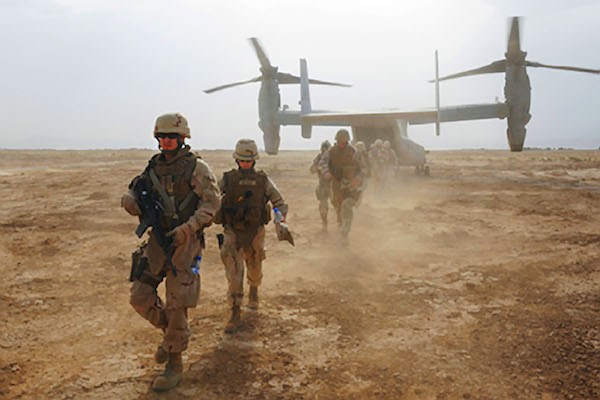
The mission that occurred in Yemen in late January. A Navy SEAL, Chief Petty Officer William “Ryan” Owens died in the fire fight. A state-of-the-art Osprey V-22 tiltrotor aircraft was lost. Some al-Qaeda leaders died in the battle. So did some civilians, including at least one child.

Military and national security officials are still trying to assess the value of the intelligence collected. We keep hearing conflicting assessments. The president, of course, says it is of high value.

But the current commander in chief has done something that is quite extraordinary — and inexcusable. He is laying the blame for Petty Officer Owens’ death on the military planners. “They” lost the SEAL, Trump has said.

Wait a flippin’ minute, Mr. President! The buck is supposed to stop at your desk. One of your predecessors, President Truman, famously posted the sign on his Oval Office desk that said “The Buck Stops Here.” President Kennedy once declared that “victory has a thousand fathers, while defeat is an orphan” after the failed Bay of Pigs operation shortly after he became president.

Trump’s response? He has declared that the planning for the Yemen raid was done by President Obama’s national security team. They crafted the plan that failed, Trump has implied. It’s their fault, too!

This is not what commanders in chief do. Under any other circumstance, presidents stand up and take the heat when things go badly. They do not blame others — namely the military brass or their predecessors. JFK’s failed mission in Cuba was actually conceived by his predecessor, President Eisenhower, but the new guy took the hickey, accepted full responsibility for the mission’s failure.

A military man who just a few years later would become commander in chief himself, devised a strategy to liberate Europe from Nazi Germany. Army Gen. Dwight Eisenhower — supreme commander of Allied Forces — launched the D-Day invasion of Normandy, France in June 1944. The mission succeeded, Europe would be liberated.

But Ike had written an alternative announcement he would have read over the radio had the mission failed. In the message that was never broadcast, he took full responsibility for its failure.

That is what leaders do.

I am not going to wander into the muck over whether the Yemen raid was a success or failure. The president’s assertion that the generals were to blame for the death of a brave young SEAL suggests to me that he has doubts about the mission’s overall success.

Whatever the case, the event occurred on the commander in chief’s watch and it is that person — no one else — who should be held fully accountable.

Chaos need not be the new White House norm

As I watch Donald J. Trump’s chaotic first few weeks as president of the United States, I have to keep reminding myself: Does it really need to be this way?

Of course it doesn’t. We’re watching Trump stumble-bum his way through controversy after controversy and his ridiculous rants and riffs with foreign leaders.

Now we’re watching an potentially unfolding major-league scandal involving the president’s former national security adviser, who quit this week in the wake of reports that he had inappropriate — and possibly illegal — discussions with Russian government officials prior to Trump taking office.

Two presidents in my lifetime have taken office amid terrible tragedy and tumult. In both cases, these men grabbed the reins of power and assumed the role of president as if they’d been there all along.

Example one: Lyndon Baines Johnson took the oath of office on a jetliner sitting on a tarmac at Love Field in Dallas on Nov. 22, 1963. His predecessor’s body was in a casket in the back of the plane and the nation was in utter shock over what had happened earlier that day when a gunman murdered President John F. Kennedy.

LBJ flew back to Washington and asked the nation to pray for him. We did. He convened his team and got to work immediately.

The nation buried JFK a few days later, President Johnson went to Congress and declared “all that I have I would surrender” to avoid standing before the nation in that moment.

The nation marched forward.

Example two: Gerald Rudolph Ford became president on Aug. 9, 1974 as his predecessor resigned in disgrace. The House of Representatives stood poised to impeach Richard Nixon for high crimes and misdemeanors relating to the Watergate scandal. It took a stalwart Republican U.S. senator, Barry Goldwater, to tell the president his time was up. He had no support in the Senate, where he would stand trial after the House impeached him.

President Nixon quit. President Ford took the oath and then told us, “Our long national nightmare is over.” He told us he was “acutely aware” he hadn’t been elected vice president or president. But he was the right man for the job.

He, too, called his team together and instructed them to get back to work.

President Ford would lose his election battle in 1976 to Jimmy Carter. It was Carter who, upon taking the oath of office in January 1977, would turn to his predecessor and begin his inaugural speech by thanking the former president for “all he had done to heal our country.”

Presidents Johnson and Ford had something in common: they both had extensive government experience prior to assuming their high office. They knew how the government worked. LBJ had served as Senate majority leader before becoming vice president in 1961 and had many friends on both sides of the partisan divide. Ford had served as minority leader in the House of Representatives before Nixon tapped him to be vice president in 1973 after Spiro Agnew quit after pleading no contest to a corruption charge. Ford also had many friends on both sides of the aisle.

These men assumed the presidency under far more trying circumstances than Trump did, yet they made the transition with relative ease … compared to the madness we’re witnessing these days with the 45th president.

We are witnessing in real time, I submit, the consequences of electing someone who brought zero public service experience to the most difficult and complicated job on Planet Earth.

Film reminds us of space race thrill

We just returned from watching a film that reminds me of the excitement of an earlier time.

I wish we could gin it up once again.

“Hidden Figures” is a story about a math genius, a computer genius and a budding engineer — all of whom are African-American women — who go to work for NASA in the early 1960s. The space race was getting revved up. The Soviet Union had launched Sputnik and sent Yuri Gagarin around the world in a 100-minute orbit. The United States was still trying to figure out how to launch its Redstone rocket that would take Alan Shepard on a 15-minute up-and-down flight into space before splashing down in the Atlantic Ocean.

They needed this young math whiz to figure out landing coordinates. Taraji P. Henson portrays Katherine Goble Johnson, the math genius who is asked to verify the coordinates where John Glenn’s spacecraft is supposed to land after completing a few orbits around the planet.

The film relays the sense of urgency we felt then. President Kennedy implored the nation to pursue space flight “not because it is easy … but because it is hard.”

It occurred to me while watching the film with my wife that our recent presidential campaign didn’t produce a single policy statement or pledge — that I heard, at least — from either Donald J. Trump or Hillary Rodham Clinton about restoring and resuming the U.S. manned space program.

The candidates were too busy insulting each other and impugning each other’s integrity to spend time talking about much of anything of substance.

I consider manned space flight a fairly substantive issue to pursue.

The United States scrapped its space shuttle program and is now hitching rides aboard Russian space ships into Earth orbit. I’m trying to imagine how Presidents Kennedy and Johnson would feel about that particular turn of events.

Even during his farewell speech to the nation Tuesday night, President Obama said not a single thing about the future of space flight. I wish he would have at least offered an ode to the future of manned space exploration as something future presidents and Congresses should pursue.

The film we watched today affirms to me that this nation has it within its soul and spirit to reach farther than ever before. We’ve landed on the moon. We made space flight “routine,” through those shuttle missions, if you believe a program that took the lives of 14 astronauts should ever deserve to be considered routine.

NASA is developing a deep-space craft that is supposed to take human beings to Mars, or perhaps to one of the asteroids, or perhaps to one of Jupiter’s moons.

I don’t know if I’ll live long enough to see that happen. I damn sure hope so. The film we saw today has reinvigorated my desire to see us reach beyond our comfort zone yet again.

Trying to decide whether to watch inauguration

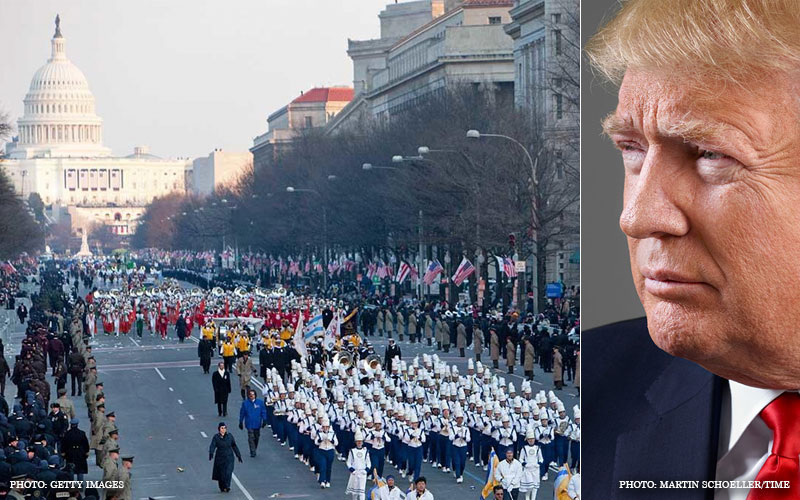
Some friends and a couple of family members have asked: Are you going to watch Donald Trump’s inaugural?

I don’t yet know.

I have made no secret of my disappointment in the outcome of the 2016 presidential election. Sure, my candidates have lost before. This one, though, feels different in a way I cannot yet define clearly and concisely.

It might be that I do not consider Trump fit or qualified at any level to become president of the United States. That’s not how it turned out at the ballot box. He collected enough electoral votes to win the election. That’s that.

Inaugural speeches usually are filled with high-minded, soaring rhetoric. A few of them over the years have produced phrases for the ages: President Lincoln’s “with malice toward none and charity for all” at his second inaugural in 1865; President Franklin Roosevelt’s “We have nothing to fear but fear itself” at his first inaugural in 1933; President Kennedy’s “ask not what your country can do for you, but what you can do for your country” in 1961; President Reagan’s “government is the problem” at his first inaugural in 1981.

The rest of them? Well, I don’t remember certain phrases, although I do recall all the presidents spoke of high ideals and grand goals.

I’m trying to imagine Donald Trump expressing himself in such a fashion. I’m also trying to speculate as to whether the 45th president will even be able to maintain his focus long enough to read the text on his Teleprompter; or will he spin off on one of those tangents, one of those stream-of-consciousness riffs.

My tendency has been to watch these speeches. I try to soak it all in. I seek to glean some sense of hope from the president.

With this guy Trump, though, such optimism remains a distant dream for me. His campaign was too steeped in anger, bigotry and exclusion for me to feel any sense that he ever can appeal to what’s best in Americans.

Inaugurals are meant to set a tone for the presidency. They are intended to give us hope. How in the world is Donald Trump going to deliver such a message after running the kind of campaign that propelled him to the highest office in the land?

Decisions, decisions …

Trump continues to diss U.S. intelligence agencies

My head is spinning.

Republicans at one time used to condemn Julian Assange, the founder of WikiLeaks, for revealing U.S. national secrets to the rest of the world.

Now some of them — including the president-elect of the United States — believe him more than they believe U.S. intelligence officials who contend that Russian spooks hacked into the American electoral system.

What in the world has happened here?

http://www.msn.com/en-us/news/politics/trump-cites-assange-claim-about-russia-hacking/ar-BBxT4NI?li=BBnb7Kz

“Julian Assange said ‘a 14 year old could have hacked Podesta’ – why was DNC so careless? Also said Russians did not give him the info!” Trump tweeted Wednesday.

As USA Today reports: “Podesta is the Hillary Clinton campaign chairman whose emails were released by WikiLeaks during the campaign, part of an effort that U.S. intelligence officials attributed to the Russians, perhaps in order to help Trump win the election.”

Trump continues to disparage the intelligence agencies who will be charged with providing him information about our foreign adversaries. Will the president continue to disparage them even as they seek to brief him potential crises?

Presidential historian Michael Beschloss wondered today on MSNBC what might have happened in 1962 had the CIA presented to President Kennedy pictures of “something being built” in Cuba that turned out to be ballistic missile launchers. What if the president had disregarded them? Beschloss asked.

Trump now has sided with someone who has been scorned by politicians within his political party, someone who’s been defending the Russians’ denial of doing anything wrong.

Julian Assange is no friend of the American intelligence network.

Sen. Tom Cotton, R-Ark., said that “I have a lot more faith in our intelligence officers” than in “people like Julian Assange.”

For the ever-loving life of me I cannot figure out what’s happening here. The president-elect of the United States of America is taking the word of a reputed national security threat over the word of those assigned to protecting our national interests?

I need to take something for my spinning head.

Let’s avoid righteous rebuke of Russians

salvadorallendeweb_986

I feel the need to stipulate a couple of things that might seem to contradict each other.

First, I shudder at the notion that Russian computer geeks hacked into our vast cyber network to seek to influence the outcome of the 2016 president election. It galls me in the extreme to believe that Russians might have engineered the election of Donald J. Trump as the next president of the United States.

Second, it’s time we put all of this into some historical context, which is that the United States of America isn’t squeaky clean in this regard. Far from it. Indeed, we’ve interfered as well with other countries’ political processes.

Some examples come to mind:

* 1963: South Vietnamese President Ngo Dinh Diem was assassinated in a coup with backing by U.S. diplomats.

* 1961: U.S.-trained troops stormed ashore at the Bay of Pigs in Cuba in an effort to overthrow Fidel Castro. The invasion failed, the invaders either were killed or captured. President Kennedy took full responsibility for the failure.

* 1973: CIA-led insurgents managed to overthrow the government of Marxist Chilean President Salvadore Allende.

* 2003: U.S. troops invaded Iraq with the expressed purpose of “regime change” in Baghdad. They drove Saddam Hussein from power, then found him hiding in that “spider hole.” Saddam was put on trial, convicted of crimes against humanity and was hanged.

The anger at the Russians’ interference with U.S. political processes is taking on the air of righteous indignation that we would do well to rein in. The United States of America has gotten involved, too, in other nations’ internal affairs.

Hoping for the next true American hero

08butlandweb-master768

Dale Butland has written a truly depressing essay about the death of John Glenn.

Writing for the New York Times, Butland — who once worked for the one-time Ohio U.S. senator — seems to think Glenn is the “last American hero” … ever!

I wince at the thought. I shudder to think that there won’t be someone who can capture Americans’ hearts the way Glenn did in 1962.

The essay itself isn’t depressing. Its premise, though, surely is.

http://www.nytimes.com/2016/12/08/opinion/john-glenn-the-last-american-hero.html?smid=tw-share

Do I have any clue, any idea where the next hero will appear?

Of course not!

However, I am going to remain the eternal optimist that we haven’t yet traipsed through the portal that takes us all into some parallel universe where no heroes can ever exist.

Sure, Glenn was an exceptional American. A Marine Corps fighter pilot who saw combat in World War II and Korea. The astronaut who became the first American to orbit the planet. A successful business executive. A close friend of John and Robert Kennedy and their families. A four-term U.S. senator. A man who got the call once again, at age 77, to fly into space aboard the space shuttle Discovery.

He became “an American legend.”

That, dear reader, is a full life.

Is he the final legendary figure ever to walk among us?

Oh, man … I pray that someone will emerge.

Let’s get back into space

space_flight-wide

John Glenn’s death reminded many of us old enough to remember such things about how space travel once thrilled the nation.

It was a new thing back then, when Glenn orbited the planet three times in just a little less than five hours. We were riveted to our TV screens. We held our breath. We prayed for the safe return of these men.

Then, oh so strangely, space flight became “routine.” Routine! Are you kidding me?

How ridiculous! You put human beings on top of a missile loaded with flammable fuel, light the rocket and hurl these humans into orbit at 17,000 mph. That becomes routine?

We launched men into orbit during the Mercury space program. Then came the Gemini program that featured two-person space ships. After that, it was the big one, the Apollo program that sent men to the moon.

Those missions became so “routine” that the space agency stopped sending men to the moon, apparently believing they had done all they could do.

Skylab came later. The space shuttle program followed that.

About six years ago, we grounded the remaining shuttle fleet — after two of the ships, Challenger and Columbia, were lost, killing 14 crew members. Routine? Hardly.

I’m recalling the adventure associated with John Glenn’s first flight into space and hoping for a time when we can send human beings back into space aboard our own rocket ships. Today, we’re relying on Russia to ferry our men and women into Earth orbit — and I’m trying to imagine how President Kennedy, who challenged the nation to put men on the moon by the end of the 1960s, would react that knowledge.

I came of age watching the space program take flight. I am old enough to remember how these missions forced us all to hold our breath when these heroes were thrown into space.

The next step awaits. It no doubt will involve sending humans way past the moon and toward places like Mars. I hope to live long enough to see that occur.

I will wait anxiously for a day when we can view spaceflight once again as the spine-tingling adventure it’s always been.

A great American has just left us

aalhlnh

A great American life has come to an end.

We shouldn’t mourn John Glenn’s death, which was announced this afternoon. We should celebrate what this man accomplished during his 95 years among us.

What a man! What a life! What an extraordinary legacy he leaves!

I almost feel as though I’ve lost a member of my family.

Glenn and six other Americans burst onto the scene in the late 1950s when a newly formed agency, NASA, selected these men to become the first Americans to fly into space.

Glenn would be third of them. He was the first American to orbit the planet.

This is just one chapter of this great man’s life.

He joined the Marine Corps. He flew combat missions during the Korean War. Then he became a test pilot. Then NASA selected him to fly into space. He took three quick trips around Earth, returned home and didn’t fly again into space again for another 36 years.

In the meantime, he got elected to the U.S. Senate from Ohio, ran or president once in 1984. Along the way, he became friends with presidents, princes and potentates.

aalh90m

In 1998, he flew aboard the space shuttle Discovery. Sen. Glenn had a distinct advantage over two other members of Congress who flew previously into space — U.S. Sen. Jake Garn, R-Utah, and U.S. Rep. Bill Nelson, D-Fla. The Discovery flight crew and its support team didn’t have to translate their unique language to Glenn as they prepared for their flight. Glenn was fluent in astronaut-speak.

He boarded Discovery and the ship roared off the pad as the public address announcer told the world about the launch of the shuttle carrying “six astronaut heroes … and one American legend.”

***

Why the family-like connection with Glenn?

My mother and I were addicted to watching these early Mercury launches. We would awaken early and wait, and wait and wait some more for these rockets to blast off.

On Feb. 20, 1962 — after an interminable number of weather-related delays, holds, and mission scrubs — Mom and I watched on our black-and-white TV as Glenn Mercury-Atlas rocket roared into space.

The flight lasted about five hours. Then he splashed down — and came home a hero. They had a ticker-tape parade in New York. President Kennedy toasted him at the White House.

John Glenn was a glamorous kind of guy. Ruggedly handsome, he fit central casting’s description of a test pilot-turned astronaut.

There’s perhaps a touch of irony that Glenn would be the final Mercury astronaut to pass on. He was the oldest among them; Glenn was 40 at the time of his first flight aboard Friendship 7 in 1962.

So it is, then, that we remember this great American.

I’m thinking at this very moment of something his late Mercury colleague Scott Carpenter said to Glenn as his friend sat atop the rocket waiting to be blasted into space.

Godspeed, John Glenn.