Tag Archives: Vietnam War

CIA: former foe of the left becomes its friend

An interesting Internet meme is making the rounds. It says that “real patriots” don’t question when the Central Intelligence Agency says that Russians hacked into our electoral system in 2016.

Now, those of us who are old enough to have lived through a good bit of U.S. history remember something quite different about American attitudes toward the CIA.

The meme to which I referred is intended to take a swipe at conservatives who are siding with Donald J. Trump’s view that the CIA’s intelligence-gathering capability isn’t up to snuff. Think about that for a moment: Liberals are siding with the spooks.

It wasn’t always this way.

Let’s flash back for a moment to the 1970s. The Vietnam War was still raging; a Republican president was about to be re-elected; the CIA was allegedly helping the president develop an “enemies list” that targeted left-wing protesters; then came that burglary at the Watergate office complex; the president then told the CIA to instruct the FBI to back off its probe of the break-in.

The crap hit the fan. The CIA was caught doing something wrong. Liberals cheered; conservatives moaned. The president resigned and it took years for the CIA to wipe its face clean.

More than four decades later, the CIA is still on the job. It is conducting intelligence operations around the world. It is well-run. Indeed, the CIA played a huge role in the mission that killed Osama bin Laden in May 2011, an event that brought liberals and conservatives together to cheer the success of that endeavor.

Politics, though, does have this way of ebbing and flowing. We are the point today where the CIA is seen as a valuable watchdog against those who would do harm to our political system.

The CIA — and a few other agencies — have concluded that Russian meddled in our 2016 presidential election. Whether they actually swung the election in Donald Trump’s favor is one of the questions of the moment; I tend to think Trump would have won regardless. That’s not the point.

The point is that they meddled. The CIA has determined they have meddled. A lot of political hands across the spectrum — and that includes progressives/liberals — believe in the CIA analysis. The most prominent denier of all this happens to the Republican president of the United States, the current darling of the conservative movement, the guy who says he wants to “put America first” and to make this country “great again.”

Oh, the winds of change do have this curious way of blowing away old thoughts and bias.

GOP: the party of diversity in thought, philosophy

I want to toss a bouquet or two at the Republican Party.

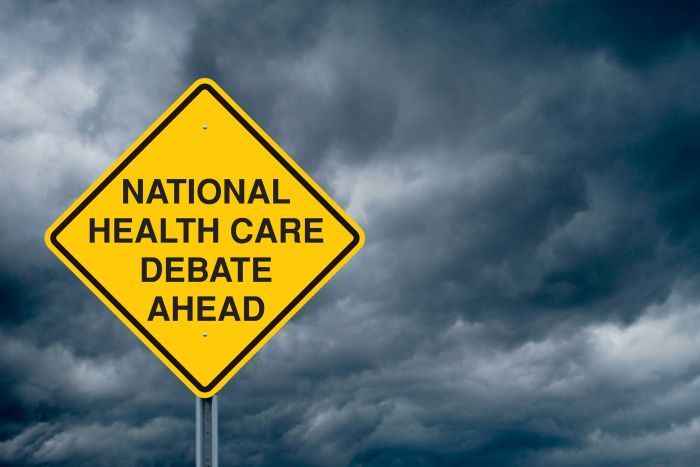
The Grand Old Party has become the organization filled with diverse thoughts, philosophies, competing ideas. It is being revealed yet again as the GOP struggles over how to enact a bill that would overhaul the Affordable Care Act.

It wasn’t always this way.

A couple of generations ago, those of us of a certain age remember when the Democratic Party exemplified turmoil, tumult and tempest. The Vietnam War tore Democrats apart, had them ripping out the throats of their brethren. Republicans stood firm in support of that war.

The GOP would split in 1976 when conservative champion Ronald Reagan challenged President Ford’s election effort, only to lose narrowly at the party’s political convention.

Now we see Democrats standing as one in opposition to the GOP plan to dismantle the ACA and replace it with something else.

Republican moderates dislike the GOP alternative because it takes too much money from Medicaid. Republican conservatives hate it because they call it a “light” version of the ACA and are pushing for a more drastic departure from President Barack Obama’s landmark domestic legislative achievement.

Frankly, I find the intraparty debate refreshing and healthy for Republicans. There might be a purging after it’s all over. Whichever sides wins the argument will likely have to heal the rift that has developed with the other side, and vice versa.

I’ve always like diversity of thought. Democrats’ divisions in the 1960s and early 1970s cost them dearly over the course of many presidential election cycles. They would lose six of seven presidential elections from 1968 to 1988. Democrats eventually got their act together enough to win in 1992, 1996, 2008 and 2012.

It remains to be seen whether the current Republican political divide will cost that party as dearly as it did the Democrats. I believe, though, that the party’s struggle over health care overhaul will be ultimately good for its long-term future — if the GOP is able to cope with all this arguing.

Most toxic ever? Well … it’s a different type of toxicity

An acquaintance of mine posed a question to me today. Since he asked it in a public social media venue, I’ll answer it here.

He wondered: “Has it always been this toxic? Or are we entering a new era?” The “it” to which he referred is the political atmosphere.

I’ve thought about it for several hours and I’ve concluded that it’s more likely a “new era” than the most toxic ever.

This fellow seems to think I’m an expert on political matters. I’m not. I am, however, a 67-year-old red-blooded American patriot who’s been witness to a lot of anger, anxiety, fear and loathing in the halls of power.

One highly toxic era occurred in the late 1960s and early 1970s. The first trigger was the Vietnam War, followed immediately — and in a related sort of way — the Watergate scandal. I served in that war for a time, came home and then got involved politically as a newly married college student.

Politicians were angry at each other because of their respective views on the war. That anger spilled into the streets. People died during riots. Then came Kent State in 1970 when National Guard troops opened fire and killed four student protesters. The nation was grief-stricken.

The Watergate break-in — in June 1972 — stirred Americans even more. The scandal that ensued threatened to swallow the nation in one big bite. It didn’t. The U.S. Constitution did its job; a congressional committee approved articles of impeachment against President Nixon, who then quit.

There was plenty of anger then, too.

Two decades later, a newly elected president became the focus of intense Republican anger. The GOP detested President Clinton. Republicans won control of Congress in 1994 and began their quest to get rid of him. They hired a special counsel, who then stumbled onto a discovery: the president’s relationship with a young White House intern. The counsel summoned the president, made him swear to tell the “whole truth” to a grand jury; the president didn’t uphold that oath when he was asked about the intern.

There you go. Impeachment proceedings began. Was there intense anger then? Uh, yeah. The air was poisoned by partisan bias. The House impeached President Clinton in 1998, but the Senate acquitted him in a trial.

Now comes the Donald John Trump era. The air is toxic. It’s full of bitterness. Democrats cannot stand the very idea of this guy being elected president of the United States. The president’s core supporters are firing back, telling Trump foes to get over it; he won fair and square.

Another special counsel is now on the job. He’s researching whether the president had an improper relationship with Russian government officials. The president has impugned the integrity of the political system, the nation’s intelligence network that has concluded Russians sought to influence the 2016 presidential election.

Trump’s tweet storms have infuriated his foes, energized his friends.

The president cannot seem to tell the whole truth. The only difference between this president’s penchant for prevarication and Bill Clinton is that Trump hasn’t lied under oath … yet.

Trump’s candidacy for president ushered in a new political era. His election as president hammered it all home. The reaction to his election has generated yet another storm the likes of which many of us never have seen.

Is it the worst ever? I won’t say that. It damn sure feels like something brand new.

Memorial recalls memory of favorite veteran

WASHINGTON — The atmosphere in the nation’s capital has become overheated, overblown and overstated. It’s not a happy place if you are a politician who wants to do the right thing, but you get caught up in the daily — if not hourly — struggles between the two major political parties.

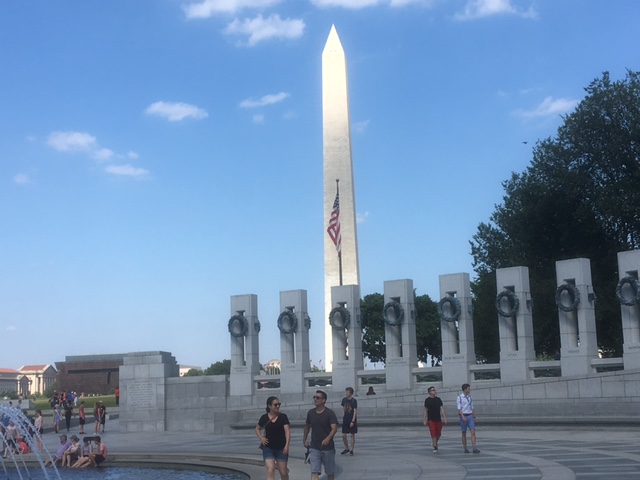
They all ought to come to this place perhaps once a week. They should cast their eyes on the World War II Memorial, which reminds us of just how titanic our struggles can get.

I came here with my wife, our niece and her husband. It was hot that day. During our entire walk along The Mall, I managed to put contemporary politics aside. I thought instead of my favorite veteran. I’ve written before about my father, the late Pete Kanelis. He served during this struggle, the one that enveloped the globe from 1939 until 1945.

The picture above honors those who served in the European Theater of World War II, as Dad did. He saw combat as a sailor in the Med.

Yes, I have heard about critics of this particular memorial, one of the newer exhibits along The Mall. It’s too gaudy, too grand, too big, they say. It really isn’t, at least in my view. It honors a massive military engagement. By the end of the global war, more than 16 million Americans suited up to enter the fight; whether it was at home or abroad, they answered the call and performed magnificently.

They were, as the author/journalist Tom Brokaw has written, The Greatest Generation.

At the other end of the WWII Memorial pool is a section devoted to the Pacific Theater of Operations.

There, too, Americans and their allies fought across the vast ocean to take back land conquered by Japan. They endured sacrifice most of only can imagine. My favorite veteran happened to be in The Philippines when President Truman ordered the dropping of the atomic bombs in August 1945. The enemy surrendered. Thus, I remain convinced that the president likely saved Dad’s life. I am eternally grateful for the president.

We walked along the Vietnam Veterans Memorial, the Korean War Memorial, the Martin Luther King Jr. Memorial, the Franklin Delano Roosevelt Memorial, the Washington Monument and the Lincoln Memorial. They all reminded us of the nation’s greatness and they allowed me to set aside the ongoing anger and anxiety I am feeling about the present day.

Later in the day, we saw Marine One fly overhead on its way back to the White House, carrying the president of the United States back from wherever he had spent the weekend.

I had been filled with awe at what we had seen. In that context, seeing the presidential aircraft made me appreciate the struggles that accompanied the building and the development of the world’s greatest nation.

Dad would have been proud, too.

Nation’s capital still stirs the emotions

WASHINGTON — This is the most political city in America, if not the world and politics being what it has become in recent decades, this city is full of a lot of hard feelings and recrimination.

You know my own feelings about the current president of the United States. But this blog post isn’t about that — and it damn sure isn’t about him. It’s about the myriad monuments, memorials and assorted structures throughout the city that pay testament to the nation’s greatness.

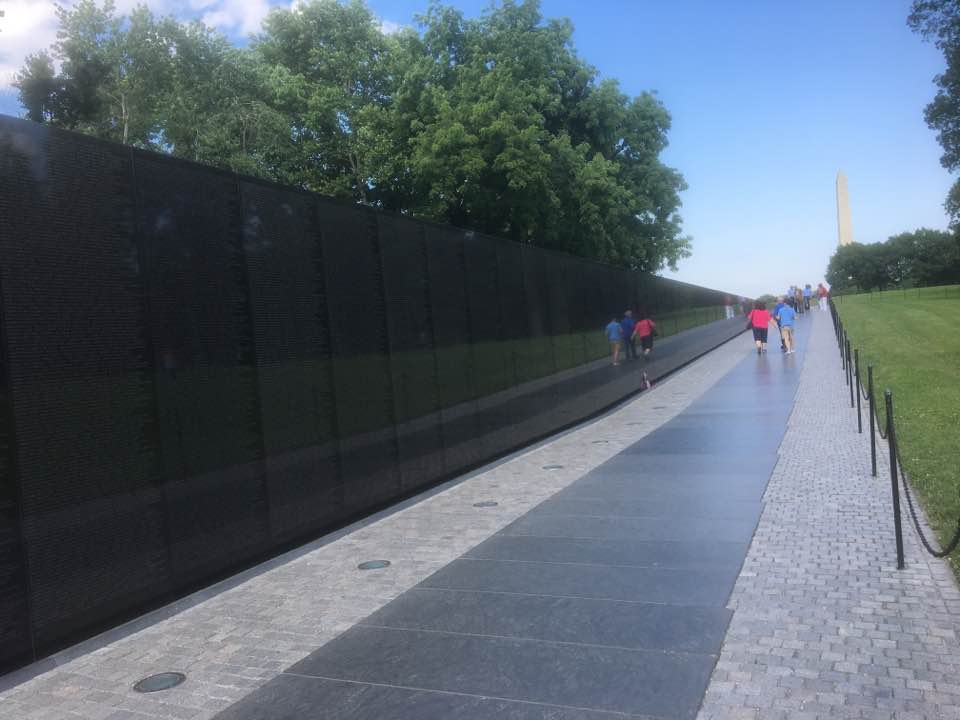
We came to the Vietnam Veterans Memorial. It’s like an outdoor church. Visitors lower their voices. They speak in solemn tones. They look at the 58,000-plus names etched into the stone, seeking to recall memories of the individuals who gave their last full measure.

I found a name I had spotted the first time my family and I came here in 1990. He was a young man with whom I served briefly in Vietnam. He was set to go home in a few days, but fate intervened at a landing zone where he and his Huey helicopter unit was ambushed in June 1969 by enemy fighters.

We toured much of the Washington Mall, walked through the World War II, read the inscriptions from the likes of Chester Nimitz, Franklin Delano Roosevelt, Dwight Eisenhower, George C. Marshall that paid tribute to the brave Americans who — along with soldiers from many other nations — saved the world from tyranny. My all-time favorite veteran, my father, was one of the 16 million Americans who answered the call to duty. I thought of Dad while marveling at the grandeur of the WWII memorial.

Not far from that is the Korean War Memorial, which pays tribute to the “forgotten war.” It, too, cost tens of thousands of American lives. I prayed for the souls of those who paid the ultimate sacrifice.

We cast our eyes on the Washington Monument, the Lincoln Memorial, the Jefferson Memorial and toured the FDR Memorial.

For several precious hours while taking all that in, I was able to set aside the events of the moment. I didn’t think a single time about the confusion, controversy and contentiousness of the present day. I thought instead of the great Americans who built the country and created a nation that remains — despite rhetoric to the contrary — the greatest nation in human history.

We had to see these things to remind us of who we are.

Dear Vietnam vets: Return to that beautiful land

A blog post I wrote noting a preview of an upcoming PBS documentary special on the Vietnam War brings to mind something I’ve told Vietnam veterans for the past 28 years.

They should return to that land, to the place that was so ravaged for decades by war. Vietnamese battled the Japanese during World War II; then they fought the French who tried to re-colonize their country; then came the Americans, who went to Vietnam ostensibly to protect the south against communists invading from the north.

I was one of them who went there in the spring of 1969. The Army sent me there after training me to service OV-1 Mohawk airplanes. They ordered me to Marble Mountain, just south of Da Nang.

After I returned home and eventually separated from the Army, I re-enrolled in college, got married, produced two sons, started my career in journalism and then, in 1989 had the opportunity to return to Vietnam as part of a delegation of editorial writers and editors.

The PBS series that will debut on Sept. 17 contains interviews with many veterans, one of whom comments on how beautiful the country was — and is! He is so correct.

Two decades after serving there, I found a country that had commenced its recovery from all that warfare. It, indeed, is a beautiful land, with beautiful citizens who — even then — welcomed these American journalists with open arms.

I’ve told many vets since that marvelous journey that they should return. Most of them beg off. Too many terrible memories, they tell me. The combat veterans especially seem to want no part of returning there. I tell them candidly that they should go nonetheless. They will find healing in a return there. Indeed, my trip to Vietnam with fellow journalists included several veterans, some of whom saw their share of combat during the war. They, too, felt revived upon returning to that place.

I did, too. I discovered one of the big surprises of my life upon returning to Marble Mountain in 1989. It was that I had been lugging around emotional baggage and I didn’t even know it!

Our government guide — a true-blue communist named Mai — was explaining to me how the Vietnamese were able to absorb all that we had left behind. The building materials, the equipment, even the pierced-steel planking (PSP) upon which we parked our aircraft all was put to use by the Vietnamese, she said.

That’s when I lost it. That is when I shed my emotional baggage.
The PBS documentary produced by acclaimed filmmaker Ken Burns is going to bring much of that home to vets who watch it.

I would urge them all to return to Vietnam if they can. Take my word for it. They will not regret returning.

https://highplainsblogger.com/2017/05/get-ready-for-a-major-history-lesson-on-vietnam/


JFK’s life will be forever unfinished

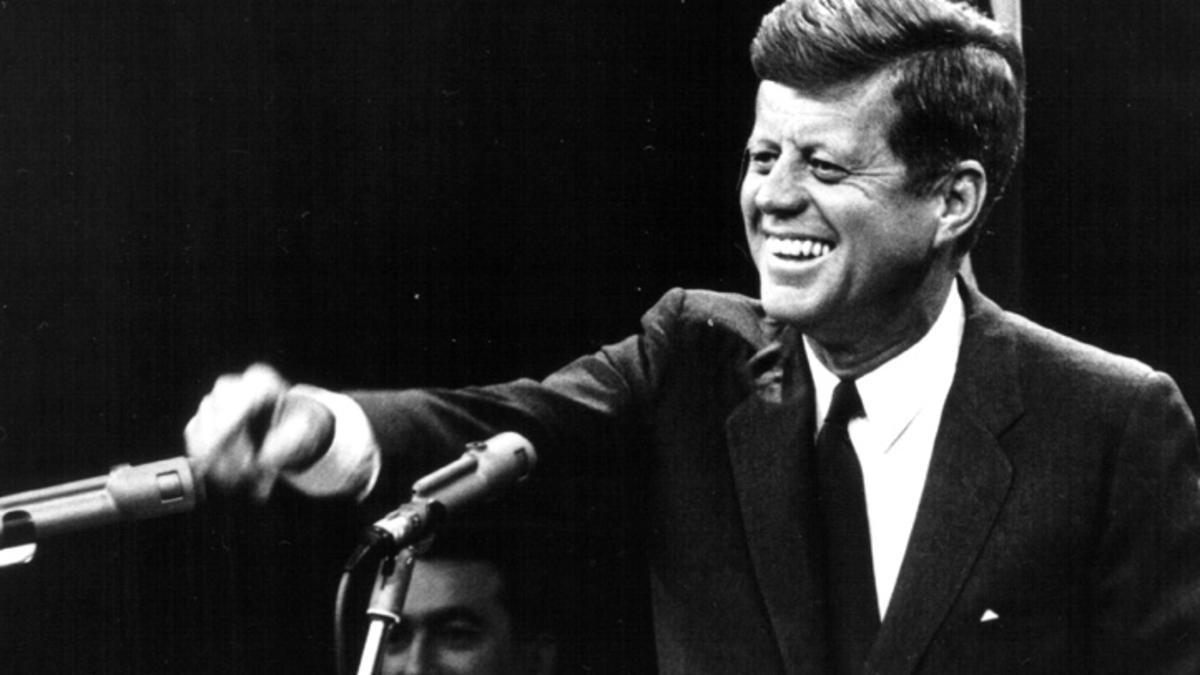
It sounds strange to consider that John F. Kennedy would turn 100 years of age today.

Those of us who are old enough to remember the 35th president of the United States remember him as a young man who, even stranger as it seems, seemingly gets younger the older we all become.

JFK was the youngest man ever elected president in 1960. He was 43; the youngest ever to become president was Theodore Roosevelt, who ascended in 1901 to the highest office at 42 upon the death of President William McKinley.

Less than three years after taking the oath of office, President Kennedy’s life ended as he took a rifle shot on that street in downtown Dallas.

I have resisted the temptation to rank President Kennedy among the greatest who ever held that office. I consider his life to be an unfinished work. I bristle a bit at those surveys that place JFK at or near the top of such lists. How can we measure what he actually accomplished? The truth is we cannot.

I prefer to think of the president in terms of what he might have done. Even that is an exercise in futility because we cannot know with absolute certainty how history would have played out had he served the entire length of his presidency. I’ll presume he would have been re-elected in 1964. Then what? How would the Vietnam War have gone? What would he have done, say, by the end of his second term?

His life is frozen in time. For the president, it ended after just 46 years on Earth.

Still, the man’s legacy remains in large part due to the work done by those who came after him. President Lyndon Johnson’s “war on poverty,” his landmark civil rights legislation and, yes, the tragedy that continued to unfold in Vietnam all are part of JFK’s historical record.

I have trouble even grasping the notion of John F. Kennedy becoming an old man, let alone one who might have lived long enough to celebrate his centennial birthday.

If only he could have finished his marvelous life. JFK will remain, as the song suggests, “forever young.”

Get ready for a major history lesson on Vietnam

Oh, how I love public television.

Americans are going to receive, via what looks like a spectacular PBS documentary series, a history lesson for the ages.

The subject: The Vietnam War.

Documentary filmmaker Ken Burns has assembled yet another masterpiece that airs beginning on Sept. 17 on Panhandle PBS. I just watched a 30-minute preview of the multi-part series. I have a few thoughts to share about it … and about the series that I want to urge all Americans to watch.

Burns calls the Vietnam War the nation’s “second civil war,” in that it tore this country apart to a degree not seen since the actual Civil War that was fought from 1861 until 1865. Perhaps just like the Civil War, this nation hasn’t yet come to grips fully with what happened here while young Americans were dying in a foreign land.

My interest in the series, of course, is quite personal. I was one of about 3 million Americans who went to Vietnam. My tiny contribution to that effort as an Army soldier is not worth detailing here. I went there, came home — and was privileged to return to Vietnam two decades later on assignment with a group of journalists.

My major takeaway from the return to Vietnam in 1989 was that I shed some emotional baggage that I never even realized I was lugging around. Perhaps this PBS series will allow other Americans to do the same thing.

Burns and his crew interviewed American veterans, South Vietnamese veterans, Viet Cong fighters, North Vietnamese veterans. One former VC soldier tells how he witnessed American soldiers weeping over their dead comrades. He said he realized then that “those Americans are just like Vietnamese,” in that both sides had a shared sense of humanity.

One of Burns’s producers talked about the music of that era, calling it “the best music in American history.” Yeah! Do you think?

The Kent State riots in Ohio in 1970, according to one of the historians interviewed, symbolized the fracture among Americans. “They were kids on both sides; National Guardsmen and student protesters,” he said.

And, oh yes, how did some of those who protested the war treat those who returned from that battlefield? Not well. One of them expresses profound sadness over calling these warriors “baby killers and worse.” That has changed as Americans today profess profound gratitude for the young men and women we send abroad in defense of our nation.

This Vietnam veteran is filled with gratitude for that change.

Burns believes that PBS is the only network in the nation that could present a series such as the Vietnam special that will air in a few weeks.

Thus, I am grateful beyond measure as well for public television’s willingness to teach us what we need to learn about this important chapter in our nation’s ongoing story.

Praying for the souls we have lost

My wife and I are going to spend part of Memorial Day doing what all Americans ought to do.

I don’t mean to hold us up as paragons of patriotism, but our plans for the day include a visit to the Texas Panhandle War Memorial, next to the Randall County Courthouse Annex at Georgia Street and Interstate 27 in Amarillo. Yes, we’re going to grill some burgers later in the day … but first things first.

There will be a ceremony at 11 a.m. honoring those who have fallen in defense of the nation we all love so dearly.

I’ve been blessed in countless ways, all beyond measure. One of those blessings includes a sparse number of friends, acquaintances and loved ones who have perished while serving in time of war. I haven’t lost any of my buddies from my childhood who went to war in Vietnam.

But I’ll remember a particular fellow I did lose one day in June 1969. I’ve introduced you to him already on his blog. His name was Jose De La Torre. He was from Fullerton, Calif. We served in the same U.S. Army aviation battalion in Da Nang. I was assigned to a fixed-wing unit. De La Torre served on a Huey helicopter crew and manned an M-60 machine gun when the ship flew.

He took off one day on a “routine” troop lift. However, the landing zone was hot, full of enemy forces who opened fire on the ships delivering troops to the battlefield.

De La Torre was one of those killed in action.

I’ll remember him and will pay tribute and honor to all who have died in service to our country.

The Panhandle War Memorial pays tremendous honor to those Panhandle residents who gave their last full measure of devotion. I was honored to have had a hand in producing the exhibit. I was awarded the task of writing narratives about many of the conflicts that are profiled there, dating back to the Spanish-American War of 1898.

This blog post, however, is about the individuals whose names are inscribed on the stone tablets. They answered their nation’s call.

There’s an inscription at the memorial that tells us that “All gave some, some gave all.” These proud Americans gave all they had.

They are heroes — every one of them — in the truest sense of that overused word.

May they all rest in peace.

President continues his insult tirade

One of the many promises Donald J. Trump made when he became president was that he would “act like a president.” He would talk like one, too.

He was elected to the highest office in America after burying his Republican primary foes in a mudslide of insults. Then he turned his insult machine loose on Democratic nominee Hillary Rodham Clinton.

Lyin’ Ted Cruz, Low Energy Jeb Bush, Little Marco Rubio all ran against Trump in the GOP primary. Trump also told an interviewer that Sen. John McCain was a Vietnam War hero “only because he was captured; I like people who aren’t captured, OK?”

Then he turned his guns loose on Crooked Hillary Clinton. He urged on campaign rally crowds to yell “Lock her up!”

His core of supporters didn’t mind. Trump merely was “telling it like it is,” they said. He’s not a politician, they insisted. He talks like the rest of us, they added.

Has he stopped hurling insults now that he’s president?

Nope. Not a chance. Now we hear — from the “fake news” mainstream media outlets such as the New York Times — that he fired FBI Director James Comey because he’s a “nut job,” that he’s “crazy.”

Ah, yes. That’s how the president refers to the nation’s top federal cop, America’s top law enforcement officer. A nut job. He’s crazy.

Who heard the president offer this bit of presidential dignity? The Russian foreign minister and Russia’s ambassador to the United States. They were invited into the Oval Office on a suggestion from Russian President/dictator/killer Vladimir  Putin, who asked Trump to have these fellows stop by for a visit.

Oh, and then there’s this: Trump banned American journalists from the meeting. The Russian news agency, Tass, was present. Tass photographers took pictures of the meeting.

If you’ll forgive me for borrowing a term that Trump himself used in one of his endless string of tweets: This man’s behavior is so “unpresidented.”