Tag Archives: George W. Bush

HIV/AIDS gets short shrift from Trump administration

Here’s a quick story about the respective value two Republican presidents have placed on researching a cure for HIV/AIDS.

One of them is George W. Bush, who in 2002 managed to create an agency called the President’s Emergency Plan for AIDS Relief, or PEPFAR. It has delivered an enormous contribution to the worldwide fight against the dreaded disease.

In 2004, I was fortunate enough to attend the International Conference on AIDS in Bangkok, Thailand, where I learned that because of PEPFAR, the United States has given more money to AIDS research than every other nation in the world combined.

President Bush began pondering such an initiative in 1998 when he was still governor of Texas but considering a run for the presidency in 2000.

Now, let’s fast-forward to 2017. President Barack Obama has departed the White House after two terms and Donald J. Trump has settled into his new gig. What’s happened to the national effort on HIV/AIDS research? Six members of the president’s HIV/AIDS council have quit in anger. They say Trump doesn’t care about HIV/AIDS.

According to The Hill newspaper: “The group said that the administration ‘has no strategy’ to address HIV/AIDS, doesn’t consult experts when working on policy and ‘pushes legislation that will harm people living with HIV and halt or reverse important gains made in the fight against this disease.'”

They wrote in their letter of resignation: “As advocates for people living with HIV, we have dedicated our lives to combating this disease and no longer feel we can do so effectively within the confines of an advisory body to a president who simply does not care.”

This, dear reader, looks to be yet another travesty of the Donald J. Trump administration.

Ready for the White House portrait unveiling?

At some point near the end of Donald J. Trump’s current term as president, his protocol staff will likely schedule an appearance by his immediate predecessor, Barack Obama, and the former president’s wife, Michelle.

It’s been a custom for many years. The former first couple returns to the White House to unveil their official portraits. The president’s portrait hangs next to other presidents; the first lady’s portrait hangs in a gallery that includes her predecessors.

I remember watching when President Obama and Mrs. Obama welcomed George W. and Laura Bush back to the White House in 2012. It was a heart-warming ceremony, with all four — the current and former first couples — exchanging quips and remembrances of their time in the White House.

Is it possible for the Obamas to return to the White House at the invitation of Donald and Melania Trump? Can the former president set aside the astonishing rhetoric that the current president hurled at him? We have the on-going lie that Trump kept alive about Obama’s place of birth; then we have the defamatory accusation from Trump that Obama “ordered the wiretap” of the president-elect’s campaign office.

Oh, and how about the comments that Michelle Obama delivered in the wake of that ghastly “Access Hollywood” video in which Trump admitted to groping women and grabbing them by their private area?

I can just imagine how, um, tense the next portrait-unveiling is going to be when — or if — it occurs.

Bipartisan era gone forever? Looks like it

I am thinking at this moment of an earlier era when presidents and members of Congress reached across the great partisan divide to ponder their joint legislative agendas.

The thought came to me when I heard that Donald J. Trump is going to meet this week with Republican congressional leaders to talk about upcoming projects.

No Democrats need not attend. Nope! Stay away, you folks. We don’t need you.

I’ll go back a few decades for a moment.

* Lyndon Johnson needed Republicans to help him enact landmark civil-rights legislation.

* Richard Nixon needed Democrats to run interference for his environmental agenda.

* Ronald Reagan developed a great personal and professional relationship with congressional Democrats, such as House Speaker Tip O’Neill.

* Bill Clinton relied on congressional Republicans to assist in producing a balanced federal budget.

* George W. Bush sought Democratic help in crafting education-overhaul legislation. I should add that President Bush had plenty of practice working with Democrats, as he did quite well in that regard while he governed Texas and became partners with Democrats who controlled the Legislature.

That’s when it seemed to end. Barack Obama didn’t develop many relationships with key Republicans, who — lest we forget — made clear their intention to block damn near everything the president intended to accomplish. And now we have Donald Trump seeking to push through a legislative agenda with zero Democrats in his corner.

I also recall those photo ops when presidents would sign bills in front of large bipartisan gatherings of lawmakers. He’d hand out ceremonial pens left and right. They’d all clap and slap each other on the back while extolling the virtues of working together for the common good.

Do you expect to see anything like that with the current president occupying that office in the White House?

Me neither.

Good vs. evil ‘has nothing to do with religion’

Great day in the morning! Could it be that the Trump administration finally is awakening to the reality of what this “global war on terrorism” is all about?

Donald J. Trump stood before a large room full of Muslim heads of state, potentates, kings and crown princes and spoke for 35 minutes without uttering the words “radical Islamic terrorism.”

Instead, he framed the fight against international terror in much the same language used by his two immediate predecessors — Republican George W. Bush and Democrat Barack H. Obama — as a war of “good vs. evil.”

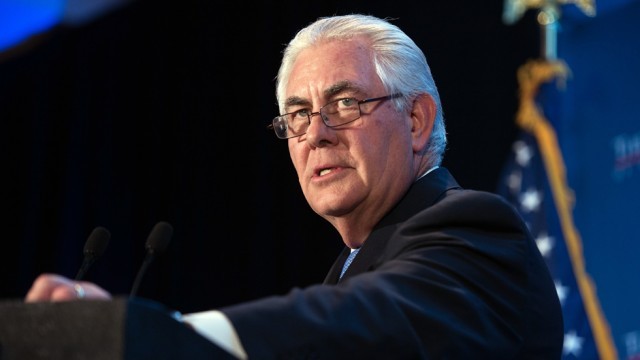
Then up stepped Secretary of State Rex Tillerson to say that the conflict between our side and the other side “has nothing to do with religion.”

Really! He said that. He echoed the long-awaited and much-belated message the president delivered.

I hope hell hasn’t frozen over. I hope Earth will continue to spin on its axis. I trust the sun will rise in the east tomorrow morning — and beyond.

http://thehill.com/homenews/administration/334474-tillerson-in-saudi-arabia-this-is-a-fight-of-good-against-evil

“And I think the context of all of this where the President begins his journey here at the home of the Muslim faith under the leadership of the Custodian of the Two Holy Mosque – this great faith, the Muslims – then to travel to the home of Judaism and then to the great leader of Christianity, that the President is clearly indicating that this fight of good against evil has nothing to do with religion,” Tillerson said in a press conference after the president’s speech.

Trump and his team have sounded alarmingly bellicose ever since the billionaire business mogul entered politics by running for the presidency. He once pledged to ban “all Muslims” from entering the United States. While running for office, Trump said “Islam hates America.” Once elected, he sought to impose a travel ban on refugees fleeing certain Muslim countries; that effort is tied up in the federal court system that has ruled it unconstitutional.

Today, the president sounded quite different as it regards this war against terror.

The religious perversion that has overcome the monsters who purport to be Muslim too often gets lost in the United States. Too many Americans have taken the bait that “Islam” is the enemy. It is no such thing. The enemy are those who commit these heinous acts around the world — mostly against Muslims — in the name of a great religion.

President Bush made that point immediately after 9/11. President Obama continued to recite that mantra, often to criticism that he was a “Muslim terrorist sympathizer.”

I doubt we’ll hear any such fecal matter coming from those who continue to support Donald John Trump. Nor should we ever have heard it.

As long as POTUS keeps talking about the election …

I’m going to presume that as long as the president of the United States insists on talking about the 2016 election that it’s OK for the rest of us to bring it up, too.

Donald Trump won. He got the requisite number of Electoral College votes he needed to take the presidential oath of office on Jan. 20. But as a story in the New York Times notes, he keeps feeling the impulsive tug to remind visitors to the White House that — by golly! — he won.

Trump get past the win

The story relates how Trump hands out cards showing the electoral map, which gave the president a reasonably comfortable margin over Hillary Clinton. He doesn’t mention to visitors, though, that Hillary won nearly 3 million more popular votes. But that’s all right; Hillary’s “victory” meant far, far less than Trump’s actual win.

The story draws an interesting comparison between Trump’s victory and the previous win by a president who collected fewer popular votes than his opponent. That would be, of course, George W. Bush in 2000.

How did President Bush deal with his skin-of-the-teeth victory? Here’s how the Times analyzed it:

“After President George W. Bush lost the popular vote in 2000 but won the narrowest of Electoral College victories after the Supreme Court stopped a hotly disputed Florida recount, he did not publicly dwell on the way he had gotten into office.

“Instead, Mr. Bush plowed forward with his agenda and put the election behind him, rarely speaking of it again. He also made a point of reaching out to Democrats in the early days of his administration on issues like education and tax cuts to try to heal some of the wounds caused by the election, eventually winning bipartisan votes on major legislation in his first year.

“’He knew he won, but he knew many people didn’t see him as a legitimate president and needed to reach out,’ said Matthew Dowd, a senior strategist for Mr. Bush in 2000 and chief strategist for his 2004 re-election campaign. ‘But he didn’t look back in any kind of insecurity because he knew he could only control what was happening today or in the future.’”

That’s how a grownup deals with close calls. If only we had one in the White House these days.

Cheers have ‘Mission Accomplished’ ring to them

All that back-slapping and high-fiving at the White House today seems a bit premature — to say the very least.

Congressional Republicans sauntered down from Capitol Hill to the White House to congratulate themselves for approving a measure that repeals the Affordable Care Act and replaces it with the American Health Care Act.

“Today we made history by taking the first important step toward rescuing hardworking families from the failures and skyrocketing costs of Obamacare,” House Majority Whip Steve Scalise,  R-La., said in a statement.

They all are members of the House of Representatives. The bill, which passed 217-213 — with zero Democratic votes — now must go to the Senate, where their fellow Republicans are sending signals that the House bill is dead on arrival. It’s a goner. The Senate is going to craft an entirely different bill.

As The Hill reported: “The bill, known as the American Health Care Act, repeals the core elements of ObamaCare, including its subsidies to help people get insurance coverage, expansion of Medicaid, taxes and mandates for people to get coverage.

“In its place, the bill provides a new tax credit aimed at helping people buy insurance, though it would provide less help than ObamaCare to low-income people.”

The Hill also reported: “The measure is expected to undergo a major overhaul in the Senate, especially on the Medicaid front, where several Republican senators from states that accepted the expansion are wary of cutting it off.”

Cheers are quite premature

I was reminded of another celebratory moment in recent U.S. history.

It was in 2003 and President George W. Bush flew onto the deck of an aircraft carrier, jumped out of the jet aircraft wearing a flight suit, changed his duds and then delivered a speech under a banner that declared “Mission Accomplished.”

The president was saluting the capture of the late dictator Saddam Hussein, who our troops pulled out of a spider hole in which he was hiding. The Iraqi dictator was put on trial, convicted and hanged.

The Iraq War, though, raged on … and on … and on. Thousands of American service personnel were killed and injured for years as they sought to bring the fighting under control.

The “Mission Accomplished” banner was premature in the extreme.

So was today’s GOP cork-popping at the White House.

Stand tall, David Frum

David Frum has emerged as my newest favorite conservative thinker/writer/pundit/analyst.

I actually have become enamored over the years with a number of such folks: William F. Buckley, William Safire, Peggy Noonan, George F. Will, David Brooks, Kathleen Parker, Jennifer Rubin all come to mind. They are great thinkers, solid in their beliefs, but not crazy.

Now we have David Frum, a former speechwriter for President George W. Bush. He’s also a persistent critic of Donald J. Trump, who’s come along to become president of the United States. He has been astonished — along with many of his fellow Americans — at how wholly unprepared Trump is to serve as president and commander in chief.

The president said in an interview with Reuters that the office to which was elected is tougher than he thought it would be.

Who knew?

Frum’s response — delivered in a series of tweets — is utterly classic.

Here it is. http://occupydemocrats.com/2017/04/28/trump-just-whined-hard-job-bushs-speechwriters-response-epic/


These projects don’t pay for themselves

Donald J. Trump’s proposal to cut taxes — notably for the wealthiest Americans — is getting considerable play in conservative media and political circles.

The president thinks he’s on to something. He has pitched what his team has called the most sweeping “tax reform” package in U.S. history.

Now …

Let’s get real for a moment.

* The president also wants to enact a few big projects. He has proposed spending an additional $54 billion next year alone on the Department of Defense. He contends the military is depleted and, of course, blames the previous administration for all but rendering us defenseless against our enemies.

* He also wants to rebuild our nation’s roads, bridges and airports. The price tag for that? A cool $1.2 trillion. This is a project worth doing, given the sorry state of our highways and airports. I’m still baffled as to how this plays among fiscal conservatives who (a) voted for Trump in 2016 and (b) say they dislike spending money the government doesn’t have in the bank.

* The president also wants to build that “big, beautiful wall” along our southern border. The price tag varies on this matter, but I’ll go with the bigger number that’s been floated: $25 billion. I do not believe the wall will be built. Nor should it be built. Still, the president insists that it will and he no longer is saying at every campaign-style rally that “Mexico will pay for it.”

These things do not pay for themselves. Thus, Americans across the land need to ask themselves: Are we willing to step up to shoulder the cost of all these projects or are we going to ignore the reality that the money must come from each of us?

The tax cut mantra has become standard Republican Party policy. President Reagan famously sought to cut taxes while “rebuilding” the military. He railed against President Carter’s budget deficits, only to preside over a skyrocketing deficit during his two terms in office. President George H.W. Bush challenged us to “read my lips” while vowing at the GOP convention in 1988 to never raise taxes; which helped get him elected. He then raised taxes — wisely, in my view — and it cost him votes among his conservative GOP base in 1992. President George W. Bush cut taxes in 2001, then went to war with international terrorists after the 9/11 attacks; the deficits exploded.

A new Republican president is now proposing another massive tax cut while at the same time seeking to do big things. With what, Mr. President? Where’s the money coming from?

I hate the wall idea. If the president wants to stem illegal immigration, then invest more money in better enforcement along both of our lengthy borders — north and south — and at ports of entry along all three coasts.

The defense buildup doesn’t need to cost nearly what Trump is proposing. Our military remains the strongest in the world.

Infrastructure improvement makes sense, but it’s going to cost Americans a lot of money to get it done.

Are we going to fall for the GOP tax-cut dodge because we don’t want to pay for the things we insist that government do for us? Or are we going to understand that our government requires us to spend a bit of our money to make it work?

Another old-school journo calls it a career

Of all the colleagues with whom I worked during my 37 years in daily journalism, I am hard-pressed to think of anyone who fit the description of “ink-stained wretch” better than a fellow who has just retired from a newspaper where we both once worked.

His name is Dan Wallach. He is a native of New York state. He graduated from the University of Arizona and ended up in Beaumont, Texas, where he worked at the Beaumont Enterprise for more than three decades.

Dan represents — to me — the individual who is committed fully to covering his community, of telling the myriad stories that give that community its life, its personality.

What’s more, he is unafraid to reveal the community’s scars and to press relentlessly the individuals who are responsible for inflicting those wounds.

He has just entered my world … of retirement. I welcome him gladly and wish him well, but I am absolutely certain that journalism as we both understand the craft is going to be a good bit poorer without more people such as Dan pursuing it.

I now want to tell a short story that personifies the kind of tribute that Dan earned from news sources over his many years in print journalism.

In the spring of 1995, just a few months after I had left Beaumont to become editorial page editor of the Amarillo Globe-News, I got a call from then-Texas Gov. George W. Bush’s office. The governor invited me to Austin to meet with him.

I arrived at the State Capitol Building a few days later. Gov. Bush and I  shook hands and he led me to his office. We exchanged a few pleasantries before we got down to brass tacks.

The governor knew I had worked at the Enterprise and he thanked me for the newspaper’s editorial endorsement in the 1994 governor’s race in which Gov. Bush defeated incumbent Democrat Ann Richards.

“It kind of surprised me,” Bush said. “Why is that?” I asked.

He told me about a “reporter you had there who gave me all kinds of trouble” when Bush talked to the media during his campaign stops in the Golden Triangle.

“I can’t remember his name,” he said. I responded, “Oh, you must be thinking of Dan Wallach.”

“Yeah, that’s who it was,” the governor said.

“He was one tough son of a b****.”

We both laughed out loud.

I told Dan not long after that meeting what the governor had said about him. I took it as a statement of high praise and I believe to this very day that’s how George W. Bush intended for it to be taken.

I have wanted for years to tell that story in some public forum. Dan’s retirement has given me that chance.

Well done, Dan.

War with no end goes on and on and on

Brian Castner calls it a Forever War.

The man knows war when he sees it. He is former explosive ordnance disposal officer who has written a provocative and thoughtful op-ed article for the New York Times.

Here it is.

Indeed, Castner tells a sad tale of Americans who are likely going to die or suffer grievous wounds in a war being fought in multiple countries, on multiple fronts, against multiple enemies who likely cannot be eradicated.

This war began, for all intents, on that glorious Tuesday morning, Sept. 11, 2001. Terrorists flew airplanes into the World Trade Center in New York, into the Pentagon in Washington, D.C., and fought with passengers aboard a third jetliner before it crashed into a Pennsylvania field.

President Bush gathered his national security team and in short order sent military forces into Afghanistan to kill the individuals responsible for that heinous act.

The war was on.

Many of us worried at the time — while supporting the president’s decision to retaliate — about whether there ever could be a way to win this war. Could we ever declare victory and then bring all our troops home? Many of us are old enough to remember when the late, great Republican senator from Vermont, George Aiken, thought we could do just that in Vietnam: “Let’s just declare victory and go home,” Sen. Aiken said.

The answer, nearly 16 years later, is “no.” We cannot make such a declaration about the Forever War.

Castner’s essay centers on the death of a 42-year-old sailor, Scott Dayton, who became the first American to die in combat in Syria. Castner’s Forever War has now expanded to that country, where we are working with Syrian resistance forces against the government of Bashar al Assad and against the Islamic State.

Castner writes: “The longest conflict in American history — from Afghanistan to Iraq, to high-value target missions throughout Africa and the Middle East — has resulted in the nation’s first sustained use of the all-volunteer military, wounding and killing more and more service members who resemble Scotty: parents, spouses, career men and women.”

Then he writes: “The Forever War is unlikely to end soon, and for those not in the military, continued voluntary service in this perpetual conflict can be hard to understand. Popular explanations — poor outside job prospects, educational enticements, the brashness of youth — don’t hold up under scrutiny.”

I would challenge only this: A war that lasts “forever” not only won’t “end soon,” it will never end.

We have taken a long march down the road to a sort of “new normal” when it comes to modern warfare. President Bush’s decision to go to war in Afghanistan was righteous, given what al-Qaeda — based in that desolate nation — had done to us. Then he expanded that fight into Iraq, a nation that had nothing to do with the 9/11 attacks; the president and his team concocted some scenario about weapons of mass destruction. They were tragically, horribly wrong.

Barack Obama continued the fight and has handed it off to Donald Trump.

This interminable war has expanded now to several nations. How does it end? How do we know when we’ve killed the last bad guy?

Think of it as our nation’s internal fight against hate groups such as the Ku Klux Klan. How do we remove the last Klansman? How do we persuade the KKK to give up its hate, to stop intimidating Americans?

Accordingly, how do we know when the last international terrorist who’ll ever pick up arms against us has been taken down? We cannot know any of it.

Yet this Forever War continues.

And I fear that it will continue … forever.