Tag Archives: World War II

Memorial recalls memory of favorite veteran

WASHINGTON — The atmosphere in the nation’s capital has become overheated, overblown and overstated. It’s not a happy place if you are a politician who wants to do the right thing, but you get caught up in the daily — if not hourly — struggles between the two major political parties.

They all ought to come to this place perhaps once a week. They should cast their eyes on the World War II Memorial, which reminds us of just how titanic our struggles can get.

I came here with my wife, our niece and her husband. It was hot that day. During our entire walk along The Mall, I managed to put contemporary politics aside. I thought instead of my favorite veteran. I’ve written before about my father, the late Pete Kanelis. He served during this struggle, the one that enveloped the globe from 1939 until 1945.

The picture above honors those who served in the European Theater of World War II, as Dad did. He saw combat as a sailor in the Med.

Yes, I have heard about critics of this particular memorial, one of the newer exhibits along The Mall. It’s too gaudy, too grand, too big, they say. It really isn’t, at least in my view. It honors a massive military engagement. By the end of the global war, more than 16 million Americans suited up to enter the fight; whether it was at home or abroad, they answered the call and performed magnificently.

They were, as the author/journalist Tom Brokaw has written, The Greatest Generation.

At the other end of the WWII Memorial pool is a section devoted to the Pacific Theater of Operations.
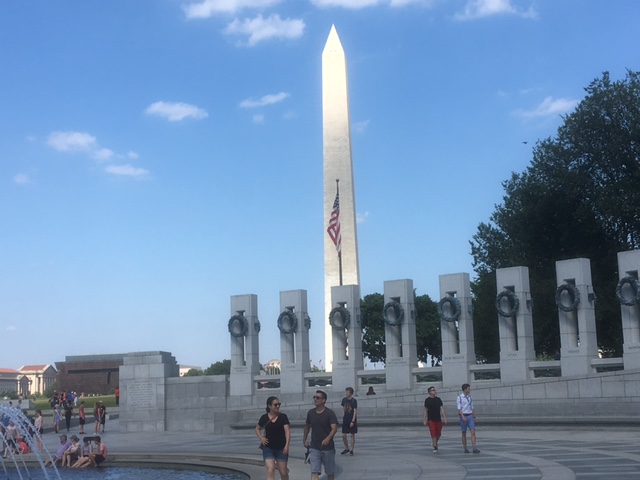
There, too, Americans and their allies fought across the vast ocean to take back land conquered by Japan. They endured sacrifice most of only can imagine. My favorite veteran happened to be in The Philippines when President Truman ordered the dropping of the atomic bombs in August 1945. The enemy surrendered. Thus, I remain convinced that the president likely saved Dad’s life. I am eternally grateful for the president.

We walked along the Vietnam Veterans Memorial, the Korean War Memorial, the Martin Luther King Jr. Memorial, the Franklin Delano Roosevelt Memorial, the Washington Monument and the Lincoln Memorial. They all reminded us of the nation’s greatness and they allowed me to set aside the ongoing anger and anxiety I am feeling about the present day.

Later in the day, we saw Marine One fly overhead on its way back to the White House, carrying the president of the United States back from wherever he had spent the weekend.

I had been filled with awe at what we had seen. In that context, seeing the presidential aircraft made me appreciate the struggles that accompanied the building and the development of the world’s greatest nation.

Dad would have been proud, too.
Nation’s capital still stirs the emotions

WASHINGTON — This is the most political city in America, if not the world and politics being what it has become in recent decades, this city is full of a lot of hard feelings and recrimination.

You know my own feelings about the current president of the United States. But this blog post isn’t about that — and it damn sure isn’t about him. It’s about the myriad monuments, memorials and assorted structures throughout the city that pay testament to the nation’s greatness.

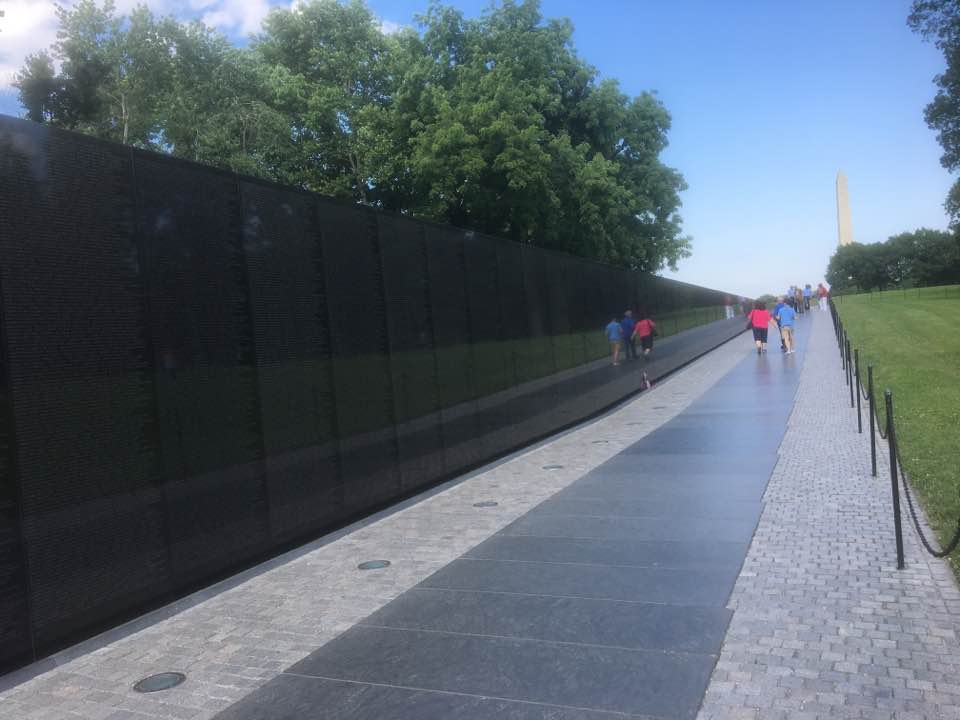
We came to the Vietnam Veterans Memorial. It’s like an outdoor church. Visitors lower their voices. They speak in solemn tones. They look at the 58,000-plus names etched into the stone, seeking to recall memories of the individuals who gave their last full measure.

I found a name I had spotted the first time my family and I came here in 1990. He was a young man with whom I served briefly in Vietnam. He was set to go home in a few days, but fate intervened at a landing zone where he and his Huey helicopter unit was ambushed in June 1969 by enemy fighters.

We toured much of the Washington Mall, walked through the World War II, read the inscriptions from the likes of Chester Nimitz, Franklin Delano Roosevelt, Dwight Eisenhower, George C. Marshall that paid tribute to the brave Americans who — along with soldiers from many other nations — saved the world from tyranny. My all-time favorite veteran, my father, was one of the 16 million Americans who answered the call to duty. I thought of Dad while marveling at the grandeur of the WWII memorial.

Not far from that is the Korean War Memorial, which pays tribute to the “forgotten war.” It, too, cost tens of thousands of American lives. I prayed for the souls of those who paid the ultimate sacrifice.

We cast our eyes on the Washington Monument, the Lincoln Memorial, the Jefferson Memorial and toured the FDR Memorial.

For several precious hours while taking all that in, I was able to set aside the events of the moment. I didn’t think a single time about the confusion, controversy and contentiousness of the present day. I thought instead of the great Americans who built the country and created a nation that remains — despite rhetoric to the contrary — the greatest nation in human history.

We had to see these things to remind us of who we are.

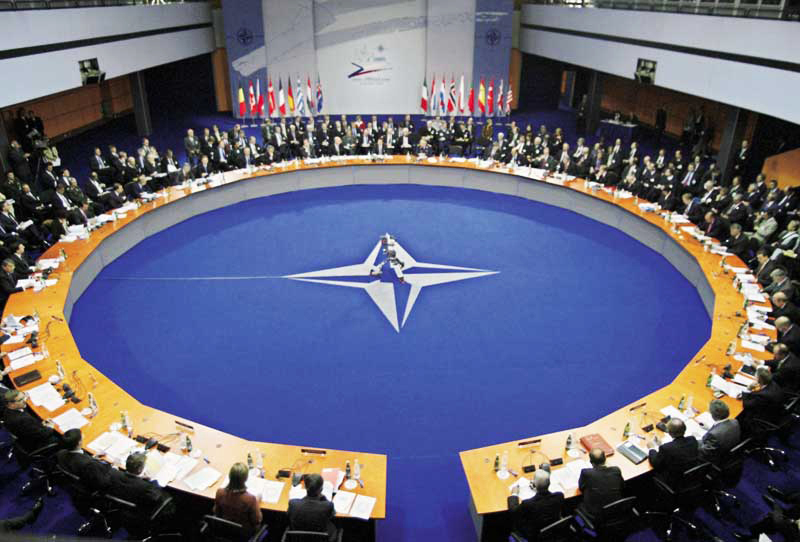
NATO never has been ‘obsolete,’ Mr. President

The North Atlantic Treaty Organization once was “obsolete.”

Now it’s relevant.

That’s the former and current view of the president of the United States. What changed? What did NATO do to regain its status as a dependable and valuable defense treaty?

Donald John Trump met today with NATO Secretary General Jens Stoltenberg. The two men had a cordial and constructive meeting at the White House.

So here we are. The president who campaigned for office in 2016 while griping repeatedly about NATO’s obsolescence now says the organization is a partner in the fight against terrorism.

Will we learn from the president what changed his mind on this matter? Hardly. My guess is that even he doesn’t know, except that the secretary general told him that NATO matters.

Well, it does. It matters a lot.

The NATO alliance sits just west of its big and fearsome neighbor. I refer to Russia, which is governed by Vladimir Putin who — until just recently — seemed to be bound at the hip to Donald Trump. The bromance is fading quickly as the Trump administration starts turning the screws on Russia over its complicity in the Syrian civil war; oh, and Congress is starting to fire up the jets under Putin over his government’s role in seeking to “rig” the 2016 presidential election in Trump’s favor.

NATO matters

Yes, NATO came into being after World War II to deter potential aggression by the former Soviet Union. But in 1991, the Evil Empire disappeared, only to be replaced by another sinister governmental being. Russia has shown its aggressive self already, threatening Ukraine, retaking Crimea and blustering about re-conquering the Baltic States of Lithuania, Latvia and Estonia.

NATO now comprises 28 nations. Its relevance is quite vital to the stability of Europe, which remains crucial to the national security interests of the United States of America.

If only we could get the president to stop yammering about how NATO must pay its “fair share” or else. It’s the “or else” that some of us find most troubling.

My curiosity persists, though. What did NATO do to regain its status as a partner in the struggle to maintain international equilibrium?

Spicer earns dubious place in flackery annals

As if we needed proof of the seemingly obvious …

Sean Spicer’s performance this week has confirmed what many Americans have long suspected, which is that he’ll go down in history as one of the most inept White House press flacks in the history of the office.

My goodness. How does one calculate the impact of this man’s performance as he sought to clarify, re-clarify, and then re-re-clarify a statement he made about the Syrian government’s use of chemical weapons on civilians?

However, at another level, I feel a bit badly for Spicer. He is merely representative of the most incompetent presidential administration I’ve ever witnessed. Hey, I’m now 67 years of age. I’ve been watching these transitions with some interest now for quite some time. I’ve witnessed presidents assemble governments quickly in the wake of intense national tragedy and national scandal. None of them compares with the bungling boobery  we’ve witnessed with the Donald John Trump administration.

Spicer this week demonstrated precisely the muddled messaging that occurs with startling regularity.

During his daily press briefing, Spicer said — during the week of Passover, for crying out loud! — that Adolf Hitler didn’t use “chemical weapons” on millions of Holocaust victims. Huh?

He implied that Syrian dictator Bashar al Assad’s gassing of civilians somehow was worse than what Hitler did to European Jews prior to and during World War II.

OK, then he backed off of that … more or less. He said he meant to acknowledge that Hitler gassed millions of people, but was comparing it to Assad’s use of aircraft to drop chemical weapons on “innocent victims.” OK. Then, did he mean that the Holocaust victims weren’t, uh, innocent?

No, that’s not what he meant … he said.

Throughout all this stumbling and bumbling, he dropped in the term “Holocaust center” to refer to the Nazi death camps erected throughout eastern and central Europe during World War II.

Social media exploded.

Finally, Spicer spoke to NBC News and offered a fulsome apology for the mistakes he made. I give him great credit for refusing to say, “If I offended anyone … “, which I consider to be the phoniest form of apology one can offer. He took ownership of his inarticulateness.

He came to the White House after serving as press secretary for the Republican National Committee. I was willing to give him the benefit of the doubt when Trump selected him. Then, during his first press confrontation, he excoriated the media for reporting that Trump’s inaugural crowd was far smaller than the one that welcome Barack Obama in January 2009.

Actually, young man, the crowd was much smaller. There was no need to scold anyone in the media for reporting the truth. Thus, we heard the term “alternative facts” presented for the first time by another White House adviser, the inimitable Kellyanne Conway.

The president keeps telling us that things are going swimmingly at 1600 Pennsylvania Ave., when in fact they are not. The president cannot fill key staff jobs; critical political appointments haven’t been made. So, Mr. President, stop insulting our intelligence by repeating such outright falsehoods about your “fine-tuned machine.”

Now we hear that the annual White House Easter Egg Roll — set for Monday — is in trouble because the administration lacks the staff to assemble an event that has become a staple of first families’ occupancy of the White House.

Speaking of first families, where is the first lady, Melania Trump? Isn’t it her responsibility to put this event together?

I’m actually beginning to pity Sean Spicer. He delivered a clunker of a performance this week. It’s tough being the face and the voice of a presidential administration that doesn’t have a clue.

So, this is how we act toward our friends?

Donald J. Trump is unchained, uninhibited … perhaps he has become unhinged.

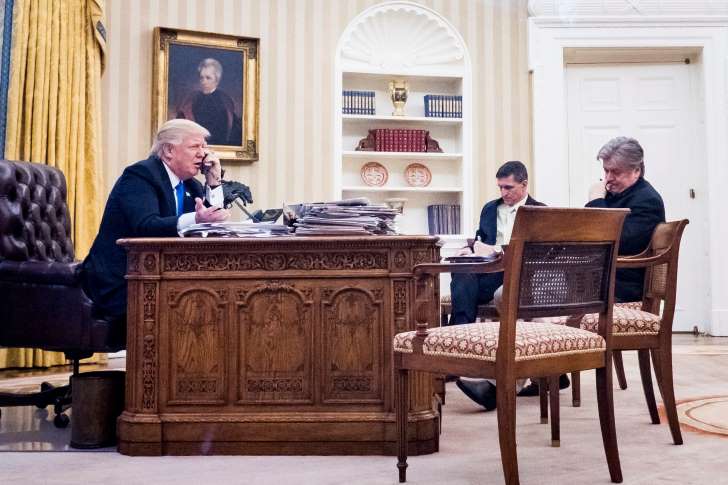
The Washington Post reports today that the president of the United States got into a long-distance phone tiff with Australian Prime Minister Malcolm Turnbull and then hung up on him.

What gives here?

The Australians are among our strongest allies. They’ve been with us through thick and thin. They fought with us in Vietnam, in Korea, in World War II for crying out loud!

According to The Post: “It should have been one of the most congenial calls for the new commander in chief — a conversation with the leader of Australia, one of America’s staunchest allies, at the end of a triumphant week.

“Instead, President Trump blasted Australian Prime Minister Malcolm Turnbull over a refu­gee agreement and boasted about the magnitude of his electoral college win, according to senior U.S. officials briefed on the Saturday exchange. Then, 25 minutes into what was expected to be an hour-long call, Trump abruptly ended it.”

http://www.msn.com/en-us/news/politics/no-%e2%80%98g%e2%80%99day-mate%e2%80%99-on-call-with-australian-prime-minister-trump-badgers-and-brags/ar-AAmwmJc?li=BBnb7Kz

Does the president really believe Prime Minister Turnbull really cares about the size of Trump’s Electoral College victory?

I am not yet understanding how the 45th president intends to conduct himself on the world stage. Maybe that’s by design. Perhaps he is doing all this on purpose to keep our friends and foes off balance.

But, crikey, mate! This isn’t how you talk to a long-standing ally!

The world is watching a ‘great’ nation’s turmoil

I’m watching the news today and getting an eye and earful about how the world is reacting to Donald J. Trump’s inauguration as president of the United States.

I received this e-mail message from a friend of mine in Australia. He is a worldly fellow, a keen student of U.S. politics. My friend writes: “We’re all praying for you … and ourselves as well. We’re all in this together. For historical precedent, check out Germany 1918-1939 or the Cultural Revolution in China. I honestly thought the extent of Russian involvement in the election was grounds for treason, but clearly the rules have changed!”

No mention, of course, of the women’s marches around the world that are occurring today.

I’m guessing women marched in my friend’s city in South Australia.

I won’t elaborate on his statement regarding pre-World War II Germany or what happened in the 1960s in China.

Suffice to say that, though, that the world — if my friend’s message is any indicator, and I believe it is — cares deeply about what happens in the United States.

What does that mean? To me it means two things.

One is that we are in fact the world’s most indispensable nation.

The other aspect is that the United States of America continues to be “great,” despite what the brand new president has bellowed to the contrary.

Get well, Mr. President and Mrs. Bush

First, a confession … and then a salute.

I didn’t vote for George H.W. Bush either time I had the chance to do so. Not in 1988 or in 1992 when he ran for president. For that matter, I didn’t vote either for the ticket led by Ronald Reagan in 1980 and 1984 when Bush ran as The Gipper’s vice-presidential running mate.

But as the years have sped by I have developed a tremendous amount of respect for the 41st president of the United States.

In 2007, I had the high honor of shaking his hand and engaging him in about 45 seconds of conversation. They took a picture of the president and me (sorry to be a name dropper) and I display it proudly in my home.

The president isn’t well these days; he is battling pneumonia. I worry about him — and about his wife, Barbara, who’s also in the hospital — as I write these few words.

I’ve said for many years that I have long thought that George Bush was the most singularly qualified man ever to hold the office of president. His life story goes back to his days as the son of a U.S. senator from Connecticut; then he enlisted in the Navy and became a decorated fighter pilot who was shot down over the Pacific Ocean during World War II; he came home to build a business; he served two terms in Congress from Houston; he led the CIA, served as ambassador to the United Nations, led the Republican Party and served as special envoy to China; he was elected twice as vice president and then as president.

That, dear reader, is what I call a full and rewarding life.

The moment I shook his hand I said, “Mr. President, I just want to thank you for your service to this country.” He seemed to actually appreciate the expression of gratitude and thanks. He nodded and gave back a simple “thank you.” I hope he sensed my deep sincerity.

He has been in poor health. Hey, he’s 94 years of age.

Still, I want him to recover from this latest bout. The nation can use his wisdom and his grace.

Get well, President and Mrs. Bush.

No apology for attack, but still a profound promise

As the son of a gallant World War II veteran who jumped into the fight just weeks after a treacherous attack against the United States, I was hoping for an apology.

It didn’t come. Instead, the prime minister of Japan — the nation that yanked us into a global bloodbath — offered something that came pretty close to an apology.

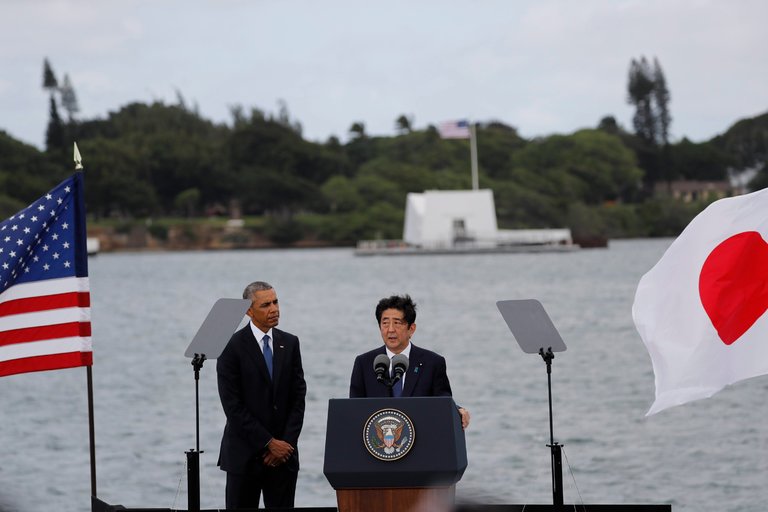
Shinzo Abe visited the USS Arizona Memorial in Honolulu as the guest of President Obama, who is on vacation there with his family. He spoke of the “precious souls” who died during the Japanese air attack on our naval and air forces on Dec. 7, 1941.

He vowed that Japan never again would go to war. Abe offered a statement of condolence that he said, in effect, will never end.

http://www.nytimes.com/2016/12/27/world/asia/shinzo-abe-text-pearl-harbor.html?_r=0

The prime minister also expressed his gratitude for the generosity that Americans have extended to his people in the years since the “date which will live in infamy.”

“On behalf of the Japanese people, I hereby wish to express once again my heartfelt gratitude to the United States and to the world for the tolerance extended to Japan,” Abe said.

An actual apology would have been the best outcome of this first-ever visit to Pearl Harbor by a Japanese head of government.

This American, though, will accept the prime minister’s statement of eternal condolence.

They fought for ‘the duration’

origin11

Seventy-five years ago today, Japanese navy pilots swooped in over Pearl Harbor, Hawaii and — perhaps without knowing it at the moment — changed the world forever.

That act dragged the United States of America into the greatest global conflict the world has ever witnessed.

The young men who answered the call from that day forward did so under terms that no longer apply in this day.

Many of them volunteered to get into the fight; others of them were drafted by the government. They all took an oath to defend the nation. Then they signed a paper that committed them to fighting for their nation for as long as it took to finish the fight.

They signed up for “the duration” of the conflict. The war would end in August 1945, but no one who signed up for that battle had a clue as to how long it would last.

Think about that for a moment. As the smoke billowed from the wreckage in Hawaii, did anyone know how long this war would last? It could last for a year, two, three. It could go on for decades.

The young Americans who donned their country’s uniform did so without knowing how long they would be ordered to sacrifice.

My father was one of those young men. He was 20 years and seven months old when we entered World War II. He waited just a few weeks before deciding one day to go to the federal courthouse in downtown Portland, Ore., and enlist in the armed services. His first choice was the Marine Corps. The office was closed. He then walked across the hall and enlisted in the Navy.

He didn’t know when he’d be finished. He didn’t know if he’d ever come home. Dad wanted to fight the enemy.

And he did.

We don’t ask such things of our young men and women these days. We send them off to war for a length of time. They serve and return. Of late — since 9/11 to be exact — we’ve been sending them back into harm’s way repeatedly. That, too, is creating tremendous emotional stress on our young warriors and I wouldn’t for a moment wish to be wearing their boots.

Many of us today, though, will recall the sacrifice made by the young Americans who answered their nation’s call to arms against tyranny.

When we do, think of how they might have felt knowing they might be going into a battle with no end.

That’s what I call “sacrifice.”

No apology coming for Pearl Harbor attack? It should

abe-obama

That settles that issue, I guess.

Japanese Prime Minister Shinzo Abe is coming to the United States late this month for a state visit with President Obama.

He won’t apologize for what his forebears did on Dec. 7, 1941. You see, Abe will be at the place where the United States was drawn into World War II. He’ll visit Pearl Harbor, Hawaii. He’ll likely tour the USS Arizona Memorial. He’ll get to hear about the suffering brought to the men who are entombed in the shattered remains of the ship that still rest at the bottom of the harbor.

As the Associated Press reported: Chief Cabinet Secretary Yoshihide Suga said that ‘the purpose of the upcoming visit is to pay respects for the war dead and not to offer an apology.'”

Frankly, I wish he would at least offer an expression of regret.

We’ll learn in due course whether he changes his mind.

President Obama visited Hiroshima, Japan earlier this year. He didn’t apologize, either, for the atomic bomb that President Truman ordered dropped on that city. Then again, I don’t believe an apology — in that instance — was warranted. The Japanese started the fight with the sneak attack on our forces at Pearl Harbor; we finished it with the bombs dropped on Hiroshima and, three days later, on Nagasaki.

Abe’s circumstance, of course, is much different. He represents a government that in an earlier era talked to American diplomats about seeking peace while plotting an act of war.

He need not grovel. He need not beg for forgiveness. Indeed, U.S.-Japan relations are stronger than ever at this moment seven decades after the two nations’ forces fought each other to the death throughout the Pacific Theater of Operations.

http://www.msn.com/en-us/news/world/japanese-leader-abe-wont-apologize-at-pearl-harbor/ar-AAl9oyg?li=BBnbfcL

He’ll emphasize the “reconciliation” that has occurred. That’s fine. We all know that it is strong.

The act of war that precipitated the era of good feelings that followed, however, ought to require a statement of contrition from the leader of the government that caused all that senseless carnage in the first place.