Category Archives: political news

Time to praise SCOTUS selection

I am feeling so good over the rescue of the Thai boys and their soccer coach from that flooded cave in northern Thailand that I want to offer a good word for Donald John Trump’s selection to the U.S. Supreme Court.

I’ll stipulate up front that you’ll deem this to be faint praise, but it’s praise nonetheless.

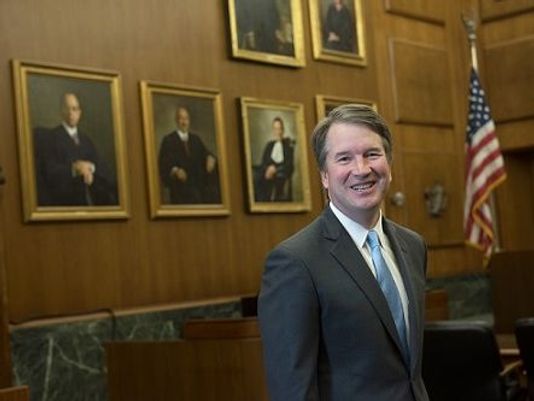
Appeals Court Judge Brett Kavanaugh’s nomination to the Supreme Court has angered the crackpot Trump “base.” They’re none too happy with Kavanaugh, fearing that he doesn’t appear to be as firmly opposed to Roe v. Wade as the base continues to be. Former U.S. Sen. Rick Santorum of Pennsylvania chided the president for surrendering to what he called the “Washington elite” by selecting Kavanaugh.

To be sure, the justice nominee is a conservative. He appears to be what one could call a “mainstream conservative,” not a goofball/wack-job conservative.

He has pledged to be independent and to study the law as it is written, not as one wishes it were written.

Is this the kind of judge I would have selected? Of course not! However, Trump is the president of the United States.

By anyone’s measure, Kavanaugh is supremely qualified to serve on the high court. He’s a Yale Law School grad, meaning that the entire Supreme Court would comprise Ivy League legal eagles if Kavanaugh is confirmed by the U.S. Senate.

The Senate will nitpick the daylights out of Kavanaugh’s lengthy written record. Senators will need to examine Kavanaugh’s views on health care, as well as on whether sitting presidents can be indicted for criminal offenses. His record suggests he might tilt the “wrong way” on both of those issues.

I continue to believe that while Kavanaugh’s conservative credentials might solidify the court’s right-leaning bias, it doesn’t guarantee it necessarily on every single key ruling that would come before the Supreme Court.

That seeming uncertainty, I submit, is what might be driving the Trump bloc of “base” voters nuts.


Lifetime job has this way of shaping opinions

I tend to interpret the U.S. Constitution the way I interpret the Bible.

That is, I take a more liberal view of what both documents say. That’s just my view. I am not a “strict constructionist” as it regards the Constitution; nor am I a “fundamentalist” as it regards the Bible.

But let’s consider what the future might hold for the body that interprets the former document, the Constitution.

Donald J. Trump has nominated Judge Brett Kavanaugh to join the U.S. Supreme Court. He comes to this nomination after being recommended highly by the Heritage Foundation and the Federalist Society, two staunchly conservative think tanks.

Now, what does this mean for Kavanaugh’s tenure on the high court?

I’ll give you my hope for what happens. I hope Kavanaugh proves to be as unpredictable as previous “conservative” justices who were nominated by “conservative” presidents.

The record going back more than six decades is full of how this has occurred.

  • President Eisenhower appointed two “conservatives” to the high court: Earl Warren as chief justice and William Brennan as an associate justice. They both proved to be progressive in the extreme.
  • President Nixon tapped Harry Blackmun to the high court, only to watch as Blackmun wrote the majority opinion in the landmark Roe v. Wade ruling that legalized abortion.
  • President Ford’s pick to the court, John Paul Stevens, turned out to be a reliably liberal vote.
  • President George H.W. Bush nominated David Souter, who then turned out to be a liberal justice as well.

President Reagan nominated two justices — Sandra Day O’Connor and Anthony Kennedy — who became quite a bit less reliably conservative than the president would have wanted.

No one really saw these justices’ service turning out as they did in advance.

Thus, it well might be that Judge Brett Kavanaugh could join the list of conservatives who take a more, um, expansive view of the Constitution.

That is my hope. But, hey, I’m just one guy — a blogger out here in Flyover Country — who wants history to repeat itself.

Military taking a big bite out of its own hand

Donald Trump must really mean it when he implies that America should become an immigrant-unfriendly place.

The New York Times has published a story that tells of how the U.S. Army is ordering an increasing number of legal immigrants out of the military service. Why? According to one of them — an immigrant from China, with a business degree, a wife and a small child — they are deemed “unsuitable.”

As the Times noted in its story, the Army is booting out an increasing number of immigrants even though it cannot meet its recruitment goals for 2018.

The program, adopted during the Bush 43 administration, is designed to allow legal immigrants a fast track to citizenship. The Trump administration seems to see little value in the program.

What a disgraceful display of un-American treatment of men and women who come here to this country on their volition and want to serve in our military.

The irony is so rich you can taste it, given that the commander in chief sought to avoid military service during the Vietnam War by obtaining a series of student and medical deferments.

Take a look at the NY Times story here.

I am reminded of a time when this country granted automatic citizenship to immigrants who enlisted in the armed forces. How do I know that? My own grandfather, George Filipu, became an instantaneous American by enlisting in the Army in 1918. He wanted to fight in World War I. But then the war ended in November of that year. He didn’t get into the fight — but he retained his U.S. citizenship.

That’s what service and commitment to our country is all about.

The young man who might now be deported to China — after swearing an oath to “protect and defend the U.S. Constitution — now might be punished in his home country simply by enlisting in a foreign military organization.

That’s how you “put America first”? I don’t think so.

We’ll see about ‘judicial activism’ from SCOTUS nominee

Donald J. Trump says he will reject any candidate for the U.S. Supreme Court who advocates “judicial activism.”

Well now. How about that?

Here’s part of what he said in a radio address:

Judges are not supposed to rewrite the law, reinvent the Constitution, or substitute their own opinions for the will of the people expressed through their laws,” Trump said. “We reject judicial activism and policymaking from the bench.”

“In choosing a new justice, I will select someone with impeccable credentials, great intellect, unbiased judgement, and deep reverence for the laws and Constitution of the United States,” he added.

Justice Anthony Kennedy’s upcoming retirement from the Supreme Court has launched a serious national debate over the future of what many call “settled law,” meaning the legalization of abortion in the United States.

U.S. Sen. Susan Collins, R-Maine, said the next justice must leave his or her hands off of Roe v. Wade, the 1973 ruling that legalized abortion. Any hint of overturning it, she said, is a dealbreaker.

That brings up a critical point. If Roe v. Wade is “settled law,” does the court run the risk of becoming a panel of “judicial activists” if it decides to repeal any or all of the reproductive rights guarantee?

The president has said he would appoint a justice who would overturn Roe, but then has said he won’t ask any of the candidates that question explicitly. He’ll know their views on the issue if he takes time to read their writings or understands their notion of the how justices should rule on these matters.

I guess I could add that judicial activism isn’t  a malady that afflicts only liberal judges. Conservatives can get pretty damn activist, too.

Pure politics drives this SCOTUS nomination

The federal judiciary isn’t political? It isn’t driven by partisan politics?

Excuse me while I bust out laughing.

There. Now I feel better.

Donald J. Trump reportedly has narrowed his short list of U.S. Supreme Court justice candidates to an even shorter list. It’s good to ask: Do you think the president is poring over written opinions, legal scholarship and the candidates’ judicial records to help him make this pick?

I don’t believe that’s the case.

Unlike some of his predecessors — namely Barack H. Obama, who taught constitutional law before entering politics — this president depends seemingly exclusively on the politics of the moment and on whether he likes whoever he might select for a lifetime appointment to a federal judgeship.

This is a big one, folks.

Roe v. Wade — the landmark 1973 ruling that made abortion legal — is on the line. Do you believe the president has studied the implications of that ruling, that he understands its legality?

Justice Anthony Kennedy’s pending retirement gives Trump the chance to make his second Supreme Court appointment. Think of this, too: It’s only a year and a half since he took office. How many more appointments do you think this president can make before his time is up?

Then there’s the question of whether the Senate should consider this appointment before the midterm election. Given the masterful obstruction that Senate Majority Leader Mitch McConnell performed to block Obama’s selection of Merrick Garland to succeed the late Antonin Scalia, there might be a push to delay this vote into 2019. Don’t bet on it, though, given polling that suggests Americans want the Senate to proceed.

I have one more issue to raise quickly. Trump said he won’t ask his court candidates how they would vote on reproductive rights. Do you take him at his word?

Neither do I.

The drama is about to get real thick.

‘Swing vote’ will switch chairs at SCOTUS

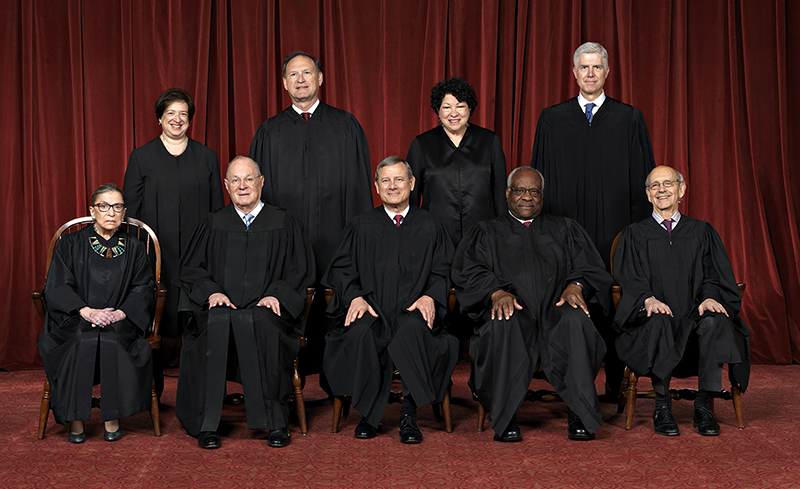
Before we get all worked up and apoplectic over the individual who will get Donald J. Trump’s nomination to the U.S. Supreme Court, let’s consider the reality of the departing justice, Anthony Kennedy.

Kennedy has been hailed as a crucial “swing vote” on the court. He sides with liberals on occasion, but mostly sides with the conservative majority.

It’s good to understand that the conservative justices hold a 5-4 majority on the court. That majority won’t change.

Indeed, I am of the opinion that’s being shared that the next swing vote will likely belong to none other than Chief Justice John Roberts, who on occasion has sided with the liberal bloc of justices on key decisions, such as the ruling that upheld the Affordable Care Act.

The court’s conservative-liberal balance won’t change fundamentally, in my view, with whoever the president nominates.

The serious crap storm is going to erupt in the event one of the court’s liberal justices decides to call it a day.

However, the president’s selection — which he plans to announce on July 9 — is no doubt going to endure the kind of public scrutiny not seen since, oh, Robert Bork was defeated in 1987.

The symmetry of that fact also is fascinating.

The U.S. Senate rejected Bork’s nomination; then Douglas Ginsburg pulled out after admitting to smoking weed while in college. President Reagan’s third pick for the court? Anthony Kennedy.

Hey, POTUS just ‘tells it like it is’

Donald John Trump’s tweet storms are overwhelming him.

Slate.com reports that the president has just denied saying something he actually said via Twitter three days ago.

The Slate.com article is here.

He said this weekend that he never asked Republicans in Congress to vote on an immigration bill.

But, but, but …

Three days earlier, in an all-capital-letter tweet — to emphasize the point, I guess — he did encourage Republicans to do precisely the very thing he would deny urging them to do.

Is this just the president “telling it like it is”?

To me, it is the president fumbling, bumbling and stumbling his way around a process of which he has zero understanding.

Weird.

Nazi Holocaust denier becomes GOP nominee … wow!

I don’t know who coined the phrase, although I heard the late Texas Gov. Ann Richards say it once or twice.

“You dance with them that brung ya.”

So it is that Illinois Republican voters are facing a strange election season this fall. The GOP primary in a Chicago-area congressional district has nominated an avowed Nazi and a Holocaust denier. His name is Arthur Jones. None other than the Cruz Missile himself, Texas U.S. Sen. Ted Cruz has urged voters in that congressional district to vote for the Democrat rather than the Republican nominee.

Cruz tweeted: “To the good people of Illinois, you have two reasonable choices: write in another candidate, or vote for the Democrat. This bigoted fool should receive ZERO votes.”

The state GOP is trying to find a way to run an alternative candidate against incumbent Democratic U.S. Rep. Dan Lipinski. I’d say Lipinski will win in the heavily Democratic district, but then again, I thought Hillary Rodham Clinton would be elected president of the United States in 2016.

Here is how Politico reported the story.

Well, I am afraid the Republican Party primary has produced a winner. Art Jones is the man slated to run for Congress. The GOP sought to get Jones pushed off the ballot; it tried to find someone to challenge him in the primary. They failed. Jones was nominated.

Should the GOP succeed in finding an “alternative” candidate? We’ll see about that. It looks to me as though Republicans will have to “dance” with the guy they nominated.

Or … they can vote for the Democratic incumbent.

O’Rourke vs. Cruz: gap closing, maybe?

U.S. Rep. Beto O’Rourke is expressing optimism in a new University of Texas/Texas Tribune poll that shows his race with U.S. Sen. Ted Cruz narrowing to just a five-point margin for the Cruz Missile.

Hmm. That’s fine, Beto. Let’s dive just a little bit deeper, though, shall we?

The poll puts the Republican Cruz at 41 percent; the Democratic challenger, O’Rourke, is at 36 percent. When I examine these polls, I tend to look at the 50-percent threshold. Neither of these fellows is close to it. That renders these poll numbers virtually useless.

O’Rourke, though, said this via Twitter: A brand-new poll has us down by just 5 points. We’re closing the gap in this race for Senate — and we rely 100% on grassroots donations from people like you to power our campaign. Let’s keep the momentum going and get Beto in the Senate!

Hey, I want O’Rourke to represent me in the U.S. Senate at the start of 2019. The young man needs to stop getting ahead of himself.

SCOTUS becomes a midterm campaign issue

The midterm elections are four months away. The entire U.S. House of Representatives is up for grabs, along with one-third of the U.S. Senate.

But forget about the individual seats taking center stage. My hunch is that the Supreme Court will rise to the level of Campaign Issue No. 1, particularly as it involves the Senate.

Senators will get to decide who succeeds Anthony Kennedy, who retires at the end of July from the seat he has held for 30 years on the nation’s highest court.

Kennedy is considered a “swing vote.” Donald Trump is likely to nominate a hard-core conservative to succeed him. The balance of power on the court could change for decades to come.

Whoever gets confirmed could determine the fate of women’s reproductive rights, myriad issues involving religion, campaign finance, environmental regulations.

Do you think the federal judiciary is “above politics”? Guess again.