Trump gets nailed … from the right!

donald

I don’t know much at all about Matt Walsh, other than he writes a pretty good essay.

He’s a conservative writer and blogger. He has written a lengthy treatise for The Blaze, a conservative website.

Here it is.

I want to encourage folks to read it.

The subject of the blog is Donald J. Trump. It’s a sort of open letter to the Trumpsters who just love the reality TV personality/real estate mogul/newly minted politician/Republican presidential frontrunner.

Trumpsters say they admire Trump because he “tells it like it is.” Well, according to Walsh, Trump is as much of a liar as all the rest of Planet Earth he’s branded with that epithet.

The crux of Trump’s lies can be found in his supposed embrace of conservative principles. Walsh has called him out on it. He’s also called him out for all the hypocrisy that Trump has demonstrated throughout his adult life.

He blasts him for his grotesque language, his behavior, his callowness, his hideous assertions about anything and just about anybody.

Walsh is speaking as a conservative. Indeed, conservatives have been none too bashful about expressing their distaste for the idea of Donald J. Trump carrying the Republican Party banner into battle this fall against likely Democratic nominee Hillary Rodham Clinton.

To be blunt, the idea of a Trump nomination has me torn. It’s pulling me in many directions.

Am I inclined to support any of the leading candidates for the GOP nomination? Probably not. The only Republican still standing that I would consider voting for, Ohio Gov. John Kasich, isn’t likely to make it to the finish line.

But of all the leading candidates seeking the GOP nod, Trump is the most dangerous, the most ill-suited, the most repulsive candidate at any level. He’s also the least likely to win the election this fall.

Do I want the party to nominate him? No. Why? Because I believe in a strong two-party system and the Republican Party needs to come to its senses in a big hurry.

Am I a huge fan of Hillary Clinton? Not really. However, considering my own bias and my own presidential voting track record, she is likely to get my vote this fall — particularly if the Republican nominee is Donald Trump.

I do not want Trump anywhere near the White House, near The Button, near the levers of government. He doesn’t know the first thing about how any of it works.

Indeed, he seems to embody the very thing that one of his vanquished foes, Jeb Bush, talked about when he ended his own presidential campaign this past weekend. Bush talked of how presidents are one of us. They serve the people and are not our “masters,” he said.

Matt Walsh has laid it out there for all of those Trumpsters to ponder.

My hunch — and my fear — is that they won’t ponder a thing. It’ll just make them love their hero even more.

For my money, though, he offers a blistering — and much-deserved — critique of someone who’s making a mockery of a once-great political party.
 

Act on the president’s court nominee

gettyimages-505901208-6ba58e5bee050257b43c9d62a921035a661e4702-s900-c85

I remain strongly in support of presidential prerogative.

It’s been one of my core beliefs ever since I started thinking seriously about policy, politics and government.

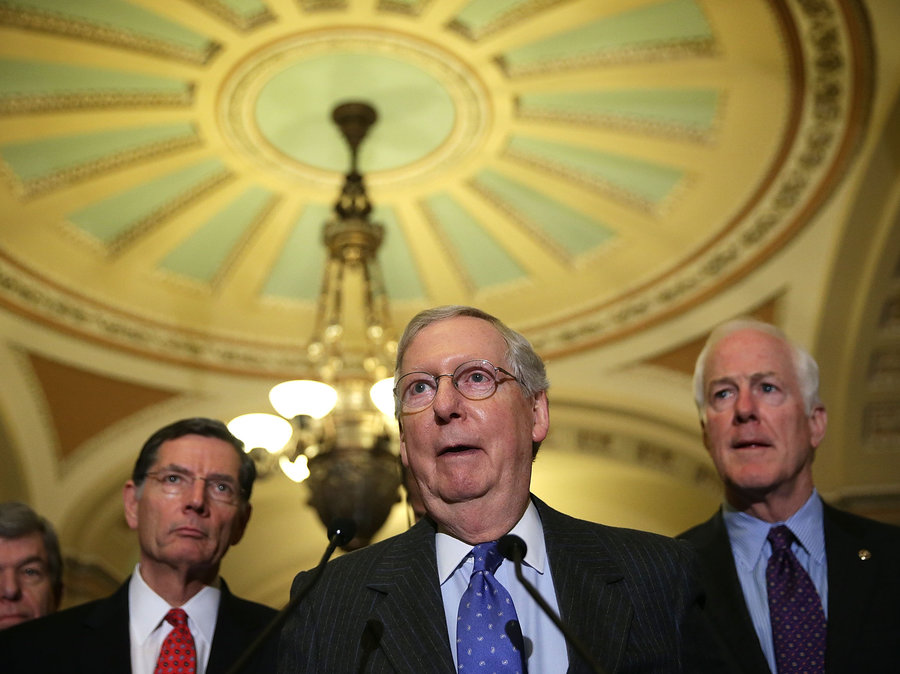
When I read stories over the past few days about how Senate Republicans plan to block President Obama’s pick for the U.S. Supreme Court — before even knowing who it is — it sends me into deep orbit.

The GOP is digging in. So is the White House.

In my view, the president’s constitutional authority should override the Senate’s role in this decision.

I’ll reiterate here something I hope hasn’t been lost on those who read this blog. My belief in presidential prerogative crosses party lines. This isn’t a partisan issue with me.

In 1991, Republican President George H.W. Bush nominated Clarence Thomas to the high court to replace Justice Thurgood Marshall. I stood behind the president on that pick while working for a newspaper in Beaumont. Did the president overstate Thomas’s qualifications for the court by calling the “most qualified man” he could find? Yes, he did.

But that was his call to make. George H.W. Bush was our president, who had been elected decisively in 1988. He earned the right to select someone with whom he felt comfortable. As for the allegations of sexual harassment that arose late in the confirmation process, well, I didn’t buy entirely into what was being alleged.

Four years earlier, President Ronald Reagan selected Robert Bork to the court. Was he the kind of jurist I would have picked? Heavens no! But that wasn’t my call to make. It belonged to the president. The Senate saw it differently and rejected Bork’s nomination to the court — despite Bork’s well-known brilliance and knowledge of constitutional law — on grounds that he would fundamentally reshape the direction of the Constitution.

The process worked as it was intended, even though I believed then as well in the principle of presidential prerogative.

Barack Obama is equally entitled — just as any of his predecessors have been — to put someone forward to sit on the nation’s highest judicial authority. The death of conservative icon Antonin Scalia has shocked us all. The court won’t stop functioning with only eight justices.

The larger problem, though, might lie in the Senate, where Democrats are vowing revenge if Republicans follow through with their threat to block the president’s court nominee from even getting a hearing.

The Senate could shut down. Government could stop. The upper congressional chamber could become a logjam of legislation approved by the House, which cannot become law over a dispute that Senate Republicans will have started.

For what purpose? To deny the president of the “other party” a chance to fulfill his constitutional duty, to which a majority of Americans entrusted to him twice with their votes.

Republicans want to wait for the next president to take office. They are gambling that the 45th president will be one of their own. It’s a risky gamble, though, that threatens to stymie everything else that their own constituents elected them to do — which is to govern.

They call them ‘country clubs’

Texas-prison-Clements-Unit-Amarillo-by-Catholic-Extension-web

It took me about 10, maybe 15, seconds when I first set foot in this place to realize that it isn’t what some folks call it.

The William P. Clements Jr. Prison Unit in Amarillo is no “country club.”

It’s a place where more than 3,500 men serve their time as wards of the state. It can be a violent place. It can be a place of death.

A Texas Department of Criminal Justice corrections supervisor, Major Rowdy Boggs, has been recommended for dismissal after an inmate, Alton Rogers, was found unconscious in his cell after he allegedly was beaten by his cellmate. Rogers died Jan. 18 of the injuries he suffered.

Boggs and 17 other corrections officers face punishment; some of them have been suspended without pay, according to the Texas Tribune.

They’re all innocent, or so they claim, according to an assistant Clements Unit warden who took me on an extended tour of the place shortly after I arrived in Amarillo in early 1995 to start a new job as editorial page editor of the Amarillo Globe-News.

Rick Hudson, then the assistant warden, walked me through the unit one day to show me the TDCJ lockup that was still quite new and in fairly pristine condition. He told me of the fights that erupt within the unit almost daily; in the summer, with the temperatures rising and tensions flaring, the inmate-on-inmate violence gets really serious, Hudson said.

I will add that TDCJ does not equip its prison units with air conditioning.

It’s a tough place to spend many years — let alone spending the rest of one’s life — paying for the crimes they commit.

Yet we hear the canard on occasion from the tough-on-crime-and-criminals crowd that prison life is “too good” for these individuals.

What’s their alternative? Take away the few privileges they get. No TV, no rec rooms, no library. Pack ’em in like sardines.

OK, then. You want more violence? Let ‘er rip! While we’re at it, let’s put the corrections officers — who many folks believe are woefully underpaid — into greater danger trying to break up the fights that are certain to erupt.

Texas got sued once in federal court by an inmate who alleged inhumane treatment. The federal court system took over the state prison system and in the late 1980s and early 1990s, the state embarked on a prison-building program that produced new lockups, such as the maximum-security Clements Unit and the medium-security Nathaniel Neal Unit nearby.

Life for these criminals got nominally more comfortable.

I am quite certain of one thing, though: They aren’t living in country clubs while they pay their debt to society.


The Birther in Chief strikes again

trump-is-a-birther1

Here we go … one more time.

First, the target was Barack Obama, the 44th president of the United States. He was born somewhere other than the United States, the allegation went.

Second, the target was Ted Cruz, junior senator from Texas, who actually was born in Canada to an American mother and a Cuban father.

Now it’s Marco Rubio, the junior senator from Florida, who was born in the Sunshine State, but whose parents immigrated there from Cuba.

All three men allegedly are constitutionally ineligible to run or serve as president.

The man making the assertion? Donald J. Trump, the frontrunner for the GOP presidential nomination.

Trump now says Rubio might not be eligible. His parents’ aren’t American, Trump said. Oh, wait. Rubio was born on U.S. soil. U.S. law says he’s a citizen automatically. Doesn’t matter, Trump asserts. He questions the eligibility, just as he has done with Cruz, even though U.S. law granted young Ted citizenship because Mama Cruz is an American citizen.

And the president? Well, he was born in Hawaii. Trump hasn’t stopped questioning his eligibility, either, even though the president’s late mother also was a U.S. citizen.

Trump is relying on others’ assertions. He’s using social media to send out the doubts that he denies planting. Sure thing. He’s adding plenty of irrigation to the doubts, though, by continuing to provoke needless discussion and unfounded questions about one of his opponents.

Will this latest specious assertion do any damage to Trump? I’ve noted before that I am done predicting such things. This campaign has entered a parallel universe where the normal rules of decency and decorum no longer apply.


Join the club of former shoo-ins, ‘Jeb!’

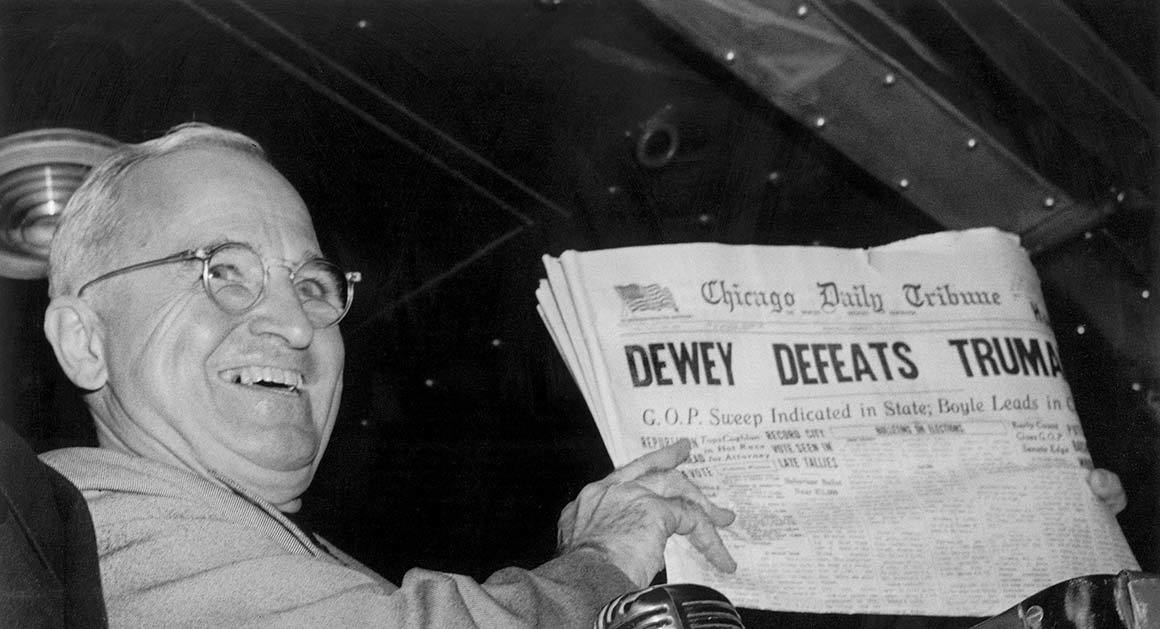
Dewey beats Truman

John Ellis “Jeb” Bush is feeling hurt at this moment, more than likely.

The former Florida governor was thought to be a shoo-in for the Republican presidential nomination. Then he ran into some fierce — or ferocious — opposition.

On Saturday night, Jeb suspended his campaign.

He was flush was cash. He had collected more than $100 million for his campaign war chest. He spent a lot of it on TV ads in Iowa, New Hampshire and then South Carolina. He got next to nothing for his investment.

He’s not the first formerly prohibitive favorite to fall on his face, as political science professor John Zeitz notes in a Politico essay.

It’s one of the “epic fails” of presidential campaigning.

The most recent example of such a “fail” is the 1980 campaign of GOP candidate John Connally, the former conservative Democrat who sought the Republican nomination, only to fail to win a single delegate.

Big John also was well-funded. He had a huge name familiarity as a former Texas governor, former Navy secretary and a victim of collateral damage on Nov. 22, 1963, when he took one of the bullets intended for President Kennedy on that horrifying day in Dallas.

We have heard much during this campaign about how “big money” corrupts the electoral process. The infamous Supreme Court “Citizens United” decision of 2010 has become a favorite target of Democrats running for the presidency seeking to roll back the effect of the court ruling that gives corporations virtually unlimited spending authority in these campaigns.

Jeb Bush was well-heeled, all right. It didn’t do him much good.

Rest assured that Bush won’t collect much solace in realizing that other big-name, sure-fire “winners” fell by the wayside.

All he needed, it now appears, was a message.


Forty-five years in isolation … then freedom

Igne-BianchiMiddle1

The strongest example of intestinal fortitude in America just might belong to a 69-year-old Louisiana man who today is free.

His name is Albert Woodfox. I read about him this morning in the Sunday New York Times and was astounded by what I learned about how he has spent the past 45 years.

Woodfox was an inmate in the Louisiana state prison in Angola. He had been accused of killing a prison guard in his home state. Woodfox had been a troubled young man. He lived a tough life in his native New Orleans. He joined the Black Panthers and became quite angry.

Then an incident occurred while he was in custody in 1971 for another crime. The guard who died, by the way, was a young white man. Woodfox was convicted of the crime and essentially tossed into solitary confinement for the next four-and-a-half decades.

Read the NY Times story here.

I won’t go into the merits of the case. I don’t know enough about the circumstances, other than what I read in the Times.

Woodfox had maintained his innocence all along. Eventually, he pleaded no contest to manslaughter in the case — and then this past Friday he walked out a free man.

The most astonishing aspect of this story is how a human being can be kept in a 50-square-foot cell for nearly all his entire adult life and then find himself able to walk among the rest of society — free, unencumbered, unshackled, untethered.

Woodfox read a lot while he was in prison. Newspapers, books, law journals. He said he kept his faith and insists he never thought he’d “die in prison.”

Most of us go through trials that test our souls, not to mention our will to live. I can think of nothing more punishing than to be locked up in a room, with virtually no human contact.

Then this man is told he can walk out and rejoin his family, or what’s left of it?

Albert Woodfox’s incarceration is believed to be the longest involving solitary confinement — they call it “administrative segregation” these days — in U.S. corrections history.

That is some dubious distinction, don’t you think?

Wow! I truly wish this man well as he attempts to build a life. If only he had a life worth rebuilding. No sir. This fellow is starting from scratch.


Trump earns evangelical support … how?

evangelicals

One of the many — countless, it seems — confounding features of this presidential election cycle concerns the support that Donald J. Trump appears to be gathering from a most unlikely bloc of Republican “base” voters.

I’m referencing here the evangelical voters, those folks who describe themselves as devout, “born again” Christians.

Trump’s victory in the South Carolina GOP primary this weekend came in good measure from the support he got among evangelicals.

I don’t pretend to understand all the nuances of every voting bloc in America. Nor will I jump to many conclusions about any demographic group.

What I know about those who adhere to evangelical Christianity is that they take their Scripture quite seriously. They also prefer that others believe as they do.

So, what does Trump believe? How has he lived?

He’s on his third marriage; he’s been divorced twice. More to the point is that Trump has actually boasted — in writing — about the extramarital affairs he’s had with women who were married to other men. Doesn’t the Bible frown on marital infidelity?

He’s on record at one time as supporting abortion. I haven’t actually heard him say he supports partial-birth abortion, but many of his critics have said as much and I haven’t heard Trump actually deny he ever favored such a thing. I believe evangelical voters vehemently oppose abortion. Isn’t that correct?

Trump has made a lot of money building hotels — and casinos, where people go to gamble away lots of money and, perhaps, engage in activity that is, shall we say, a good bit less than righteous.

The man’s lifestyle over many decades has featured a flaunting of vast material wealth. Again, I won’t presume to know what is in the hearts of those who believe in the principles espoused in Scripture, but I doubt seriously that Trump’s opulent lifestyle fits the bill.

And when I hear Trump talk about the Bible and its contents, he sounds for all the world — to my ears, at least — as though he’s talking about a paperback novel he bought off the used-book shelf. Am I wrong or does he sound to anyone else as though he doesn’t have a clue as to what the Bible actually says — about anything?

But here we are. We’ve been through three contested Republican political events; Trump has finished first in two of them. The South Carolina primary took place in a state where New Testament religion plays a major role in the lives of many of those who call themselves Republicans.

This has been a confounding electoral process so far. Donald Trump’s appeal among evangelical voters within the Republican Party base might be the most perplexing development of all.

What in the name of all that is holy am I missing?


Another Bush vs. Clinton? Not any longer

Former Secretary of State Hillary Rodham Clinton reacts as she is introduced to speak at the Massachusetts Conference for Women in Boston, Thursday, Dec. 4, 2014. (AP Photo/Elise Amendola)

It seems like eons ago.

Pundits on the left and the right not so long ago were talking — some of them bemoaning — about the idea of another race involving presidential candidates named “Bush and Clinton.”

Well, as of Saturday night that dream/nightmare went out the window.

Former Florida Gov. Jeb Bush dropped out of the Republican primary race after getting battered in South Carolina.

The “Clinton” in this scenario? Hillary Clinton won the Nevada Democratic caucus by a comfortable — if not overwhelming — margin and has returned as the prohibitive favorite for her party’s presidential nomination.

I was not one of those who dreaded another Bush-Clinton matchup. I thought then, and I still do, that Jeb Bush could have made a strong case for his own candidacy. He has executive experience and did a good job as governor of a growing state. He’s not the squishy lefty that hard-right conservatives say he is.

Donald J. Trump drew a bead on Bush early on and beat his brains in.

Then we have Hillary Clinton. I refuse to refer to her as “Hillary,” as so many others have done.

She’s got some baggage. Her own legislative and foreign policy experience will be a plus as she plows her way to the expected nomination.

Clinton has that authenticity and likability matter she’ll need to resolve.

You know what they say about any span of time being a “lifetime in politics.” It could be a day, a week, a month — perhaps even an hour, or so it seems.

A year clearly is a lifetime.

What once was seen as quite probable is now gone. Vanished. Jeb Bush could’ve been a contendah.

It didn’t happen. Now, it’s on to the next round of unpredictable finishes.


Trump breaks all the rules

720x405-GettyImages-481233084

It’s become almost a cliché these days to note how Donald J. Trump has broken all the standard political rules.

He has gone on record as supporting abortion on demand, single-payer health insurance, he’s given money to Hillary Clinton’s previous campaigns, he calls the Iraq War a “huge mistake.”

The Republican Party primary base of voters would seem to oppose him on every one of those issues.

They love the guy. He won again tonight in South Carolina’s Republican primary.

Another rule — generally speaking — is to pay some kind of tribute to a vanquished foe. Tonight the foe was former Florida Gov. Jeb Bush, who bowed out of the campaign. Bush congratulated “the other candidates” who fared better than he did; I presume he included Trump among them.

Did the victor of tonight’s South Carolina primary return a compliment to Bush? Umm. No.

He ignored Jeb Bush. He passed over any mention.

Another rule of good manners … broken!

Will it matter to those who just adore Trump? Hardly.

This has become a campaign where all the standard norms of decent behavior have been tossed aside.

Go … bleeping … figure.


Well, I’ll be dipped …

1scarolina

Dear old Dad had a saying he would use whenever he was mortified, surprised, confused or amazed.

“Well, I’ll be dipped in sesame seeds,” he would say.

Tonight, my dad is being dipped and covered in ’em. I don’t have any other way to describe the news out of South Carolina that TV celebrity/real estate mogul Donald J. Trump has rolled to another Republican Party presidential victory.

The fight is on at this moment for second place. The combatants are U.S. Sens. Ted Cruz of Texas and Marco Rubio of Florida.

I’ve admitted already, but it’s worth another admission, a confession, a mea culpa: I was wrong about Trump’s staying power. Many times along the way I thought he’d said something that would doom him.

It started with his denigration of Sen. John McCain’s status as a Vietnam War hero. “He’s a hero because he got captured,” Trump said. “I like people who aren’t captured, OK?”

There would be many other instances of profound crassness. None of them mattered in the eyes of those who continue to support this guy.

I am no longer going to make such predictions as they relate to Trump.

This campaign has become a case study in weirdness.

The insults keep piling up — right along with the victories this individual keeps winning.

He’s two-for-three at the moment. Cruz won the Iowa caucuses, barely. Trump rolled to victory in New Hampshire and appears to be rolling in South Carolina.

If the Republican National Committee still harbors any hope of stopping Trump, of denying him the party’s presidential nomination, my advice is simple and straightforward.

Y’all have to get real busy. Like right now!

Oh, and Dad? Wherever you are, I’m just as baffled as you might be.


Commentary on politics, current events and life experience