Conservatism takes new activist turn

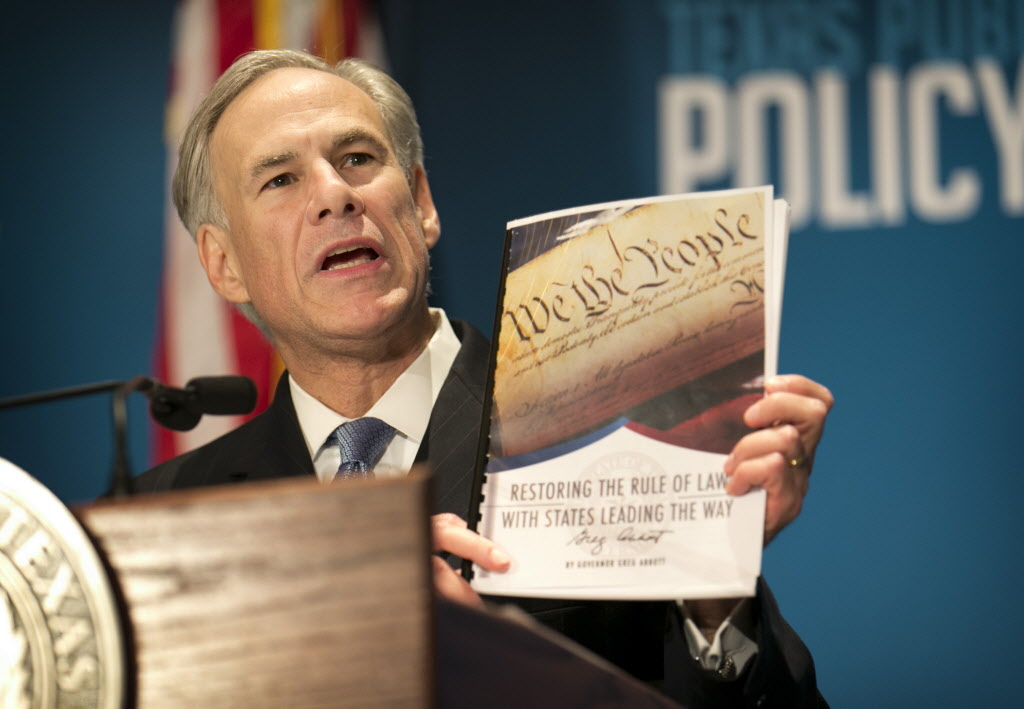
Gov. Greg Abbott calls for a convention of states to amend the Constitution during a speech at the Texas Public Policy Foundation in Austin, Texas, Friday, Jan. 8, 2016. Abbott called on Texas to take the lead in pushing for constitutional amendments that would give states power to ignore federal laws and override decisions by the U.S. Supreme Court. (Jay Janner/Austin American-Statesman via AP) MANDATORY CREDIT

Texas Gov. Greg Abbott calls himself a conservative.

Well, my understanding of conservatism traditionally has meant minimalist government; keep government quiet; don’t upset the status quo; let it ride, man.

Not these days.

Abbott has issued a seriously proactive call to remake the U.S. Constitution. He has called for a constitutional convention to craft some serious amendments to the nation’s governing document.Ā  They include:

  • Disallowing federal law fromĀ regulating activities wholly within a single state.
  • Requiring a balanced federal budget.
  • Providing a way to override decisions by the U.S. Supreme Court.
All told, Abbott has offered nine proposals.
My favorite one involves the highest court in the land.
Abbott thinks two-thirds of the states should be empowered to overturn decisions by the Supreme Court. Interesting, yes?
I believe conservatives also believe in what’s called “strict construction” of the Constitution. They want to adhere to what the Founders wrote when they created the federal government.
One of the provisions they allowed was a totally independent federal judiciary. What Gov. Abbott is proposing — in my humble view — removes that a large portion of the independence envisioned by the founders. It puts ultimate authority in court decisions in the hands of state legislatures.
I am hard-pressed to find a more remarkable reversal of the traditional definition of “conservative government.”
What’s being proposed and discussed these days is a reform movement that puts “liberal activism” to shame.

Heading for ‘home stretch’ . . . already?

Horserace

The nation’s political media are misleading the public about the nature of the 2016 presidential campaign.

I’ve lost count of the number of times I’ve heard it said on broadcast and cable TV news shows that “we’re heading toward the home stretch” of the campaign.

What’s at the end? The Iowa caucus and the New Hampshire primary.

Is it me or are the media getting way, way ahead of themselves in declaring that the major-party contests for president of the United States are about to conclude?

I’m scratching my head — even as I write the words contained in this blog post.

The Republican Party primary still has about a dozen candidates running for the presidency. I agree with most “experts,” though, in limiting the front runners to four, maybe five of the GOP candidates. Who are they? Donald Trump, Chris Christie, Marco Rubio, Ted Cruz . . . and perhaps even Jeb Bush.

The Democratic Party primary has become a two-candidate match race: Hillary Rodham Clinton and Bernie Sanders.

So, do the Iowa caucuses and the New Hampshire primary signal the end of the race? Hardly. They symbolize the beginning of it.

I am continually amazed at the shallowness of the media coverage of both parties’ campaigns. The media gripe about the “horse race” aspect of this coverage, yet they continue to focus on it at the expense of serious examination of the candidates’ issues statements.

Oh, sure, the media have had plenty to say about Trump’s immigration plan, his ban-Muslims idea and a tax plan that doesn’t add up. But they couch it in terms of what these things do to his poll standing.

The media keep focusing on whether Clinton or Sanders are leading in either Iowa or New Hampshire.

The Iowa caucus doesn’t represent the end of the campaign. It’s just the beginning. We’ve got a long way to go before the conventions get underway.

What’s more, if none of the Republican candidates can sew up enough delegates to be guaranteed the nomination before the GOP convention begins, well . . . we’re going to have a serious donnybrook on our hands in Cleveland.

The end of the race is at hand? Nope.


El Chapo back in the slammer

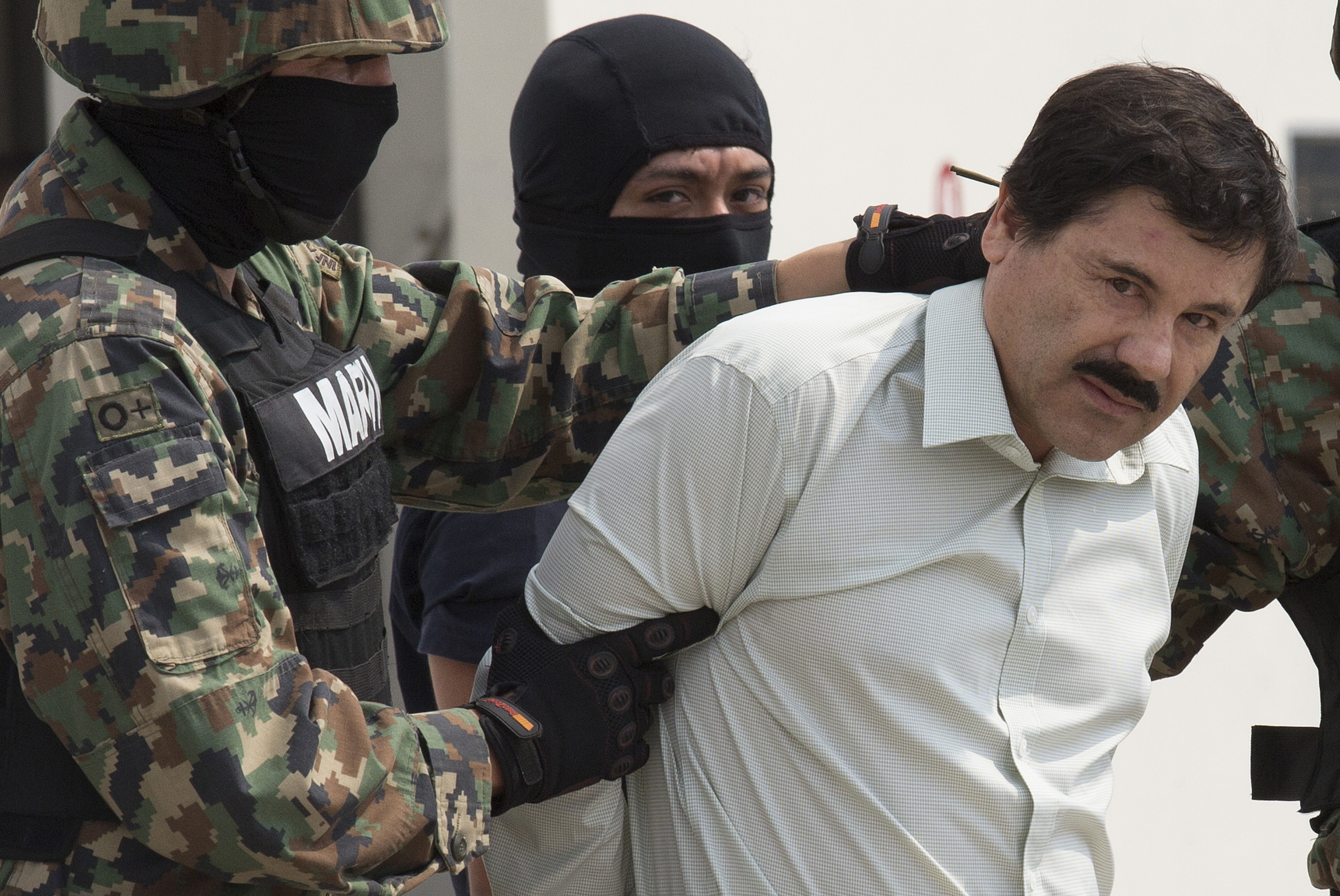
Bloomberg's Best Photos 2014: Drug trafficker Joaquin "El Chapo" Guzman is escorted to a helicopter by Mexican security forces at Mexico's International Airport in Mexico city, Mexico, on Saturday, Feb. 22, 2014. Mexico's apprehension of the world's most-wanted drug boss struck a blow to a cartel that local and U.S. authorities say swelled into a multinational empire, fueling killings around the world. Photographer: Susana Gonzalez/Bloomberg via Getty Images

Joaquin “El Chapo” Guzman, the notorious Mexican drug dealer, has been re-arrested.

Mexican authorities managed to corral the infamous drug cartel lord after only six months on the lam; he’d escaped from a “maximum-security” prison.

I don’t know how they define “maximum security” in Mexico, but my hunch is that they’d better redefine it . . . or toughen security measures in their hard-time lockups to ensure that they can keep the bad guys behind bars.

My hope for El Chapo is that this monster gets buried deep inside the stoutest walls and behind countless rows of razor wire to make sure he remains locked up for as long he continues to draw breath.

Read the story here.


Obama vetoes ACA repeal bill; what now?

obamacare-1

Who didn’t see this one coming?

Nobody. That’s who.

President Barack Obama today vetoed a bill that would have repealed the Affordable Care Act and cut federal funds from Planned Parenthood.

This was the mother of political statements.Ā And I’m not talking necessarily about the president’s veto.

I’m referring to Congress’s insistence that the ACA — also known as Obamacare — isn’t working, that it’s an albatross, that it represents a government overreach.

It’s also the president’s signature domestic policy achievement. He said all along — going back to other efforts by Republicans in Congress to repeal the law — that he’d veto any such bill if it got to his desk. It did . . . and he did.

I believe Congress needs at this time to cut its losses. It doesn’t have the votes to override the president’s veto, even with its GOP majority in both legislative chambers. Republicans need a two-thirds majority to override; they don’t have it in the Senate.

We’ve got an election coming up. We’ll have a new president a year from now. Depending on who the parties nominate, Congress might have a dramatically different look than it does today — particularly if the Republican presidential nominee happens to have the name Donald J. Trump.

The current Congress still must work with a Democratic president who — on this issue — has drawn a line deep into the dirt between the White House and Capitol Hill.

The Affordable Care Act is going to stay; moreover, the government will continue to provide public money to Planned Parenthood. Don’t mess with either of them.

Let’s get on to the many other complex issues facing the nation.

NRA was MIA at Obama town hall

gun-control

Barack Obama had a “town hall” forum tonight.

He fielded questions from an audience about his strategy to keep guns out of the hands of people who shouldn’t have them.

I was heartened to hear questions from some folks who doubt the president’s message. The forum wasn’t an amen chorus of folks who agree with the president, which of course would have ruined the notion of it being an actual town hall forum.

But the audience was missing a key component: the National Rifle Association.

The president said he had invited the NRA to attend the meeting. The nation’s leading gun-owner-rights organization was missing.

It should have been there to challenge the president, to joust with him publicly — on national television.

It’s not that I endorse the NRAĀ position on gun control. It is that when given a chance to air its views on the same stage as the president of the United States, I believe the NRA should have taken advantage of the opportunity to do so.

Will the NRA decline future opportunities? It’s my hope that we can have a sensible, intelligent discussion from individuals and organizations on all sides of this most polarizing debate.

DAI keeps its public money after all . . . good!

downtownamarilloinc1

The facts . . . just the facts.

The fictional police detective Joe Friday would say that on the TV show “Dragnet” a long time ago when questioning principals involved in a criminal activity.Ā  The admonition applies, it seems, to local media seeking to report on the status of a non-profit organization charged with shepherding downtown Amarillo’s revival.

Downtown Amarillo Inc., it was reported, was losing its revenue source from the city. Not so, DAI officials have said. Ditto, according to Mayor Paul Harpole.

A TV station reported that the city had decided to “defund” DAI. Turns out the story was a bit off the mark.

DAI failed to meet a deadline set by the City Council to come up with strategic action plan on downtown revitalization efforts.

The council, though, did not pull the plug on DAI. It extended its deadline, giving the organization a little more time to finish its work on the strategic plan. Harpole said DAI is going to present its plans at the next City Council meeting.

DAI has been the subject of a fair amount of criticism from those who dislike the effort being put into reviving downtown Amarillo. I happen to think DAI provides a service of great value to the city and want it to continue operating at full speed.

From my vantage point, it appears that the City Council and DAI need to become more familiar with each other’s move. Think of them asĀ a dance team learning how to move in sync.

There might be more hiccupsĀ along the way as DAI and the City Council — with its three new members still feeling their way through a sometimes-complicated process — move forward . . . hopefully together.

My admonition to DAI would be to ensure that meets all the deadlines required in the future by the bosses at City Hall.

Meanwhile, it’s incumbent on the media — given the occasionally overheated rhetoric that has punctuated the recent community discussion on downtown’s future — to ensure it gets it right the first time.


‘Five unelected lawyers’ have lots of power

Supreme_Court_US_2010

I saw a news clip last night that, frankly, stunned me.

I’d seen it before, but had forgotten how ill-informed the person featured in it seemed to be when he made a particular statement.

Sen. Ted Cruz is a smart guy. Harvard Law grad. Former law clerk to the current Supreme Court chief justice. Solicitor general for Texas.

He’s running for the Republican nomination of president of the United States.

But when the Supreme Court voted 5-4 this past year to legalize gay marriage throughout the country, Cruz said it was wrong for “five unelected lawyers” make such profound decisions. He sought to make the case, it appears to me, that the federal judicial system — as established by the founders of this country — was fatally flawed.

See Cruz’s statement.

I do not intend to lecture this bright young lawyer about the Constitution, but I do want to make this point.

The nation’s government framework gives the Supreme Court enormous power. That’s why making appointments to that court is arguably the most important decision a president ever makes during his time in office. Cruz knows that . . . I’m sure.

When the court rules on the constitutionality of issues, its word is final. That’s how the framers set it up. They entrusted the highest court in the land to make these decisions without qualification. Yes, some of these decisions have been reversed over time. By and large they’ve been overturned with good reason.

However, one shouldn’t trivialize these court rulings as being the mere opinions of “five unelected lawyers.” They’ve been given a huge responsibility by the very government for which Sen. Cruz, himself, works as a legislator.

The court has made decisions over the years with which I disagree. However, I honor and accept those decisions as part of the constitutional process.

At least, though, the nation’s Supreme Court comprises nine lawyers, individuals who’ve studied the law and know it pretty well. The founders didn’t require justices on that court to be lawyers in the first place.

I trust Sen. Cruz knows that to be the case as well.


House OKs another waste-of-time measure

obamacare-1

Here we go again.

The U.S. House of Representatives has approved a measure to repeal the Affordable Care Act. The House vote comes after the Senate approved the measure earlier.

Speaker Paul Ryan blustered that the measure is going to President Obama’s desk — where it faces a certain veto.

The president’s signature effortĀ is in no danger of being overturned.

Which begs the question: Why is Congress continuing to waste the public’s time and money on these efforts to repeal the Affordable Care Act?

Oh, I think I know.

Republicans who control both congressional chambers want to make political hay. They want to keep hammering at a law they detest because, they say, it expands the federal government.

Well, the ACA also does something else. It provides health insurance to roughly 17 million Americans who beforehand didn’t have it. They couldn’t afford it. They were denied medical care because they couldn’t afford to pay for it. The ACA now provides insurance.

Repeal the law? Sure. And replace it with . . . what, exactly?

House members and senators will get the veto that the president promises. They’ll be unable overturn the veto because Republicans lack the two-thirds majority in both houses to do it.

So, the dance continues.

Will someone tell the band to stop playing? Please?


Gay marriage . . . it’s back

moore

Let’s see if we can clarify something.

The U.S. Supreme Court comprises nine individuals who are charged with interpreting the constitutionality of laws. They decide whether certain laws are in keeping with the nation’s founding governing document. The justices are diverse in their thinking. Their judicial philosophies cover the entire length of the judicial/political spectrum.

The highest court in the land ruled not long ago that people are entitled under the equal protection clause of the Constitution to marry others of the same sex. The court, therefore,Ā legalized gay marriage in all 50 states.

That settles it, right? The nation’s highest court ruled that gay people are entitled to marry whoever they love with no regard to sexual orientation.

Not so fast. An Alabama state supreme court chief justice — Roy Moore — has told probate judges in his state that they shouldn’t issue marriage licenses to gay couples. Why? Chief Justice Moore said the nation’s highest court’s ruling is inconsistent with Alabama court rulings on the subject.

OK, then. Which court’s rulings carry more weight? The U.S. Supreme Court, which is where the judicial buck stops? That court’s rulings are supposed to be final, definitive. Or does a state court have the authority to overrule the nation’s highest court?

Chief Justice Moore is not new to notoriety. He once thrust himself into the limelight over whether to display the Ten Commandments on public property.

This time, he has spoken out of turn . . . in my humble view.

The U.S. Supreme Court has settled the issue about gay marriage. The Constitution, a majority of justices ruled, grants all Americans the same protection under the law. It doesn’t single out heterosexual people, granting protections to them and not to homosexuals.

Can we simply just allow the nation’s highest judicial body’s ruling stand?


Donald Trump: birther in chief

Polls%20and%20Surveys%20pic

Donald J. Trump has a birther fetish.

When he was leading the polls by a country mile, he saw no issue with the background of fellow Republican presidential candidate Ted Cruz. The Canadian-born U.S. senator from Texas has qualified fully to run for president, Trump said. “He’s in fine shape,” he said of his GOP rival.

But wait! Circumstances have changed. Cruz is neck-and-neck with Trump. He’s overtaken him in Iowa, according to some surveys.

Now-w-w-w there’s a problem, Trump said.

“People” have called Cruz’s qualifications into question, Trump said. It could present a problem for the Republicans if Cruz is their nominee, Trump added.

So, which is it, Donald. Is Cruz eligible to run and serve as president or isn’t he?

Trump has raised this birther crap before. The other time involved President Barack Obama, who was born in Hawaii — one of the 50 United States of America. Trump, though, didn’t believe it; for that matter,Ā I’m not sureĀ he believes it yet.

The Constitution stipulates that only “natural-born” citizens can run for the office and serve if elected. Yes, Cruz was born in Canada. But he earned U.S. citizenship the moment he came into this world because — get ready for it — his mother is an American. Daddy Cruz is Cuban, but that doesn’t matter. Cruz is eligible to run for the highest office.

Don’t take my word for it. Others who are a whole lot smarter than I am have said the same thing. Constitutional lawyers have affirmed Cruz’s eligibility.

So, what’s Trump’s beef?

Oh yeah. It’s those polls.

I love, too, how Trump keeps shoving this issue off to “people” who’ve said such things. Well, Trump has said it, too.

It kind of reminds me of the time Sen. Walter Mondale — the 1976 Democratic vice-presidential nominee — came to Portland, Ore., to campaign for the White House. He held a press event in which a reporter asked him if Watergate was going to be an issue in the presidential campaign.

Mondale, grinning from ear to ear, said, “I am not going to make President Ford’s pardon of Richard Nixon an issue in this campaign.”

I guess Mondale was going to let “people” talk about it.


Commentary on politics, current events and life experience