Tag Archives: Merrick Garland

Content of character: does it still count?

By JOHN KANELIS / johnkanelis_92@hotmail.com

Make no mistake that I likely would feel differently were I of African-American or Latino or Asian descent. I am none of those.

Having laid that predicate down, I want to engage in the discussion over who President-elect Biden should select as the nation’s next attorney general.

I practically jumped out of my shoes the other day when I heard an African-American commentator, Jonathan Capehart, say out loud that the three individuals Biden is believed to be considering as AG are too white for his taste. Capehart wants more “diversity” among the finalists.

Hmm. Let’s examine this briefly. The three people Biden reportedly is pondering are U.S. District Judge Merrick Garland, former deputy U.S. Attorney General Sally Yates and U.S. Sen. Doug Jones. They all possess exemplary legal credentials. They also all have committed through their careers to advancing the cause of civil rights.

Their only “shortcoming” is that they aren’t people of color.

President-elect Biden has kept his pledge to nominate executive branch team members who reflect the nation. Has loaded the Cabinet with and top-level staffers with African-Americans, Latinos, Asian-Americans, women; my goodness, he even has selected an openly gay man to serve in the Cabinet.

President Obama nominated Merrick Garland to the Supreme Court, only to have his nomination blocked in 2016 by Senate Republicans who wanted to wait for the presidential election outcome that year. Garland has been a champion for minority rights, for gay rights and has staked out a center-left course while serving on the federal bench.

Sally Yates has demonstrated her own commitment to fair and impartial justice as a deputy AG, striving to be sensitive to minority Americans’ concerns over whether the justice system was loaded against them.

Doug Jones, who lost his bid for re-election to the Senate from Alabama in 2020, served as a federal prosecutor and obtained the conviction of the Klansmen who blew up the Birmingham, Ala., church in 1963 that killed four precious African-American girls; it was one of the most notorious hate crimes of the 20th century. He, too, has earned his spurs in fighting for minority rights.

Is it essential that the next AG be a person of color? No. It isn’t. It is essential that the next attorney general refrain from engaging in partisan politics and administer justice dispassionately and in accordance with the law.

I want to remind everyone of what Dr. Martin Luther King Jr. said on the steps of the Lincoln Memorial that day in 1963. He spoke of his “dream” that one day black Americans can be judged by “content of their character” rather than “the color of their skin.”

Shouldn’t that noble goal apply to any American?

Merrick Garland haunts this hearing

By JOHN KANELIS / johnkanelis_92@hotmail.com

Merrick Garland is very much alive and well but his “ghost” floated throughout the hearing room today as a congressional hearing commenced on an appointment to the U.S. Supreme Court.

The U.S. Senate Judiciary Committee welcomed another federal judge, Amy Coney Barrett, as she began her confirmation hearing to the U.S. Supreme Court. She would take the seat occupied by the late Justice Ruth Bader Ginsburg, who died in September.

Garland’s role in this drama? Well, he once got nominated to the high court by President Barack Obama. Another justice, Antonin Scalia, died in February 2016 while on vacation in Texas. President Obama wanted to nominate a successor. Senate Majority Leader Mitch McConnell wasted no time in declaring his intention to block that effort. Why? Because the voters had a right to be heard before a SCOTUS nomination would be considered by the Senate.

We had a presidential election in 2016. Obama couldn’t run again. It turned out that Donald Trump would win the election. So, Trump got to select someone to succeed Scalia; he chose Neil Gorsuch.

The hypocrisy between then and now is stunning in its scope.

We were 10 months away from the previous election when a vacancy occurred. Now, we’re just 22 days before the next election. Don’t Americans have a right to have their voices heard before the Senate considers a nominee to succeed Ginsburg? Of course we do.

Except that Republicans who at the moment hold the majority of Senate seats are pushing full speed with the Barrett hearing.

Most astonishing of all is the comment that Committee Chairman Lindsey Graham made in 2018. He said then that if an opening occurs during Donald Trump’s term as president and the “primary season has begun,” the Senate should hold off until after the election before considering a possible replacement.

Graham said we could hold his words against him. Fine. Many of us are doing that, Mr. Chairman.

Amy Coney Barrett wouldn’t be my choice to join the court. I much prefer a jurist in the Merrick Garland mold: moderate, center-left in philosophical judicial outlook. Garland, though, never got the courtesy of a hearing, let alone a Senate vote, that appears to be in store for Judge Barrett.

It’s all because the Senate GOP majority played politics with the judicial nomination process in 2016 … and is doing so once again right now.

Shameful.

How to fill a SCOTUS post

By JOHN KANELIS / johnkanelis_92@hotmail.com

OK, how might the unfolding drama surrounding the selection of a Supreme Court justice play out?

I want to offer something of a best-case scenario for you to ponder. Ready? Here goes …

Congress stymies Donald Trump’s nominee, which he is going to announce in the next day or two or three. Democrats could pull off some political hocus-pocus to prevent the Senate from voting on a nominee prior to the Nov. 3 presidential election.

Then we elect Joe Biden president of the United States. The president-elect demands that the nominee withdraw. We go back to Square One.

Meanwhile, Democrats take control of the next Senate, possibly ousting the leading obstructionist in that body, Majority Leader Mitch McConnell. Mitch is out. Still following me? Good!

Then we swear in President Biden, who then gets to make a selection to succeed the legendary Justice Ruth Bader Ginsburg on the high court. Is he obligated to select a woman? No. He hasn’t committed to anything in that regard. I mean, he did select a woman as vice president.

So, why not roll the dice and ask a highly regarded federal judge who once got tapped by President Obama. Yep, I refer to Merrick Garland, whom the Senate GOP stiffed when they refused to grant Obama’s selection a hearing, let alone an up/down vote to join the court after Justice Antonin Scalia died in February 2016.

I might be willing to bet real American money that Judge Garland would be up for a hearing before a Senate controlled by Democrats.

Is any of this likely? I have no idea. First things first: Democrats need to find a way to prevent Trump and McConnell from shoving the pending nominee down our throats and pushing the court so far to the right that it is in danger of destroying health care legislation, women’s reproductive rights and a host of other protections that prior courts have ruled to be constitutional.

A new president deserves the opportunity to make this call. Not one who well might get defeated, and certainly not a Senate that well could see control shift from one party to the other.

I am hopeful.

Politics intersects with principle

I hate it when this happens, when principle runs headlong into partisan political interests … such as when presidents might be handed an opportunity to make a key appointment.

I refer to the U.S. Supreme Court and to Donald J. Trump.

Supreme Court Justice Antonin Scalia died suddenly in early 2016, creating a vacancy on the high court. President Obama, serving his final full year in office, then nominated Merrick Garland to succeed the brilliant conservative jurist. Senate Majority Leader Mitch McConnell slammed the brakes on that effort, saying that the Senate wouldn’t confirm an appointment from a lame-duck president in an election year.

Many of us — including me — raised holy hell. We argued that presidential prerogative allowed Obama to make that appointment. We argued on the principle that the Constitution granted him the authority to act. I also argued that McConnell was playing a shameful game of politics with this principle. The 2016 election occurred, Trump got elected, Garland’s nomination was tossed aside.

Here we are, four years later. Another Supreme Court justice, liberal icon Ruth Bader Ginsburg, revealed recently she is battling liver cancer. I now am asking myself: What happens if she can no longer serve on the court? Does Donald Trump deserve the same sort of presidential deference many of us in the peanut gallery said was due Barack Obama?

With gritted teeth and a tight jaw, I have to say: yes, he does.

Let me be crystal clear. I do not want Justice Ginsburg to leave the court until well after the November election. There’s a decent chance at this moment that Trump is going to lose to Democratic nominee Joe Biden. It is my fondest political hope that Justice Ginsburg can continue to serve on the court, can continue to write opinions and can be a full partner in the court’s deliberations. It also is my hope that should she decide to retire from the court that she can wait until after President Biden takes his oath of office in January and then is free to nominate someone of his choice.

However, if fate takes the court in another direction, I will be saddened beyond measure at what is likely to transpire as Trump wages war against those in the Senate who will fight to stall any confirmation process until after the voters have their say at the ballot box.

Yes, occasionally politics can be based on high principle. I fear that politics and principle might be pointed in opposite directions in this most volatile election year.

McConnell exhibits stunning lack of self-awareness

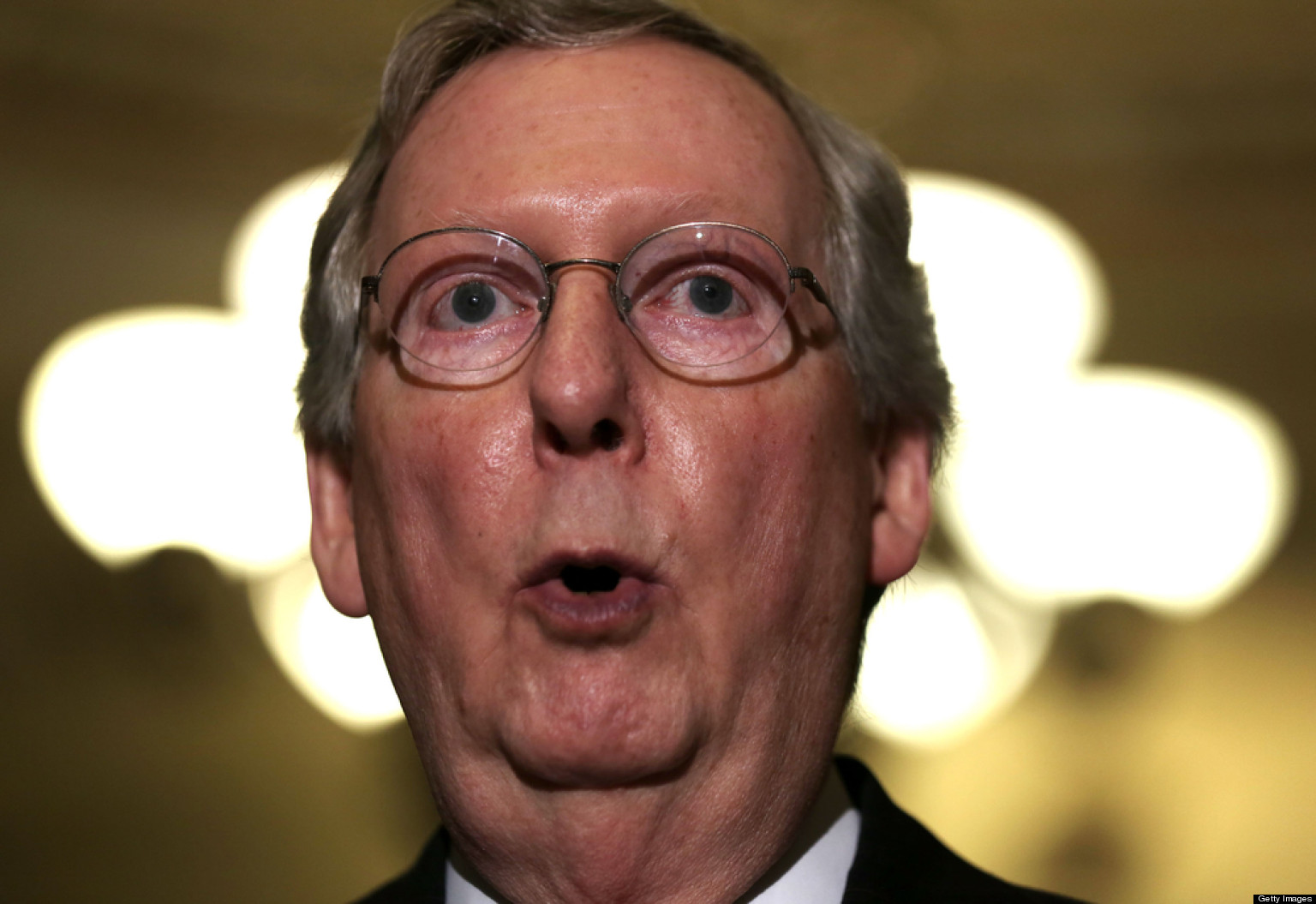
(Photo by Alex Wong/Getty Images)

Of all the statements, assertions, pronouncements and declarations I keep hearing while we watch this impeachment drama unfold, I keep circling back to what keeps coming out of the mouth of Senate Majority Leader Mitch McConnell.

The Kentucky Republican keeps hurling “partisan political” accusations at his Democratic colleagues in the Senate and in the House of Representatives. When I hear him accuse House Speaker Nancy Pelosi of acting as a purely partisan politician, I find myself thinking: Dude, do you not remember your own political history? 

Of course he does!

I harken back to the Mother of All Partisan Acts when in early 2016 he declared that President Obama would not be able to select someone to sit on the U.S. Supreme Court. Justice Antonin Scalia died suddenly that year; Obama sought to nominate Merrick Garland to succeed him; McConnell put the brakes on it, declaring that the president’s nominee would not get a Senate hearing in an election year.

Democrats were rightfully outraged. It was an act of supreme partisanship, just as he has continued to exhibit his partisan bona fides during the run-up to the Senate impeachment trial that has commenced.

Speaking of that … for the Senate majority leader to accuse anyone else of partisan game-playing is akin to getting a lecture on marital fidelity from, oh, you know who.

Principled stands occasionally rub us the wrong way

If one is going to argue a point on principle, then fairness dictates that the principle must stand no matter whose policy is the subject of the discussion of the moment.

With that, I have to declare that my vigorous opposition to Senate Majority Leader Mitch McConnell’s decision to play politics with President Obama’s authority to appoint a Supreme Court justice compels me to make a declaration that is going to anger some readers of this blog.

It is that Donald Trump deserves to be treated fairly if the time comes for him to make a SCOTUS nomination during the heat of a presidential campaign.

I heard the news about Justice Ruth Bader Ginsburg’s hospitalization over a fever and thought what many of you thought as well: What if she can no longer serve on the nation’s highest court? I hate harboring macabre thoughts, but realism requires us to recognize that the justice is 86 years of age and has been battling cancer.

OK, that said, she also is a noted progressive jurist appointed to the high court in 1993 by President Clinton. She is the second-most senior tenured justice on the court, behind archconservative Justice Clarence Thomas, appointed in 1991 by President George H.W. Bush.

The politics gets stickier than pine bar on a baseball bat.

Conservative icon Antonin Scalia died suddenly in early 2016. President Obama wanted to nominate Merrick Garland to succeed him. Garland is known as a judicial moderate who tilts a bit to the left. McConnell intervened. He said under no circumstances should Obama, a lame duck, should be allowed to fill that vacancy. He blocked Obama’s choice in the Senate, which has confirmation power.

Many of us went ballistic. I was one of millions of Americans who were enraged at McConnell’s power play. How dare he interfere with the president’s constitutionally granted authority? He wanted to wait for the 2016 election to play out before handing the matter over to the next president. It was a raw partisan act and it was wrong.

I argued the point on the principle of presidential authority taking precedence.

So, here we are today.

Another president is in office. Donald Trump has selected two high court justices already. If he gets a chance to select a third one in the event that Justice Ginsburg retires or … well, you know … then he gets to nominate a justice to succeed this progressive icon.

We all know what the reaction will be. It will mirror the reaction that erupted in progressive circles when Scalia died and Garland got the nomination. Only this time conservatives will argue that the president deserves to have his nominee seated; progressives will seek to block it, perhaps in the manner that McConnell did.

It would be as wrong to block Trump as it was to block Obama.

The more reasonable — and principled — option would be for Democrats to regain control of the Senate after the 2020 election. Then the Senate could exercise its appointment power when a conservative justice’s spot on the court is vacated. Voters also can kick Trump out of office, presuming he survives the pending impeachment and Senate trial, and elect someone who will forgo the ultra-right-wing agenda favored by the incumbent.

Given my own often-stated bias, I take no pleasure in making this declaration. I feel I must … in the name of principle.

In the meantime, I intend to pray real hard for Justice Ginsburg’s good health.

Mitch McConnell: Partisan hack demonstrates his hypocrisy

There well might be no more demonstrably partisan political hack in the U.S. Senate than the man who runs the place … and who has the gall to accuse politicians on the other side of playing politics.

Senate Majority Leader Mitch McConnell has blocked a bill that would seek to make our electoral system more secure and to prevent foreign hostile powers from hacking into our system.

Why did he do that? Because he says Senate Democrats have made it too “partisan.” They are “playing politics” with the legislation.

Wow, man!

Hmm. Let’s see how this works. Requiring paper ballots to back up the electronic ballots is “partisan”? Mandating that political candidates report to the FBI any suspected foreign-power interference is “partisan”?

Meanwhile, Donald Trump has stood with the Russians who did attack our election in 2016 and are likely to do so again in 2020. Trump’s partner in the Senate now is standing with him, declaring that Democrats are the partisan hacks.

Let’s flash back for a moment to 2016.

U.S. Supreme Court Justice Antonin Scalia died while vacationing in Texas. The conservative icon’s body barely had gotten cold before McConnell declared that President Obama — serving his final full year in office — would not be allowed to seat a justice to replace the conservative icon, Scalia.

Obama ended up nominating Merrick Garland, an eminently qualified jurist. Garland didn’t get a hearing. McConnell was at his obstructionist worst in blocking Garland’s nomination and in denying President Obama the opportunity to fulfill his constitutional responsibility.

So now the majority leader calls Democrats the partisans? He says Democrats are playing politics with an electoral security bill?

The man’s hypocrisy takes my breath away.

Sen. McConnell: partisan hack supreme

There could be little, if any doubt, about Mitch McConnell’s partisan credentials.

The U.S. Senate majority leader, though, has just removed any possible benefit of the doubt. The man plays pure, raw, partisan politics better (or worse) than anyone else in Washington, D.C.

Consider his answer to this question recently: If a seat on the Supreme Court came open in 2020, the final full year of Donald Trump’s term as president, would he seek to confirm the nominee?

McConnell’s answer: “Oh, I’d fill it.”

Just four years ago, he had the chance to “fill” a seat on the high court upon the sudden and unexpected death of Justice Antonin Scalia. His response in 2016, the final full year of President Obama’s tenure in the White House, was markedly different from what he said to the crowd in Paducah, Ky.

McConnell said immediately upon Scalia’s death that Obama would not fill the vacancy. McConnell would block any attempt for a Democratic president to replace a conservative justice appointed by a Republican president; in this case, it was President Reagan who nominated Scalia.

Obama nominated Merrick Garland to the SCOTUS. The Senate didn’t give him a hearing. Key Republican senators never even met the fellow. His nomination withered and died. We elected a new president in November 2016 — and it happened to be Donald Trump!

Oh, but now we have a GOP president in office. If a vacancy were to develop on the court, McConnell — also a Republican — would move to fill the vacancy.

Just think that this partisan hack has the gall, the stones, the chutzpah to suggest Democrats are “playing politics.”

This guy, McConnell, plays the political game with the best of ’em.

Sen. McConnell’s thinly disguised contempt for fairness — to my way of thinking — is what gives politics and politicians a bad name.

Merrick Garland to preside over Trump appeal? Oh, the irony

The irony here is just too obvious and too rich to ignore.

Donald Trump’s legal team is going to appeal a federal judge’s ruling that the president must obey congressional demands to turn over his financial records.

And just who is going to preside over the federal appeals court that will consider this case? None other than Judge Merrick Garland, the man who by all rights should be sitting on the U.S. Supreme Court instead of serving as chief of the D.C. Circuit Court of Appeals.

This is quite fascinating.

President Barack Obama nominated Garland to the high court after the sudden and shocking death of Justice Antonin Scalia in early 2016. Justice Scalia had been dead mere hours when U.S. Senate Majority Leader Mitch McConnell declared that President Obama would not get to fill the SCOTUS seat. Obama was in the final full year of his presidency and McConnell insisted that the next president be allowed to perform that constitutional duty.

In truth, Merrick Garland was a superb choice. He should have been given a hearing. He should have been confirmed by the Senate. He wasn’t because of McConnell’s partisan grandstanding.

Now the judge gets to preside over an appellate case filed by Donald Trump.

My hunch is this: Judge Garland is going to demonstrate for the entire world his impartiality, his legal judgment, his expertise and knowledge of the U.S. Constitution . . . and will show us precisely why he should be sitting on the United States Supreme Court.

Sen. McConnell is a jokester supreme

Mitch McConnell just slays me. He knocks me out. He throws out jokes when he’s trying to be serious.

Such as when he writes an essay on Politico.com and urges Democrats to stop obstructing Donald Trump’s myriad appointments.

Yep, the Senate’s chief obstructionist masquerading as its majority leader, is scolding Democrats for playing politics.

You can read Sen. McConnell’s essay here.

I want to have my say for just a moment.

Majority Leader McConnell has set a new standard for obstruction. He rolled it out in early 2016 when U.S. Supreme Court Justice Antonin Scalia died suddenly. The president at the time, Barack Obama, was empowered — by the U.S. Constitution — to nominate someone to replace Justice Scalia.

President Obama sought to do so. He nominated federal judge Merrick Garland — a superb jurist, a centrist — to join the SCOTUS.

McConnell’s response? He would not allow Garland to have so much as a Senate Judiciary Committee hearing. He wouldn’t meet with the nominee. He instructed his GOP colleagues to stiff Garland.

In fact, McConnell made clear his intention within hours of Justice Scalia’s death. He said a “lame duck” president shouldn’t be allowed to fulfill his duty. We were going to have an election that year, McConnell said, and we should let the next president fill that vacancy.

It was a tremendous gamble on McConnell’s part. He was hoping for a Republican to be elected president. It turned out to be Donald Trump, who then won the election that November.

So, for McConnell today to excoriate Democrats for “playing politics” with these appointments — in the words of a former boss of mine — is like the Happy Hooker, Xaviera Hollander, lecturing someone on the virtues of chastity.