Tag Archives: Barack Obama

Polls get in the GOP’s way regarding the ACA

Darn those pesky public opinion polls anyway.

The Pew Research Center, one of the more reliable polling organizations out there, has delivered another gut punch to congressional Republicans who are getting a snoot full already from constituents about the Affordable Care Act.

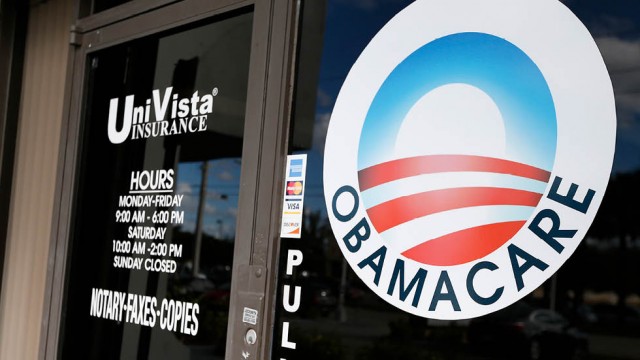
The ACA — which I now will no longer refer to as “Obamacare” — is more popular than ever with Americans.

Pew says 54 percent of Americans approve of the ACA, with 43 percent opposing it.

Republicans — and that includes the president of the United States — keep saying they’ll have a replacement plan ready to go once they repeal the ACA.

Really? Who’s seen it? I haven’t. Have you?

The GOP has eight years to craft their own version of affordable health care for Americans. Instead, they have come up empty, preferring to target the author of the ACA, former President Barack H. Obama. They detest him so much they cannot bring themselves even to refer to the ACA by its legal name, instead using the president’s last name to talk disparagingly about the plan.

Twenty million Americans have health care today who didn’t have it before the ACA was enacted in 2010. Is it perfect? Of course not. The federal government is incapable of crafting perfect legislation and then creating a perfect law.

It might need some tinkering around the edges.

Indeed, former U.S. House Speaker John Boehner — who sued the president over repeal of the ACA — this week has predicted that repeal of the act won’t happen. Congress will work to refine it, make it better, make it more “affordable” for Americans.

Oh wait! Didn’t Congress do something like this before, such as when it enacted Medicare and Social Security?

My advice to Congress is simple: Pay attention to what Americans are telling  you.

Obama and Trump: they walk on common ground

Illinois state Sen. Barack Hussein Obama told us during the 2004 Democratic National Convention while he delivered the keynote speech that “only in this country is my story possible.”

He was a self-proclaimed “skinny kid with a funny name.”

Indeed, his story was a remarkable one: a black father who was born in Kenya; a white mother from Kansas; Mom and Dad split when young Barack was a boy; Barack barely knew his father; Mom and her young son moved from Hawaii to Indonesia; Barack got a first-class education, went into public service — as a community organizer, a state senator and a U.S. senator — then got elected president of the United States.

This was not a silver-spoon existence. His election as president was a most unlikely event, given the many circumstances of his early life.

He demonstrated that “anyone” can be elected to the highest office in the nation.

Hmmm. How about that.

Donald Trump, I submit, has some commonality with his immediate predecessor. It’s not that Trump was born into a similar family situation, or that his parents struggled financially.

But think about this: In his way, Trump, too, has shown that “anyone” can be elected president of the United States.

Where’s the symmetry? It’s kind of weird, but consider some aspects of this man’s life.

He grew up the son of wealthy parents. He went to a military high school; he then graduated from an Ivy League university; he went into business when Daddy Trump staked him a few million bucks to get started; he built the business into an empire.

OK, here’s some more strange circumstance. Trump would get married three times; he would cheat on his first two wives and then would brag about it; he was host of a reality TV show; he owned a beauty pageant; he behaved like a boor at times.

Trump never ran for public office. He didn’t serve on a school board, or a city council, or a county commission. He never served in a legislative assembly.

The very first public office he ever sought was the presidency of the United States of America.

Does the president’s history suggest to you that he was well-prepared to become head of state of the greatest nation on Earth?

Me, neither.

Thus, Donald John Trump — just as Barack Hussein Obama before him — demonstrates to me that, by golly, anyone can be elected president of the United States.

‘Town hall meetings are great … ‘

I want to discuss a brief, concise and pithy message that popped into my Twitter feed this morning.

It comes from my state senator, Kel Seliger, an Amarillo Republican. It says: “Town Hall meetings are a great way to report to and interact with the public we serve. I’ve had 374. At least 37 planned for Q3 2017.”

Bear with me as I parse this statement for just a moment.

Town hall meetings have become something of a story in the past few days as members of Congress have taken their post-Presidents Day break, returned home — in many instances — to meet with their bosses.

They’ve discovered that the folks back home are none too happy with them. They don’t want their “employees,” those members of Congress, to mess with the Affordable Care Act.

Some members of Congress — such as Mac Thornberry, R-Clarendon — have decided to skip the town hall meetings altogether.

Thornberry is meeting instead with local business leaders, trying to assess the impact of federal regulations on their businesses. One of those leaders told me this week the discussion dealt with the difficulty of the rules handed down by the Obama administration and that Thornberry has given them assurances that he would work to loosen government’s regulatory reins.

Thornberry’s Amarillo meeting was a friendly event. I know … it’s shocking, shocking.

It’s fair to wonder if state Sen. Seliger would believe so strongly in the value of town hall meetings if he were forced to face down the beast that’s been awakened by the Republican-controlled Congress’s desire to repeal something that folks need.

Yes, Kel, these events “are a great to  way interact with the people we serve,” which brings me to another critical point.

These government officials do work for us, you and me. Whether we cast our votes for them or for someone else, they answer to us. We pay their salaries, provide them with their staff, pay for their public transportation, their stationery, their telecommunications devices; I almost wrote “typewriters,” then remembered that we don’t use typewriters any longer.

To that end, it is important to remind these individuals of that indisputable, irrefutable fact. The crowds at these town meetings across the land — in “red” and “blue” congressional districts alike — are doing that very thing. Good for them!

No, sir, government isn’t the same as a business

I’ve had the pleasure of visiting on three occasions with one of the smartest men in America.

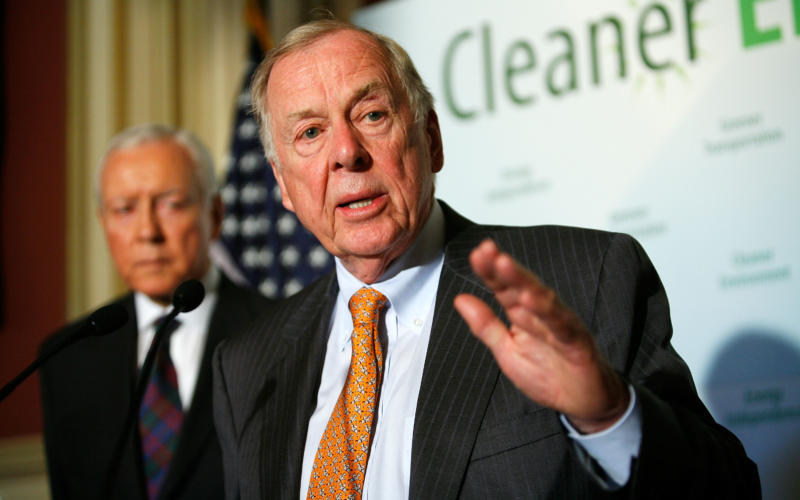
T. Boone Pickens has earned a fortune in the oil and natural gas business. He knows fossil fuels better than, well, almost anyone.

The former Amarillo resident and current fossil fuel tycoon, though, misses the mark when he says that you can run government “like a business.”

Pickens has written an essay for Texas Monthly, in which he says in part: “In the late eighties and early nineties, I considered running for governor of Texas. Now a lot has changed since that time. But one thing that hasn’t changed is the need to make sure we have a government that works.

“’Can you really run a government like a business?’ I was asked at the time. ‘Sure you can,’ I replied. ‘It’s a business to start with. Taxpayers are like stockholders, and both are entitled to a full day’s work for a full day’s pay. For a dollar spent, taxpayers ought to receive a dollar back in value.’”

Pickens is as smart a businessman as anyone you’ll ever know.

But as another tycoon is learning, government is a much different animal than a business. That tycoon, Donald J. Trump — who Pickens supported wholeheartedly for president of the United States — is learning in real time that the founders established a checks and balances system for a good reason. It is to ensure that no one branch of government runs roughshod over the other two.

The crux of Pickens’ essay was to extol the need to make the United States energy independent. He’s right about that need. He’s also got a dog in that fight, given that he owns a whole lot of fossil fuel rights in the United States and stands to benefit tremendously from pumping these fuels out of the ground.

He misses another point, though. It is that we already have made huge strides toward that goal in the past eight years. The Obama administration sought to provide incentives for investment in alternative energy sources: wind, solar, hydropower, biofuels. The big spike in oil prices in recent years has prompted much more fossil fuel exploration in this country. Add to that the fuel efficiency standards mandated on automakers and you have a sort of perfect storm that weans us from foreign oil.

Back to my main point.

Business is business. Government, though, is another creature altogether. I get that Pickens desires a business-like approach to government. However, the principles one applies to running a business do not transfer straight into the act of politicking, legislating and the making of laws.

Business executives can make decisions that stick, with no questions asked. Politicians have a different platform on which they operate. They have voters to whom they must answer. They also have colleagues who might have different points of view, a differing world view. They are as wedded to their view of the world as the businessman or woman is wedded to whatever he or she believes.

The “business” of running a government requires a certain skill set that business executives need to learn. From what I’ve seen of the businessman/president, he hasn’t yet learned it.

Perhaps someone like Boone Pickens could figure it out. If only, as he said, he had less history behind him and more in front of him.

Trump’s ‘fine-tuned machine’ needs help

I found myself somewhat amazed as I read a story in the Sunday New York Times about Donald J. Trump’s apparent inability to get his administration fully staffed.

The article talked about Trump’s insistence on loyalty. Those who say negative things about The Boss are fired; those who fall into that category are disregarded as potential new hires.

I totally understand the president’s desire to have loyal team members on board. The head of our government is entitled to insist that his lieutenants follow the policies set at the top.

Still, Trump crowed this past week about the “fine-tuned machine” that is his presidential administration. Except that he hasn’t hired a whole lot of assistant secretaries or deputy secretaries to assist his Cabinet picks.

But here is where the amazement kicks in.

Loyalty hasn’t been Trump’s No. 1 requirement in filling at least two Cabinet places.

Can you say “Ben Carson” and “Rick Perry”?

Carson is the housing secretary who ran against Trump in the 2016 Republican Party presidential primary. He and Trump clashed openly at times on the campaign trail and on debate stages across the country. I recall Dr. Carson saying some pretty harsh things about the president-to-be as his own campaign went down in flames.

But then there’s former Texas Gov. Perry, another former GOP foe. It was Gov. Perry who called Trump a “cancer on conservatism.” He’s now slated to become secretary of energy.

The Times reports, though, that Trump or his senior advisers are nixing appointments because of what individuals have said about the president. Meanwhile, all these posts remain vacant, their offices are dark and top-level administration officials are being denied the kind of help they need in carrying out Trump administration policies — whatever the hell they are.

I love this passage from the Times story: “It is not just Secretary of State Rex W. Tillerson who has no deputy secretary, much less Trump-appointed under secretaries or assistant secretaries. Neither do the heads of the Treasury Department, the Education Department or any of the other cabinet departments. Only three of 15 nominees have been named for deputy secretary positions. Defense Secretary Jim Mattis has a deputy only because he kept the one left over from President Barack Obama’s administration.”

This is a “fine-tuned machine”? It needs a healthy dose of WD-40.

Obamacare repeal effort losing steam?

Some chatter is beginning to develop that suggests efforts to repeal the Affordable Care Act might be subsiding among congressional Republicans.

A New York Times story lays out what appears to be an interesting scenario. It is that with President Barack Obama now out of power, the repeal-and-replace effort is being replaced by suggestions of tinkering around the edges of the ACA.

What gives?

It appears to me that the issue among House and Senate Republicans might have had more to do with the man who crafted the legislation than the legislation itself.

It’s not an unreasonable view.

ACA also is known as Obamacare, which has been a whipping boy for Republicans and other critics of the former president’s signature domestic policy initiative. Donald J. Trump has called for repeal and replacement of the ACA, calling the insurance plan a “disaster” for the country.

But … is it?

Twenty million Americans now have health insurance who didn’t have it before. Why? They couldn’t afford it prior to enactment of the ACA.

Then we’ve had those town hall meetings across the country. Citizens have been flooding meeting halls and shouting down members of Congress with demands to keep their hands off the ACA out of fear they would lose health insurance coverage.

There might be signs of lawmakers getting spooked by the anger they’re hearing out here among their constituents. Lawmakers also are finding out that crafting a replacement law is far more complicated than simply scrapping the old one. Go figure.

As the Times notes, Obama’s absence from the public stage now has turned attention to potential solutions. According to the Times: “But with President Barack Obama out of office, the debate over ‘Obamacare’ is becoming less about “Obama” and more about ‘care’ — greatly complicating the issue for Republican lawmakers.”

Republicans have had nearly eight years to come up with a replacement plan. However, for virtually the entire length of the Obama presidency, they’ve been hung up on repealing legislation that has the name of the man they detest.

Now they’re learning about the difficulty of replacing it.

Response to Trump … it’s about what we should expect

Donald J. Trump’s supporters are pushing back on the intense criticism coming from the portion of the country — most of which voted against him in 2016 — of the man’s presidency.

I feel the need to flash back for a moment to 2009.

Let’s remember what a leading Senate Republican said at the time about the previous president of the United States, Barack H. Obama.

Mitch McConnell then was the minority leader in the Senate and I presume he was speaking on behalf of the GOP Senate caucus when he made a straightforward and ominous declaration.

He said his “No. 1 priority” as the Senate GOP leader was to “make Barack Obama a one-term president.”

Yep. That’s what he said. He laid down his marker early in the Obama administration. He didn’t stress enactment of landmark legislation, or working with the president to rescue the economy — which was collapsing when Obama took office. He didn’t propose any reforms of his own or suggest ways Republicans and Democrats could find common ground.

He said he intended to make Obama a one-term president. That translated into “obstruct everything he intends to do.”

Hmmm. It didn’t quite work out that way. Obama got re-elected in 2012 and finished his time in the White House with soaring approval ratings in every single leading public opinion poll.

Is it right and proper for Democrats now to follow the Republicans’ lead? Mostly “no.”

I’ve noted here before that I don’t wish for the president to fail. A presidential failure means the country fails and we all pay the price for that.

However, as the new president seeks to form a government — and he still has quite a way to go — my hope is that Democrats can find some common ground with the Republican president whenever possible.

The problem, though, is that Donald Trump has begun harping about the media being the “enemy of the people” while continuing to boast about his Electoral College victory. Enough, already!

Some positive proposals ought to be formulated and presented for Congress to ponder.

Until then, my Republican friends ought to just swallow the swill they offered eight years ago when Barack Obama was elected … with, I feel compelled to note, a far more robust majority than his successor earned.

What? No outrage over pricey Trump outings?

Wait for it. The fiscal conservatives who were so outraged over President Barack Obama’s vacation tabs are going to go ballistic over the cost to taxpayers of Donald J. Trump’s jaunts to his posh Florida estate.

Do you think they’ll cry the blues over it?

Naw. Me neither.

It’s a fascinating case of selective outrage. The current president’s outings to Mar-a-Lago have cost taxpayers nearly as much in a month as the Obamas cost in an average year of Barack Obama’s presidency.

What was outrageous is now acceptable. Isn’t that the message?

I am having difficulty understanding any of this, much as I am having difficulty understanding why Trump’s behavior has been given a pass by those who continue to hang on his every inarticulate sentence.

I should note that Trump was among those who were critical of Obama’s golf outings, his family vacations and his assorted visits to whomever and wherever away from the White House.

Judicial Watch, a conservative think tank, estimated the annual cost of Obama’s travel expense at $12 million annually. Meanwhile, the Trumps’ three visits to Florida since he became president a month ago have cost about $10 million. It’s a rough equivalence, but it’s telling nevertheless.

Still, the silence from the right about the president’s pricey travel to his resort home in Florida is deafening in the extreme.

And, what the heck: I haven’t even mentioned — until this very moment — the cost of providing Secret Service protection for the first lady and the couple’s son, who are living in Trump Tower in New York City.

‘Fake news’ now gets under Trump’s skin

Does anyone else see the irony of Donald J. Trump’s bitching about “fake news”?

This is the guy who for about a half-dozen years kept alive the bogus “news” about Barack Obama’s place of birth. He questioned whether the former president was qualified to serve in the office he held for eight years.

He kept harping on the rumor that Obama was born in Kenya, the birthplace of his father. He fomented the Mother of All Fake News Stories.

Now the president — the one-time bard of the birther movement —  calls anything he considers negative to be “fake news”?

Oh, the irony is rich. Isn’t it?

It’s the temperament, man … the temperamant

I’ve been trying to determine when I’ve ever seen a president of the United States treat the media in the manner being displayed by the current one.

I cannot remember a single time. Not even during President Richard Nixon’s time in the White House.

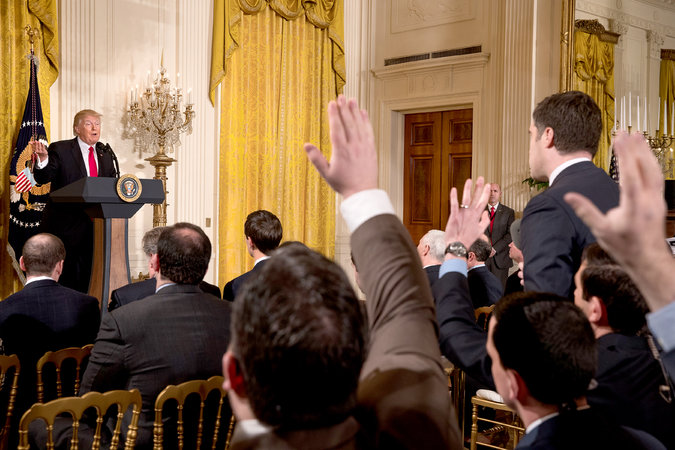
Donald Trump has shown utter contempt and disrespect for the men and women assigned to cover the White House for their various news organizations.

It manifests itself when he gets a question he dislikes. He tells reporters to “sit down, that’s enough” when they seek to elaborate on their question, to fill in a blank or two. No, the president will have none of it.

Forget for a moment that he calls them “dishonest” out loud, in public, to their face … and then expects these fellow human beings to treat him with kid gloves.

The disrespect — as I’ve witnessed it — is unlike anything I’ve ever witnessed, even from afar.

If we march back through time — starting from Barack Obama and going backward — I cannot remember a president acting the way this one does in front of the media.

There was one memorable, testy exchange in the 1970s between then-CBS News correspondent Dan Rather and President Nixon. The president was getting entangled in the Watergate scandal and Rather asked him a pointed question. Some members of the press gallery chuckled, some even clapped. Nixon asked Rather, “Are you running for something?” Rather responded, “No, Mr. President, are you?”

Presidents usually have strained relations with the media. They dislike negative coverage, as does any politician — no matter what they might say. As I’ve watched presidential/media relationships from a distance over the years, I have noticed a sometimes cool cordiality between the Big Man and the media that cover him.

What we’re getting now is open hostility and an exhibition of extremely bad manners from the guy who needs the media as least as much as they need him.

I’m trying to imagine what will occur if and/or when the crap really hits the fan at the White House. I fear the president will go berserk.

Didn’t someone mention temperament as a quality we look for in a president of the United States of America?