Tag Archives: Hillary Clinton

Comey deserves some blame, however …

hillary-and-comey-500x300

Hillary Rodham Clinton’s shocking loss to Donald J. Trump in the 2016 presidential election can be laid at the feet of many culprits.

Clinton has chosen to single out, though, the director of the FBI. James Comey’s letter to Congress just 11 days before Election Day informing lawmakers that he had more information to examine regarding those “damn e-mails” stole the Clinton campaign’s “momentum,” she said. By the time Comey said nine days later that the information wouldn’t result in any further action, the damage had been done, Clinton told campaign donors.

Let’s hold on a second.

I don’t doubt that Comey’s 11th-hour intervention had some effect on the campaign outcome. However, I believe a bit more introspection is required of the defeated candidate before we start writing the final history of what no doubt will be logged in as the strangest presidential campaign in U.S. history.

Hillary Clinton should have iced this campaign long before the Comey letter became known.

Think about a few factors here … and bear with me.

Clinton is eminently qualified to become president of the United States: former first lady, U.S. senator and secretary of state. Boom! Right there, she has a dossier that commends her for the top job. Trump is not qualified: reality TV celebrity, commercial real estate developer, thrice-married rich guy with zero public service commitment on his lengthy record in private business. The endless litany of insults and hideous proclamations that poured out of Trump’s mouth throughout the campaign are too numerous to mention. You know what he said. It didn’t matter to the Trumpkins who backed him to the hilt.

It is true that Clinton’s enemies made a huge story out of something that had been declared dead and buried — the e-mail controversy — which gave life to the corpse near the end of an insult-driven campaign.

Clinton’s qualifications, her knowledge of world affairs and her contacts around the globe made her an excellent — if not perfect — choice to lead the greatest nation on Earth. Many observers — me included — considered it possible that Clinton would roll up a historic election victory that could have eclipsed, say, the Lyndon Johnson, Richard Nixon or Ronald Reagan landslides of 1964, 1972 and 1984, respectively.

If only, though, she could have demonstrated some innate quality of authenticity that could have fired up her base. She didn’t. Clinton was unable to light the fire that burned brightly when Barack Obama ran twice successfully for the presidency.

She was a flawed candidate who brought much more to the table than she was able — or perhaps willing — to reveal.

Comey did his part, for sure, to run the Clinton campaign over the cliff. The FBI boss wasn’t the sole reason. The candidate herself deserves much –indeed most — of the blame for what transpired on Election Day.
Is a presidential pardon out of the question?

presidential-pardon

Donald J. Trump said many crazy things while campaigning successfully for the presidency of the United States.

Take, for instance, his statement to Hillary Rodham Clinton that “You’d be in jail” if he were president.

His crowds chanted the “Lock her up!” mantra continually at his rallies. Trump didn’t silence the madness from his followers.

The FBI director, James Comey, concluded in July that “no reasonable prosecutor” would bring criminal charges against Clinton over her use of a private e-mail server while she was secretary of state. Then he told Congress 11 days before the election that he found more e-mails that deserved his agency’s attention; eight days after that he said, “Nope. Nothing has changed.”

Trump continued to hammer “crooked Hillary” with accusations that she broke the law.

So, here’s a nutty idea. Would the new president issue a blanket pardon, clearing his opponent of any potential future prosecution?

Trump isn’t saying. Neither is his transition staff.

Hey, this notion has precedent. President Ford granted a pardon for his immediate predecessor,  former President Nixon, a month after Nixon quit the presidency on Aug. 9, 1974, over the Watergate scandal. No criminal charges had been brought against Nixon, yet Ford sought to prevent a further political fracturing that would occur had any prosecution had been allowed to proceed.

It turned out that the pardon opened up a whole new set of fissures.

But, the nation moved on.

Might there be such an action in our nation’s immediate future?

I wouldn’t oppose such an action. How about you?

Election result: no ‘authoritative command’

mandate-gif

My dictionary describes “mandate” thusly: an authoritative command or instruction.

That’s pretty clear, correct?

So, it’s fair to ask: Does a presidential election in which the winner captures more electoral votes than the other candidate, but who fails to win — by an apparently growing margin — the popular vote deliver a “mandate” for the victorious candidate?

I would say categorically, “no!”

Here is what we are facing with the election of Donald J. Trump as the 45th president of the United States. He won, by a comfortable margin, the electoral votes he needed. His opponent, Hillary Rodham Clinton, is continuing to pile up more actual votes than Trump.

The president-elect made some bold pledges while winning. He’s going to build a wall across our southern border, ban Muslims from entering the country, repeal Obamacare, revoke trade deals.

He said that “I alone” can fix what he believes is wrong with the country.

Does an election result that we’ve witnessed give him license to do what he promised to do?

I do not question the legitimacy of Trump’s election. He won this race fair and square. The system wasn’t “rigged” to ensure his election. Sure, some will argue that it was. Keep saying it. It’s not so.

However, I do not sense that voters delivered a “mandate” for him to make sweeping changes.

Richard Nixon was elected in 1968 with 43 percent of the vote. Bill Clinton was elected president in 1992 also with 43 percent of the vote and was re-elected four years later with 48 percent; George W. Bush was elected in 2000 with one more electoral vote than Al Gore, who won more popular votes than Bush. Neither of those men’s victories commanded “mandates” any more than Trump’s. Their victories were equally valid.

For that matter, John F. Kennedy was elected in 1960 with slightly less than 50 percent of the vote, and by a margin of fewer than 140,000 ballots. Is that a mandate … an “authoritative command”? Hardly.

Trump’s fans are continuing to crow about the mandate that their guy captured while defeating a candidate virtually every media pundit, politician and so-called “expert” knew would become the next president.

The Trumpkins need to tone down the boasts. They need to understand that effective and constructive governance is a shared responsibility, that the winners must work with those they defeat.

In this case, more than half of those who voted ended up on the losing end of this election, which adds volume to their voice.

Trump’s mandate? He needs to proceed with great care and caution.

The ‘system’ elected Donald Trump

trump-wins

The irony of the 2016 presidential election outcome is too good to let go.

Donald J. Trump bitched continually about the possibility of losing the presidential election to a “rigged electoral system.” He even threatened to forgo accepting the result if he came up on the short end of the count.

Then he won. He was elected president of the United States with a healthy Electoral College majority. It stands currently at 290 electoral votes, with more likely to come in once they declare that he won in Michigan, which is still “too close to call.”

But wait! Hillary Rodham Clinton has collected nearly a million more actual votes than Trump. That number is likely to increase once they finish counting all the scattered ballots … and there appear to be many more to be counted in California.

So …

As someone has pointed out already on social media, the people voted for Hillary, but the system elected Trump.

And the world thought the GOP was in trouble

hillary

It’s only been a few days since Americans elected a new president.

Consider the distance traveled in just a short span of time. Prior to that election, the political world was wondering: How in the world is the Republican Party going to reshape itself?

Then they counted the ballots and we found out that Donald J. Trump, the Republican, had won the election. It wasn’t Hillary Rodham Clinton, the Democrat.

Now the tables are turned and it’s the Democratic Party that faces the question: How does it recover?

Let’s start with the obvious: The Democrats’ future does not rest with anyone with the last name of Clinton.

http://www.msn.com/en-us/news/politics/what%e2%80%99s-next-for-democrats-for-starters-a-battle-for-the-soul-of-the-party/ar-AAkd0Qv?li=BBnbcA1

Hillary Clinton had her chance. She was seen on the cusp of making history. Then it came apart, thanks in large measure to an FBI director who decided 11 days away from the election to raise more questions about an issue we all thought had been settled, that the feds didn’t have any grounds to prosecute Clinton over those “damn e-mails.”

She lost. The election is history. Trump is preparing to take the reins of government. The Republican Party had nominated someone with zero public service experience. Now he’s about to embark on the steepest climb in U.S. political history as he seeks to learn something about which he knows nothing: the art of governance.

Meanwhile, Democrats are left to ponder where they go from here.

Those of out us here in the peanut gallery — and that would include yours truly — have no clue at this moment how the party collects itself.

Does the party leadership reflect the changing demographic? Consider this from the Washington Post: “The Democratic establishment had their chance with this election,” said Stephanie Taylor, co-founder of the Progressive Change Campaign Committee. “It’s time for new leadership of the Democratic Party — younger, more diverse and more ideological — that is hungry to do things differently, like leading a movement instead of dragging people to the polls.”

Leading a movement? Hmm. Interesting. Trump started calling his effort a “movement” as well. He won without the kind of “ground game” organization that Democrats boasted would carry Clinton across the finish line first.

They say that “elections have consequences.” Boy, howdy, do they ever! What looked like a sure thing for Democrats now has them — not Republicans — searching for answers.

Reaction to Trump … merely a continuation

nc_signshocks_141119

Just so we’re clear, I dislike the street protests that have occurred since the election of Donald J. Trump as the 45th president of the United States.

It ain’t my style. Got it? OK.

But before the nation’s Trumpkins get all wadded up over the anger being expressed by those who voted for Hillary Clinton, I feel the need to remind them of what transpired after the election of the 44th president, Barack H. Obama, in 2008.

The anger then perhaps was even more palpable, more demonstrative and more, um, hateful than what we’re seeing now. (See picture attached to this post.)

May I remind everyone about the signage that portrayed the then-new president as some sort of alien? Or suggested he was a terrorist sympathizer? Or that he was not a legitimately elected individual, that he didn’t qualify for the office because he was born in some far-off foreign place?

Who was one of the leaders of that slanderous endeavor? Oh, wait! Donald Trump!

I hope the Trumpkins of this nation spare us soon the “Get over it” mantra.

There’s a lot of anger out there. Trump himself tapped into it while winning this election. Much of the anger is misplaced and it doesn’t do any good.

It’s real, though.

It also is a carryover from two previous elections.

And we’re finding out that, by golly, the other shoe does fit.

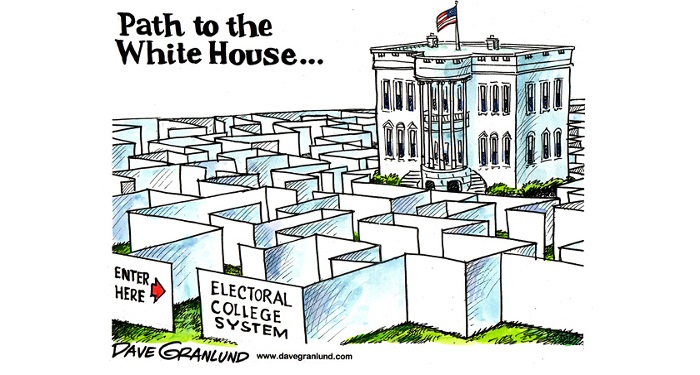
Now … about the Electoral College

electoralcollege

Election Night 2016 proved to be one for the books.

Donald J. Trump got elected president of the United States despite being outvoted by Hillary Rodham Clinton.

But wait! He won more electoral votes.

They’re still counting ballots and it appears that Clinton’s vote lead will expand before they’re all done.

Then came the question from one of the folks attending an election watch party at some friends’ house: Is the Electoral College in the U.S. Constitution?

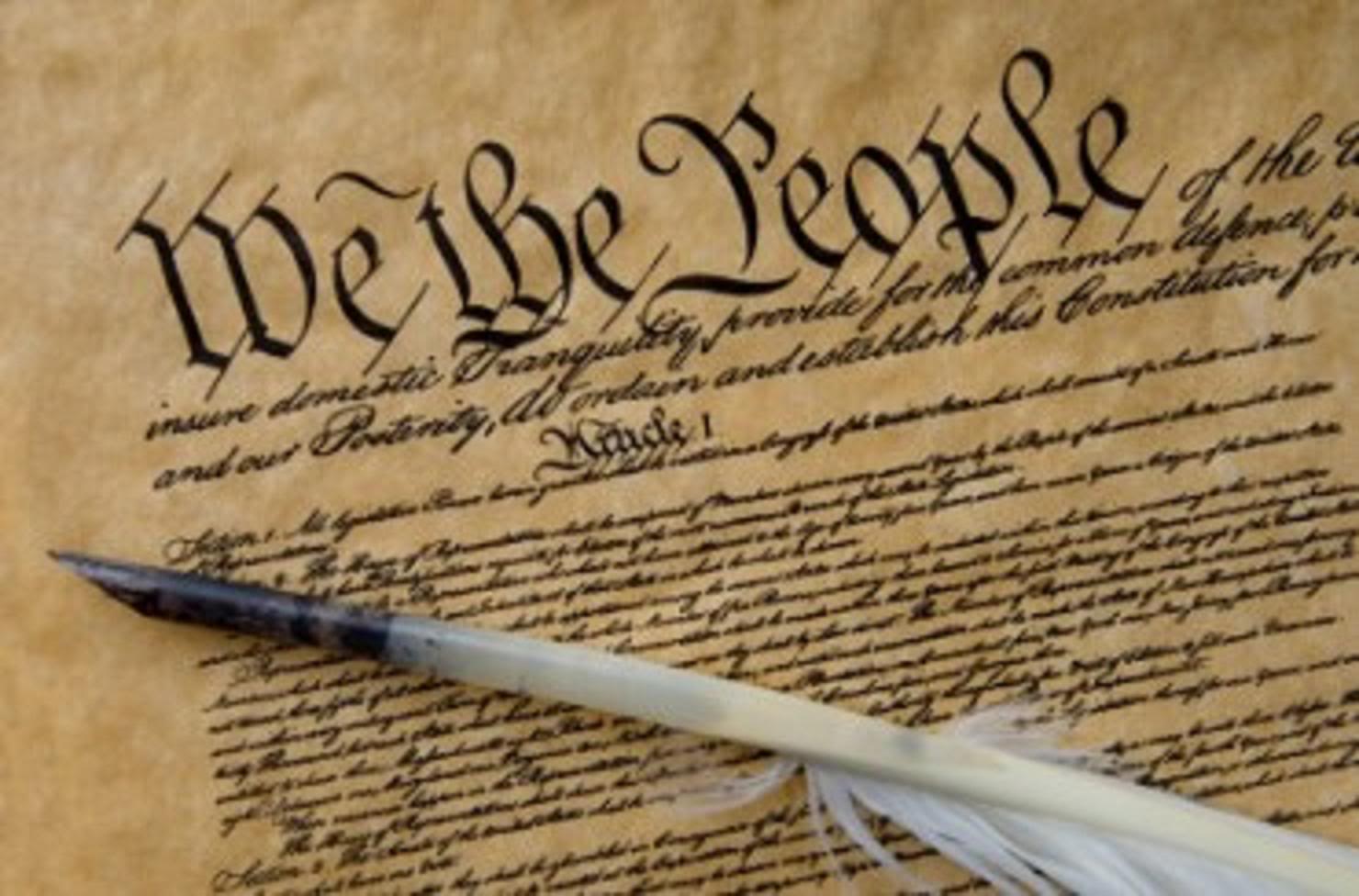
Yes it is. Article II lays out the rules for the Electoral College. You know how it goes: We aren’t voting directly for president; we’re voting for electors who then meet in December to cast their votes for president in accordance — supposedly — with the majority of voters from their respective states.

I’ve found myself defending the Electoral College to people abroad who cannot understand how it works, or why the founders created the system. In November 2000, for example, my wife and I were in Greece, the cradle of western civilization and the birthplace of democracy. The Greeks are quite sophisticated about these things. However, they couldn’t quite grasp the idea of one candidate — Al Gore — getting more votes than George W. Bush, but losing the election. The 2000 presidential election was still in doubt while my wife and I were touring Greece. I defended the Electoral College as best I could.

Sixteen years later, we’ve had another circumstance with the “winner” getting fewer votes than the “loser.”

It’s the fifth time in our nation’s history where this has occurred. Three of them occurred in the 19th century; two of them have occurred within just the first two decades of the 21st century.

I’m not yet ready to jump on climb aboard the dump-the-Electoral College bandwagon. I have to say, though, that that I am beginning to grow less enamored of the archaic system that was devised by men who — in their time — didn’t grant rights of full citizenship to women or to blacks. Women didn’t get the right to vote until 1920, for crying out loud and it took landmark civil rights legislation in the 1960s to guarantee full citizenship rights to African-Americans.

The gap in time — just 16 years — between the last two elections in which one candidate wins the “popular vote” but loses a presidential election is giving me serious pause about the wisdom of a system that hasn’t changed with the nation.

Still waiting for the mea culpa on ‘rigged election’

vote1

Donald J. Trump leveled some pretty hideous accusations at local election officials throughout the country.

The president-elect said while campaigning for the highest office in the land that the election would be “rigged” against him … if he lost.

He, quite naturally, never uttered a peep about such corruption in the event he would win.

Well, he did. He won it fair and square.

Have we heard a sound from the winner about the “rigged” election process? Have we heard him say a word about how at times campaign rhetoric gets a bit overheated and that, well, he was trying to make some kind of political point?

Remember how Trump sought to excuse his anti-woman comments as mere “entertainment,” that he really had “great respect” for women and that he didn’t really mean what he said about how he judged women on their appearance?

He’s capable of taking back these statements, yes?

Trump ought to do so in this case.

http://www.beaumontenterprise.com/opinions/editorials/article/EDITORIAL-Trump-s-triumph-proves-system-is-not-10605289.php

He’s likely to finish with more than 300 electoral votes. Hillary Rodham Clinton is likely to finish with more actual votes than Trump.

The system isn’t “rigged.” It never has been. The system has been run at the local level by dedicated public servants committed to ensuring the integrity of this cherished right of citizenship.

The man who benefited most from that system, the president-elect, owes them all an apology.

Transitions should be peaceful … always

obama-trump-meeting-at-wh-jpg

Barack Obama and Donald J. Trump are giving Americans a fascinating civics lesson.

A bitter, divisive, ruthless and occasionally slanderous presidential has come to an end. The president is about two months out from the end of his two terms in office. The president-elect — one of the principals in the aforementioned campaign — is about to take the reins of the only public office he’s ever sought.

The two men met for 90 minutes in the Oval Office on Thursday.

They sat before the media and spoke of the transition that has begun. No outward sign of the acrimony that punctuated this campaign. No apparent hard feelings over the amazingly nasty things these men said about each other.

As Trump noted, they had never met face to face — until Thursday.

Now, to be sure, the backdrop isn’t entirely peaceful. Demonstrators have been marching in major-city streets for the past few days protesting Trump’s election. They vow to keep it up. Nor will the outward peacefulness at the White House dissuade others from making angry statements about the winner of this campaign, or about the candidate who lost, Hillary Rodham Clinton.

That shouldn’t cast too large or too dark a pall over the formalities that are occurring at and/or near the center of power.

The president is vowing a smooth transition; indeed, he wants to model the hand-off he got from President Bush and his team in 2009.

The peaceful transition of power is a marvelous aspect of our system of government. It becomes especially noteworthy when the presidents are of differing political parties.

In this particular instance, the transition should become a virtual miracle given the fiery rhetoric that was exchanged over the course of the past 18 months. Indeed, in the case of Trump, he’s been at the forefront of one of the biggest political lies of the past century: the one that suggested that President Obama wasn’t a legitimate American citizen.

None of us knows what the men said to each other in private. I would love to know how that conversation went.

However, we’re entitled to hear what they say in public. I am going to retain my faith that the tradition of peaceful political transition at the highest level of power in the United States will continue.

It’s all part of what enables the United States of America to remain the greatest nation on Earth.

Let’s not despair a Trump victory

(c) 2006 Bonnie Jacobs

Social media are fluttering all over the place with despair.

Those who supported Hillary Rodham Clinton’s bid for the U.S. presidency are predicting gloomy days, months and years ahead as Donald J. Trump prepares to become the next president.

I make no apologies for my own loyalties. I preferred Clinton to win, too.

I just want to put a little perspective on what I believe lies ahead for the nation … and the new president.

Trump says he intends to do a lot of things: He will “build a wall,” he’ll revoke the Affordable Care Act, he’ll ban Muslims from entering this country, he’ll revoke trade deals.

Here’s this little impediment to all those things he intends to do: the United States Congress.

The founders got it exactly right when they built a three-tiered system of government: the executive, legislative and judicial branches.

As a friend and mentor once reminded me: A president proposes, Congress disposes.

So, there you have it. The president can declare his intention to do all kinds of things, but Congress stands in the way of all those bold — and occasionally nutty — intentions.

Factor in, too, that Trump — who has zero military or government experience — has damn few friends in Congress. He has built no relationships on Capitol Hill. The Republican “establishment” pols who run both congressional chambers dislike Trump, who spent a great deal of his political capital trashing the work they do; of course, it’s understood that congressional Democrats despise the president-elect.

Does anyone seriously believe the Congress is going to give the new president a free pass on anything, let alone some of the more controversial — and ridiculous — ideas he has pitched to American voters?

You also ought to consider that members of Congress are going to watch Trump carefully to ensure he doesn’t stray too far off the constitutional trail.

Trump is going to learn in very short order that the Constitution grants the president limited authority. He will be unable to the things he wants to do unilaterally. What about executive authority? Well, he’d better take care with how he uses that power as well.

I continue to have faith in the system of government that our founders created. These were wise men who, I’ll concede, didn’t grant a perfect government document. They didn’t give women the right to vote, nor did they grant equal rights to our nation’s black citizens; those reforms came later.

However, they did place plenty of power in the legislative and judicial branches of government, which they can use to blunt an executive branch that seeks to reach beyond its grasp.

Donald Trump campaigned for the presidency as if he didn’t quite understand all of that.

He will learn it quickly.