Tag Archives: George W. Bush

It’s do or die for ‘Jeb!’

Jeb  Bush

Erica Greider, writing for Texas Monthly’s blog, offers an interesting analysis of the stakes for today’s South Carolina Republican presidential primary.

She thinks Sen. Marco Rubio has the most to gain — or lose — from the results.

But she inserted this into her blog:

“The prevailing wisdom is that the alternative with the most at stake tomorrow is Jeb Bush. More specifically, there’s a sense that if he can’t manage a strong third-place finish, at least—despite all his advantages at the outset of the race, a strong performance in the most recent Republican debate, and being joined by his brother, former president George W. Bush, on the trail—that it’s time to pack it in.”

Here’s the rest of what she writes.

I’m going to go with the “prevailing wisdom,” which is that the biggest loser from the South Carolina primary could be John Ellis Bush, aka Jeb!

His brother, W, came out of the shadows to campaign actively for his  younger sibling. The 43rd president — who’d made a vow, like their father had done — to stay out of the political arena once he left office. George W. Bush could remain silent no longer, as Donald J. Trump continued blustering about how W and his bunch had “lied” their way into starting the Iraq War.

Jeb figured that Brother W’s continuing popularity in South Carolina could propel him a strong finish when the votes are counted.

I am not privy to the details or the fine print, but it’s looking as though Jeb Bush might not make the grade.

I’ll just offer this bit of personal privilege. I did not vote for W any of the four times I had the chance: his two elections for Texas governor or his two elections for president of the United States. I do, though, like him personally. I’ve had the privilege of visiting twice with him extensively while he was governor — and once briefly in 1988, before he won his first term as Texas governor.

He’s an engaging and personable fellow.

It was my hope that some of that would rub off on Jeb. It apparently hasn’t. Jeb has been caught in that anti-establishment buzzsaw being wielded by he likes of Trump and — oddly enough — U.S. Sen. Ted Cruz.

I will not dare to predict the outcome of the South Carolina vote today. Jeb Bush had better hope he finishes much nearer to the top of the heap than the bottom of it.

At this moment, I am pessimistic.


It’s wrong now … and was wrong then

Sen. Chuck Schumer, D-N.Y., expresses his dismay at Russian Vladimir Putin leader granting asylum to American secrets leaker Edward Snowden, at a news conference at the Capitol in Washington, Thursday, Aug. 1, 2013. Defying the United States, Russia granted Edward Snowden temporary asylum on Thursday, allowing the National Security Agency leaker to slip out of the Moscow airport where he has been holed up for weeks in hopes of evading espionage charges back home. (AP Photo/J. Scott Applewhite)

I believe it was that great fictional Native American sidekick — Tonto — who said to the Lone Ranger, “Two wrongs don’t make a right.”

Thus, it amuses me when I hear critics of this blog and others take note of Democratic U.S. Sen. Chuck Schumer’s declaration in 2007 that the Senate shouldn’t approve any of President Bush’s Supreme Court appointments.

They bring that up to — more or less — justify a statement by Republican U.S. Sen. Mitch McConnell to do the same thing regarding the vacancy on the U.S. Supreme Court.

If Schumer can make a wrongheaded declaration then it’s OK for our guy to do it, they seem to suggest.

Schumer was wrong then and McConnell is wrong now.

Neither man has distinguished himself on this matter of constitutional authority and presidential prerogative.

So, Schumer’s assertion in 2007 got past me. He absolutely was wrong to say what he said. The U.S. Constitution gives presidents the authority to make appointments to the federal bench and I’ve long given deference to the presidents’ prerogative on these issues. If the president nominates a qualified individual to these posts, then the Senate should grant the appointee a fair hearing — and then vote.

George W. Bush was re-elected in 2004 with voters knowing he would appoint conservative judges to the federal courts. His final Supreme Court appointment came in 2006 when he selected Samuel Alito. Thus, Schumer’s ill-advised admonition a year later became a moot point.

It doesn’t give Senate Majority Leader McConnell any license to erect barriers to the current president doing what he was re-elected to do.


Is this the year the U.S. gets hit?

ISIL%20fighters

Well before the sun set on Sept. 11, 2001, defense analysts and terror experts were almost unanimous in their assessment of our nation’s future.

If was not a matter of “if” we would be hit again, but “when.”

The head of the Defense Intelligence Agency, Lt. Gen. Vincent Stewart, told the U.S. Senate Armed Services Committee, that he believes this is the year it will happen.

The Islamic State, he said, is going to continue to hit Europe and well might plan a coordinated attack on our shores.

When will it occur? The general didn’t say. He cannot know.

In reality, though, he didn’t provide a serious scoop on what’s been understood since the terror attacks of 9/11.

That attack on the World Trade Center and the Pentagon was so daring, so audacious, so brilliantly executed that it prompted President Bush and his national security team to create an entirely new Cabinet agency assigned to protect us. The Department of Homeland Security has been on the job ever since.

Now, the question always has been: Will this country be able to protect itself forever against the next terror attack? There can be zero guarantee against another attack that could rival the horror that al-Qaida brought to our shores on the beautiful Tuesday morning in New York and Washington.

But then again, had we been fully alert to the dangers that always have lurked, perhaps we shouldn’t have been so totally shocked at what transpired that day.

The Bush administration — once it gathered itself after the horror of that day — managed to keep us safe for the remainder of its time in office. The Obama administration has kept up the fight and has continued to keep the terrorists at bay.

But Gen. Stewart’s prediction of another terror attack — this time by the Islamic State — shouldn’t be seen as a big-time news flash.

Al-Qaida managed to get our guard up. Our task always has been to ensure we stay on the highest alert possible.

The enemy, though, is as cunning as they come. Many of us will not be surprised when they strike again.


Lee Atwater’s home state: dirty tricks thrive there

maxresdefault

Lee Atwater has been dead for some time, but his legacy lives on.

The late Republican Party operative — a South Carolina native — was known as an aggressive campaigner. He was so aggressive, in fact, that many observers called him “dirty,” “mean-spirited,” “cheap.”

The GOP presidential dog-and-pony show is heading into the Palmetto State, where it appears to be quite likely that the nastiness that has punctuated the party primary campaign just might get whole lot nastier.

Oh, I remember some of the recent history relating to South Carolina.

Dirty tricks await the candidates

Perhaps the most memorable hatchet job occurred in 2000, when U.S. Sen. John McCain, fresh off his Republican primary victory in New Hampshire, ran into a dirty-trick buzzsaw.

Someone floated a bogus rumor that Cindy McCain — wife of the former Vietnam prisoner of war — had a “drug problem.” Then came another falsehood, that Sen. McCain had fathered an African-American child out of wedlock.

McCain blamed the dirty tricks on Texas Gov. George W. Bush’s campaign. It rankled McCain so badly that at one GOP debate that year, McCain told Bush to “take your hand off” the senator’s arm.

Lee Atwater was known as a tough-as-nails operative. He died of cancer in 1991. Wherever he is today, I’m quite certain he’d wish he could return to take part in what is likely to become a bloodbath.

It’s the South Carolina way.

So much for southern gentility.


Rove: Trump as GOP nominee would be disastrous

karl-rove1

Karl Rove came to Amarillo to hawk a book and to speak to an organization called the Senate 31 Club, which is run by the office of state Sen. Kel Seliger, R-Amarillo.

Seliger inherited the club from his predecessor, the late Teel Bivins.

And today, he brought in the man known around the country as “Bush’s Brain,” as Rove helped elect George W. Bush twice as Texas governor and twice more as president of the United States.

Rove is considered one of the smarter political operatives around.

His view of the crazy race for the 2016 Republican presidential nomination?

He got right to the point today during a luncheon in the packed main dining room at the Amarillo Country Club in which he talked about his latest book, “The Triumph of William McKinley.” Seliger asked Rove to offer a comment on the current campaign

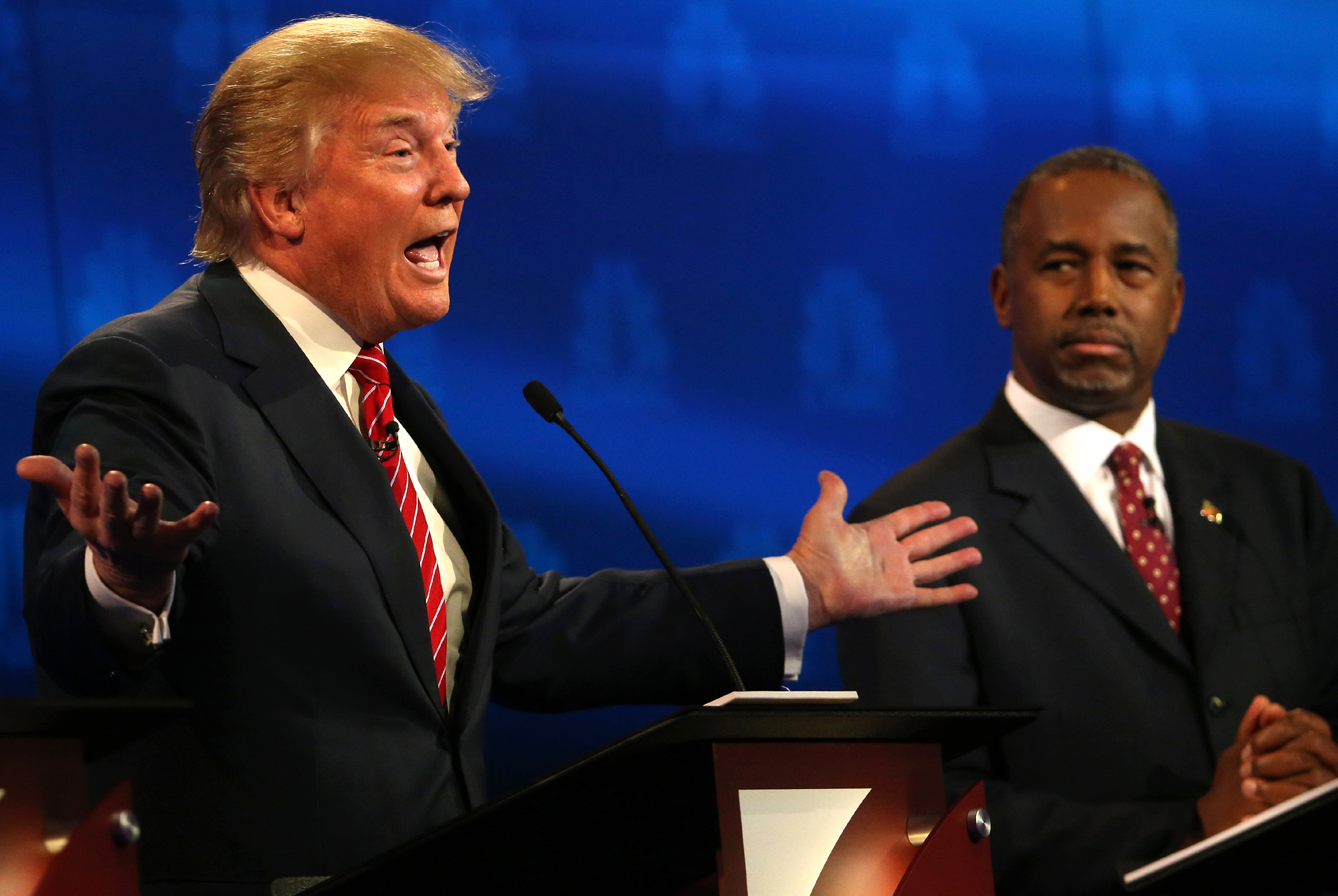
“If Donald Trump wins the nomination his chances of being elected president are slim and none,” Rove said.

The real estate mogul/reality TV star’s poll negatives are the highest among any of the remaining GOP candidates, Rove said. He continues to trail the still-presumed Democratic frontrunner, Hillary Clinton, in every poll taken.

I found it interesting that Rove would bring up Trump’s four bankruptcy filings, suggesting — to me, at least — that they will be factor that kills Trump’s chances of ever attaining the Oval Office.

The Democrats, Rove said, “will find every paint contractor, lawn care person, anyone who got screwed in these bankruptcies and put them on TV.”

If it’s Trump leading the Republican ticket this fall, the party stands a good chance of losing control of the Senate. The key race there? Florida, said Rove, which will have an open Senate seat because Marco Rubio — who’s also running for president — isn’t seeking re-election.

“If we don’t win Florida, we don’t keep the Senate,” Rove said.

Rove didn’t get into why Trump continues to lead the pack. He didn’t explain the candidate’s curious appeal to the “base” of a once-great political party.

I’m continuing to wonder whether that curious thing called “political gravity” will pull Trump back to Earth. However, given what’s transpired so far in this wild-and-crazy campaign, I’m not willing to wager that the Republican Party that many of us remember will be able to gather its wits in time to stop Donald J. Trump.

Rubio makes sense on immigration

Senator Marco Rubio of Florida speaks at the Conservative Political Action Conference (CPAC) at National Harbor, Maryland March 14, 2013. Two senators seen as possible candidates for the 2016 presidential election will address a conservative conference where Republicans will try to regroup on Thursday after their bruising election loss last year. REUTERS/Kevin Lamarque (UNITED STATES - Tags: POLITICS) - RTR3EZQO

Lo and behold . . . I heard Republican presidential candidate Marco Rubio make sense on one element of immigration policy.

When the young U.S. senator was serving in the Florida legislature, he backed a provision that would allow the children of illegal immigrants to be granted in-state tuition privileges.

Rubio today reaffirmed that view in an interview with ABC News’s George Stephanopoulos.

You go, Marco!

He was careful — naturally, given the nature of the GOP voter base — to say he doesn’t favor “amnesty” for those who are here illegally. He did say, though, that children who were brought here when they were young, say 5 years of age, and who grew up speaking English and whose only outward loyalty is to the United States of America deserve to be pay in-state tuition at public colleges and universities.

Does that sound familiar? It should. Two former Texas governors — Republicans George W. Bush and Rick Perry — stood tall on the same principle. Perry, though, was pilloried during the 2012 GOP primary campaign for standing on that notion; the TEA Party wing of the Republican Party would have none of it.

I’m no fan of young Marco. However, I was heartened this morning to hear him speak with a sense of humanity and compassion that has been lacking among many in the still-large field of GOP presidential candidates.

Donald J. Trump gets high-fives and hosannas from the base over his plan to round up all 11 million illegal immigrants and toss ’em out of the country.

Meanwhile, at least one of his Republican presidential candidate colleagues demonstrates that the Grand Old Party isn’t speaking with one voice on a critical national issue.


Still pulling for Jeb

Jeb  Bush

John Ellis Bush, aka Jeb, is trying to goad Donald Trump into making more stupid pronouncements.

To be honest, I might be one of the few Americans, let alone non-Republicans, pulling for Jeb to get Trump’s goat.

Jeb wants Trump one-on-one, in a debate. Just the two of ’em. Man to man.

It won’t happen, of course, given federal election rules that prohibit the exclusion of other declared presidential candidates.

Jeb, though, is trying to inject some of the energy that Trump has said is missing from his campaign.

Why am I pulling for Jeb?

OK, a couple of reasons.

One is that I long have admired the man’s family and its history of public service to the country. I point specifically to his grandfather, the late Sen. Prescott Bush, and — of course — his dad, the 41st president of the United States, George H.W. Bush.

Daddy Bush — known as Poppy to his family — in my view was the most qualified man ever to serve as president. He brought a stellar public service resume to the White House.

The second reason is that while I didn’t vote for older brother George W. for any public office — as Texas governor or as president — I happen to like him personally. I’ve met the 43rd president on three occasions: once on an elevator in New Orleans during the 1988 GOP presidential convention; in a lengthy 1995 interview in Austin not many months after he became governor; and in 1998 when I interviewed him in Amarillo while he was seeking re-election as governor.

My face-to-face contact with George W. Bush persuaded me beyond a doubt that he got a  bum rap from those who accused him being a dim bulb. Bush proved to be an amazingly quick study as governor.

Will the younger Bush be able to energize his moribund campaign? I hope he does and I also hope he’s able to knock Donald J. Trump down a peg or four along the way.

I am not going to predict it will happen, but my version of hope does spring eternal.


American Muslims need to stand up for their nation

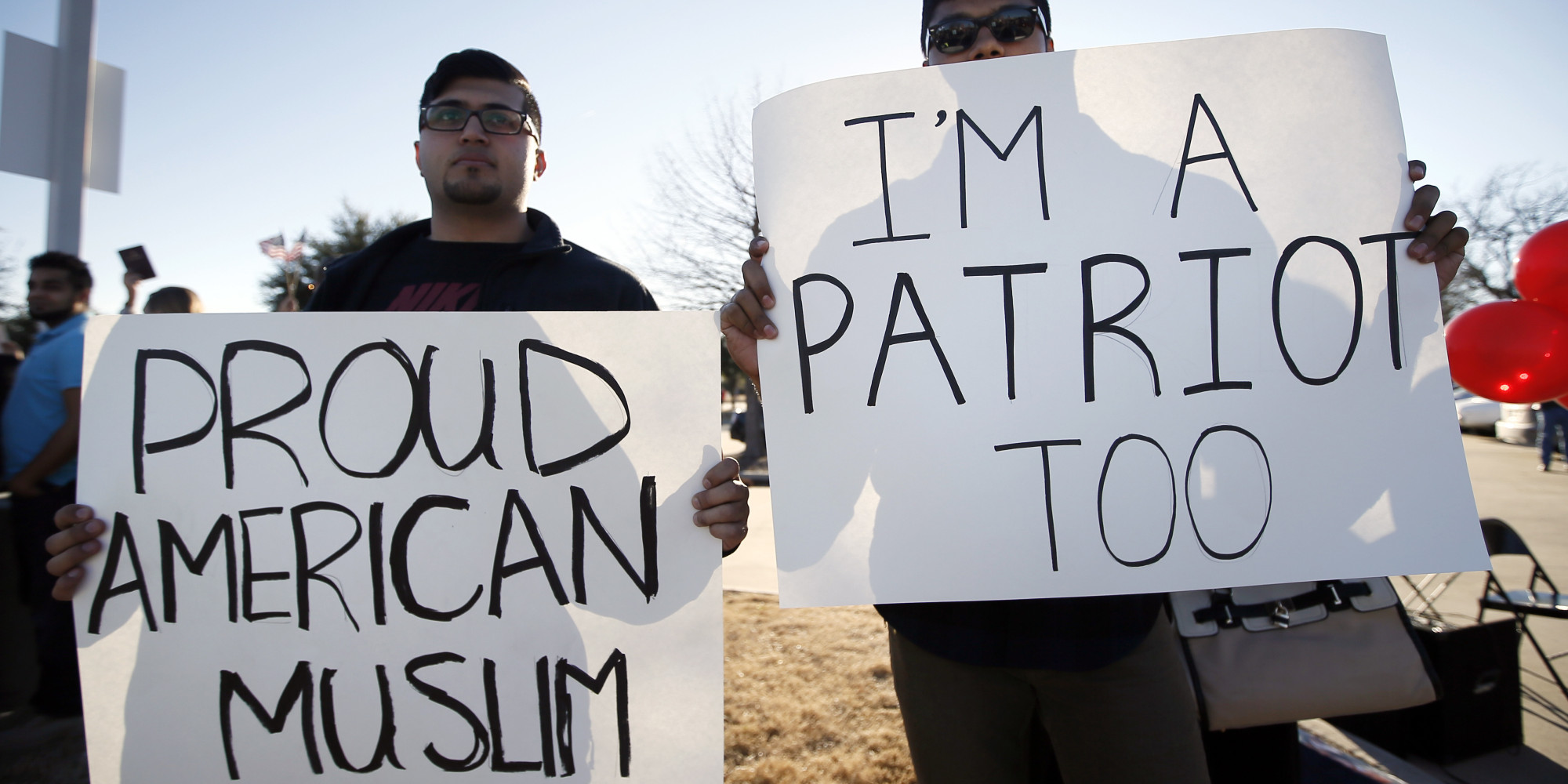
Sharjeel Hassan, left, and Yusuf  Alwar,, both of Richardson, Texas, holds signs as they stand with supporters outside the Curtis Culwell Center, Saturday, Jan. 17, 2015, in Garland, Texas. A muslim conference against terror and hate was scheduled at the event center. (AP Photo/Tony Gutierrez)

I keep waiting to hear it.

The chants of “USA, USA, USA!”

Those chants need not come from large crowds at football games, necessarily. Instead, I am waiting to hear those chants coming from American Muslims who are standing up for their country.

I get that Muslims are upset at mosques being defaced. I have great sympathy for those who feel the pain of discrimination because of their faith. I share their angst at calls to ban all Muslims from entering the United States. I also share their disgust with presidential candidates saying that Muslims shouldn’t run for — let alone serve as — president of the United States.

However, there’s an element missing from the outrage that Muslims have been expressing in regard to the violence that’s erupting all around the world — including here in the United States.

President Bush said we are not at war with Islam. President Obama has reiterated it. We’re at war with extremists who have perverted a great religion. The extremists are killing more Muslims than any other religious group in the world.

They also are attacking nations, including this one.

I want to hear American Muslims shouting out their love of country as loudly as they do for their faith.


Why is cutting carbon emissions so bad?

banner_emissions

President Barack Obama is singing high praise for the worldwide climate deal brokered in Paris this past week.

No surprise there, right? The president believes, as many of us out here do — me included — that human activity has contributed to the worsening of our worldwide environment.

However, you know what? I’m not going to debate that point. Skeptics of the climate change crisis have their minds made up; those of us on the other side have made up our minds, too.

So, we’ll go on with the rest of the discussion.

The agreement calls for reducing carbon emissions, those pollutants that come from fossil fuels. They increase carbon dioxide levels in the atmosphere and create a gradual warming of the atmosphere.

Beyond that, though, why is it a bad thing — as some interested parties contend — to cut those fossil fuel emissions.

This deal, they say, is “no better” than the Kyoto Protocol worked out during the Clinton administration in 1997. It never was ratified by Congress. President George W. Bush, Bill Clinton’s successor, said the agreement would cost American jobs and would give emerging powers — such as China and India — a free pass.

I keep coming back to the notion, though, that reductions in these emissions — which are indisputably harmful to Earth’s ecosystem — will produce a net positive impact on the future of the planet.

We can conserve those fossil fuels, which are a finite resource. We can invest in alternative energy sources, such as wind, solar and — yes! — nuclear power.

As Politico reports as well, there was some water down of the language in the agreement, which initially stipulated that developed nations “shall” cut those greenhouse gases; Secretary of State John Kerry got the conferees to change that language to “should” with the hope it would stand a better chance of being ratified by the Republican-controlled Congress.

http://www.politico.com/story/2015/12/paris-climate-talks-tic-toc-216721

Shall or should? Whatever.

The goal remains the same: to reduce greenhouse gases that harm the only planet we have.

How can that be a bad thing?


Always a political back story

refugees

I am a strong believer in what the Founding Fathers intended by creating an independent federal judiciary.

They gave the president the authority to nominate federal judges for lifetime jobs, pending approval by the U.S. Senate. The intent, as I’ve always understood it, was to de-politicize the judicial branch of government.

It works.

Judge blocks order

Then again, politics always seems to be part of the subplot of every federal judicial decision.

U.S. District Judge David Godbey, for example, today struck down Texas Attorney General Ken Paxton’s ban on Syrian refugees coming to Texas. Paxton cited security concerns in asking for the temporary restraining order. Godbey ruled within hours of the request that Paxton had failed to demonstrate that the refugees posed any kind of threat.

Godbey wrote, according to the Texas Tribune: “The Court finds that the evidence before it is largely speculative hearsay,” the judge wrote. “The [state] has failed to show by competent evidence that any terrorists actually have infiltrated the refugee program, much less that these particular refugees are terrorists intent on causing harm.”

So, it’s fair to ask: Is this judge sitting on the federal bench because a liberal Democratic president, Barack Obama, appointed him? No. He was selected in 2003 by Republican President George W. Bush to serve the Northern District of Texas. Paxton, let’s point out, is a Republican as well.

Does it really matter, then, whether a judge gets picked by a Democrat or a Republican? It shouldn’t. Judges take an oath to uphold the Constitution without regard to political favor. They do, remember, have a lifetime job.

But the politics of this particular issue — the refugee crisis and the political debate swirling all over it — causes one to look carefully at who’s making these decisions.

Judge Godbey appears to have put the law above his political leanings.