Tag Archives: Richard Nixon

It wasn’t just a ‘war on drugs’

d4b7e386cc6a496090a245c74d94bd6c

I’m still trying to process this bit of news from our nation’s past.

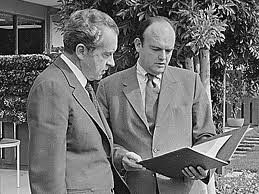
John Ehrlichmann, one of President Nixon’s chief aides, reportedly told an author that the president’s “war on drugs” had a more insidious meaning within the walls of the West Wing.

Erhlichmann supposedly said the drug war was meant as a way to shore up Nixon’s “southern strategy” that curried favor with white voters while targeting African-Americans and hippies who were opposed to the Vietnam War in particular and to Richard Nixon’s presidency in general.

A lot of Americans remember Ehrlichmann. He was the president’s chief domestic adviser and a leading figure in the cover-up of the Watergate scandal that eventually brought down the Nixon presidency.

He died in 1999, so he isn’t around to defend himself against the remarks that are just now being published in Harper’s magazine.

A part of me believes that President Nixon was quite capable of concocting such a nefarious strategy. Another part of me wishes and hopes it isn’t true.

Ehrlichmann’s five children have said the statements attributed to their father are false. They stand behind his character and say they weren’t raised that way.

According to reporter Dan Baum, writing in Harper’s, Erhlichmann said: “You understand what I’m saying? We knew we couldn’t make it illegal to be either against the war or black, but by getting the public to associate the hippies with marijuana and blacks with heroin. And then criminalizing both heavily, we could disrupt those communities. We could arrest their leaders. raid their homes, break up their meetings, and vilify them night after night on the evening news. Did we know we were lying about the drugs? Of course we did.”

The war on drugs is still being waged. It produced mandatory sentencing policies that federal judges have to follow. It was supposed to get tough on those who produce, buy, sell and consume the hard drugs such as heroin and various hallucinogens.

Has it worked? Well, drug use hasn’t abated in the nearly 50 years since the feds declared war on it. Moreover, I’ve seen the studies that suggest that African-Americans have been imprisoned at far greater rates than the rest of the U.S. population.

As for the motives behind the declaration in the first place, it saddens me beyond belief — if they are true.

The late president’s views on minorities, anti-war protesters and anyone who didn’t support his foreign and domestic policies are well-known to historians. They have been revealed in those infamous recordings of the president speaking to his top aides.

And what about John Erhlichmann’s personal motives? Did he buy into a hideous effort to fight back against the president’s enemies?

My own hunch is that he was loyal to the boss — Richard Nixon. When the boss told him to do something, then he followed orders. Does that make Erhlicmann a racist? We can’t ask him directly, so we’re left to speculate.

This isn’t the first time Americans have heard from officials seeking to atone for their mistakes. The late secretary of defense, Robert McNamara, revealed in the mid-1990s that he thought the Vietnam War was doomed to failure, even as he counseled two presidents to keep escalating the fight.

If only Ehrlichmann was around to clear the air about these revelations …

Many of us who are, sadly, are left to think the worst.

Oh, for the old days of presidential debates

Nixon-Kennedy-debate_1960

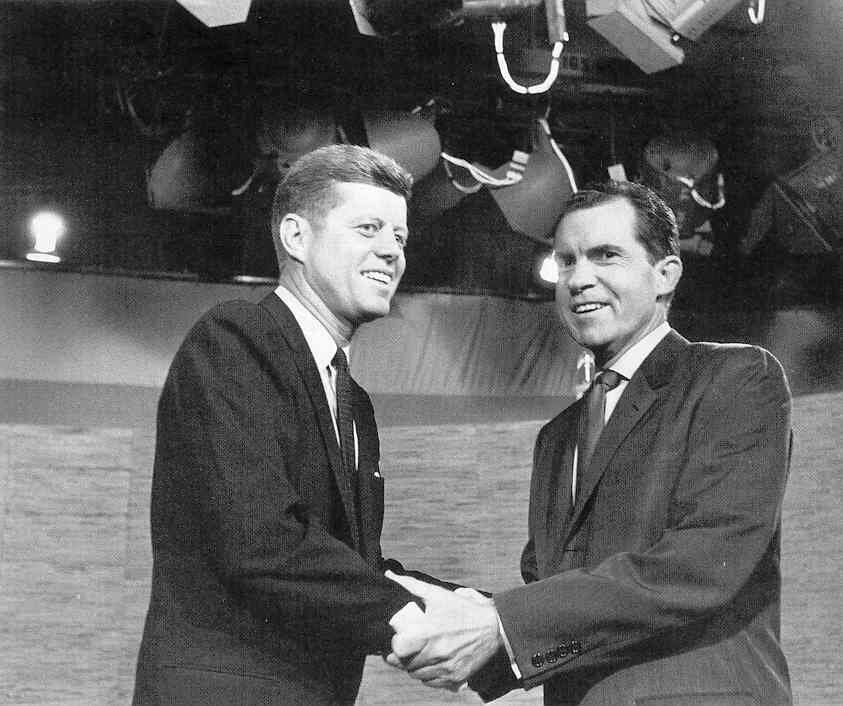
CNN broadcast a special the other night on the landmark debate series between two men vying for the presidency of the United States of America.

Democratic U.S. Sen. John Kennedy faced Republican Vice President Richard Nixon.

The special talked at length about the men’s preparation for the encounters and the consequences that they delivered to the U.S. electoral system.

If only we could return to those days when the most trivial thing we talked about was whether one candidate looked more robust than the other one.

These days, we’re talking about a lot of things that have pulled these joint appearances into the gutter.

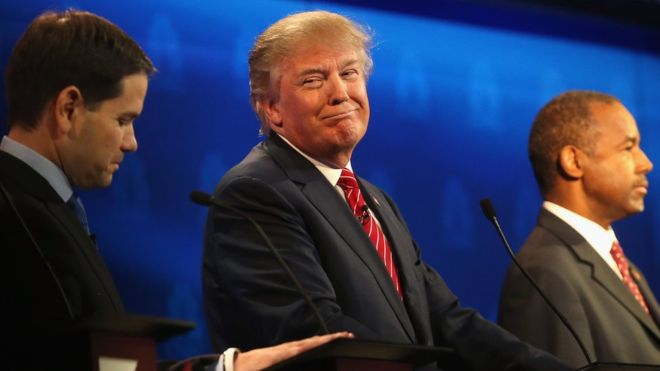
The leading Republican candidate, Donald J. Trump, is fond of tossing insults out at his opponents. Lately, some of those foes have responded. One of them, young Marco Rubio, has introduced — in a round-about way — the subject of Trump’s sexual endowments.

We’ve heard comments about perspiration, watched Trump make fun of Rubio’s physical appearance, listened at Trump has called Ted Cruz a lying son-of-a-gun.

And then — from the peanut gallery — former GOP nominee Mitt Romney has weighed in with comments and questions about why Trump doesn’t release his tax returns; he’s also called Trump a “phony” and a “fraud.” Trump’s response? Romney is a loser, a has-been.

We are witnessing an absurd demonstration of petulance on a level many of us have never before witnessed at this level of what is supposed to pass for political discourse.

Fifty-six years ago, two men faced off in a series of three joint appearances. We were enthralled then just at the notion of watching them on live television. Those grainy black-and-white pictures now seem quaint.

The high-minded debate they engaged in, though, now looks statesmanlike, dignified, the kind of encounter one should expect to see between two individuals seeking to become the next head of state of the world’s greatest nation.

These days? It’s a clown show.


Trump now challenges the speaker of the House

donald-trump-1a64c2eda04ee51d

House Speaker Paul Ryan today laid out an interesting challenge to the Republican Party’s leading presidential candidate.

He said Donald J. Trump needs to condemn the politics and policies of the Ku Klux Klan, which Trump has failed to do with anything resembling clarity. The Republican Party, said the GOP speaker, does not stand for bigotry, hatred and racism.

Trump’s response?

He said he doesn’t know the speaker but expects to get along with him once the two men get acquainted. If they don’t, said Trump, then Ryan could have some trouble.

Whoa!

Let’s hold on.

As MSNBC commentator Lawrence O’Donnell noted this evening, the speaker of the House of Representatives has far more power than the president of the United States. Thus, the GOP frontrunner needs to take care if he’s going to “threaten” the Man of the House.

Why? The House generates all tax legislation. Plus, as O’Donnell noted, speakers of the House have the ability to make life quite uncomfortable for presidents. Think of what the House did to President Nixon during the Watergate scandal; think also of what the House did to President Clinton during the Lewinsky scandal. Nixon nearly got impeached; Clinton actually was impeached.

Donald Trump needs to learn to make nice. Then again, if he had any understanding of how government actually works, he would know better than to threaten the man who runs one half of a co-equal branch of government.


Lawless? Unconstitutional? Why no impeachment?

impeach

The Republican field of candidates — even when it comprised 17 members — has been using some highly charged language to describe the twice-elected administration of President Barack Obama.

They call his actions “lawless.” They say his executive orders are “unconstitutional.”

Thus, they are accusing the president of two things: of breaking the law and of failing to uphold the oath he took twice when he was sworn in by the chief justice of the Supreme Court.

That makes me ask out loud, right here: Why haven’t the Republicans in the House of Representatives impeached the president?

If you really and truly think he’s broken the law or signed unconstitutional executive orders, then you have political recourse. Isn’t that correct?

It’s impeachment.

Two U.S. presidents have been impeached over the course of the nation’s history.

President Andrew Johnson fired his secretary of war without notifying the Senate and got impeached; he came within a single vote of conviction during a Senate trial. President Bill Clinton got impeached for lying to a grand jury about a tawdry relationship he had with a White House intern; the Senate acquitted him on three counts. A third president, Richard Nixon came within a whisker of being impeached because he blocked an investigation into the Watergate scandal; the House Judiciary Committee approved articles of impeachment, but the president quit his office.

These days, candidates for president keep tossing out verbiage that would suggest — if you are to believe it — that the current president has committed a whole array of impeachable offenses. Indeed, when you accuse a president of doing something “unconstitutional,” that by itself implies malfeasance.

Me? I don’t believe it.

I get that it’s campaign rhetoric. Therefore, perhaps they don’t really mean what they’re saying out there — on the stump or on those debate stages.

So, how about saying what you mean, fellas?

Still prefer a debate without crowd noise

GOP debate

The GOP Five are still debating on that Houston stage as I write this.

I am taking a moment to lament the circus atmosphere that these joint appearances have taken on.

Hillary and Bernie play for the same applause lines as Democrats.

Tonight, the Republican presidential candidates are engaging in a multi-pronged insult exchange aimed at bringing out the loudest cheers, hoots, shouts possible.

I wish we could return to the way it was done when these televised presidential debates first came into being.

In 1960, two men — U.S. Sen. John F. Kennedy and Vice President Richard Nixon — talked to each other about the issues of the day. A moderator sat in front of them. There was no crowd noise.

The upshot of it? We remember the substance of the debates those two men had. We also remember some of the “optics,” such as at the first debate when Sen. Kennedy appeared robust and Vice President Nixon appeared to have pulled himself out of a sick bed.

The crowd noise is a distraction and it provokes the kinds of exchanges we’re hearing tonight.


Get ready for the biggest fight of all

Supreme-Court-blue-sky

The fight over immigration?

Or the Affordable Care Act?

Or budget priorities?

How about gay marriage?

All of those battles between President Barack Obama and the U.S. Congress are going to pale in comparison to what’s coming up: the battle to find a suitable nominee to the U.S. Supreme Court.

Justice Antonin Scalia’s sudden and tragic death Saturday has caused political apoplexy in both sides of the divide in Washington.

Democrats want the president to nominate someone sooner rather than later. Republicans want the nomination to wait until after the election, with the hope that one of their own will occupy the White House beginning Jan. 20, 2017.

President Obama indicated last night he’s inclined to move forward, to nominate someone and to insist on a “timely vote.”

He is correct to insist that he be allowed to fulfill his constitutional responsibility and that the Senate fulfill its own duties.

One of the Republican candidates, Sen. Marco Rubio, said last night that no one has been appointed during an election year. He’s half-right. President Reagan appointed Anthony Kennedy to the high court in 1987; a Democratically controlled Senate confirmed him in 1988, which certainly was an election year.

Consider this, though: Justice Kennedy succeeded another GOP nominee, the late Justice Lewis Powell (picked by President Nixon). Kennedy’s appointment and confirmation did not fundamentally change the balance of the court.

This vacancy is different. By a lot.

Justice Scalia was a towering figure among the conservative majority that serves on the court. Whoever Obama selects surely will tilt to the left.

Therein lies the fight.

Senate Majority Leader Mitch McConnell, a Republican, said the vacancy should be filled after the election, adding that the “American people deserve a voice” in determining who sits on the court.

He could not be more off base. Yes, the voters deserve a voice. However, they spoke decisively about that in November 2012 when they re-elected Barack Obama as president.

Indeed, elections have consequences. There can arguably no greater consequence than determining who gets to select candidates to sit on the nation’s highest court.

The president — whoever he or she is — has a constitutional responsibility to act on a timely manner when these vacancies occur. Moreover, the Senate has an equal responsibility to vote up or down on anyone nominated by the president.

I’ve long believed in presidential prerogative — and my belief in that has never wavered regardless of the president’s party affiliation.

So, let’s mourn the death of a distinguished and, in the president’s words “consequential” justice. Then let us allow the president to do the job allowed by the Constitution and then let us demand that the Senate do its job by voting on whoever the president selects to fill this critical court vacancy.


Sanders’ ‘revolution’ might be overstated

revolution

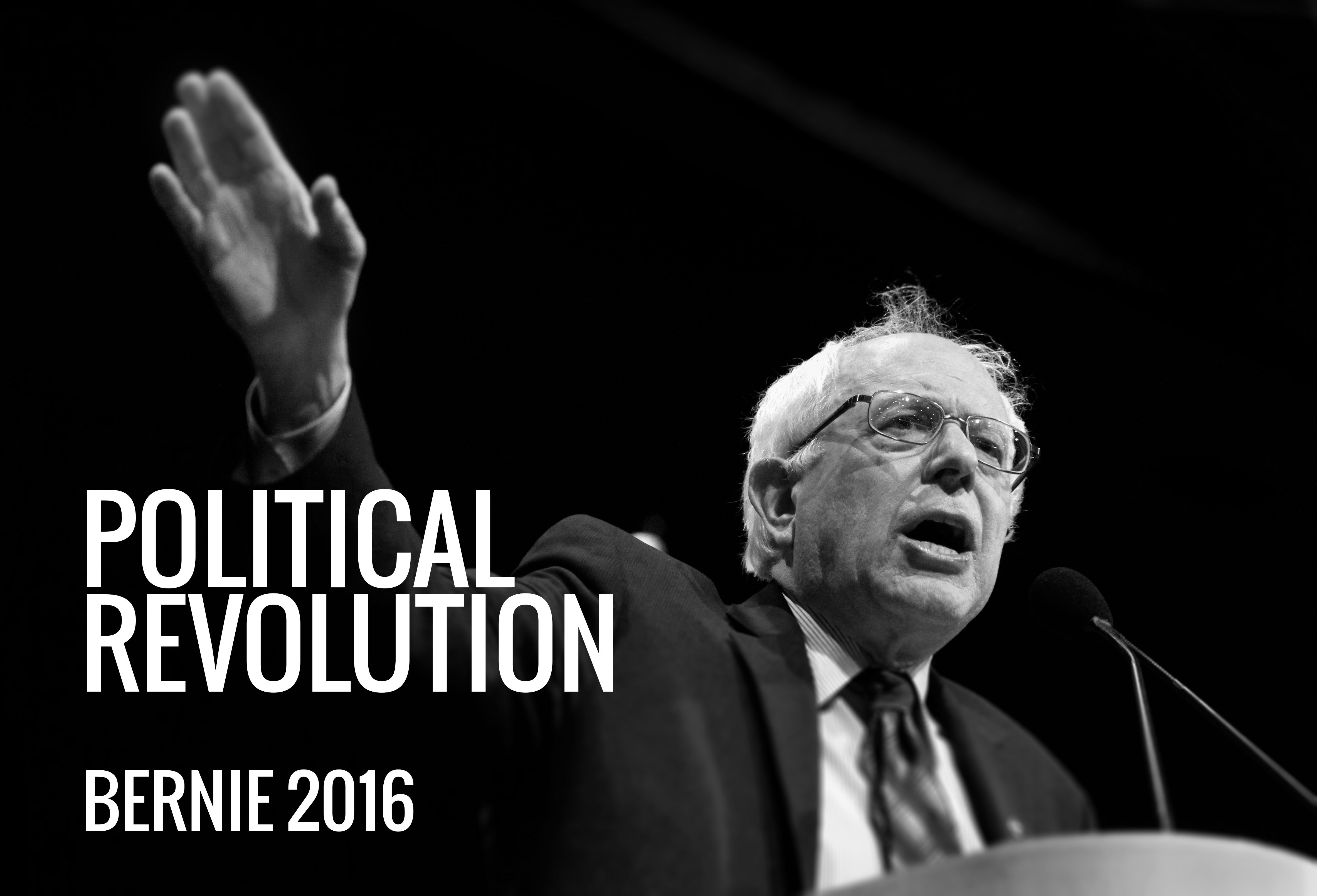
Sen. Bernie Sanders is now using the word “revolution” to describe the nature of his bid to become president of the United States.

He’s leading Hillary Clinton in every poll there is in New Hampshire, which I think is filling the Vermont senator’s head with visions of overinflated grandeur.

It’s not that his Democratic support is fake. It’s real. But let’s cool the “revolution” talk for a bit.

Three presidential campaigns of the late 20th century also were labeled “revolutions” in some quarters. How did they do?

1964: Sen. Barry Goldwater of Arizona took the Republican Party presidential nomination by storm, defeating “establishment” candidates, such as New York Gov. Nelson Rockefeller in a wild primary fight. He went on to lose the general election that year to President Lyndon Baines Johnson in a historic landslide. LBJ, of course, traded a good bit on the legacy of his slain predecessor, John Kennedy, and vowed to continue pursuing JFK’s unfinished agenda.

1968: Just four years later, the Vietnam War caused another revolution. LBJ’s popularity had gone south. Democrats looked for an alternative. They turned to one in Sen. Eugene McCarthy of Minnesota, who stunned LBJ with a stronger-than-expected showing in the New Hampshire primary. In came another anti-war candidate, Sen. Robert F. Kennedy of New York, brother of the murdered president and a political hero to many Americans — including yours truly. Vice President Hubert Humphrey, another “establishment” candidate, won the nomination, but then lost to Republican Richard Nixon by a narrow margin that fall.

1972: Let’s call this one the Anti-Vietnam War Revolution 2.0. The flag bearer this time would be U.S. Sen. George McGovern of South Dakota, who beat the party “establishment” led by Sen. Ed Muskie of Maine to win the nomination. McGovern drew big crowds to rallies, too, just like Sanders. Did they equate to votes that November? Ummm, no. President Nixon won 49 out of 50 states and buried McGovern’s “revolution” under the landslide.

Yes, some “revolutions” succeed. Ronald Reagan’s landslide victory in 1980 is one. Barack Obama’s election in 2008 could be considered another one. But they required extraordinary circumstances. The Iranian hostage crisis hurt President Carter grievously in voters’ minds in ’80 and the economic free-fall of 2008 helped lift Sen. Obama into the White House eight years ago.

Sanders might think he’s carrying the torch for another revolution. Then again, Republicans such as Donald Trump, Ted Cruz and perhaps even Marco Rubio might want to say the same thing . . . for entirely different reasons.

I just want to remind the revolutionaries out there that the political establishment doesn’t get to be so entrenched and powerful by being made up of pushovers or patsies.


Voting: Feels like the first time …

Old fashionet American Constitution with USA Flag.

A young Facebook friend of mine posted a giddy comment about something she did today for the first time.

She voted.

The object of her excitement was being able to vote “FOR” the multipurpose event venue that city voters today are deciding whether to endorse or reject.

I’m glad my young acquaintance is so thrilled at voting for the first time. I hope she remains engaged, involved and energized by the political process that has rippled through the city in recent weeks.

I remember my own first vote. It was, shall we say, a very long time ago.

It was 1972. I had turned 21 two years earlier. The minimum voting age would be reduced to 18 in 1971 with enactment of the 26th Amendment to the U.S. Constitution.

So, that meant I could vote in 1972. I got involved politically in the presidential campaign of U.S. Sen. George McGovern. I had separated from the Army in 1970, re-enrolled in college in January 1971 and became involved in the anti-Vietnam War movement.

Heck, I’d taken part in that war and was as confused over the reasons for fighting it upon my return to the States as I was when I went over there in the spring of 1969.

McGovern became my candidate of choice. I registered new voters among fellow college students. We held rallies, carried signs, chanted slogans … all those things that young activists do when they’re fired up about a candidate or a cause.

Well, all that energy didn’t produce the desired result.

President Nixon cruised to re-election that year, winning 61 percent of the popular vote and 49 of 50 states.

Ouch!

Still, it didn’t dim my love of politics and policy … and my strong desire to make sure my vote is counted at any and every level of government.

That is my wish for my young Facebook friend as she moves forward with her own life and her own interest in politics and public policy.

Keep up the good fight, young lady.


Sen. Thompson made his mark early

BBmHuKG

There will be tributes a-plenty in the next few days and weeks as politicians — and actors — remember one of their own: former U.S. senator and former TV and film actor Fred Dalton Thompson.

The Tennessee Republican was a larger-than-life guy who died today at his home after battling a recurrence of lymphoma.

He ran for president once. Served in the Senate. Acted in some pretty good films and had a good run as the district attorney in the hit TV show “Law and Order.”

I want to remember this man in another fashion.

R.I.P., Sen. Thompson

The first time I saw him was in 1973. It was on TV. I was a college student majoring in political science at Portland State University in Oregon and Thompson was serving as chief counsel for the Republican senators serving on the Select Senate Committee on Watergate.

Its chairman was the late Democrat Sam Ervin, the self-described “country lawyer” from North Carolina.

Thompson’s role in that committee was to provide legal advice for the Republicans on the committee. The panel was investigating the Watergate scandal that was beginning to metastasize and eventually would result in the resignation of President Nixon.

Fred Thompson had really bad hair, as I recall. But appearances aside, he was a tough interrogator, as was the Democrats’ chief counsel, Sam Dash.

My memory of Thompson was jogged a bit the other day by MSNBC commentator Lawrence O’Donnell who opined — after the daylong hearing of Hillary Clinton before the Select House Benghazi Committee — that senators and House members shouldn’t be allowed to question witnesses. O’Donnell cited the work that Thompson and Dash did in pursuing the truth behind the Watergate scandal.

Leave the questioning of these witnesses to the pros, O’Donnell said. The Benghazi committee congressmen and women, he said, made spectacles of themselves.

Thompson, indeed, was a tough lawyer. My memory of him at the time was that he questioned anti-Nixon witnesses quite hard and didn’t let up very much on those who supported the embattled president.

He did his job well.

That is what I remember today as the nation marks Sen. Thompson’s passing.

May he rest in peace.


Political ‘debates’ become show biz

CNBC panel

I might have a solution to returning some decorum and dignity to these presidential joint appearances.

I’ve said it before: Get rid of the audience.

CNBC’s moderators became the target of many of the Republicans running for president at tonight’s so-called debate.

First of all, I concur that the moderators were terrible. They lost control of the event. They let the proverbial tail wag the dog — to borrow a political phrase.

Indeed, the candidates fed off the crowd that gathered at the University of Colorado in Boulder. They cheered ’em on. They provoked the zingers. They roared every time a candidate took a shot at the “mainstream media.”

Tonight’s GOP joint appearance lacked almost any semblance of dignity. It became a circus and the moderators — Becky Quick, John Harwood and Carl Quintanilla — became the ringmasters.

It’s not as though the questioners didn’t ask good questions. They sought to probe the candidates’ backgrounds, prod them to explain previous statements and provoke them to make memorable statements.

It seemed, though, that CNBC debate troika set themselves up to become as much a part of the story as the candidates.

Why is that? The moderators were fueled as much by the audience as the candidates.

I have an intense dislike for what these events have  become.

Both parties have become enamored of the entertainment value that the audiences bring to these confrontations.

I’m old enough to remember the very first televised presidential debates, involving Republican Richard Nixon and Democrat John F. Kennedy. They had three of them. Each one got a little more vigorous than the preceding encounter.

Audiences? None. Just the two men … and Americans learned a lot from them both, without the distraction created by the cheers and catcalls.