Tag Archives: Texas Panhandle

Repeating the same cliche I’ve been hearing

Good grief. I am now repeating the cliché I keep hearing from family and friends when the discussion turns to the fate and cloudy future of print media.

I have talked about the slow and inexorable demise of quality journalism at one of the newspapers where I once worked, the Amarillo Globe-News.

Then I get the response: It’s happening everywhere!

I guess they intend to make me feel better. It has the opposite effect. That response seems to diminish the agony my former colleagues and I felt while we watched the newspaper decline ever so slowly and steadily.

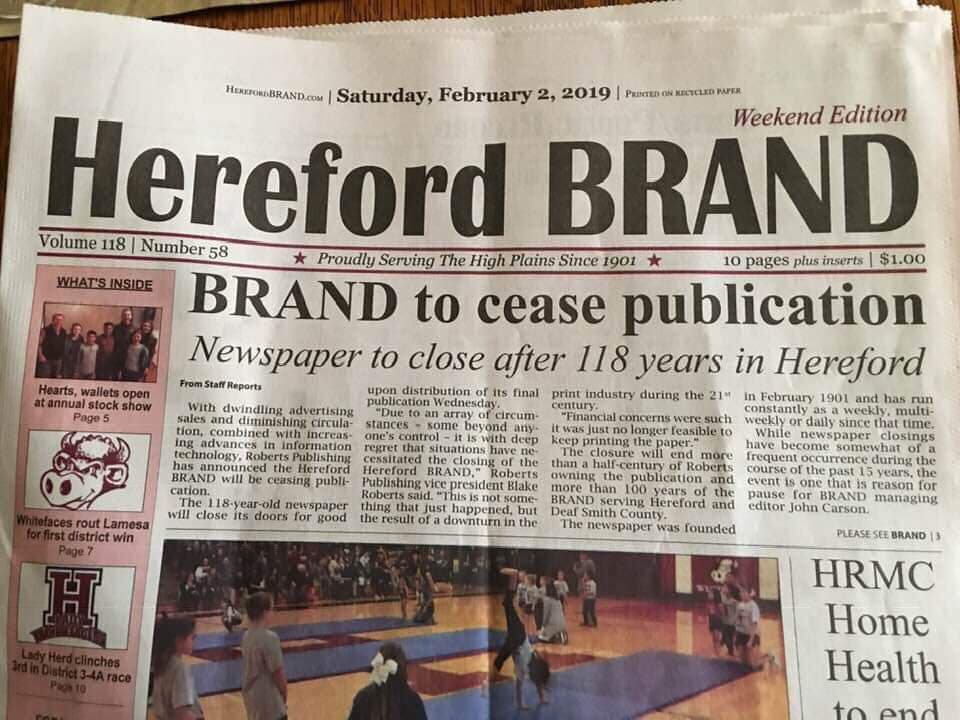
Now comes news of the death of a community newspaper, the Hereford Brand. Wouldn’t you know it? I am now saying the very thing I’ve been hearing: What’s occurring in Hereford is happening in small towns all across the United States of America.

It sickens me, man.

The social media have helped render newspapers — the products of quality journalism — increasingly irrelevant in people’s daily lives.

Who needs a newspaper when people have those phones in their pockets, or hitched to their belt, or tucked in their purses? They have 24/7 access to cable news shows, Internet sources and any manner of other outlets. They are bombarded with opinion, much of it unqualified. They form their world view on the basis of what pours into those phones or into their laptop or desk top computers.

The Brand will close up officially on Wednesday. Its publisher said declining circulation and advertising revenues have brought about this inevitable outcome.

And by golly, it ain’t unique to Hereford or Deaf Smith County or the Texas Panhandle. It’s happening in communities all across the land.

What’s more, every single one of them is poorer because of this relentless trend.

I am saddened beyond measure and I hate with a passion that I am being forced to acknowledge the sad truth that it’s happening everywhere.

Keep our eyes on Texas Tech vet school progress

I have spoken already on this blog about some of the damage that can be done to West Texans who depend on their state senator to look after projects that provide direct benefit to their part of the state.

I want to discuss briefly one specific project: the Texas Tech University System’s plan to build a school of veterinary medicine at its medical school campus in Amarillo.

Why mention it? Because a veteran legislator, Sen. Kel Seliger, an Amarillo Republican, has been yanked out of the chairman’s seat on the Higher Education Committee. Seliger lost the chairmanship he has occupied for several legislative sessions.

The loss of that seat could cost the Panhandle dearly. My sincere and adamant hope is that it does not endanger the veterinary medicine school that Tech wants to build in Amarillo.

The Tech Board of Regents has signed on. The Amarillo Economic Development Corporation has committed tens of millions of dollars to it. The Panhandle community supports the vet school, which would be the second such college in Texas; the only other vet school is run by Texas A&M University, which quite naturally has been pushing back against Tech’s plans to build the school.

The school of veterinary medicine will provide a direct boost to Amarillo and the Panhandle. Tech has established a need for such a school, which could cater to large-animal veterinary care in a region known for its livestock.

Does the Seliger removal from the Higher Ed chairmanship put the vet school in dire peril? It must not! However, there is the possibility that the Panhandle’s lack of a voice on the Higher Ed panel could work against the forward momentum that is building for the completion of the project.

Lt. Gov. Patrick has done some damage to the Panhandle with his apparent vendetta against the region’s senior state senator. Let us all keep our eyes and ears open to the legislative maneuvering as it involves the Texas Tech school of veterinary medicine.

Hey, Dan Patrick: Senators work for us, not you

I have to weigh in one more time — although quite possibly not the final time — on the growing Texas Senate feud between Lt. Gov. Dan Patrick and Kel Seilger, an Amarillo Republican.

The way I see it, Patrick is acting as if he employs the 31 members of the state’s upper legislative chamber. That ain’t the case, fella. They work for us. They work chiefly for the people who they represent in their respective Senate districts as well as for those who live in other parts of the state, given that they enact laws that affect all Texans.

The lieutenant governor stripped Seliger, a seasoned veteran of the Legislature, of all his committee assignments. Why? According to Seliger it is because the two men have different world views and legislative priorities; Patrick claims he did it because Seliger reportedly has a potty mouth and made some “lewd comments” to a female Patrick staffer.

Either excuse seems to point to a dictatorial streak being exhibited by Lt. Gov. Patrick.

The Dallas Morning News this morning published a lengthy feature on Seliger and the reputation he enjoys among his Senate colleagues. I’ll attach it to this blog post. Spoiler alert: The reporter, Lauren McGaughy, called yours truly for comments on Seliger, and she included some of them in this piece.

Here it is.

My point here is that Seliger answers to West Texans first and to the rest of the state second. Patrick place on the senator’s pecking order priority list is a very distant third.

I already have stated my pro-Seliger bias in this dust-up. The Texas Panhandle — where I used to live — and the rest of Seliger’s vast Senate District 31 have been disserved mightily by Patrick’s petulance. He referred to Seliger in an earlier DMN piece as a “corrosive force” in the Senate. The comments given to the Morning News by senators in both political parties paint a vastly different picture of the man with whom they have worked and served our great state.

I will continue to stand by my friend, Sen. Seliger.

Regional commentary: it’s spreading!

I am so sorry to report that Amarillo and Lubbock aren’t the only two communities in America where newspaper editorial policy is suffering from the urge to combine resources under a combined “regional” approach to commentary.

A friend sent me a link telling me that Charlotte and Raleigh in North Carolina are combining their editorial pages, that they’ll be supervised by a regional editor who will oversee editorial policies in both communities.

Here is the link.

Oh, my goodness! The deterioration of editorial autonomy is deepening.

GateHouse Media, which owns the Amarillo Globe-News and the Lubbock Avalanche-Journal recently announced hiring a guy who will serve as a “regional director of commentary.” He’ll live in Lubbock and then commute to Amarillo on occasion during the week, I suppose to try to read the pulse of the community.

The early returns aren’t too promising. The Texas Panhandle no longer has a newspaper that provides leadership on local issues; nor does the South Plains region.

As to what is happening in North Carolina, I predict a similar fate befalling those Charlotte and Raleigh. McClatchy Newspapers runs the Charlotte Observer and the Raleigh News  & Observer. Those cities also are even more diverse and disparate than Amarillo and Lubbock. They both are cosmopolitan cities; they are highly sophisticated. Raleigh is part of that Research Triangle region that brims with high-tech expertise; Charlotte is the state’s largest city and is a bustling financial center.

The release I read about the N.C.-merger reads, in part: The move is the latest in a series of changes that combine McClatchy’s North Carolina operations. Presumably, this will mean the board will focus more on statewide news and less on local news specific to Charlotte or Raleigh.

There you have it . . . more than likely. Both communities’ newspaper editorial pages are likely going to look away from those issues of specific interest or concern to them individually.

Oh, the demise of newspaper editorial leadership continues. It is painful for this former opinion writer/editor to watch.

Time of My Life, Part 12: Whom or whether to ‘endorse’

We have entered an era of enhanced distrust or mistrust of the media. That wasn’t always the case and I was proud to practice a craft that the public held in much higher regard than it does now.

We weren’t universally adored and admired, but come election time we had politicians lining up — quite literally — waiting for a chance to be interviewed by those of us who comprised an “editorial board.” They sought our “endorsement” for the campaign they were waging for whatever public office was on the line.

It’s a bit different these days. Politicians are forgoing those meetings with editorial boards. The most memorable “snub” occurred in 2010 when Texas Gov. Rick Perry decided he wouldn’t speak to any editorial boards in the state. He said he preferred to take his re-election message “directly to the people.” We got the message. What did we do? The Amarillo Globe-News decided to invite his Democratic Party challenger, former Houston Mayor Bill White, to talk to us. White accepted. He came to Amarillo and sat down for an hour or so talking about issues affecting his campaign and the state.

The paper then recommended White for election as governor. We were far from alone. However, judging from the response we got from our readers, you would have thought we had just endorsed Satan himself. The anger was palpable based on the mail we got from our heavily Republican-leaning readership.

It didn’t matter. Gov. Perry was re-elected in a breeze. And he established a trend for others to follow:

https://highplainsblogger.com/2014/10/ernst-follows-perry-model-who-needs-editorial-boards/

One of the more fascinating after effects of these editorial endorsement interviews — particularly with candidates running for local offices — was that every election cycle proved to be a learning experience for me. I always learned something at some level about the community where I lived that I didn’t know. Whether it was in Oregon City, Ore., or Beaumont or Amarillo in Texas, I learned something new about the community.

I was able to interview candidates who were invested deeply in their communities and they would share their often heartfelt experiences growing up there. I tried to take something new away from those encounters. Did I learn all there was to know about Clackamas County, Ore., or the Golden Triangle or the High Plains region? No. However, I did know a lot more about all those areas when I left them than I knew going in.

I was privileged to meet a future president of the United States, U.S. senators, members of the U.S. House, movers and shakers of all stripes, men and women who wanted to serve on city councils, or county commissions, they sought legislative office, various statewide public offices, school boards . . . you name it, we met ’em.

It always was a privilege to get to know these individuals, even those who weren’t serious in their quest. Believe me, we encountered our share of those as well.

They were willing to subject themselves to the grilling we provided them. They withstood our sometimes-difficult questions. There is something good to be said about them, too — and the process in which we all took part.

Local media ‘voice’ is being stilled

My concern about the future of local print journalism in the community where I lived and worked for 23 years appears to be bearing fruit — and it saddens me.

The Amarillo Globe-News, where I served as editorial page editor for more than two decades, looks for all the world as if it is morphing into something I don’t recognize. Its editorial page isn’t examining local issues, isn’t looking critically at local concerns and those who shape policy. It has become part of a “regional voice” that speaks in unison with another newspaper ensconced 120 miles straight south, in Lubbock.

Today’s editorial — in both papers — tells me this. They are the same. The Globe-News and the Lubbock Avalanche-Journal, both owned by the same company, have expressed identical opinions on what they hope for the “community” looking toward 2019.

That’s right. GateHouse Media, which owns the papers, believes (apparently) that Amarillo and Lubbock have identical concerns. The regions have matching issues they need to confront.

Hmm. Well . . .  they don’t. They are different communities. They used to have newspapers that addressed their unique circumstances through their opinion pages. Residents of those communities used to look to their newspapers for leadership, possibly some guidance — or maybe just as places to hurl their gripes over editorials with which they disagreed.

The media are changing before our eyes, folks. We’re all seeing it. It ain’t pretty, at least not to me, a retired ink-stained wretch.

I was on duty at the Globe-News when the media climate began changing. The company that formerly owned the newspaper, Morris Communications, sought to deal with the changes. It reduced staff, tried to redirect its emphasis to a more “digital presence.”

On the editorial page, I tried to employ a new strategy. I discussed with my publisher at the time an idea to focus our editorial page on local, regional and state matters. My thought was that our readers didn’t care what we thought about national or international issues; their minds were made up and they were getting their “editorial guidance” from other media sources. Given that we served a politically conservative region, it didn’t take a genius to figure out that our readers were dialed in to Fox News, Rush Limbaugh and other assorted conservative voices.

So we sought to write about local matters. The right-wing media geniuses weren’t going to discuss City Council votes, or local public education matters, or whether their county commissioners courts were spending their money wisely; we would fill that void.

We had some success in keeping our voice relevant to the community mood.

I left the Globe-News in August 2012 and went on to “pursue other interests.” The newspaper abandoned the local-only strategy I had developed. Morris sold the Globe-News and the A-J — along with all its newspaper properties — to GateHouse. The new owners changed publishers and brought in a guy to run both papers, an executive editor to oversee both newsrooms and a “director of commentary” to write editorials for both communities.

Therefore, the local voice in each community has been muffled.

I quit relying on my ol’ trick knee to make political predictions, but the knee is throbbing again. It’s telling me the West Texas media landscape — from the Panhandle to the South Plains — is going to have a single voice speaking for the entire region.

Welcome to the new world. Wow!

This ink-stained wretch is saddened by what is happening.

Fear not, others will step up

The news of the death this week of Wales Madden Jr. in Amarillo hit me hard, as it hit others who knew him equally hard.

As sad as I am at this good man’s passing, I find myself resisting the urge to wonder: How will the community replace him? How does any community full of giant men and women replace those who pass from this good Earth?

Well, I have what I hope is an acceptable answer.

I don’t know how a community replaces someone of Wales Madden’s immense stature. I only know that Amarillo, Texas, will move forward.

Amarillo is like any community in this great country of ours. It comprises roughly 200,000 residents. It has a long and storied tradition of embodying the pioneer spirit. Trail blazers settled on what was seen as a desolate landscape in the 19th century. They built a thriving community of farmers and ranchers that has grown into the unofficial “capital” of the High Plains region that includes parts of four states.

They endured hardship the likes of which few communities have ever experienced. The Dust Bowl? The misery of that terrible time in the 1930s was centered in the High Plains. Many of them fled. Many others stayed. They powered through it. They rebuilt their shattered lives. That’s how communities learn to thrive past their hardship and sadness.

Other communities with which I have some familiarity also have suffered grievous loss. Civic giants pass from the scene and somehow other emerge to take their place.

Before I moved to Amarillo, I lived and worked for nearly 11 years in Beaumont, Texas, another wonderful community along the Gulf Coast. It, too, is full of dedicated citizens who are the direct descendants of those who built that oil and petrochemical refining community into what it has become. Men and women pass from the scene and others step up, they fill the breach.

Amarillo is going to gather Saturday at the church where Wales Madden worshiped with his beloved wife, the late Abby Madden. Folks will hug each other, talk about Wales and Abby, remembering their philanthropy, their love for each other and for the community. They’ll remember Wales’ passion for climbing all those “14ers” — the peaks that exceeded 14,000 feet — in Colorado and California.

They need not worry for an instant whether anyone will emerge to replace the great man.

Great communities find a way to keep moving forward even as they bid farewell to those who helped build them.

Democratic excitement causes flashbacks

I must be hallucinating, or having some sort of flashback . . . which I assure you isn’t drug-induced.

Texas Democrats, not Republicans, are all agog over the looming struggle for attention between two rising stars. One of them came so very close to being elected to the U.S. Senate; the other is a former big-city mayor and a former housing secretary for the most recent Democratic president.

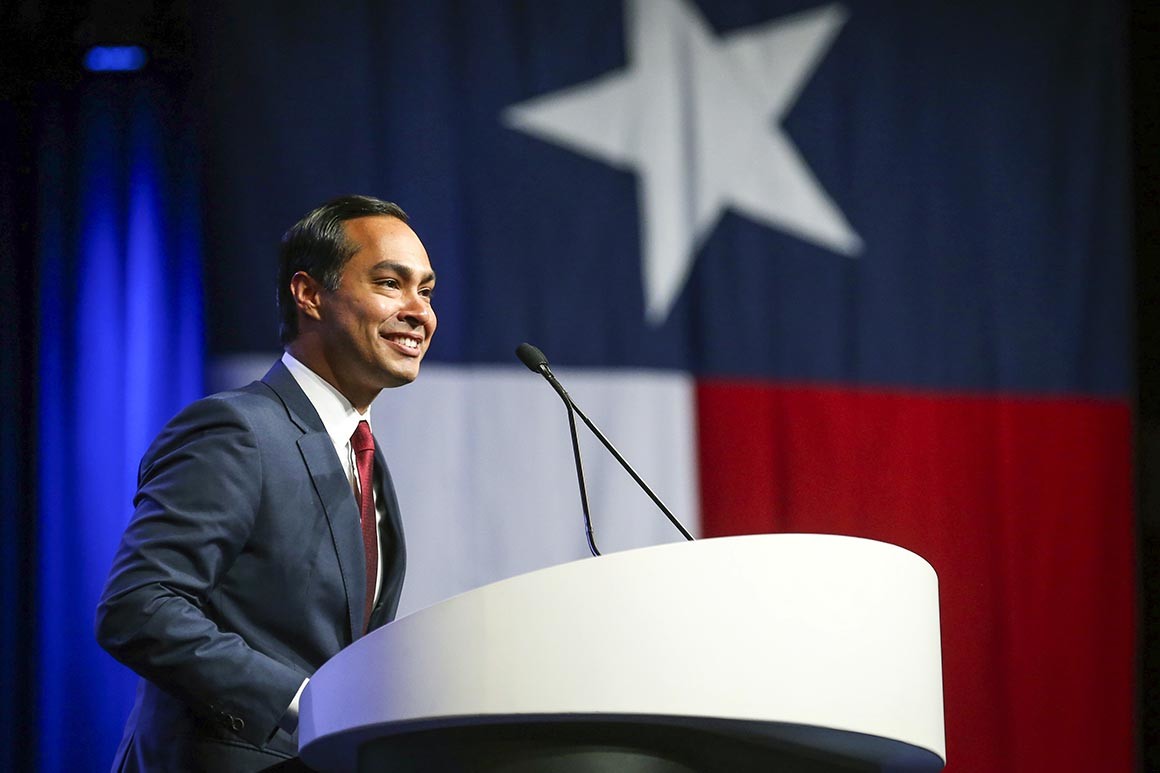
Stand tall, Beto O’Rourke and Julian Castro.

O’Rourke almost defeated Republican Sen. Ted Cruz in the midterm election; he might run for president of the United States in 2020. Castro was mayor of San Antonio, the state’s second-largest city and served in the Cabinet of Barack H. Obama; he, too, might run for POTUS.

Of the two of them, Castro seems the surer bet to toss his Stetson into the ring, although O’Rourke keeps tantalizing many around the country with messages that suggest that he, too, is likely to join the Democratic free-for-all.

Texas once was a Democratic bastion, where only Democrats were seen and heard. Then it morphed into a Republican stronghold and the GOP snatched all the headlines, the air time and people’s political attention.

It’s now becoming more of an inter-party competition, instead of an intra-party donnybrook. I like the idea of the two parties fighting hard for the hearts and minds of Texans and other Americans.

As for O’Rourke and Castro, I am beginning to sense a rivalry in the making.

Politico reports that a Texas political strategist, Colin Strother, sees the two men’s disparate upbringing well could produce a unique situation in Texas. They won’t be fighting for the same constituency, Strother guesses. “I see them as two completely different types of candidates,” he said.

Castro sees himself as the underdog, given O’Rourke’s meteoric rise while losing his race to Cruz. He has a twin brother, U.S. Rep. Joaquin Castro, who’s been helping him raise money to try to bring down the O’Rourke colossus.

O’Rourke, you might recall, campaigned against Cruz without the help of high-powered, top-dollar political consultants and/or pollsters. He just visited every one of Texas’s 254 counties, talked to voters wherever he found them. What astounded me was the amount of time O’Rourke spent in GOP-stronghold counties in rural West Texas, from the Panhandle to the Permian Basin. Didn’t anyone tell him the Panhandle is where the John Birch Society used to give “mainstream politicians” fits?

I don’t know whether both — or either — of these young men are going to vie for the Big Prize in 2020. I’m just delighted to see the excitement they both are generating in a state that has grown quite unaccustomed to hearing noise from Democrats’ side of the fence.

USS Arizona artifact honors the fallen

Randall County Judge Ernie Houdashell’s mission is accomplished.

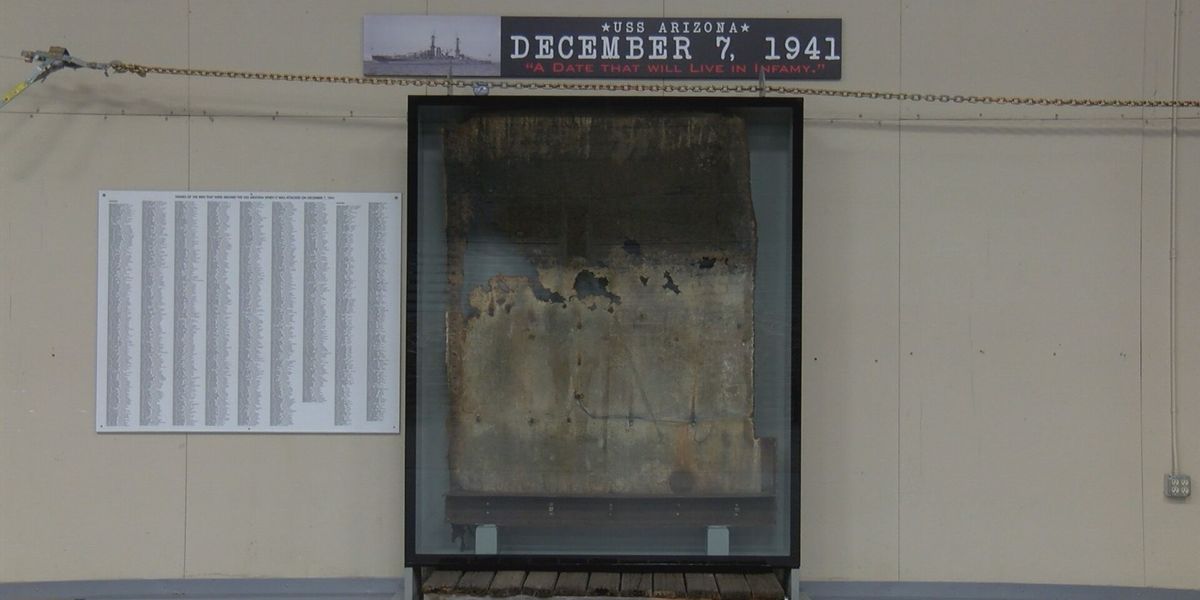
A piece of an iconic historical treasure is now in display at the Texas Panhandle War Memorial. It is a small section of the USS Arizona, the World War I-era battleship that was sunk 77 years ago today at the attack on Pearl Harbor, Hawaii, by Japanese fighter pilots.

The event thrust the United States into World War II.

More than 1,000 men died on the Arizona.

Houdashell made it his mission to bring a piece of the sunken ship to Amarillo, to display it at the War Memorial, which honors the men from the Texas Panhandle who fell in battle in conflicts dating back to the Spanish-American War.

The judge told KFDA NewsChannel 10: “Pearl Harbor, the Arizona, is a cemetery,” said Judge Houdashell. “There’s hundreds of men still buried on that. We have a piece of a national relic and it’s a sacred relic. Very few people have a piece that big. There’s a little bitty piece at the WWII Museum but we have a huge piece.

He meant to welcome the display on Pearl Harbor Day, when the nation remembers the event that mobilized the nation into a new era of industrial and military might in the fight to quell the tyrants in Europe and Asia who sought to conquer the world.

I am delighted that Ernie Houdashell accomplished his mission, just as he worked to bring the F-100 Super Sabre jet fighter and the UH-1 Huey helicopter — both Vietnam War relics — to the War Memorial grounds at the site of the former Randall County Courthouse Annex in south Amarillo.

These displays are important to Houdashell, who served two tours in the Vietnam War himself and who wears his love of country on his sleeve. Indeed, they are important to all Americans, all of us who understand the sacrifice made by those who fell in battle. The names of the Panhandle sons who fell are inscribed on the stone tablets that stand on the memorial grounds.

They now are accompanied by yet another historical artifact, a reminder of the horror of the bloodiest war the world has ever seen. May it stand as the worst the world will ever see.

Happy Trails, Part 132: Feeling more like ‘home’

I took Toby the Puppy for a walk this afternoon. Then it dawned on me as I looked at our surroundings.

Collin County is feeling more like “home” to me. I believe it is for my wife, too. Toby the Puppy? He’s fine no matter where he is, as long as we’re with him.

It’s more of a sense than anything else. You know already that we’re getting more comfortable navigating our way around the Metroplex. The sense today is that our neighborhood is feeling more like we belong here.

Now, we aren’t likely to stay in our particular neighborhood forever. My wife and I are moving toward purchasing a new home; at the moment, we are renting an apartment. We like our residence just fine, but we have this desire to sink our roots a little more deeply into our new surroundings.

It helps satisfy my own sense of belonging to feel more acclimated to our new surroundings.

I discovered in 1984 that I am a highly adaptable creature. We moved from Oregon to the Texas Gulf Coast that spring. I had spent my entire life in Portland — except for two years in the Army, which took me to the East Coast and eventually to Southeast Asia.

Oregon was “home” for me. Then opportunity called and we settled in Southeast Texas. That was our home for nearly 11 years. More opportunity called and we pulled up stakes and settled in Amarillo, which became our home for more than 23 years.

Our life in Beaumont became the new normal. Then it shifted to the Texas Panhandle.

Now it is reconstituting in Collin County, just a bit north of Dallas. Most importantly, we’re now just a few minutes away from our precious granddaughter.

As I look around our new digs, though, my comfort level is more satisfied believing that I am feeling at home.