Memo to fellow Vietnam vets: go back to see it again

I caught up with the PBS series on the Vietnam War. I am riveted all over again by the tragedy that unfolded in that faraway land.

The Ken Burns-Lynn Novick directed documentary is going to be known as a landmark television event. The way I figure it, anything with Ken Burns’ name attached to it has that potential. This one will make the grade.

***

As I watched the first two segments, I was struck by something I’ve told Vietnam veterans over the course of the past 28 years: You need to go back; you need to see the country now; you need to see what that place you remember as a war-scarred nation has become since the shooting stopped.

I served there many years ago as an Army aircraft mechanic. But in 1989, I was granted an extraordinary opportunity. I returned to Vietnam two decades after I reported for duty at Marble Mountain, a secure Army aviation unit just south of Da Nang. I’ve shared with you already on this blog the emotion I experience upon returning to that spot.

When I came back home at the end of that three-week journey — along with other editorial writers and editors from around the country — I made an unofficial pact to encourage other Vietnam War veterans to do that very thing. They need to see that place.

I must make a point that Vietnam in 1989 wasn’t yet the country it has become in the years since then. The United States had no diplomatic relations with its former enemy when my colleagues and I went there. Those relations took root in the 1990s and the country has made huge economic development strides since then.

The reaction I’ve gotten from vets, though, has been muted. Few of them have embraced the notion. Most of them say, “No way, man. I’ve had enough of the place.”

I tend to back off when I get the “hell no!” response from vets. They have their reasons and I’m sure it has everything to do with the misery they experienced during their wartime tour of duty.

To those who waffle a bit, I tell them a couple of things.

First, the country still smells the same. I can’t describe the odor one whiffs — whether in cities or in rural settings. It’s not exactly pleasant. It’s just, um, unique.

Second, I like to tell my fellow vets that the Vietnamese are gracious, welcoming and quite anxious to greet Americans. I can recall setting foot for the first time in Saigon in 1989. I jumped off the van that had took us from the airport to our hotel. I was greeted by a Vietnamese gentleman who figured I was “of age” to have been there during the war.

“Did you serve here in the military?” he asked as he clasped my hand. Yes. I did. “Welcome back to my country,” he said.

I will concede this point, though, about why the Vietnamese are so welcoming: They won the war!

Returning to that place, though, is good for Americans’ soul. Trust me on that one. I went there believing I wasn’t packing an ounce of emotional baggage. I was wrong.

Others are likely to experience the same catharsis that gripped me.

https://highplainsblogger.com/2017/05/dear-vietnam-vets-return-to-that-beautiful-land/


GOP launches ACA repeal 2.0

For the ever-lovin’ life of me I cannot grasp this notion that congressional Republicans keep insisting on repealing the Affordable Care Act.

They don’t want to fix what’s wrong with it. They want it gone. They want it tossed, ground up, thrown onto the trash heap. Why? I only can gather it’s because it has the name “Barack Obama” on it.

The GOP-run U.S. Senate is scrambling now to get a second run at tossing the ACA out. They’re trying to round up enough votes to approve repeal with a simple majority; after Sept. 30, according to a Senate rule, they’ll need 60 votes to do the job.

The Senate fell a vote short of the majority it needed earlier this summer. ACA repeal was thought to be a goner. It’s back.

What does the new bill look like? I understand it looks a lot like the old one. It diminishes Medicaid benefits for low-income Americans; it gets rid of the cost reduction subsidy that the ACA provides for those who seek health insurance under the government plan.

Sen. John McCain, R-Ariz., who cast the deciding vote that killed the Senate effort before the August recess, called for a return to “regular order.” He wants Republicans to work with Democrats; he wants bipartisan cooperation, if not buy-in.

He’s preaching to no one within his Republican Senate caucus.

Senate Republicans are intent on doing precisely what they accused Senate Democrats of doing in 2010 when the ACA was approved and signed into law by President Obama. They’re going to shove it down the other party’s throats and make Americans like what they’re doing … no matter what.

I remain baffled by the idea that they cannot find a way to fix the ACA. Indeed, the former president offered to work with Republicans if they could find a solution. They stiffed him.

They could do the same thing now, with a Republican in the White House.

Indeed, it now appears that Donald Trump is showing some sign that he’s beginning to learn one of the lessons of governing in Washington, D.C.: Legislating is a team sport that works best when both political parties are sitting at the same table.

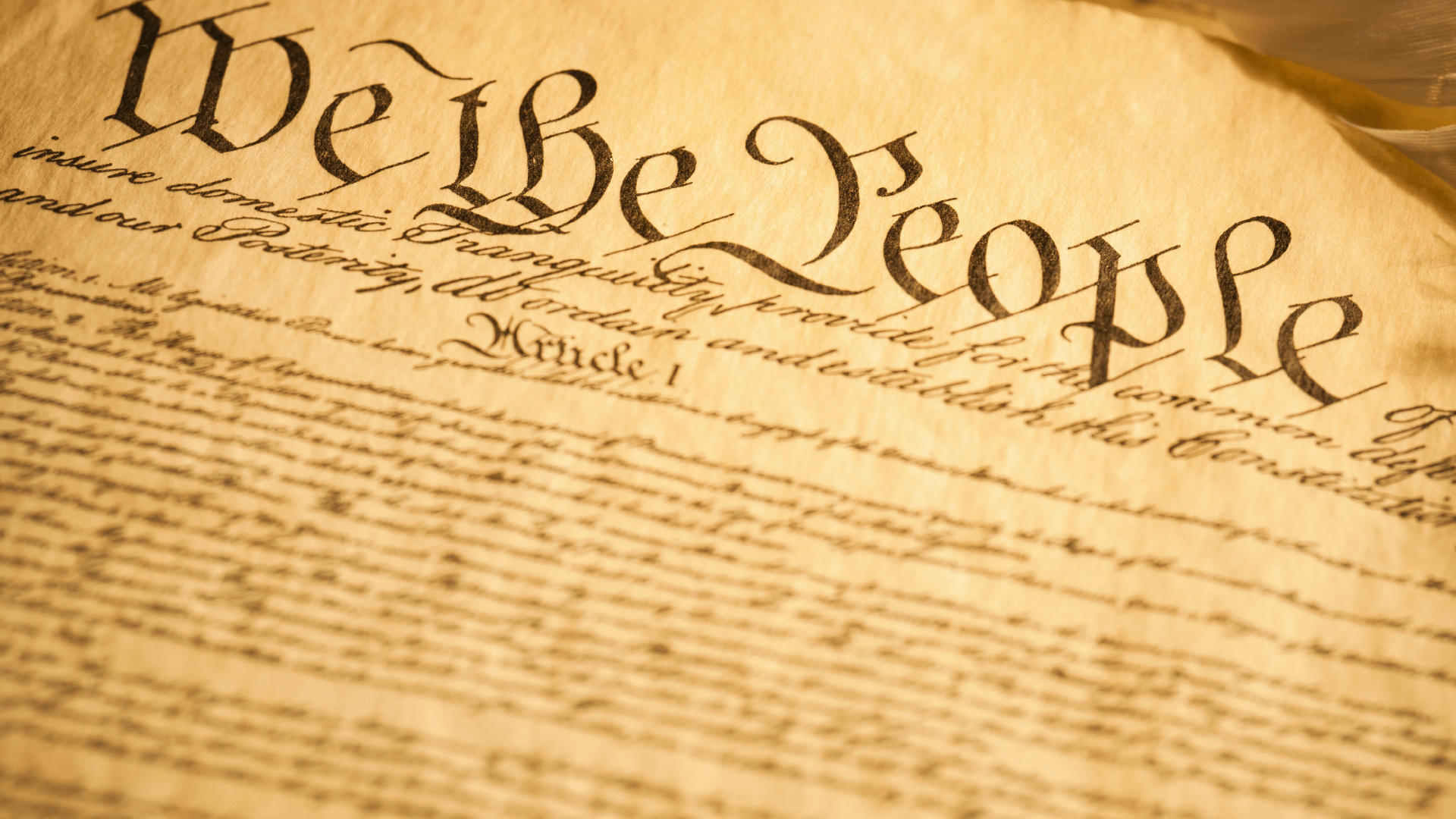
About the Constitution’s ‘simplicity’

The Amarillo Globe-News published a brief editorial this morning. Two elements contained within it compel me to respond. Here’s the editorial:

Sunday was Constitution Day — the day set aside for celebrating the anniversary of the U.S. Constitution.

Allow us to present a few facts about the U.S. Constitution, which more than likely are not in history books.

The phrase “separation of church and state” is not in the U.S. Constitution.

The concept of marriage is not mentioned in the U.S. Constitution, much less the authority of government to require marriage licenses.

The U.S. Constitution is the oldest and shortest of written, national constitutions. There is probably a reason for this — simplicity. The document was written in clear and concise language.

It is too bad these facts about the U.S. Constitution are forgotten — or ignored — today.

I love the U.S. Constitution as much as the next guy. Maybe more so. Allow me this brief rejoinder.

The Constitution doesn’t need to use the phrase “separation of church and state” to make this point abundantly clear. The First Amendment says “Congress shall make no law respecting the establishment of religion.” Is that clear enough? I believe the intent in that clause is to separate church from the state.

Nor does the Constitution need to insert the term “marriage,” either. I am guessing the G-N is suggesting that same-sex marriage, which the U.S. Supreme Court has sanctioned, isn’t covered by the nation’s founding governing document; the G-N opposes the court’s decision. You see, the 14th Amendment provides “equal protection under the law” for all Americans. That includes marriage, by golly.

If we’re going to parse the Constitution’s language, let’s also note that it doesn’t mention the words “murder,” or “extortion” “bank robbery,” let alone does it say specifically that those activities should be deemed illegal.

I do agree that the founders wrote a fairly simple and declarative document when they created the United States of America. They didn’t need to clutter it up with a lot of do’s and don’ts to make clear what’s allowed.

Spicer makes fun of himself … what’s the big deal?

Count me as one American who has no problem with former White House press flack Sean Spicer making a surprise guest appearance at the 2017 Emmy Awards show.

I didn’t watch it live. I have no interest in entertainment awards shows.

But I heard about Spicer’s surprise cameo this morning. I saw the clip of him coming onstage behind the kind of mobile podium that the comedian Melissa McCarthy made famous in her “Saturday Night Live” skits mocking the embattled press secretary.

I heard about the “mixed reaction” to Spicer’s appearance. I also saw a column in this morning’s New York Times by one of my favorite columnists, Frank Bruni, who is just outraged that Spicer would do such a thing.

Good grief, dude. Get a grip.

I thought Spicer’s act at the Emmys was damn funny. I laughed out loud when I saw it this morning.

What does it tell me about this guy? It tells me he has a sense of humor. It tells me he doesn’t take himself super-seriously. He was able to poke fun at himself. I also could argue that in showing a self-deprecating side, he also poked a bit of fun at his former boss, Donald J. Trump, the president of the United States of America.

To the critics of Spicer’s guest gig at the Emmys, I want to say only to chill out. The guy was damn funny.

On the hunt for PBS signal

DURANGO, Colo. — I’m so mad I could spit.

We hauled our fifth wheel recreational vehicle into the Rocky Mountains for a long weekend, getting away from the hustle, bustle and some of the tussles of the world.

But surely — clearly, without a doubt — we could land in a spot that picked up the Public Broadcasting Service.

Oh, no. Didn’t happen.

We’re in Durango, cooling our jets until the morning arrives. I am missing the premiere episode of a landmark television event, PBS’s epic series “The Vietnam War,” put together by the great documentary filmmaker Ken Burns and Lynn Novick. It’s going to run for 10 days.

I am sort of reminded of a comment the late pro football coach Bum Phillips once said of Orange, Texas, where he was born. “It’s not the end of the world,” Bum said in a Playboy magazine interview, “but if you get up on your tippy toes, you can see it from there.”

That’s kind of how I am feeling this evening as PBS is airing “The Vietnam War.”

I’ve published several posts on this blog commenting on the importance of the series to a generation of Americans, many of whom served in that war. I am one of those Americans.

I won’t let it depress me. We’re shoving off tomorrow for another location — in Albuquerque — where I am certain we’ll get PBS in our fifth wheel. I know this because we stayed there the other night en route to Durango. By golly, I watched some PBS programming while we were parked there.

I am going to pray that the weather doesn’t get in the way. You are welcome to wish me luck. Oh, and be sure to watch it yourself.

Trump shows more juvenile petulance

The nation’s juvenile delinquent in chief just keeps demonstrating his unfitness for a job that requires a huge measure of dignity.

Donald John Trump Sr. fired up his Twitter finger to retweet an animated image of the president hitting Hillary Rodham Clinton with a golf ball.

Pretty funny, huh? Oh, not at all!

But that’s the president of the United States of America for you. He just cannot stop insulting his political foes and critics. He just cannot resist the temptation to illustrate why so many of his fellow Americans detest the notion of his occupying the White House.

It goes without saying that heads of state need to conduct themselves with dignity and decorum. Trump doesn’t understand the tradition that accompanies the office he won in 2016, defeating Clinton in one of the most raucous and divisive elections in our nation’s history.

Trump’s Twitter tirades need to stop. They won’t, of course. The president will continue to denigrate others through this social medium for as long as his base of supporters keep cheering him on.

What the heck. He’s pandering to his base on many levels, forsaking the rest of the country that didn’t support his election in the first place.

Adam Schiff, the ranking member of the U.S. House Intelligence Committee, calls it “distressing that we have a president who will tweet and retweet things as juvenile as that.”

I’ll add another word: disgraceful.

However, the president is going to “make America great again.”

Aren’t you proud of him? Neither am I.

No efforts to ‘erase history’

I used to have a relationship — albeit a distant one — with a fellow named Carl Fowler.

He used to write the occasional letter to the editor and guest column to the Amarillo Globe-News, where I worked as editorial page editor for nearly 18 years. I see that he’s still submitting commentaries to the newspaper. Truth be told, I cannot let this one pass without a brief comment.

Fowler, as is his wont, is highly critical of who he calls the “far left” for seeking to remove Confederate monuments from public squares.

And in his essay, he manages to do a couple of things that are wrong on their face. He refers to the “Democrat Party,” which is not the name of the party known officially as the “Democratic Party.” That’s how modern conservatives seek to demonize the Democratic Party and those who belong to it.

He also misquotes former President Barack Obama. He refers to a statement the former president once made about the United States no longer being “just a Christian nation.” Of course, Fowler said Obama’s quote was that we are “no longer a Christian nation.” The word “just” is important here, because the former president was referring to the increasingly non-Christian mix of Americans who are becoming key components of our diverse national texture.

Moreover, we never have been a “Christian nation.” Fowler, a retired academic, ought to know better than to imply anything of the sort. All he’s got to do is read the U.S. Constitution and he won’t find the words “Christian” or “Jesus Christ” anywhere in it. You see, the founders created a secular state that gave us all the right to practice whatever religion we wanted — or to not practice any if we so chose.

The essence of Fowler’s essay, though, is to condemn those who take a dim view of honoring those who went to war against the United States of America. The Civil War killed more Americans than any other conflict in our history. To my way of thinking, those who sought to destroy the Union were traitors.

Should we erase that chapter from our national story? Of course not. Let’s just call the Confederates who they were.

Here is Fowler’s essay. Check it out. The floor is now open for discussion.

POTUS set to tell U.N. to go … ?

The president of the United States is getting ready to deliver a speech to the United Nations General Assembly. It’s a big test for Donald J. Trump. Is he up to the task?

Trump is a novice at this worldwide geopolitical stuff. He campaigned for the office he now holds by pledging to “put America first.” That means, according to some observers, that he intends to pull the United States out of its traditional role as the world’s most indispensable nation. We won’t be the “world’s policeman” any longer, according to Trump’s campaign stump rhetoric.

But … now he’s the man in charge. He’s the president of the world’s remaining military superpower.

Trump went to Europe not long ago and scolded our NATO partners about their lack of paying their fair share for its self-defense. It didn’t go well with our military alliance partners.

He already has decided to back out of the Paris Climate Accord, joining just two countries in refusing to join a worldwide agreement to reduce carbon emissions that a vast majority of scientists believe is contributing to the changing worldwide climate. Oh, wait! The president calls all that climate change stuff a “hoax.” Who needs the rest of the world?

Perhaps the biggest issue for Trump to confront will be the Iran nuclear deal brokered by the Obama administration. It seeks to prevent Iran from developing nuclear weapons. International watchdog groups say Iran is compiling with the agreement. Trump — no surprise here — is suggesting the Iranians aren’t doing what they’re supposed to do.

The president has until Oct. 15 to make a final determination on Iran’s compliance. What … will … he … decide?

I am going to await the tone of Trump’s remarks. He continues to look and sound like someone who has yet to find his comfort zone on the world stage. Sure, he talks about his prowess as a dealmaker and touts his business acumen. He’ll be standing in front of representatives of a couple hundred sovereign states, each with their own set of values, and political agendas.

Putting America first might play well in front of select domestic audiences. On the world stage? I’m waiting to see if he tries to sell that one to an international crowd.

Happy Trails, Part 43

MESA VERDE NATIONAL PARK, Colo. — Oh, how I love parks. National parks, state parks, municipal parks. You name ’em. I love ’em.

We’ve spent a good bit of travel time visiting and staying at public parks. They’re quite friendly to us recreational vehicle users. What’s more, the National Park Service has this wonderful perk it extends to us older folks. It’s called a “Senior Pass.” It gets us into national parks for free — for the rest of our lives.

Texas’s state parks system also allows us free entry, but it’s not a lifetime pass. We have to renew it annually. It’s worth it for us, given that (a) state park overnight RV lodging is cheap and (b) the state parks in Texas generally are places of beauty.

We ventured to Mesa Verde National Park, which is about 40 miles west of Durango. It features 1,000-year-old — and older — cliff dwellings carved out of canyon walls high up in the mountains. It’s about a 20-mile drive from the park entrance to where one can see the dwellings. It’s a winding, highly scenic excursion along the way.

If I had one gripe about our national parks, it’s that they aren’t exactly pet friendly. We found this out on another trip to Guadalupe Mountains National Park in Texas and at Carlsbad Caverns National Park in New Mexico.

We had to sneak Toby the Puppy along with us to Mesa Verde’s exhibits. He wasn’t allowed to walk along any trails, but since we didn’t see “trails” as I understand the meaning of the word, we took him with us along paved walkways toward the exhibits; then we would pick up him and pack him through some of the dwelling exhibits.

Shhh! Don’t rat me out … please.

Our travels are going to take us to many more of these federal parks. I believe we’ve been to 17 national parks already in our 46 years of life together. One of my unofficial bucket-list objectives is to see all of them before I’m no longer able to travel long distances.

So … the adventure continues.

Glad to see Confederate debate arrive

I am delighted to see that Amarillo, Texas — my current city of residence — has entered a serious debate that many other communities have already joined.

How do we remember those who fought for the Confederate States of America? Should we remember them? Should we forsake them?

This is an important discussion that erupted in August as a riot ensued in Charlottesville, Va. White supremacists, Klansmen and neo-Nazis marched to protest a plan to remove a statue of Confederate Gen. Robert E. Lee from a public park. Counter protesters emerged to challenge the first group. A young woman was killed when she was run over by a car allegedly driven by a young man with white supremacists sympathies.

The debate hasn’t really let up since.

Now it’s arrived in Amarillo. On Monday, the Amarillo public school system is going to discuss whether to rename Robert E. Lee Elementary School. The Robert E. Lee school situation presents an amazing irony, given that the school is located in a historically black neighborhood. Think of that for a moment: That school is named to honor a man who fought to destroy the United States. And for what purpose? To preserve the enslavement of black Americans!

There’s more discussion about the status of a Confederate soldier statue at Ellwood Park.

A pro-Confederate advocate is urging the City Council to “leave history alone.”

I come at this from a different angle. I am a transplant who chose to move to Amarillo in early 1995. My wife and I came here from Beaumont, Texas, where we lived for nearly 11 years prior to moving to the Panhandle. Indeed, we have witnessed our fair share of racial strife since we moved to Texas in 1984 from Oregon, where I was born and where my wife lived for many years.

Do we honor traitors?

I see the Confederacy as an aftertaste of the nation’s bloodiest armed conflict. The Civil War killed more than 600,000 Americans. Why did they fight? The Confederacy came into being as a protest against federal policy that the Confederate States believed interfered with their own right of self-determination.

Let’s not be coy about what those states wanted to preserve: One of their goals was to maintain slavery.

They separated from the United States of America and then went to war. Where I come from, I consider that an act of treason.

Is that the history we want to preserve? Is that what we honor?

I don’t have any particular concern about those who plaster Confederate flags on their bumpers or fly the Stars and Bars from their car radio antennae. That’s their call. Do I question why they do these things? Sure, but I don’t obsess over it.

Putting these symbols, though, on public property — be they parks or public schools — is another matter.

Preserving and honoring history is fine. I’m all for it. The Civil War, though, represents a dark and grim chapter in our nation’s history that should be remembered, studied and discussed. But do we honor that time? That’s why we have historical museums. We’ve got a damn fine historical museum in Canyon, at the West Texas A&M University campus.

So, let’s have this discussion in Amarillo about the Confederacy. Keep it civil and high-minded.