Category Archives: political news

No ‘town hall’ meetings; no surprise

I guess this is one of the least-surprising things I’ve heard since Donald J. Trump became president of the United States.

West Texas’s congressional delegation is coming home for a weeklong recess — but none of them is planning any town hall meetings with constituents.

Why do you suppose they’re forgoing these events? My guess — and that’s all it is — would be that they might not ready to withstand the heat that their colleagues have gotten from their constituents when they have had town meetings back home.

U.S. Rep. Mac Thornberry, who has represented the 13th Congressional District since 1995, says he’ll be accessible to voters. Good. I trust he’ll keep his word while he’s back home.

The issue on voters’ minds happens to be the Affordable Care Act. Congressmen and women have been getting a snoot full from constituents about the ACA and what Congress intends to do if it repeals it. They don’t want to lose their health insurance and, near as I can tell, Republicans lack a replacement plan to insert in place of the ACA if they get around to repealing it.

But our West Texas congressional representatives aren’t going to hear from their constituents in a town hall setting.

I hope, though, that they open and read their mail and their staffers listen to phone calls from concerned citizens.

We aren’t brain dead in this part of the country. Indeed, lawmakers representing deep-red, solidly Republican congressional districts are getting their share of gripes.

I doubt we’re any different here.

Obamacare repeal effort losing steam?

Some chatter is beginning to develop that suggests efforts to repeal the Affordable Care Act might be subsiding among congressional Republicans.

A New York Times story lays out what appears to be an interesting scenario. It is that with President Barack Obama now out of power, the repeal-and-replace effort is being replaced by suggestions of tinkering around the edges of the ACA.

What gives?

It appears to me that the issue among House and Senate Republicans might have had more to do with the man who crafted the legislation than the legislation itself.

It’s not an unreasonable view.

ACA also is known as Obamacare, which has been a whipping boy for Republicans and other critics of the former president’s signature domestic policy initiative. Donald J. Trump has called for repeal and replacement of the ACA, calling the insurance plan a “disaster” for the country.

But … is it?

Twenty million Americans now have health insurance who didn’t have it before. Why? They couldn’t afford it prior to enactment of the ACA.

Then we’ve had those town hall meetings across the country. Citizens have been flooding meeting halls and shouting down members of Congress with demands to keep their hands off the ACA out of fear they would lose health insurance coverage.

There might be signs of lawmakers getting spooked by the anger they’re hearing out here among their constituents. Lawmakers also are finding out that crafting a replacement law is far more complicated than simply scrapping the old one. Go figure.

As the Times notes, Obama’s absence from the public stage now has turned attention to potential solutions. According to the Times: “But with President Barack Obama out of office, the debate over ‘Obamacare’ is becoming less about “Obama” and more about ‘care’ — greatly complicating the issue for Republican lawmakers.”

Republicans have had nearly eight years to come up with a replacement plan. However, for virtually the entire length of the Obama presidency, they’ve been hung up on repealing legislation that has the name of the man they detest.

Now they’re learning about the difficulty of replacing it.

‘Enemy of the people’ talk is way overblown

All the recent “enemy of the people” discussion prompted by the president of the United States has caused me to think about the career I pursued.

I worked in the mainstream media for 37 years. I got to pursue some great stories. I was able to see and do some fascinating things and meet some remarkable individuals.

I never considered myself an “enemy of the people.” Donald J. Trump has labeled the media as such, while proclaiming he doesn’t think the media are his personal enemies.

When the president of the United States impugns the integrity of the individuals who are doing what I used to do, well, I take it personally.

Did I make everyone happy while pursuing my job? Not in the least. I angered some public officials, made them squirm. For instance:

* I once wrote an investigative piece about a trial judge in Oregon City, Ore., who had developed a reputation as a jurist who lacked the temperament to do the job properly. I interviewed fellow judges, prosecutors, defense counsel and, of course, the judge himself. We published the story.

Then the judge died. My editor then assigned me to write his obituary. Who did I call to collect information about the judge? His wife. We had a nice visit and she told me she didn’t harbor ill feelings — let alone hatred — for me.

* I moved later to Beaumont, Texas, and then got another judge quite riled at me when I noticed something in a news story we had published one day. It spoke of the district judge getting a permit to operate a private business on the ground floor of the county courthouse where he worked as a state employee.

Big deal, you say? Well, yes. You see, he used facsimile state letterhead stationery to communicate with the county auditor, who had to approve the bids; the auditor — who reported to a panel of district judges, including the judge who was bidding for the permit — then granted the judge the permit.

I wrote some editorials calling this activity into question. The judge took great offense at it and, from what I heard, wanted to sue the newspaper and yours truly for libel.

* I moved to Amarillo after that and promptly got sideways with a former city commissioner who was appointed to the board of a public district that oversaw the then-publicly owned hospital. The problem, though, was that he was employed by a competing for-profit hospital, which seemed a tad inappropriate; he shouldn’t have served on a public hospital district board while working for a competitor. I wrote an editorial calling attention to that conflict of interest — and incurred the wrath of the former city commissioner.

I was doing my job as I understood it in all those cases. I never thought of myself as a purveyor of “fake news” or someone who “had an agenda” that differed from the public I sought to serve.

When the president assumes such things about the media and then challenges them in such a direct manner, a lot of us with ties to this particular craft take it all quite personally.

I am one of them.

I might have angered my share of officials along the way. As for “the people,” well, they cannot live without a free and aggressive press … no matter how mad the president says they might be in the moment.

Response to Trump … it’s about what we should expect

Donald J. Trump’s supporters are pushing back on the intense criticism coming from the portion of the country — most of which voted against him in 2016 — of the man’s presidency.

I feel the need to flash back for a moment to 2009.

Let’s remember what a leading Senate Republican said at the time about the previous president of the United States, Barack H. Obama.

Mitch McConnell then was the minority leader in the Senate and I presume he was speaking on behalf of the GOP Senate caucus when he made a straightforward and ominous declaration.

He said his “No. 1 priority” as the Senate GOP leader was to “make Barack Obama a one-term president.”

Yep. That’s what he said. He laid down his marker early in the Obama administration. He didn’t stress enactment of landmark legislation, or working with the president to rescue the economy — which was collapsing when Obama took office. He didn’t propose any reforms of his own or suggest ways Republicans and Democrats could find common ground.

He said he intended to make Obama a one-term president. That translated into “obstruct everything he intends to do.”

Hmmm. It didn’t quite work out that way. Obama got re-elected in 2012 and finished his time in the White House with soaring approval ratings in every single leading public opinion poll.

Is it right and proper for Democrats now to follow the Republicans’ lead? Mostly “no.”

I’ve noted here before that I don’t wish for the president to fail. A presidential failure means the country fails and we all pay the price for that.

However, as the new president seeks to form a government — and he still has quite a way to go — my hope is that Democrats can find some common ground with the Republican president whenever possible.

The problem, though, is that Donald Trump has begun harping about the media being the “enemy of the people” while continuing to boast about his Electoral College victory. Enough, already!

Some positive proposals ought to be formulated and presented for Congress to ponder.

Until then, my Republican friends ought to just swallow the swill they offered eight years ago when Barack Obama was elected … with, I feel compelled to note, a far more robust majority than his successor earned.

Regretting a stance on Amarillo’s congressional alignment

Every now and then, as I wander through Amarillo, I encounter people I knew in my previous life as a journalist and with whom I maintain friendly relations to this day.

I ran into one of them today. He is former Bushland School Superintendent John Lemons. We chatted about this and that, about people we know and how they’re doing these days. Then the conversation turned to an old friend of his, former U.S. Rep. Larry Combest.

Our discussion pivoted to a position the Amarillo Globe-News had taken while I was working as editorial page editor of the newspaper: It dealt with congressional reapportionment.

I told John that I have grown to regret a position the paper had taken, and which I had expressed through editorials published on the matter. The G-N argued for the “reunification” of Amarillo into a single congressional district.

A brief history is in order.

***

The 1991 Texas Legislature, which was dominated by Democrats, redrew the state’s congressional districts. Seeking to protect Democratic U.S. Rep. Bill Sarpalius, the Legislature split Amarillo in half: Potter County would be represented by Sarpalius in the 13th Congressional District; Randall County’s congressman would be Republican Larry Combest.

The realignment outraged the G-N at the time. They paper began calling for the city to be made whole by being put back solely into the 13th District.

The gerrymandering worked through the 1992 election, as Sarpalius was re-elected to his third term in Congress; so was Combest. The paper kept up its drumbeat for unification. The city’s interests were being split between men of competing political parties, the G-N said.

Then came the 1994 election. Sarpalius ran into the Republican juggernaut. A young congressional staffer named Mac Thornberry defeated him. Thus, the city would be represented by two congressmen from the same party.

I arrived at my post in January 1995 — and the paper kept hammering away at the unification theme. Bring the city together, we said. I scratched my head a bit over that one. I couldn’t quite understand why we were so upset with divided representation, given that both Reps. Combest and Thornberry were of the same party. They were rowing in unison, singing off the same page, reciting the same mantra … blah, blah, blah.

I told Lemons today that the city was able to “double its pleasure, double its fun” with two members of Congress representing its interests. One of them, Combest, held a leadership position on the House Agriculture Committee.

But we kept it up.

I told my pal John Lemons today I regret not pushing my boss at the time to rethink the notion that Amarillo needed to be made whole.

So … now I’m sharing my regret here.

I had a wonderful — and moderately successful — career in daily print journalism. However, it wasn’t regret-free.

Council to lose its loudest mouth

I do not know this person, only witnessed his antics from some distance. Still, I feel the need to offer a brief critique of someone who is going to exit the Amarillo political scene.

I hope his departure is permanent … unless he learns to change his way of doing things and learns how to act in a more collegial manner.

Randy Burkett has served one occasionally tumultuous term as an Amarillo city councilman. He has chosen not to seek re-election to a second term. I won’t miss him or his occasional outbursts and fits of petulance.

Burkett was one of three newbies elected to the council in May 2015. He promised to change things. He did — in his own sort of way.

You see, I’ve always viewed Amarillo City Hall politics to be a fairly genteel endeavor. I have watched it up close — as a journalist — for more than two decades and have grown fairly familiar with the rhythm of the place and of the governing body once known as the City Commission and now known as the City Council.

There’s always been a sort of unwritten code among City Council members: You are welcome to disagree with policy matters, but once we make a decision, we prefer to lock arms and speak with one voice. The city has had a couple of notable contrarians who have served during the years I have watched its governing body. I can think of the late Commissioners Dianne Bosch and Jim Simms. They generally, though, lived by the terms of that unwritten code.

Burkett didn’t seem to adhere to that code. He would mouth off publicly when he disagreed with a city policy, or if he had differences with the way Mayor Paul Harpole conducted City Council proceedings.

Burkett seemed quite willing to call attention to himself.

He recently talked out loud about a so-called pending deal to lock up a minor league baseball franchise relocating to Amarillo. He drew a sharp rebuke from the head of the Local Government Corp., which is negotiating the deal. The deal is far from done, said LGC chairman Jerry Hodge, who said he was “ashamed” of Burkett for speaking out of turn.

Burkett loves to use the social medium known as Facebook. He has posted some pretty, um, controversial messages. Some critics have complained about what they consider to be some xenophobic comments regarding Muslims.

A TV reporter just recently broadcast a story that questioned whether Burkett — the owner of an outdoor advertising company — had profited from a City Council vote he had cast that benefited the firm he owns. Burkett denied it — vigorously and vociferously on social media.

Burkett makes no apologies for the manner in which he helped govern the city. I don’t expect any from him. And I do wish him well as he departs from the public arena after the May 6 municipal election.

My expectation would be for the city to return to a more civil public demeanor among its governing council members.

And, no, I don’t want a pack of “yes” men and women. However, it’s not unreasonable to hope they can return to the credo that has helped keep this wonderful city moving forward smoothly for the past several decades.

City faces second straight ‘change’ election

Amarillo voters opted for “change” when they cast votes for their City Council in 2015.

Three new guys got elected to the council two years ago, giving the body a new majority.

Guess what, folks. The city is setting up for its second straight “change” election this coming May. The context is a bit different than the 2015 earthquake, but it’s fascinating in the extreme nevertheless.

Word came out today that one of the “change agents,” Councilman Randy Burkett, has decided against seeking re-election. From my vantage point, City Hall won’t miss him.

Burkett becomes the third incumbent to forgo another go on the council. Councilwoman Lisa Blake, appointed to succeed former Councilman Brian Eades, won’t seek election. And then there’s the mayor, Paul Harpole, who has decided to call it a public service career.

What I see shaping up is a City Council that will be a more functional and collegial body, now that Burkett has decided to bow out.

Ginger Nelson appears to be the prohibitive favorite to be elected mayor. That would be a good thing for the city.

Elisha Demerson and Mark Nair — the other two newbies who got elected in 2015 — are seeking re-election to their seats.

Blake endorsed Freda Powell to succeed her in Place 2. From what I’ve observed of Powell over the years, she would add a great, fresh new voice to the council.

Burkett’s Place 3 seat well might be filled by Eddie Sauer, an Amarillo dentist apparently with many friends within the city’s business community.

Two years ago, two of the three new council members defeated incumbents; this year, three new council members will succeed incumbents who are bowing out voluntarily.

Despite the differing circumstances, the city is facing its second consecutive “change election.”

I have been a longtime supporter of Mayor Harpole, but I believe the city is poised to welcome a strong new presiding officer on its council, assuming that it’s Ginger Nelson.

I don’t know Lisa Blake well, but I’ve been impressed by her own commitment to the city and hope she returns to the arena eventually.

Demerson and Nair have done fine in their first term as council members. I trust they’ll continue to grow and learn as they work with a city administration led by City Manager Jared Miller.

As for Burkett — a social media gadfly and occasional loudmouth who’s argued openly with Harpole about city policy — his “contribution” won’t be missed. I’ll concede that my knowledge of Burkett lies only in what I’ve read in local media reporting of his antics.

If his successor is Eddie Sauer, then I have a good bit of faith that the city will be served well.

Can we handle a second straight “change election”? Sure we can.

Trump redefines ‘fake news’

I am still rolling this one over in my noggin, but it might be that Donald “Smart Person” Trump has crafted a new definition of what we know as “fake news.”

During that rambling and ridiculous press conference Thursday, the president kept asserting that the Russia story is “fake news.”

As Shepard Smith of Fox News points out, it ain’t “fake,” Mr. President, and you need to provide some answers to Americans who are demanding to know the truth.

The Hill reported Smith’s response to Trump’s criticism of the media: “No sir,” Smith continued. “We are not fools for asking this question, and we demand to know the answer to this question. You owe this to the American people. Your supporters will support you either way. If your people were on the phone, what were they saying? We have a right to know, we absolutely do and that you call us fake news and put us down like children for asking these questions on behalf of the American people is inconsequential. The people deserve an answer to this question at very least.”

Smith, of course, is correct to challenge Trump’s constant berating of media for doing their job.

I’m now beginning to think that what Trump calls “fake news” really is news that is unimportant. It’s true, just not worth the media’s — or the president’s — time.

The whole “fake news” story burst on the public stage with bogus reports intended to do damage to political figures. Someone makes a story up, posts it on the Internet, the story goes viral and people respond the way the person who posts it intended. They make money on all the “clicks” they get on the bogus item. Some of these trolls get caught, are exposed for what they are — liars! — and then vow to quit doing it.

The Russia stories aren’t “fake” if you adhere to that original definition of “fake news.”

Trump’s former national security adviser, Michael Flynn, had conversations with Russian officials. The question pending is when he did that and at whose request or command. Moreover, when did Flynn lie to the vice president about it and did he violate the Logan Act, which bars unauthorized citizens from “negotiating” with foreign governments?

In other words, did Flynn tell the Russians that the new president would reduce or eliminate the sanctions leveled on them by the man who still was in power, President Barack H. Obama? Remember, too, that the sanctions came after CIA and other intelligence agencies determined that Russian hackers sought to influence the 2016 presidential election.

It isn’t “fake,” Mr. President. Reporters have every right — indeed an obligation — to ask you about all this.

It’s important in the extreme.

So, knock off the “fake news” description.

Let’s set the record straight, Mr. President

I know it’s not a hu-u-u-u-ge deal.

However, I feel the need to set the record straight on another one of those prevarications that flew out of Donald J. Trump’s mouth.

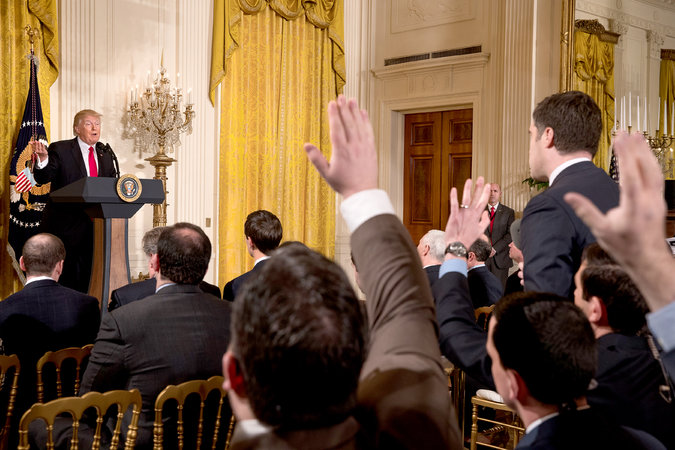
The president called a press conference today and spoke — and jousted — with the media for more than an hour. Among the mistruths he spoke today dealt with his assertion that his Electoral College victory over Hillary Rodham Clinton was the biggest “since Ronald Reagan.”

Uh, Mr. President, no sir. It isn’t. Not by a long, long shot.

Let’s review, shall we?

1984: President Reagan was re-elected with 525 electoral votes.

1988: Vice President George H.W. Bush was elected with 426 electoral votes.

1992: Bill Clinton was elected with 370 electoral votes.

1996: President Clinton was re-elected with 379 electoral votes.

2008: Barack Obama won with 365 electoral votes.

2012: President Obama was re-elected with 332 electoral votes.

2016: Donald Trump won with 304 electoral votes.

There are the numbers. Trump’s victory wasn’t the biggest since Reagan. Oh, here are some more numbers to put Trump’s victory into, um, a little different perspective.

Clinton collected 2.8 million more popular votes than Trump. The president’s victory was sealed in three states — Wisconsin, Michigan and Pennsylvania — which he won by a total of 77,000 votes, out of more than 120 million ballots cast nationally.

If Clinton had won those states, she would have been elected. She lost them to Trump. I am acutely aware that Trump won the contest where it counted, so please spare me the lecture and accusation that I’m still choking on all those sour grapes.

A reporter — NBC’s Peter Alexander — today challenged Trump’s statement about the size of his victory. The president said he was referring only to “Republican” presidents. Oh. I see. Then Bush 41’s victory didn’t count?

Trump’s bogus assertion about the size of his victory isn’t a big deal by itself. It does illustrate the man’s propensity for playing fast and loose with facts.

Perhaps, though, they merely are those “alternative facts” to which his senior policy adviser, Kellyanne Conway, referred.

Chaos, confusion still reign in White House

Amid the chaos and confusion that continues to swirl through the White House, Americans are being “treated” — if you don’t mind my use of that verb — with an example of ignorance of how our federal government is supposed to work.

The rhetoric of a young firebrand working inside the Trump administration offers a classic case in point.

Stephen Miller — a senior policy adviser — was trotted out this past weekend on the news talk shows in which he declared that “unelected judges” have no business deciding matters that come before them. He said that U.S. District Judge James Robart must not “make laws” in determining that Donald Trump’s ban on refugees coming to this country needs further review; he said the same thing about the federal appellate court judges, the 9th U.S. Circuit, who upheld Judge Robart’s decision.

Hold on, young man!

The founders created a government that entitles those judges to do precisely what they did. The president’s ruling bars refugees coming here from Muslim-majority countries. It, in effect, discriminates against people on the basis of their religion. Trump says he wants to protect Americans against “radical Islamic terrorists.” Of course, the ban doesn’t necessarily cover blond, blue-eyed Europeans who well might have been recruited by terrorist organizations to do the very thing we all want to prevent.

Miller, it should be noted, helped write Trump’s Republican presidential nomination acceptance speech this past summer in which the nominee said “I alone can fix” what ails the nation.

Actually, this isn’t a one-man game.

The Washington Post published a fascinating profile of Miller.

Here it is.

But my essential point is that Trump — who is facing a mountainous pile of potential crises so early in his administration — needs to grasp the notion that governance is a complicated process. It involves a complex set of machinery that is intended to limit the power of one man, or one branch of government. They are “co-equal branches of government” for precisely that reason.

Add to all of that the pandemonium that has erupted over the resignation of the national security adviser and questions about whether he and others in the administration covered up improper contacts with Russian intelligence officials, and you have a prescription for unmitigated disaster.

“Unelected judges” are part of the process, young Mr. Miller. If the boss is going to continue to shoot first and aim later with executive orders and tweets, then all of them had better get used to more of what the courts have delivered.

***

I have to share with you a column I saw this morning from Leonard Pitts Jr., a Pulitzer Prize-winning essayist, who takes the president down hard.

Pitts is angry with the what he calls Trump’s “so-called presidency.”

Pitts can turn a phrase … or two.

He has done so with great precision here.