Klansman statement is soaked in irony

Time for a pop quiz, ladies and gentlemen.

You ready? Here goes: What comes into your mind — immediately — when you hear the term “Ku Klux Klan”?

Time’s up.

The answer should be: hatred, bigotry, violence, virulent and vicious racism and anti-Semitism.

It is with that context established that I must offer a brief comment on a statement offered this weekend at a clash between supporters of the KKK and the Black Panthers, who gathered in front of the South Carolina state capitol to protest the taking down of the Confederate flag. The flag came down as a response to the heinous murders of nine African-Americans at a church in Charleston, S.C., by a white gunman. A young man is accused of the crime.

http://www.cnn.com/2015/07/19/us/south-carolina-kkk-black-panther-rally/index.html

The KKK and the Panthers rallied today to express different points of view of the flag.

One comment stands out, at least to me. It came from a Klansman, who told CNN: “The Confederate flag does not represent hate. A lot of Americans died for that flag,”

Ah, yes. It “does not represent hate.”

Back to my question about the Klan: What words come to mind when you hear the term?

I’ve actually covered a couple of Klan rallies. Both were in Texas; one in Orange and one in Amarillo. They took place to protest government policies that helped African-Americans. What was the predominant symbol seen at both rallies? The Confederate battle flag.

Let’s recall — if we need reminding — that the Klan has a long and infamous history of violence toward blacks and Jews. Lynching? Shootings? Arson? Cross-burnings?

And they have performed these acts while standing next to or under the Confederate battle flag. They’ve wrapped themselves in that banner. They proclaimed proudly that they stand for what the flag stands for. And that would be … ?

The Klansman is right about one element of his statement. A “lot of Americans” did die for the flag. He didn’t say, apparently, that they fought on the side that sought to tear the country apart. Why was that? Because they fought that that euphemistic principle of “states’ rights,” which was to allow states to continue the practice of slavery.

So, let’s quit slinging the horse manure around on this issue.
This is when Donald Trump’s candidacy died

Mark it down.

The weekend of July 18-19 is when Donald Trump’s presidential candidacy came to a screeching halt.

That’s the good news.

The bad news — which in reality is good news — is that (a) he doesn’t realize it, (b) he’ll refuse to realize it and (c) he’ll stay the course for as long as he can.

Trump decided to self-immolate his campaign by declaring to a conservative audience that he preferred U.S. military veterans “who weren’t captured.” That was his inimitable way of denigrating the heroic service of another Republican presidential candidate, 2008 GOP nominee John McCain.

Sen. McCain, of course, was captured by North Vietnam when his plane was shot down in 1967. He suffered grievous injuries, which weren’t treated properly his captors.

He spent more than five years in captivity. He came out in 1973, along with hundreds of other POWs, after the United States agreed to a negotiated end to the Vietnam War.

Trump, though, didn’t serve in the military. He got those deferments, allowing the war to swallow up millions of other young Americans.

He didn’t have a chance in hell of being nominated by the Republican Party, let alone getting elected as the 45th president of the United States.

This latest bit of verbal excess just seals the deal.

If his chance of nominated was next to nil before, it’s now really at — or below — that level today.

But, heck, don’t drop out, Donald. Some of your GOP foes think you’ve disgraced yourself enough. Get out, man, they’re imploring him.

Stay in, Donald. Another fellow GOP candidate, Sen. Ted Cruz of Texas, thinks The Donald deserves to be heard. I do, too.

However, he’s going to find it harder and harder to get his message heard above the laughter — and the boos.

Yes, John McCain is a hero

I think I’ve officially heard all there is to hear.

Of all the things that have poured out of Donald Trump’s mouth, he finally said more than most Americans can handle.

He actually said that U.S. Sen. John McCain does not qualify as a war hero. He really and truly denigrated the service McCain performed for his country.

http://www.msn.com/en-us/news/politics/donald-trump-attack-on-john-mccain-war-record-is-new-low-in-us-politics/ar-AAdbgjc

Is there anything that Trump will not declare off limits? Has this political buffoon said enough?

I am not a political fan of Sen. McCain. I do not like his world view. I didn’t vote for him when he ran for president in 2008. But as God himself is my witness, I truly admire this man’s service. I consider him to be a heroic figure.

And for Trump to ignite the firestorm that he’s ignited through utterly careless musings about someone who — in what passes for his political judgment — criticized him for earlier statements, well, that goes so far beyond the pale it defies Americans’ ability to express their rage in harsh enough terms.

Not only that … yes, there’s more, Trump did not serve in our nation’s military. He obtained student deferments during the Vietnam War. By my standard, Trump qualifies as a “chicken hawk,” who has zero standing to comment on someone who did serve — and did so with remarkable valor and, oh yeah, heroism.

McCain never has leaned on his service during the Vietnam War to promote a political cause. He was shot down over Hanoi in 1967; he suffered serious injuries as he parachuted into a lake in the middle of the city. He was taken captive, thrown into a cell, beaten nearly to death, suffered other forms of torture. He was placed into solitary confinement, brought out, beaten and tortured some more and then returned to solitary.

He was given a chance for an early release as a POW; the North Vietnamese thought they could get political mileage out of releasing young McCain early, as his father was a senior naval officer who helped shape U.S. war policy in Vietnam. McCain declined to be released. His payback for refusal? More torture.

That doesn’t qualify him as a hero?

Donald Trump has lost his marbles.

Former Texas Gov. Rick Perry, another GOP presidential candidate and an Air Force veteran, said Trump’s attack on McCain is a “new low in American politics” and demanded that Trump “immediately withdraw from the race for president.”

Aww, heck. Trump ought to stay in the race — and keep shooting off his mouth.

Get rid of gun free zones? Really?

Back in 1995, when the Texas Legislature was debating whether to allow Texans to carry concealed handguns, the publisher for whom I worked posed an interesting question to our state senator.

“Why don’t you just allow folks to carry guns on their hips and walk around the State Capitol?” he asked the late Teel Bivins, a Republican and an avid proponent of gun-owners rights.

I cannot recall Bivins’s response. Perhaps he thought it was a rhetorical question.

But it comes to mind now as I read this essay about gun free zones in the wake of the Chattanooga murders of four Marines and a sailor.

http://www.politico.com/magazine/story/2015/07/gun-control-us-capitol-120310.html?hp=t2_r#.VapPCbnbKt8

Why not allow guns into the U.S. Capitol?

Joel Zeitz, the author of the essay, noted that Donald Trump sounded like a mainstream Republican when he said we need to “get rid of gun free zones.” According to Trump, the men who died at the hands of the shooter didn’t have a chance because they were in a zone where gun are prohibited, which of course didn’t stop the shooter from sneaking a gun into the place.

The U.S. Capitol has seen gun violence erupt. People have gotten past security systems with weapons. They have harmed individuals and damaged the structure.

Would guns inside the Capitol stopped the incidents? I have trouble believing they would have worked.

Texas’ concealed handgun carry law, by the way, hasn’t been the disaster some of us thought it would be when the Legislature enacted it two decades ago.

However, this argument that more guns makes us a safer society has yet to be proven — at least to me.

Shooting ignites knee-jerk reaction

Here come the knee-jerk activists.

Someone twists off, goes on a shooting spree, kills four U.S. Marines and, oh yes, he happens to be Muslim.

How do some of us react: Curtail immigration from Muslim countries. Why, shoot, let’s just ban them altogether.

https://www.washingtonpost.com/world/national-security/chattanooga-shooter-came-from-middle-class-muslim-family/2015/07/16/815c39c2-2c04-11e5-bd33-395c05608059_story.html

Mohammad Abdulazeez grew up in Chattanooga, Tenn., the son of a conservative Muslim couple who came here when the young man was infant. He now is accused of killing four people in a shooting rampage.

What fueled the gunman’s anger? Was he determined to carry out a jihad against the “infidels”?

Who in the world knows what triggered the outburst?

I do believe, though, that we must not react to this tragedy as if it somehow fits some still-unknown pattern.

Abdulazeez might embody all the things many Americans fear the most: a mass attack on Americans by people who are intent on killing all of us.

Then again, he might just be a disturbed young man who had a beef with someone and then snapped.

Those things happen with people of all faiths, ethnic origins or socio-economic backgrounds.

Prison is far from ‘normal’

“We have a tendency … to think it’s normal that so many of our young people end up in our criminal justice system. It’s not normal. It’s not what happens in other counties. What is normal is teenagers doing stupid things. What’s normal is young people making mistakes.”

— President Obama

Doesn’t it strike you as odd that of all the men who’ve served as president of the United States, that it took the current individual — Barack Obama — to become the first one to visit a federal penitentiary?

I find it odd. It’s a long overdue examination by the head of state and government of a key component of the federal judiciary system.

President Obama went to the federal lockup in El Reno, Okla., and told corrections something they no doubt knew but rarely spoke about out loud, in public. It was that many of the non-violent criminals are no different from other young offenders who’ve made mistakes.

Lord knows I made my share when I was much younger and much less aware of the consequences one faces for making mistakes.

http://www.msnbc.com/msnbc/president-obama-meets-non-violent-inmates-oklahoma?cid=sm_fb_msnbc

Obama talked about the explosion in the prison population. It happened in Texas, to be sure, partly because a federal judge — William Wayne Justice — ruled that overcrowding in the Texas prison system created an unconstitutional form of punishment for inmates. He ordered the state to fix the problem, so the state went on a prison-building binge — including the two units in Amarillo — to help relieve the crowding issue.

Federal drug laws became the focus of Obama’s visit to the El Reno lockup. The sentencing guidelines put non-violent offenders into prison, often serving life sentences. He recently commuted the sentences of 46 non-violent offenders and went to Oklahoma to talk up the need to rethink these sentencing guidelines.

That it took so long, though, for a sitting president to step inside one of these prisons is mind-boggling in the extreme.

Is it “normal” for teenagers who make mistakes to pay for them by spending the rest of their life behind bars?

The president said “no.”

I happen to agree with him.

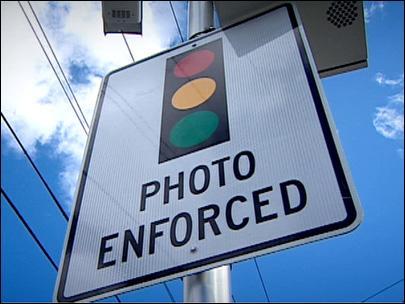
Red-light cameras don’t blink

red light cams

A legal challenge to Texas cities’ deployment of cameras to stop red-light runners has come to an end.

It was tossed out. The case had been filed out of Fort Worth, but it affected all the cities that are using the cameras.

That includes Amarillo.

Now, can we just stop yapping and yammering about these devices?

I continue to support the use of the cameras. It’s not that I cherish the thought of people getting pinched. It’s that I hope knowledge of the cameras at specific intersections eventually will deter motorists from running through the red lights and putting other motorists and pedestrians at risk of getting injured … or killed!

I keep falling back on the comments delivered by my one-time favorite Amarillo City Council member, Ellen Robertson Green. She scolded protesters who were griping about the red-light cameras, telling them flat out that all they to do to avoid getting caught was not obey the law and not run the red lights.

State law is clear: Money raised by the devices must be dedicated to improving traffic in the city. The Legislature tinkered and toyed with the idea of revoking cities’ ability to deploy the cameras. Then it backed off for lack of support. That was a good deal.

Cities should be allowed to determine whether to use the cameras if they perceive a red-light running problem. Amarillo identified such a problem and took steps to deter it.

Let’s allow the system to keep working.

Better take a hard look at border security, eh?

Juan Francisco Lopez-Sanchez is accused of killing Kate Steinle in a horrific act of random violence.

It happened in San Francisco, a “sanctuary city.”

Lopez-Sanchez was in this country illegally. What’s worse — and a lot worse, at that — is that he’d been deported four times, sent back to Mexico. His fifth illegal re-entry resulted in Steinle’s shooting death.

http://www.usatoday.com/story/opinion/2015/07/15/immigration-sanctuary-shooting-steinle-lopez-sanchez-editorials-debates/30100967/

This case has resonated on several levels, each of which is worthy of comment.

First, there must be some head-knocking occurring at Immigration and Naturalization Service, Border Patrol and Homeland Security offices. How in the world does someone keep getting into this country after getting caught and deported multiple times?

Second, it is time to re-examine this whole concept of “sanctuary city,” which is aimed at giving immigrants a way to avoid being captured by federal immigration authorities. As USA Today said in an editorial: “San Francisco is one of nearly 300 cities and counties across the country with sanctuary laws or policies aimed at separating federal immigration enforcement from local policing, in order to build trust between immigrant communities and local police. The reasoning goes like this: If immigrants, including millions of undocumented ones, see local police officers as a tool for deportation, they will not report crimes or come forward as witnesses, even when they are victims, and public safely will suffer.”

That reasoning did not work in this tragic case.

Third, President Barack Obama has been oddly silent about Steinle’s death. Why is that, Mr. President? Your critics make a valid point that you should be leading the nation in mourning the death of a young woman whose life was taken by someone who shouldn’t have been here in the first place.

Am I going to join the Donald Trump amen chorus in implying that most illegal immigrants are here to commit the kind of act that Lopez-Sanchez is accused of committing? Not on your life.

But the system failed us badly. A young woman’s family is grieving. A nation needs answers.

Ready for citizens panel to monitor Amarillo PD?

Let’s go carefully on the notion of setting up a citizens advisory panel to monitor the activities of the Amarillo Police Department.

The issue came up this week in a public hearing. Some residents have complained that the police department has committed acts of “brutality,” mostly against minorities and poor residents.

http://www.newschannel10.com/story/29558538/police-brutality-claims-stem-oversight-committee-proposal

Let’s hear the examples, chapter and verse.

The allegations leveled at the police department contain some tough language. The very word “brutality” connotes something quite a bit more severe than an arresting officer twisting a suspects arm a bit too aggressively while slapping on the handcuffs.

I don’t object to a citizens panel being selected to review cases of alleged brutality when they occur. But you’ve got to be careful in selecting individuals to serve on this panel. They need to be as impartial and fair in their assessment as, say, someone selected for a trial jury. There cannot be any predisposition of bias either for or against law enforcement officers.

First things first. There needs to be a compelling need for such a panel to exist. So far, I haven’t heard it.

Randall County Criminal District Attorney James Farren — himself a former police officer — noted that the system already has a “checks and balances” provision built in. He said he’s prosecuted only four police officers during his more than two decades as district attorney. OK, fine. That might be the result of grand juries’ reluctance to indict officers.

This topic has been broached once again.

Let’s talk about it. Carefully and with great care.


Granddaughter: how sweet the sound of the word

Emma 2014 Halloween

We got into the car this morning to run a couple of errands.

As we pulled out of the driveway, I turned to my wife and told her how excited I was about the next time we’d see our granddaughter. She agreed, naturally. Duh?

Then I reminded her of a couple of things: One was how when she and I were newly married we got a major kick out of referring to each other as “husband” and “wife.” I guess it’s common for newlyweds to do such things. We giggled at the sound of the words when we were so very young.

Well, you know what? Two years and four months into grandparenthood, we’re still giggling at the sound of “grandma” and “grandpa” and, oh yes, “granddaughter.” I reminded my wife of that as well.

Little Emma Nicole has turned us into mush.

OK, no surprise at that, correct? Every grandparent we’ve met along our long journey together has told us essentially the same thing: Your grandchild will change your life. You’ll become someone you don’t recognize. He or she will wrap you around every little finger of his or her hand … repeatedly, and then even some more after that.

I’m now able to proclaim that Emma has done that. In spades.

My sister, who’s got a bunch of grandkids — and great-grandkids — has told me time and again about the impact that this next generation of children brings with them.

It’s beyond explanation.

I keep wishing for the impossible at this stage, which is: How do we keep Emma this age, this adorable, this precious?

I don’t really and truly want that to happen, given that I know it won’t. My strong hunch is that she’ll become even more adorable and more precious.

Meantime, I never intend to lose touch with how good it feels to say — and hear — the words “our granddaughter.”

Commentary on politics, current events and life experience