Gov. Abbott sheds the dogma … and heads to Cuba

cuba

Texas Gov. Greg Abbott is using his office the right way while steering away from some of the dogma we’ve been hearing from those in his party about a particular issue.

Abbott is going to Cuba next week on a mission to promote Texas-Cuba trade.

Abbott is a proud Republican. But unlike some of his GOP brethren, he is putting common sense and what I call “enlightened self-interest” ahead of posturing.

Some prominent Republican politicians — namely Texan Ted Cruz and Floridian Marco Rubio, who are running for president — have called the re-establishment of relations with Cuba virtually a pact with Satan himself. These two Cuban-Americans still seem to fear the island nation that is governed by dedicated communists.

Why, how can President Obama grant those commies any favors while they still have one of the world’s worst human-rights records? That’s part of the mantra we’ve heard from some on the far right about this sensible diplomatic initiative.

Gov. Abbott often has joined some on the far right on a whole host of topics with which to criticize the president.

Not this time. Good for him. Better still, good for the state he governs.

The Texas Tribune’s Aman Batheja reports: “Texas was once a leading exporter to Cuba in a quiet partnership that helped produce hundreds of jobs and millions in revenue for the Lone Star State. Even following the implementation of the U.S. trade embargo more than 50 years ago, the relationship continued to thrive for decades.”

That stopped in the early 1960s when the United States ended all relations with Cuba in the wake of Fidel Castro’s takeover of the island nation’s government. The deep freeze in U.S.-Cuba relations lasted through eight American presidencies; meanwhile, Fidel Castro and his brother, Raul, have remained in power.

President Obama made the right call to restore relations. The Cold War is over. Cuba presents no threat to the United States. It’s still dirt poor. Yes, it’s still run by communists, but Cuba is far less of a threat to U.S. interests than, say, the People’s Republic of China, a nation with which we’ve had relations since 1978.

Texas has a lot of goods and commodities it can sell to Cuban interests. Let me think … what can we sell them from, oh, this part of the state? Oh, how about some beef, or maybe cotton for starters?

Travel safely, governor.
 

Lapel pins, anyone?

comparepin3

Let’s talk for a moment about lapel pins.

They’ve become something of a political statement for politicians. Have been since 9/11. Why bring it up today?

Well, a friend of mine posted something earlier today on Facebook that spoke to a ban on lapel pins by ABC News. The friend of mine who shared the post, I presume, was aghast at the decision.

I think it was an old post. I had heard years ago about broadcast and cable news networks banning the display. The new executives’ view is that journalists shouldn’t advertise their bias in favor of any cause — even if it speaks to their own country. It’s not a big deal. I get what the news execs mean.

But back to the point.

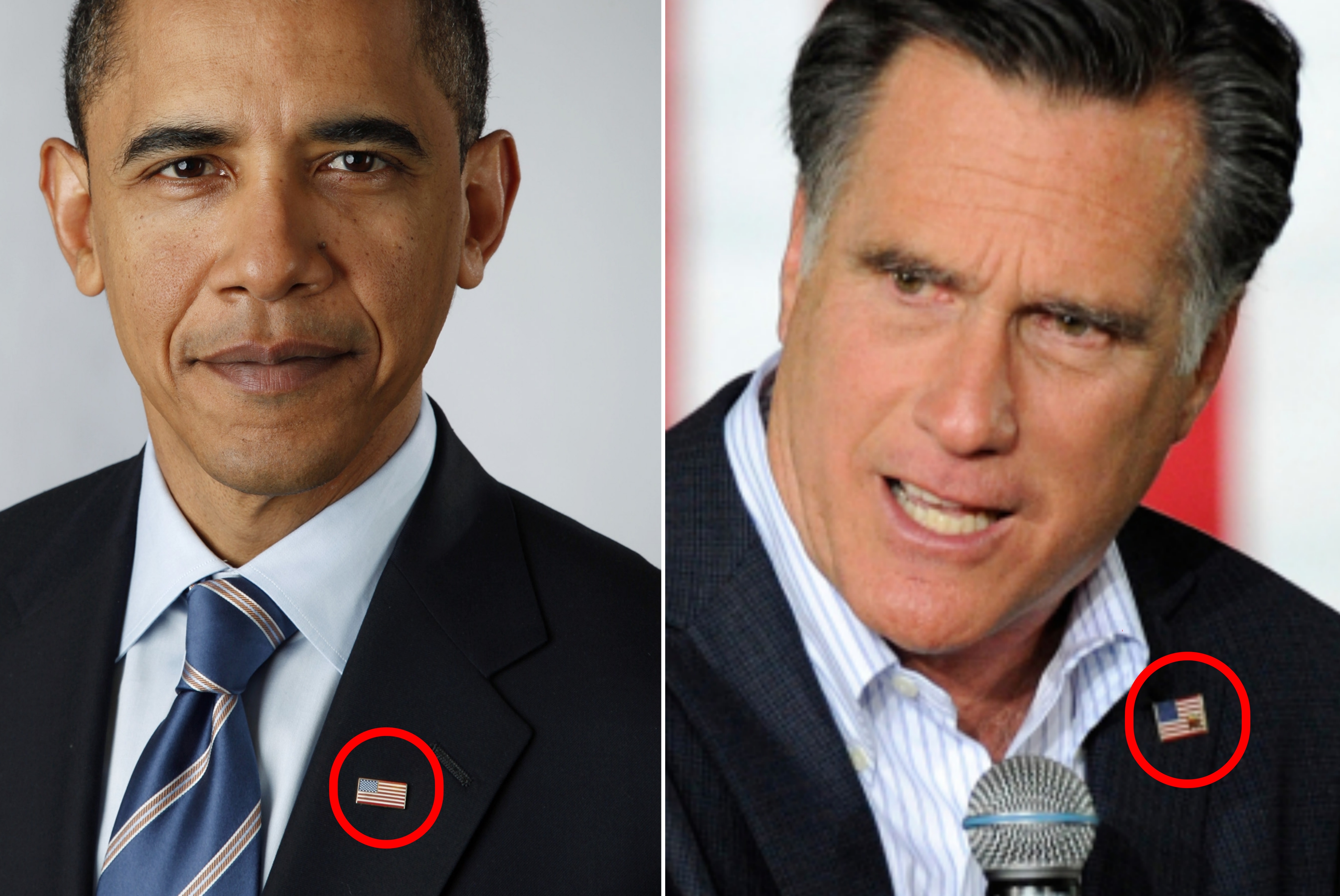
Lapel pins have become part of politicians’ uniform of the day. We see them wearing these little pins depicting U.S. flags. They’re intended to demonstrate the pols’ love of country. They began showing up on politicians’ clothing days after the terrorist attacks.

Journalists aren’t politicians, quite obviously. So, when an employer mandates that journalists — whether they’re print or broadcast journalists — shouldn’t wear the patriotic symbols, they’re trying to walk the straight-and-narrow line right down the middle.

Politicians, though, wear them because they seem to suggest that wearing a lapel pin makes them look more patriotic than those who don’t.

Frankly, the flag symbols on a politician’s jacket doesn’t mean diddly-squat in terms of their patriotism.

When the terrorists flew the airplanes into the World Trade Center and the Pentagon, politicians all across the land rose up to declare their love of country by wearing the flags on their jacket. Republicans do it. So do Democrats. I like wearing them, too, but not because I have a statement to make. I think they look nice on a jacket.

Let us not get all worked up, though, when we see these social media posts about media policies regarding how journalists should present themselves to the public. The absence of a patriotic lapel pin should not be construed as a lack of love of country.

Huey to ‘land’ at Panhandle War Memorial

randall_county_vet_memorial_a

Ernie Houdashell is the master of the deal.

The Randall County judge was chief of staff to state Rep. John Smithee and before that worked for U.S. Rep. Beau Boulter. His job description in both of his prior lives was to make things happen for the seasoned politicians.

He also is a proud veteran of the Vietnam War.

Houdashell has just scored another coup to honor those who served as he did during two tours in ‘Nam. A Vietnam War-vintage Huey helicopter has been towed from Arizona to the Texas Panhandle.

Eventually, the old bird is going to get gussied up, painted, detailed out and put on display at the Texas Panhandle War Memorial. Houdashell has worked for years to bring a Huey here, to show it off and to have it serve as part of an eternal display to honor those who served in Vietnam.

I’m proud of Houdashell for showing the persistence needed to bring another display to the War Memorial, which is slated to grow into a truly spectacular exhibit for visitors and those who live here.

Fundraising has begun on a 12,500-square foot education center that will be built at the War Memorial, next to the Randall County Annex at the corner of South Georgia Street and Interstate 27. The center will serve as an interactive exhibit to educate visitors on all the nation’s conflicts.

The memorial already contains stone tablets describing the conflicts dating back to the Spanish-American War; the tablets also contain the names of those Panhandle residents who died in service during those conflicts.

Houdashell developed his interest in aviation the hard way. He served in the Army and on his second tour in Vietnam served on a flight crew aboard a Huey. He remains a licensed pilot. Indeed, a few years ago, he negotiated for the delivery of an F-100 Super Sabre fighter jet that had seen service during the Vietnam War; the F-100 is not on display at a corner of the War Memorial property.

The county judge isn’t certain when the Huey will be ready for display. It was simply enough for him to negotiate for its delivery to the Panhandle.

As a fellow Vietnam veteran, I will await eagerly the day when the Huey is delivered to the Panhandle War Memorial, where it can enhance what has become a wonderful tribute to those who have defended our nation.

Thank you, judge, for your hard work.

City still needs water expertise

atkinson

Jarrett Atkinson brought some rare knowledge to his job as Amarillo city manager.

He’s no longer in that spot, but the need for that knowledge remains.

Atkinson is a highly regarded expert on water management and acquisition. Prior to taking over as city manager he served as an assistant to the then-manager Alan Taylor; and prior to that he served as the chief water-planning guru for the Panhandle Regional Planning Commission.

In a six-minute interview with my friend Karen Welch at Panhandle PBS, one gets a sniff of Atkinson’s expertise on water issues as he and Welch talk about some of the challenges facing city government.

Take a look.

Atkinson was essentially forced out of his job by a dramatic change at the top of City Hall’s governance. Three new City Council members were elected in May and they brought a brand new approach to governing. Atkinson is too much of a gentleman to have said it out loud and directly when he tendered his resignation, but it’s fairly clear he couldn’t work with the new council majority.

The city’s downtown revival is going to proceed. Where it will end up remains anyone’s guess at the moment.

It’s that water issue that also must remain at the top of the city’s agenda. Without water, Amarillo cannot function. Atkinson speaks with easy eloquence about the technical issues relating to drilling for the water, pulling it out of the ground and quenching the city’s thirst for well past the foreseeable future.

The city’s near- and long-term water needs will be met through the purchase of water rights, Atkinson assures Panhandle PBS viewers.

That’s fine. The city will miss his knowledge, though, on managing that priceless resource.

My hope is that the next city manager — whether it’s the current interim boss, Terry Childers  or someone else — brings water management knowledge to the job, even though Atkinson’s depth of expertise on the subject will be difficult to duplicate.


PETA will get angry, but …

pest-action

I am married to a territorial woman.

She loves God’s creatures as much as anyone I know — except when they invade our home.

Then she becomes ruthless. Stay out of my space, she says with extreme prejudice.

A mouse invaded our pantry a few days ago. It’s now gone. Is it dead as I write this? I do not know for a fact that it is. I’ll assume it will be in due course.

The little critter had feasted on some pasta in our pantry, scattering the noodles all over one of the shelves.

That did it, according to my wife. We pulled out some mouse traps, the kind with the sticky glue; mouse walks onto the glue to get at the bait and, oops!, it gets stuck.

What about our 13-year-old cat, Mittens? Well, there once was a time when she was a merciless mouse killer. She has lost interest in that endeavor as she has entered her golden years. I’ll give her a pass, as she’s earned her keep through previous pest control.

People for the Ethical Treatment of Animals won’t like what I’m going to say next, but that’s too bad. PETA can take it up with my wife … and good luck with that!

I put some peanut butter on the trap. Little Mickey found it during the night. It got stuck on the glue.

I grabbed the mouse and the trap, put it all in a plastic bag, tossed the bag into a larger trash bag, tied the bigger bag up and took it all out to the Dumpster in the alley behind our house.

Hey, I don’t like disposing of God’s little creatures, either.

It’s just that I dislike them eating my food even more.

Sorry, PETA. Deal with it. I’m just doing what I’m told.


Evolution, creationism? Why not both?

Problems-with-the-Creationism-vs-Science-Debate

Polls occasionally drive me a bit crazy.

Take the one discussed in a Slate.com article that says young Americans favor Charles Darwin’s theory of evolution over the belief that God created the world in six calendar days.

May we hit the pause button for a moment?

I am a Christian. I’ve read the Bible many times in my life. I know what the Bible says about how the world came to be.

I also believe that the world was populated by dinosaurs and other creatures for zillions of years before human beings made themselves known.

Thus, I believe that the two ideas are not mutually exclusive.

Is it possible that God created the world and allowed it to evolve into what it has become? I believe that is precisely what occurred.

The Slate article was written by Rachel E. Gross, who it is clear to me believes exclusively in Darwin’s theory. She writes: “Now, at long last, there seems to be hope: National polls show that creationism is beginning to falter, and Americans are finally starting to move in favor of evolution. After decades of legal battles, resistance to science education, and a deeply rooted cultural divide, evolution may be poised to win out once and for all.”

She adds: “The people responsible for this shift are the young. According to a recent Pew Research Center report, 73 percent of American adults younger than 30 expressed some sort of belief in evolution, a jump from 61 percent in 2009, the first year in which the question was asked. The number who believed in purely secular evolution (that is, not directed by any divine power) jumped from 40 percent to a majority of 51 percent. In other words, if you ask a younger American how humans arose, you’re likely to get an answer that has nothing to do with God.”

Read the whole story here

I get the divide over how to teach science in classrooms. Fundamentalists want to teach creationism as it is written in the Bible. They also want to present evolution as just as much of a theory as creationism. This issue has been kicked around at the highest level of public education governance in many states, none more so arguably than in Texas, where we elect State Board of Education members who run for the office as politicians.

Creationism, though, is a religious doctrine. Evolution is a secular one. That doesn’t mean — to my way of thinking — that one of them is invalid.

What it means to me is that the biblical version of creation was written as a metaphor. “Days” can’t be measured in 24-hour increments; for that matter, it might be possible that every element of time takes on meanings that we cannot comprehend.

Does any of this discount the role that God played in creating our world? Not in the least.

As for whether we should teach creationism in our public schools alongside evolution, well, I do not believe that’s appropriate.

Creationism should be taught in places of worship, which I also believe also is part of God’s plan.

Boy, family seek $15 million … for what?

ahmed

Ahmed Mohamed once was in the news.

He was doing a science project for his school in Irving, a Dallas suburb. Ahmed brought a homemade clock to school. But the clock was confiscated, Ahmed was detained, questioned intently by school officials and police who thought he had made a bomb. He then was suspended.

The incident brought a lot of attention because Ahmed and his family are Muslim.

Mr. and Mrs. Mohamed were so upset — and rightfully so — that they took their son out of school and moved to Qatar.

That should have been the end of the story.  It isn’t.

The family is now seeking reparations from the school district totaling $15 million.

That’s right. Fifteen million bucks! They also want a written apology from the school district.

Ahmed’s reputation, they family says, has been damaged beyond repair. They want the Irving district to pay them.

I’m generally in favor of allowing plaintiffs the right to sue for as much as they can get … within reason, of course.

However, not for something like this.

Ahmed’s detention and the publicity he got over the bogus bomb scare brought him a great deal of positive attention. President Obama invited him and other science students to the White House for an astronomy demonstration project.

Ahmed’s damages, such as they are, pale in comparison to what his parents’ reputation will endure by making such an unreasonable demand for reparations.


We are a nation of refugees

founders

The debate over how — or whether — to welcome refugees to our land is continuing at full throttle.

It is dismaying to hear talk from presidential candidates that we should slam the door shut on Syrians — or Muslims — out of fear that some of them might be terrorists intent on harming Americans.

President Obama has declared several times, “That’s not who we are.”

Well, who are we?

By my reckoning, we are a nation founded and built by refugees.

You’ve learned about these individuals. They sailed to the New World to flee religious and political oppression. They came here in search of a new life. They encountered the indigenous population here and were met with mixed feelings by their new “hosts.”

The refugees persevered throughout most of the 17th century and into the 18th century. They rebelled eventually against the empire from which they had fled. They launched a revolution. The fighting ended in 1781 and a nation was created.

Those refugees then crafted a government built on a document that specified certain things. One of them would be that they would apply no religious test for those seeking political office.

However, some politicians today actually have said in the current climate that people of a certain religion are not “qualified” to seek public office. That’s not who we are, either.

Do we intend to live in fear? Are we doing to forsake the very principles on which those first refugees founded this great nation?

How about we take a break, look inward at just who we are as a people — as a nation?

How might those first refugees think of what has happened to their descendants and their reaction to world events?


Time to suspend politics

political-debate

The business card I have been handing out for some time now talks about High Plains Blogger’s intent, which is to comment on “politics, current events and life experience.”

Well, dear reader, I’ve made a command decision regarding this blog.

I am suspending the “politics” part of this blog’s mission effective on Thanksgiving Day. My intention is to stay out of the political dialogue through Christmas. Heck, I might be inclined to wait until New Year’s Day before re-entering the fray.

Why the change?

I am weary of the anger and the nonsense that’s coming out of the mouths of all the presidential candidates … in both major political parties. What’s more — and this is even more to the point — I am weary of the back-and-forth that has ensued, not just among the candidates but also among their legions of supporters and opponents.

I’ve at times entered the fray with my own commentary, only to be sniped at by those who disagree with me. I don’t mind the disagreement. I’ve merely had it up to here with the anger that such commentary — not just from me — has engendered in partisans on both side of the aisle.

So, High Plains Blogger is going to take a breather from all of that.

Will this blog comment on current events as they occur? Certainly. It will not, though, engage in the political discourse that emanates from those events. And by all means the blog will comment on life experience, both personal and of things the author — that would be me — observes on his journey.

Rest assured on this point: I am not giving up totally on politics cold turkey. I will continue to comment on politics through my Twitter and Facebook feeds.

I do not intend to use this blog as a forum to state my own political bias. The way I figure it, Twitter only gives me 140 characters to make a statement. That’s efficient and doesn’t require too much emotional energy on my part; plus, my tweets are posted automatically to my Facebook feed, so — pow! just like that — I’m able to perform a two-fer.

But I’m also thinking of scaling back significantly the political commentary on those two social media outlets. Nor am I going to argue any point.

So, those of you who spend a lot of time engaging others in political debate and name-calling on social media are welcome to knock yourselves out; I will not join you in that exercise in futility.

Here’s my final thought on all of this.

Thanksgiving is a time to give thanks for all that we have. I am grateful beyond measure for the many blessings in my life. Christmas? Well, that is the time we celebrate the birth of Jesus Christ. What more can I say about that?

In keeping with the Christmas spirit, I hereby refuse to be dragged into the emotional gutter by politicians whose mission is to distort the other guys’ world view.

Thanksgiving is almost here. High Plains Blogger will stay in the game for a little while longer.

After that? I’ll see you on the other side.


Refugee fight pits states vs. the feds

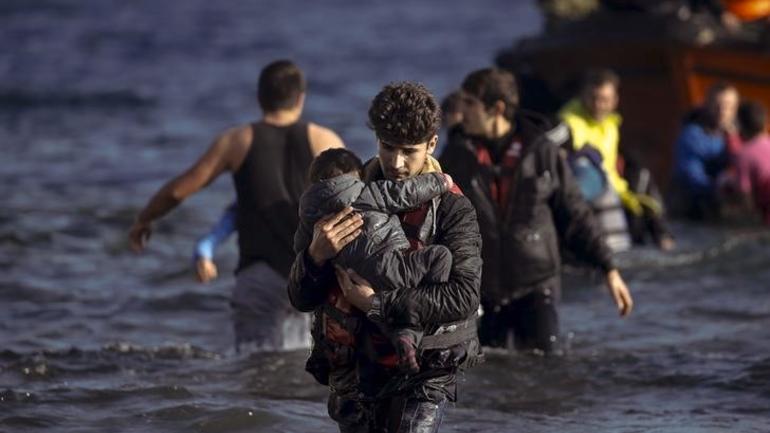
A young man carries a child as refugees and migrants arrive on a boat on the Greek island of Lesbos, November 7, 2015. REUTERS/Alkis Konstantinidis

Just about any day now I expect some governor to declare that his or her state has the right to protect residents against foreigners, that the governor is preserving the “state’s right” to self-protection.

This might become the leading back story coming out of governors’ refusal to let Syrian refugees into their states.

But according to a University of Michigan law professor — not to mention constitutional scholars all over the place — the governors don’t have the authority to supersede federal law.

The bottom line, according to Richard Primus is this: “They can’t do it. The decision to admit a person to the United States belongs to the federal government exclusively. Once a person is legally admitted to the United States, she can live wherever she chooses. States don’t issue visas any more than they declare war. Indeed, putting foreign affairs under the firm control of one central government was one of the primary motivations of the Founders in creating the Constitution in the first place.”

Primus argues, though, that governors resisting the feds — such as what Texas Gov. Greg Abbott has done fairly routinely — makes good politics, even though it runs directly counter to what the law allows.

Primus writes that the states do have some say in refugee resettlement: “That’s not to say governors are totally powerless to shape the flow of refugees. There are things states can do to make themselves less attractive destinations. Most refugees need help getting their lives restarted—housing, language education, employment leads, and other social services. A fair amount of that resettlement work is run through state social-service agencies with the support of federal dollars. The states are the one with the boots on the ground in education, housing, and so forth—and they could simply decide not to take the federal money and not to provide resettlement services. Several governors have actually taken this line, saying that they’ll cease providing resettlement assistance.”

But to declare categorically that Syrians — or any other foreigner — cannot come to this country? That’s the federal government’s call.


Commentary on politics, current events and life experience