Tag Archives: Barack Obama

Justice Sandoval, anyone?

sandoval

You’ve got to hand it to the White House media machine.

It puts out a report that has Washington all a-flutter, even if it appears to be the longest of long shots.

Or is it?

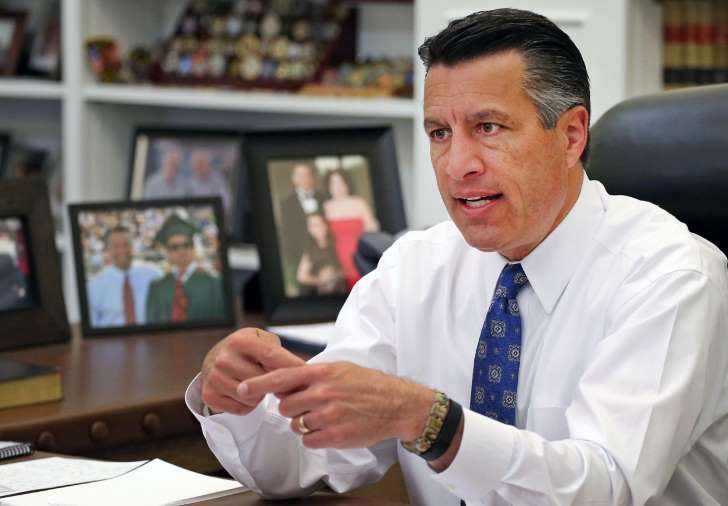
Nevada Gov. Brian Sandoval is being considered for that coveted spot on the U.S. Supreme Court.

Two things about Sandoval make this a remarkable consideration.

One: He is a former U.S. district judge whom the Senate confirmed overwhelmingly.

Two: He is a Republican.

Sandoval being vetted

It’s the second part of Sandoval’s resume that is most intriguing.

GOP senators, led by Majority Leader Mitch McConnell, have said they won’t consider anyone for the spot that President Obama wants to fill to replace the late Justice Antonin Scalia.

But are they really and truly going to slam the door shut on one of their own Republicans, someone they’ve endorsed already for a lower court post?

Sandoval is reportedly a moderate Republican. That, of course, doesn’t fit the profile desired by so many of the hard-right senators who will have to vote on whomever the president selects.

The chatter already has suggested that the president is going to nominate a centrist. He’ll forgo an ideological battle in order to get someone seated.

Gov. Sandoval is a long way from being nominated, let alone being considered for the job.

It makes me wonder: Is the president trying to stick it in the ear of the folks with whom he’s been fighting throughout his entire presidency?


Oh, that silly thing called ‘public comment’

bidenjoe_102015getty

A member of my family challenged me earlier today to recall a statement from a politician that seemed to contradict what President Obama has said about his upcoming nomination for someone to serve on the U.S. Supreme Court.

The president wants the Republican-controlled Senate to give the nominee a fair and thorough hearing and then a vote in a “timely fashion.” Democrats are angry that GOP senators are pledging that whoever gets the nod won’t get a committee hearing, let alone a vote.

One of those angry Democrats is Vice President Joe Biden.

Oh, but wait. He said something different in 1992 when a Republican was president. Then-Sen. Biden said President George H.W. Bush shouldn’t get a Supreme Court nominee approved in an election year.

My family member brought that statement to my attention and asked me whether I opposed it then.

My answer? I couldn’t remember the statement, let alone what I thought about it at the time.

White House defends Biden

The vice president has said that the statement has been “taken out of context.” Biden says that he added later in his Senate floor remarks that he’d consider a nominee if he or she were a moderate; Biden chaired the Senate Judiciary Committee at the time.

I, too, believe the Senate should consider a presidential appointment to the Supreme Court to fill the vacancy created by the death of Justice Antonin Scalia.

Which brings me back to where we started.

We hear so many things through so many channels, venues, forums and information-delivery systems that most of us can’t remember who said what, when they said it and in what context they said it.

If I’d heard it at the time I likely would have condemned it. However, that’s a hypothetical event, which politicians say they dislike. I’ll concede that I probably didn’t hear Sen. Biden say what he’s now acknowledged he said.

Sure, Biden would be wrong — if he favored obstructing future high court nominations and left it at that. He says now he had more to say than what’s being reported.

Fine …

None of this justifies today’s Senate leadership vow to obstruct the current president from filling a seat on the Supreme Court.

Americans have already decided who gets to choose

Senate Majority Leader Mitch McConnell, R-Ky., center, is joined by, from right to left, Majority Whip John Cornyn, R-Texas, Sen. John Thune, R-S.D., Sen. John Barrasso, R-Wyo., and Sen. Roger Wicker, R-Miss., as he speaks with reporters following a closed-door policy meeting on Capitol Hill in Washington, Tuesday, Feb. 23, 2016. The Senate will take no action on anyone President Barack Obama nominates to fill the Supreme Court vacancy, Senator McConnell said as nearly all Republicans rallied behind his calls to leave the seat vacant for the next president to fill. His announcement came after Republicans on the Senate Judiciary Committee ruled out any hearing for an Obama pick. (AP Photo/J. Scott Applewhite)

What part of the American electoral process don’t U.S. Senate Republican leaders understand?

Majority Leader Mitch McConnell said “the American people should decide” who gets to make the next appointment to the Supreme Court.

Texas Sen. John Cornyn of Texas, a member of the Senate Judiciary Committee, has echoed that sentiment.

McConnell said the Judiciary Committee will not conduct any hearings to decide whether to confirm whomever the president nominates. It’s malarkey, man.

OK, this isn’t an original thought, but it’s the best one I can come up with.

Americans already have decided who gets to fill the vacancy created by the sudden death of Justice Antonin Scalia. They decided it in two presidential elections.

Barack H. Obama won them both. He won the 2008 election by nearly 10 million votes; he was re-elected in 2012 by nearly 5 million votes.

Both times the young man gave every indication he would find someone to sit on the court with whom he — as a progressive Democrat — was ideologically comfortable. Two of his picks, Sonia Sotomayor and Elena Kagan — already have taken their seats on the court.

He gets to nominate a third individual to succeed Justice Scalia.

Yeah, he’s a “lame duck.” What difference does it make? None. He’s still the president. The Senate is still functioning.

So … let the president propose and let the Senate dispose.

Senators can stop hiding behind the cheap canard that the “American people” deserve a voice.

The people’s voice has been heard. Twice!

Why all this fuss over Gitmo?

Detainees in orange jumpsuits sit in a holding area under the watchful eyes of military police during in-processing to the temporary detention facility at Camp X-Ray of Naval Base Guantanamo Bay in this January 11, 2002 file photograph. A cache of classified U.S. military documents provides intelligence assessments on nearly all of the 779 people who been detained at the Guantanamo Bay prison in Cuba. The secret documents, made available to The New York Times and several other news organizations, reveal that most of the 172 remaining prisoners have been rated as a "high risk" of posing a threat to the United States and its allies if released without adequate rehabilitation and supervision, the newspaper said in its report late on April 24, 2011.  REUTERS/Stringer/Files (CUBA - Tags: CRIME LAW POLITICS) - RTXL0IH

I’ll admit that I’m very late in this discussion, but here goes anyway.

Guantanamo Bay — aka Gitmo — has been the subject of a lot of political discussion since it began housing terror suspects after the 9/11 attacks.

I’ve listened to the back-and-forth on all these years and am left to ponder: Why has this effort been so contentious?

President Obama said today he’s going to “change course” and move to close the detention center on the U.S. Navy base in Cuba before he leaves office. He wants to relocate the detainees to the United States.

It’s not that I fear bringing them here. They are being kept under serious lockdown at Gitmo. It’s safe to presume that whatever federal lockup gets them that they will be treated with the same seriousness.

Again, why the consternation over their detention at the military site?

The 9/11 attacks provoked a ferocious initial response from the U.S. military. It embarked on a mission to kill and/or capture as many terrorists as it could. Those who were captured were brought to Gitmo, which existed long before the terrorist attacks on D.C. and New York City.

There reportedly were abuses of prisoners at Gitmo. However, does the location of the alleged abuses matter? What if they had occurred at, say, Fort Leavenworth, Kan., where the military operates another hard-time lockup for military prisoners?

The suggestions by some foes of closing Gitmo that bringing them to the United States somehow puts Americans at increased risk doesn’t wash.

Still, the suggestions that we must close Gitmo because it somehow doesn’t comport with “American values” is equally nonsensical.

The individuals housed at Gitmo are seriously dangerous criminals who’ve been accused of committing acts of war against the United States of America. Whether they’re locked up at the island detention center or somewhere on U.S. soil doesn’t seem to matter one little bit.

Our Navy base is as secure as any of our installations.

Therefore, now that I’m awakened — finally — to this critical issue, someone will have to explain to me why it became so critical in the first place.


Act on the president’s court nominee

gettyimages-505901208-6ba58e5bee050257b43c9d62a921035a661e4702-s900-c85

I remain strongly in support of presidential prerogative.

It’s been one of my core beliefs ever since I started thinking seriously about policy, politics and government.

When I read stories over the past few days about how Senate Republicans plan to block President Obama’s pick for the U.S. Supreme Court — before even knowing who it is — it sends me into deep orbit.

The GOP is digging in. So is the White House.

In my view, the president’s constitutional authority should override the Senate’s role in this decision.

I’ll reiterate here something I hope hasn’t been lost on those who read this blog. My belief in presidential prerogative crosses party lines. This isn’t a partisan issue with me.

In 1991, Republican President George H.W. Bush nominated Clarence Thomas to the high court to replace Justice Thurgood Marshall. I stood behind the president on that pick while working for a newspaper in Beaumont. Did the president overstate Thomas’s qualifications for the court by calling the “most qualified man” he could find? Yes, he did.

But that was his call to make. George H.W. Bush was our president, who had been elected decisively in 1988. He earned the right to select someone with whom he felt comfortable. As for the allegations of sexual harassment that arose late in the confirmation process, well, I didn’t buy entirely into what was being alleged.

Four years earlier, President Ronald Reagan selected Robert Bork to the court. Was he the kind of jurist I would have picked? Heavens no! But that wasn’t my call to make. It belonged to the president. The Senate saw it differently and rejected Bork’s nomination to the court — despite Bork’s well-known brilliance and knowledge of constitutional law — on grounds that he would fundamentally reshape the direction of the Constitution.

The process worked as it was intended, even though I believed then as well in the principle of presidential prerogative.

Barack Obama is equally entitled — just as any of his predecessors have been — to put someone forward to sit on the nation’s highest judicial authority. The death of conservative icon Antonin Scalia has shocked us all. The court won’t stop functioning with only eight justices.

The larger problem, though, might lie in the Senate, where Democrats are vowing revenge if Republicans follow through with their threat to block the president’s court nominee from even getting a hearing.

The Senate could shut down. Government could stop. The upper congressional chamber could become a logjam of legislation approved by the House, which cannot become law over a dispute that Senate Republicans will have started.

For what purpose? To deny the president of the “other party” a chance to fulfill his constitutional duty, to which a majority of Americans entrusted to him twice with their votes.

Republicans want to wait for the next president to take office. They are gambling that the 45th president will be one of their own. It’s a risky gamble, though, that threatens to stymie everything else that their own constituents elected them to do — which is to govern.

The Birther in Chief strikes again

trump-is-a-birther1

Here we go … one more time.

First, the target was Barack Obama, the 44th president of the United States. He was born somewhere other than the United States, the allegation went.

Second, the target was Ted Cruz, junior senator from Texas, who actually was born in Canada to an American mother and a Cuban father.

Now it’s Marco Rubio, the junior senator from Florida, who was born in the Sunshine State, but whose parents immigrated there from Cuba.

All three men allegedly are constitutionally ineligible to run or serve as president.

The man making the assertion? Donald J. Trump, the frontrunner for the GOP presidential nomination.

Trump now says Rubio might not be eligible. His parents’ aren’t American, Trump said. Oh, wait. Rubio was born on U.S. soil. U.S. law says he’s a citizen automatically. Doesn’t matter, Trump asserts. He questions the eligibility, just as he has done with Cruz, even though U.S. law granted young Ted citizenship because Mama Cruz is an American citizen.

And the president? Well, he was born in Hawaii. Trump hasn’t stopped questioning his eligibility, either, even though the president’s late mother also was a U.S. citizen.

Trump is relying on others’ assertions. He’s using social media to send out the doubts that he denies planting. Sure thing. He’s adding plenty of irrigation to the doubts, though, by continuing to provoke needless discussion and unfounded questions about one of his opponents.

Will this latest specious assertion do any damage to Trump? I’ve noted before that I am done predicting such things. This campaign has entered a parallel universe where the normal rules of decency and decorum no longer apply.


Give Cubans the dickens, Mr. President

cuba-us-corporation-revolution_si

Critics of President Obama’s upcoming visit to Cuba ought to chill out for a moment or two.

They’re raking Obama over the coals because, they say, he’s lending “legitimacy” to the dictators who are running the island nation. They’re a bunch of commie Marxists who don’t deserve a visit from the head of state of the world’s most powerful nation, they say.

Hey, let’s take a breath.

The president is going there to continue the normalization of relations between the nations. The Cold War is over. We won. Cuba no longer presents any kind of threat to this nation. Its benefactor, the Soviet Union, receded into the dustbin more than 20 years ago.

What shouldn’t be lost is the opportunity that the president will have to tell Cuban President Raul Castro of the concerns the United States still has over the communists’ treatment of their citizens. Obama says he’ll bring it up directly. Face to face. Man to man.

Let us also be mindful that the two men will be able to speak outside of earshot of prying media representatives. Does anyone ever really with utter certainty what two leaders ever say to each other when no one is listening?

The president insists that the visit will keep the normalization process moving forward. Part of that movement must depend on assurances that the Cubans are going to do better at recognizing the rights of all human beings — and that should include their own citizens.

Look at it this way as well: Did the Texas Republican governor, Greg Abbott, just visit with Cuba on a trade mission aimed at boosting commerce between Texas and our nation’s former enemy?

Where was the criticism of that visit?


It’s all about the court balance

90

President Obama picked up the phone today and made a couple of important calls.

One of them went to Senate Majority Leader Mitch McConnell; the other went to Senate Judiciary Committee Chairman Charles Grassley. Both men are Republicans. The president is a Democrat.

The president informed the senators he intends to make a pick for the U.S. Supreme Court. And, according to White House press secretary Josh Earnest, Sens. McConnell and Grassley both voted in favor of President Reagan’s “lame duck” selection of Anthony Kennedy to join the court in 1988, which was just as much of an election year as 2016.

McConnell, though, says the current president should notpick the next justice. That task belongs to the next president, he said.

What has changed?

It’s the balance of the court. It means everything. Every single thing.

You see, the late Justice Antonin Scalia, the man Obama wants to replace, was a conservative stalwart on the court. The president is not a conservative; therefore, his appointee won’t echo the judicial philosophy of Justice Scalia.

The next justice — if he or she is approved by the current Senate before the end of this year — is likely to change the fundamental balance of the court, which has comprised a thin conservative majority.

Senate Republicans don’t want the court balance to change. They’ll do whatever they can to prevent the president from making the pick.

There’s just this one little issue that, by my way of thinking, should matter more than anything else. The Constitution grants the president the authority to make the appointment, which this president said he’s going to do. It also grants the Senate the authority to vote whether to approve or deny the appointment. It doesn’t require the Senate to act.

If the Republican-controlled Senate is going to stymie the president, then it faces a serious charge of obstruction. Senate Republicans keep denying the obstructionist label.

A failure, though, to act in a timely fashion on this appointment gives even the casual observer ample cause to suggest that, by golly, we have just witnessed a case of political obstruction.

If the president selects someone who is eminently qualified and who has a proven record of judicial moderation — which conservatives still will see a serious break with the conservative judicial record built by the late Justice Scalia — then shouldn’t the Senate give that nominee a fair hearing and a timely vote?

I would say “yes.” Without equivocation.


Justice Biden? Maybe?

biden

I’ll toss a name out there for President Obama to consider for the vacancy on the U.S. Supreme Court.

Joseph Biden.

The vice president told Rachel Maddow last night that he has “no interest” in serving on the court. The MSNBC host had asked him directly if he’d consider the appointment if it were offered. He has “no interest.”

Is that a blanket, categorical refusal to serve? No. It isn’t. It means, more or less, the same thing as when a politician says he has “no intention of running” for a particular office.

“No intention” can be parsed to mean that “no intention … at this moment.” So, when a politician says he or she has “no interest” in a particular job, one can possibly suggest that the pol is speaking in the present tense.

Biden predicted that Obama will pick a centrist. He said the president won’t likely pick a flaming liberal jurist in the mold of William Brennan to fill the seat vacated by shocking death of archconservative Justice Antonin Scalia.

He’s also said that a nominee should have GOP support.

Hmmm. Let me think. Who might that be?

Oh, how about the vice president? He’s got many Republican friends in the Senate. He’s proven his ability to work well with GOP lawmakers. He once chaired the Senate Judiciary Committee.

My hunch is that he’d be more of a moderate than a flamer.

OK, he’s also pretty long in the tooth. He might not want to stay in the public eye. The vice president has had a long public service career — and he’s just lost his beloved son, Beau, to cancer. Not only that, the president has given him a task to lead the effort to find a cure for the killer disease.

However, as a fan of the vice president, I happen to think he might be one court candidate who could pass senatorial muster.


‘Decency’ got lost amid the politics

la-na-scalia-race-20151210

This blog provokes its share of scolding from critics.

A scolding came in overnight that I want to share here. It comes from a High Plains Blogger critic who revealed something to me I should have known was there all along: Politics can blind people. It blinded me.

I wrote an earlier blog post suggesting that President Obama made the wrong call in declining to attend the funeral of Justice Antonin Scalia. I cited all kinds of “political” reasons for his decision. I looked past the obvious one.

Here’s part of what my critic noted:

“Could I add another reason or two to go? How about decency? How about respect for a high-ranking member of your government? How about to show support for the family and unity to the country in a time of loss? I guess all of those pale in comparison to the politics of it all.”

Well …

I suppose I could say that “None of us is perfect” and go on to the next topic. That would tend to lessen the sting of criticism. I won’t go there.

The individual’s comment goes on to suggest that the toxic atmosphere in Washington — and, indeed, all across the land — has tainted many people’s view of things.

I am no exception.