Tag Archives: Watergate

Happy Watergate Day, everyone

June 17, 1972 has gone down as the day when a presidency started to unravel, except that virtually no one on that very day predicted it would happen.

It started out as a “third-rate burglary.” Some men got caught breaking into the Democratic National Committee offices at the Watergate office and hotel complex in Washington, D.C.

They rifled through some files. They left. A security guard discovered the break-in and reported it to the cops.

The rest, as they say, is history.

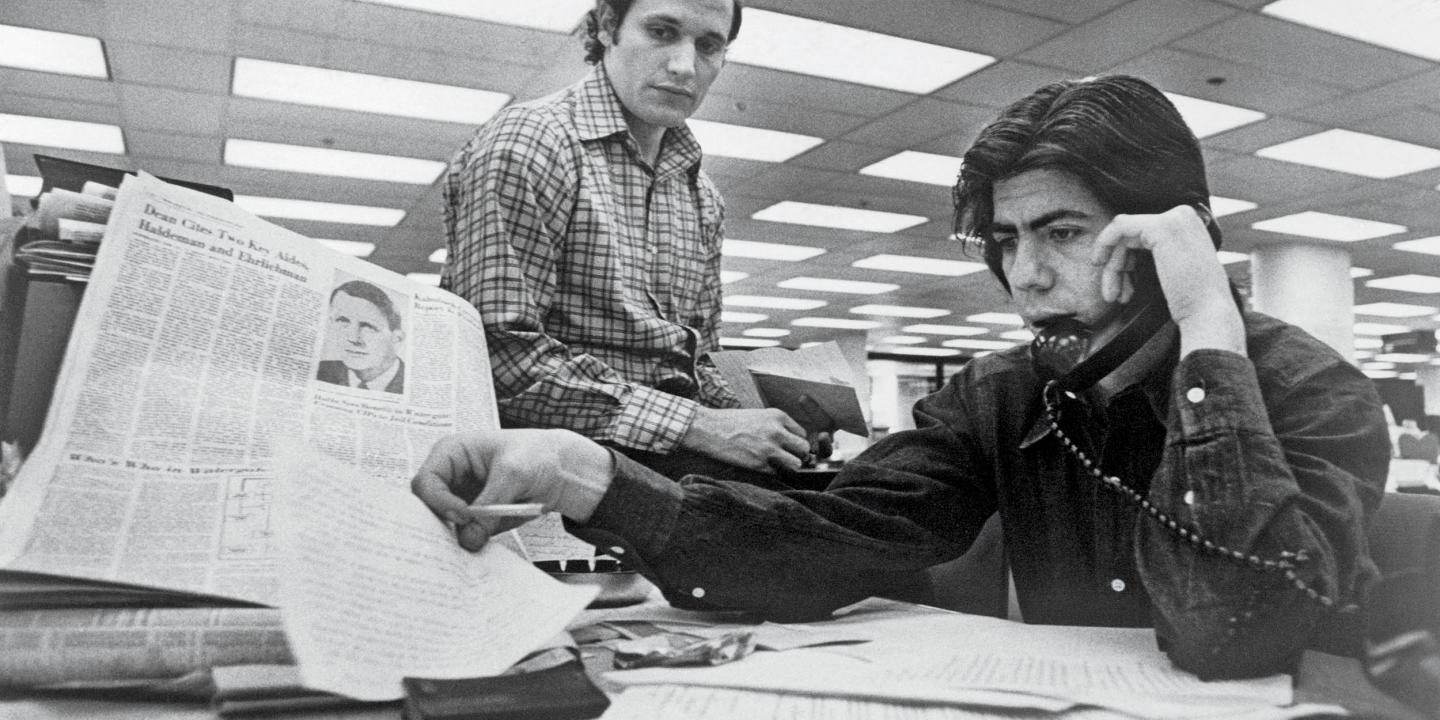
A couple of reporters for the Washington Post — Carl Bernstein and Bob Woodward — covered the event as a police beat story. Then a few tips began trickling in. The reporters then began to piece together some hints that the story was a lot bigger than a run-of-the-mill “cop shop” tale.

It turned out to be the biggest political story of the past century. President Nixon sought to cover it up. He told federal authorities to shut down the investigation. Thus, the cover-up swallowed this event whole. Revelations about the cover-up prompted the U.S. House Judiciary Committee to approve articles of impeachment; a select Senate committee had hearings as well.

It ended with the president’s resignation.

The scandal also produced a suffix that results in adding the word “gate” to every controversy — large and small — that bubbles up in the halls of power. To me, as I’ve noted before, “Watergate” stands alone. The current president recently used the term “Spygate” to describe the alleged espionage of his campaign by the FBI in 2016. Fiddlesticks! There was no spying on the Donald Trump campaign. There damn sure was no “Spygate” occurrence.

Watergate also signaled the rise of gumshoe journalism. Bernstein and Woodward would be honored by their peers for the work they did to expose the enormous level of corruption they discovered. They helped energize a crop of journalism students and young reporters who sought to serve their own communities.

The reporters who covered the Watergate scandal did their job. They held the government accountable. They revealed the truth to a public that demanded it of the media and the government.

At many levels, the Watergate scandal illustrated a dark time in our nation’s political history. It also instigated the media shining a bright light down the halls of power.

I am proud of the role the media played in revealing the truth behind the scandal that toppled a president. Yes, it produced a “long national nightmare,” as the new president, Gerald R. Ford, told us.

We awoke from it and the nation emerged stronger as a result.

Spygate? Clever, Mr. POTUS

Good grief, Mr. President.

You now have done what every cheap-seat pundit does when a controversy begins to rise to the level of a serious constitutional crisis, one that actually happened and toppled a sitting president of the United States.

You’ve attached the “gate” suffix to something that has yet to be determined to have any legs at all.

“Spygate” might go nowhere, Mr. President. In fact, it looks to me as though you have concocted something out of nothing.

Mr. President, you accuse the FBI of planting a “spy” in your 2016 presidential campaign. You imply that the FBI acted on the direction of someone within the Barack Obama administration. You offer the usual “I hope it’s not the case,” but then you say that if it’s true, we have the biggest scandal in this country since Watergate.

Holy crap, Mr. President! Why don’t you leave the “gate” reference out of it? Watergate stands on its own as the worst of the worst scandals. You might not recall these events, sir, but President Nixon’s coverup of the original crime — a so-called “third rate burglary” — was what did him in. I’ll accept that you weren’t all that interested in politics and public policy at that time; you were just coming out of college and preparing to parlay your father’s stake into a billion-dollar enterprise.

Do I need to remind you, Mr. President, that you haven’t yet produced a shred of evidence that someone “spied” on your campaign for “political purposes.”

And for crying out loud, if you’re so damn concerned about the integrity of the 2016 presidential election, why don’t you give at least a nod to the nation’s network of actual spies and intelligence experts that the Russians attacked our electoral process?

Now you’re calling it “spygate.” Give me a break.

Omarosa needs to chill out

I don’t know why I’m concerning myself with this, but I will anyway … against my better judgment.

Omarosa Manigault Newman, the former White House aide who was let go by the president — who also fired her from “The Apprentice” show he once hosted — has declared that she tried to get Donald Trump to “stop tweeting.”

She was shut down by other White House aides.

Omarosa offered a weepy assessment on an episode of “Celebrity Big Brother.” She told a fellow contestant that she fears the United States won’t “be OK” after Donald Trump’s time as president is over.

“It’s going to not be OK, it’s not. It’s so bad,” she told fellow cast member Ross Matthews while wiping away tears.

C’mon, young lady. Get a grip here.

I’m no fan of Omarosa’s former boss. I don’t want him in the White House any more than other Trump critics. But I do believe strongly in our constitutional system of government. We’ve been through plenty of crises involving presidents, lying, coverup, scandal and impeachment.

Thus, I think Omarosa (and I hope it’s OK if I refer to her by her first name) is being a tad melodramatic. I mean, she is on a TV show and she is weeping to her fellow contestant with the cameras rolling.

I feel the need here to remind us all of what a brand new president said moments after he took the oath of office. President Gerald R. Ford took office on Aug. 9, 1974, after Richard Nixon resigned in the wake of the Watergate scandal. The new president then declared, “Our Constitution works.”

Yes it did, Mr. President. Take heed, Omarosa. The U.S. Constitution still works to this day.

WH counsel saves Trump’s bacon

Oh … brother. Donald John Trump keeps stumbling toward, oh I have no idea at this point!

The New York Times has uncovered yet another blockbuster story. The president actually ordered the firing of special counsel Robert Mueller — but backed off when White House counsel Don McGahn said he would resign rather than carry out the order.

Can you say, Saturday Night Massacre II?

The “massacre” occurred in 1973 when President Nixon ordered then-Attorney General Elliot Richardson to fire special counsel Archibald Cox; Richardson quit. Then the president turned to William Ruckelshaus to fire Cox; Ruckelshaus quit as well. Up stepped Solicitor General Robert Bork to carry out the order; Bork did it. The rest, as they say, is history.

I believe in my heart of hearts that Donald Trump owes McGahn a huge debt of thanks for saving him from himself.

Can we ever keep the president’s stories straight?

He says Mueller is conducting a “witch hunt.” Then he pledges complete cooperation with Mueller’s probe into whether there was collusion between the Trump campaign and Russian seeking to influence the 2016 election outcome. The president expresses anger that Attorney General Jeff Sessions recused himself from the Russia probe. He says there’s not reason to talk to Mueller. Then he says he’ll submit to questions “under oath.” He said he has no intention to fire the special counsel.

Now comes this report that Donald Trump actually ordered Mueller’s firing, only to challenged openly by the White House’s lawyer.

Does this man — the president — have any clue as to the political destruction that would occur were he to actually fire Mueller?

My hunch is much of that damage might be done with this report.

And the saga continues …

Actually, POTUS can ‘obstruct justice’

I am not qualified to argue points of law with a lawyer, but I’ll take a brief moment to challenge a political point that Donald J. Trump’s lawyer has asserted about the president of the United States.

John Dowd says that the president “cannot obstruct justice” because “he is the chief law enforcement officer under (the Constitution’s Article II) and has every right to express his view of any case.”

I beg to differ. Dowd is old enough to remember Watergate and the trouble that President Nixon got into when he sought to obstruct justice in that investigation.

Obstruction at issue

Indeed, the U.S. House Judiciary Committee’s articles of impeachment against the president included an accusation of “obstruction of justice.” Nixon was toast at that point.

He chose to resign the presidency rather than face certain impeachment in the House and virtually certain conviction in a Senate trial.

So, can Donald Trump “obstruct justice” if the special counsel determines he did so by firing FBI director James Comey over that “Russia thing”?

I believe he can.

Are we more divided than ever?

I am old enough to have lived through some deep national divisions.

* We have the Vietnam War that tore us into two camps: Hawks vs. Doves. The Hawks wanted to fight the war to a battlefield victory; the Doves wanted out of that conflict. Riots erupted in our streets. Blood flowed.

* Then came Watergate. A team of goofballs sought to break into the Democratic National Committee offices. They were arrested and charged with burglary. Then it went downhill from there. President Nixon’s re-election committee became involved. The president sought to cover it up. Republicans stood behind the president; Democrats wanted his political head to roll. The president resigned.

* After that, President Clinton faced impeachment. Why? Ostensibly it was because he lied to a grand jury about his relationship with That Woman. Republicans were looking for a reason to impeach him. The president gave it to them. Republicans detested Clinton from the beginning of his presidency. Democrats stood firmly with him. The Senate acquitted Clinton.

* And then we had the 2000 election. President Bush was elected despite getting fewer popular votes than Vice President Al Gore. It came down to Florida’s results. They started recounting the ballots. The Supreme Court ruled 5 to 4 to stop the recount. Bush was elected with 537 votes to spare in Florida. He won the state’s electoral votes. Republicans hailed the victory; many Democrats never quite got over it.

All of those prior divisions seem to pale in comparison to what we’re witnessing now. Donald J. Trump won on a platform that preached nativism, nationalism, populism. It’s us against them. He vowed to “put America first” and to “make America great again.”

He also vowed to “unify” the nation.

The president has done nothing of the sort. Indeed, it strikes me that he’s deliberately sought to do precisely the opposite. He keeps re-litigating the election, which he won! He keeps picking needless fights with pro football players who protest police practices, with media representatives, with Gold Star families.

This is how you unify the country?

Just today, the president lined up with a GOP Senate candidate who’s been accused of sexual assault on children. Why is that? Because he’s not a Democrat! The president’s base adores this kind of rhetoric. It doesn’t matter how divisive it is and how it contradicts what the president himself vowed to do after winning a bitter, contentious, hateful campaign.

I can speak only for the eras I have witnessed. This era’s division seems deeper than anything I have watched in the past 50 years.

The worst element of this division is that its catalyst occupies the White House.

Senators concerned about POTUS and the nukes

More than 40 years ago, the U.S. Senate Foreign Relations Committee asked some tough questions about the president of the United States’ fitness to be in command of the nuclear launch codes.

President Richard Nixon was being swallowed up by the Watergate crisis. Questions arose about whether the president would do something foolish in a moment of intense political anguish.

Concerns arise once again

Flash forward. The Senate Foreign Relations Committee of today is now concerned, apparently, with the current president’s ability to handle this awesome responsibility. Senators didn’t come to any conclusions or seek any substantial change in the policy, but they got to air their concerns on the record about Donald John Trump.

As Politico reports: “We are concerned that the president of the United States is so unstable, is so volatile, has a decision-making process that is so quixotic that he might order a nuclear weapons strike that is wildly out of step with U.S. national security interests,” Sen. Chris Murphy (D-Conn.) said during a Foreign Relations Committee hearing that yielded few clear answers about checks on the commander in chief’s power. “Let’s just recognize the exceptional nature of this moment.”

Though Republicans were not as vocal about their concern, some did express worry that one person alone can make the decision to launch a nuclear war.

The president hasn’t yet demonstrated the complete understanding of command and control. He keeps popping off via Twitter, threatening North Korea with destruction.

And oh yes, the president has virtually sole authority to launch nuclear weapons. The policy was designed during the Cold War when the United States need a quick response in case the Soviet Union decided to launch missiles against us.

The Cold War is over, although the peril of a nuclear strike remains acute, given the enormous number of nuclear-armed nations around the world.

Which requires a U.S. president to be of sound temperament and judgment. The Senate panel today sought to explore those issues today as it relates to the current commander in chief.

Given the president’s behavior and the goofiness of his public pronouncements, senators have ample reason to wonder out loud about the commander in chief’s ability to keep us safe.

‘The Constitution works’

The hour is late, but I cannot let this day pass without commenting briefly on a monumental event in our nation’s political history.

This single-sentence document is President Nixon’s resignation letter to Secretary of State Henry Kissinger. As someone noted on social media, it could fit into tweet.

The Watergate scandal came to a conclusion with this note. The president said goodbye to the White House staff, shook hands with the new president, Gerald Ford, then boarded Marine One with his wife, Pat, and flew off into political oblivion.

It’s worth mentioning yet again, I suppose, because of the current president’s troubles. There’s been no shortage of comparison to what doomed the 37th president’s tenure to what we’re witnessing today in real time.

I am not going to predict a similar end to Donald Trump’s tenure.

I merely want to recall what President Ford said shortly after taking the oath of office 43 years ago today.

“The Constitution works,” the president reminded us.

Yes, that governing document gives me great comfort as we watch the current drama play out … no matter how it all ends.

Trump channeling Nixon?

The Washington media chatterers keep making comparisons between Donald John Trump and Richard Milhous Nixon.

They note certain symmetry between the two presidents of the United States. President Nixon became involved in covering up the Watergate break-in just days after it occurred. How do we know that? It was all tape-recorded. Trump, meanwhile, is now being accused of covering up his own involvement with Russians who reportedly meddled in our 2016 presidential election.

The difference between the men’s conduct, though, is stark in one important aspect. Nixon got into trouble near the end of his first term; he would be re-elected in a landslide in 1972, and then the crap really hit the fan. Trump has been president only for a few months; he still has years to go before the end of his current term — and the crap is beginning to hit the fan already.

I am not going to predict that Trump’s presidency will end the way Nixon’s did. The lies, dissembling, the switching of stories, the dramatic and drastic personnel changes at the highest levels of executive governance all are beginning to alarm many of us.

John Kelly stepped with both feet into this maelstrom when he became the new White House chief of staff this week. He scored a big victory in his first hours on the job by getting communications director Anthony “Mooch” Scaramucci booted out of the White House. Whether that initial move portends better days, weeks and months ahead at the White House remains a gaping, open question.

The Nixon comparisons only are going to mount with every revelation that is revealed. As Ruth Marcus notes in her Washington Post column, the White House is imploding.

It’s almost impossible for me to grasp the notion that all of this is happening at the very beginning of Donald Trump’s term as president. What in the world lies ahead?

Is there a Howard Baker out there?

The great Howard Baker asked a question for the ages in 1974.

“What did the president know,” the late Republican U.S. senator from Tennessee asked, “and when did he know it?”

Baker was serving as vice chairman — and ranking Republican — of the U.S. Senate select committee that was investigating the Watergate scandal that eventually forced President Nixon to resign and sent several of his top aides to prison.

The question came during one of the many hearings the committee was conducting to ferret out the truth of what was blown off initially as a “third-rate burglary” of the Democratic National Committee offices at the Watergate office complex in Washington, D.C.

I know that pundits have posed the question. I also have heard some pols ask it in the context of conversation.

But now we are being faced with the same scenario that confronted President Nixon and his top campaign and White House aides. It involves a meeting involving Donald J. Trump Jr., Jared Kushner (son-in-law of the president), and Paul Manafort, head of Donald J. Trump’s presidential campaign. They met with a Russian lawyer who sent them all an email advising them that the Russian government had some dirt on Hillary Rodham Clinton it wanted to pass on to the Trump campaign.

The revelation of the email now focuses investigators more sharply on whether the Trump campaign cooperated with Russian officials who were hacking into our electoral system, seeking to undermine Clinton’s effort to defeat Trump.

Did the three men — two of whom are members of the Republican presidential candidate’s family — advise the Big Man of the meeting in advance?

What did the president know during the campaign and when did he know it?

I am awaiting that question to come in some formal venue — say, at a congressional hearing. I also am awaiting the president’s answer.

Is there another Howard Baker out there among congressional Republicans who would dare ask that question?