Tag Archives: Amarillo

How about a State of the City speech, Mr. Mayor?

Councilmen_2015

I’ve asked this before, and didn’t get much reaction to it.

Why doesn’t the Amarillo mayor deliver an annual State of the City speech?

Governors give State of the State speeches. And, yes, some mayors craft annual speeches on the state of the cities they govern.

Not here.

I once broached the idea out loud and then-Mayor Debra McCartt gave what I believe was a single speech. I can’t remember its content, which I guess might be why mayors here don’t bother with such speeches.

However, the city has gone through quite a lot of change in the past 10 months.

We elected three new City Council members, the city manager quit, as did the city attorney; the assistant city manager retired. We had a municipal referendum on the ballot this past November on whether to support construction of a $32 million multipurpose event venue/ballpark downtown; voters approved it.

A lot of work is ongoing.

State transportation department crews are digging up highways all around the city; we’re going to get a new western segment of Loop 335 installed; the southern portion of the loop also is under construction; streets are torn up.

We’re getting a new downtown hotel and parking garage.

Why doesn’t Mayor Paul Harpole — and then future mayors — make it part of their official duty to inform us at the start of every calendar year about the state of the city?

We’ve got a Civic Center that could serve as an appropriate venue. We have public access television provided by our cable network to televise such an event.

Amarillo residents keep getting battered by the media — and I include myself here — for failing to vote in sufficient numbers. Do we not care to know how our city is faring?

Consider this yet another request for the mayor to give us the nitty-gritty on how Amarillo is progressing. And I’m even open to hearing where the city has fallen short and how the mayor intends to make it right.


Recognition for ‘Headliner’ well-earned

millennials

People say it all the time.

They don’t do things for the recognition. They have higher, loftier goals than that. It’s all fine to be honored for your work, but that’s not what it’s all about, they say.

Sure thing. Truth be told, though, we all like to be patted on the back for a job well done.

To that end, a young Amarillo woman has received a well-placed honor by the Amarillo Globe-News. Meghan Riddlespurger is a Globe-News Headliner of the Year.

She made headlines by helping spearhead a movement of fellow young Amarillo residents to get involved in a municipal election. The Amarillo Millennial Movement — named to honor those from the so-called “millennial generation” — was created to campaign in favor of a multipurpose event venue that was decided in a citywide election this past November.

Riddlespurger stepped up. It wasn’t always an easy path to notoriety. She became the target of some criticism from those who opposed the MPEV. Some of the criticism was angry to the point of being mean and cruel.

But the young woman stayed the course.

It’s not yet known whether the AMM will have staying power. Nor is it known whether the effort to energize young voters will gather even more steam. Such endeavors often need a specific goal to craft strategies and tactics to meet that goal.

It’s my hope, though, that AMM’s efforts will continue.

Many of us have long lamented a couple of sad realities about municipal elections in this city.

One is that the overall turnouts for these elections are pitiful in the extreme. The MPEV referendum produced a greater than normal turnout, but let’s face it: 20-plus percent voter participation still isn’t great.

The other is that Amarillo has suffered a “brain drain” among young residents, who graduate from high school, then head off to college somewhere far away, get their degree and then come home back only to see Mom, Dad, their siblings and a few of their best friends. They leave the city behind while they pursue their dreams elsewhere.

Riddlespurger’s effort seeks to reverse that trend. It seeks to keep young people at home to raise their own families and to build a better community.

It’s a noble effort.

I’m glad to see the recognition come her way.

Well done — and well-earned — Meghan.

Keep the faith.


What’s this about ‘drizzle’?

portland rain

I hail from one of America’s most beautiful and livable cities.

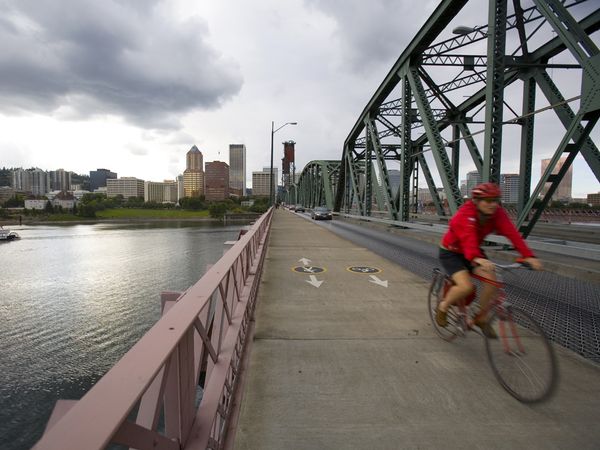
Portland, Ore., is my hometown. I was born there, came of age there, was educated there, got married there, brought my two sons into this world there. It was home until 1984.

I get asked all the time, “Where are you from?” I tell them, “Portland, the one in Oregon.” Almost with fail, the other person will say something like, “Oh yeah. Don’t they get a lot of rain?”

I’ll say yes, but then remind them that the rain falls in dribs and drabs. “It usually rains three or four days before you really notice it,” I usually say. Haw, haw, haw!

Well, yesterday it rained in my hometown. It rain a lot during the course of a 24-hour day. The old 24-hour record was .86 of an inch; yesterday it rained 3.3 inches!

OK, for those of you from, say, the Gulf Coast, that’s not all that much. I recall a rainstorm in Beaumont — where we lived for 11 years before moving to Amarillo in January 1995 — that dumped 8 inches of rain in something like three hours.

Three inches of rain during a 24-hour span? In Beaumont? Pfffttt!

It’s a big deal, though, for my family and our many friends in Portland.

I might have to revise my stock answer, though, about my old hometown.


Texas Tech announces vet school plan for Amarillo

animals2

When he was chancellor of the Texas Tech University System, Kent Hance ventured to Amarillo and made a fascinating pronouncement.

Amarillo, he said, is ready to support a full-fledged medical school campus, rather than a campus for upperclassmen and women — as it does now.

It would require community support to make it happen, Hance said. He went back to Texas Tech’s “mother ship campus” in Lubbock and the subject has been pretty much dormant ever since.

Then this happened today: The current chancellor, Bob Duncan, ventured north to Amarillo and announced concrete plans to develop a college of veterinary medicine right here.

OK, so Texas Tech isn’t yet announcing a plan for an expanded health sciences operation here, but the veterinary school announcement is pretty darn big.

Reports have been circulating for the past few days. Texas Tech is aiming to serve a significant audience by bringing such an academic institution to Amarillo. The city sits in the heart of some of the richest agricultural land in the nation. Rural residents own lots of animals — large and small — that need medical attention.

The veterinary school would be poised to train “animal doctors” to care for these patients.

Chancellor Duncan has made a significant pledge to the Amarillo region with today’s announcement and has pledged to deepen Texas Tech University’s footprint in the Panhandle, which by itself is going to bring a major economic development boost to the region.


Motorists get phone-ban message on highway

cellphone ban

SAN ANTONIO — What a capital idea!

Texas’s second-largest city has a ban on handheld cell phones and texting while driving.

How do I know that? I read repeated messages on electronic highway signs as my wife and I tooled through San Antonio en route from Rockport to Johnson City.

Holy mackerel! I lost count of the signs I saw that warned motorists that texting and using handheld phones was in violation of a city ordinance.

What a concept! Letting motorists know while they’re driving through the city that they’d better behave themselves while weaving in and out of traffic.

Gosh, do you think other cities should adopt such a proactive approach to notifying motorists — particularly those who don’t live in that city — of such municipal restrictions?

Amarillo has a similar ban. It also has a couple of interstate highways running through it.

I’ve seen general messages on occasion flashed on electronic signs about the hazards of texting or using handheld phones while driving. I do not recall reading anything about a municipal ordinance that bans such activity.

I’m thinking it’s a pretty tool to let motorists know they’d better obey the law while they’re traveling through the city.

Footnote: I would have taken a picture of a sign across the freeway, except … well, you know.


Thanks, Internet, for changing travel habits

SANTA ROSA, N.M. — We ventured west along Interstate 40 to this community.

Our intention was to relax in our fifth wheel, do a little swimming at the Blue Hole and just get away from the hustle/bustle of our regular lives — although it’s a lot less hustle-and-bustly than it used to be.

However, one of my travel indulgences includes purchasing a newspaper.

So, we awoke and, given that this was a Sunday morning, I only assumed I’d be able to drive to the nearest convenience store, truck stop, grocery market and purchase a paper from a large metropolitan area that’s not too far away from here.

Silly me.

I went to three retail outlets. At the last one, I asked the clerk: “We’re from out of town. Is there anywhere here where we can purchase a Sunday newspaper?” The lady said, “Oh no. They stopped delivering the Albuquerque Journal some time ago.”

That did it!

Then it occurred to me. I can blame the Internet for this catastrophe. Newspapers everywhere are cutting back — or eliminating — regional distribution of their editions (I refuse to refer to newspapers as “products,” which is what my former employers in Amarillo have taken to calling the newspaper that’s being published there in diminishing numbers).

Thus, one of the staples of my traveling habits has been eliminated whenever my wife and I travel to markets that don’t have a daily paper of their own.

Thanks for nothing — whoever it was who invented the Internet.


Fort Wayne emerges as civic test case for Amarillo

Fort Wayne, Ind., is home to roughly 253,000 individuals.

Amarillo’s population is just a shade less than 200,000.

Fort Wayne has developed a downtown convention and entertainment district that includes — get ready for it — a multipurpose event venue.

Amarillo wants to re-create its downtown district into something quite similar.

http://amarillo.com/news/latest-news/2015-07-18/can-it-work-here

An article in the Amarillo Globe-New by my old pal Jon Mark Beilue asks whether a Fort Wayne-style plan can work in Amarillo.

I continue to see the Amarillo proposal as a net positive for the city that could turn into a spectacular positive.

Fort Wayne has made it happen, despite some serious push back as plans were being formulated. Interesting, when you consider the resistance that has developed here over a plan that looks for all the world — to many of us, at least — like a prescription for revival.

Beilue makes an important point in comparing what Amarillo wants to do with what Fort Wayne has accomplished. The cities are comparable in size. He notes the huge disparity in population between Amarillo and, say, Fort Worth and Oklahoma City, which also have enjoyed spectacular downtown revivals. He writes: “Its (Fort Wayne’s) metro area is 416,800, about 165,000 more than Amarillo. That’s not apples to apples, but is a more realistic comparison than to the major cities of Fort Worth and Oklahoma City, which have undergone large-scale downtown transformations.”

Beilue then writes: “’We came together as a community and came up with something really valuable for economic development, for downtown development and a way to retain and gain jobs,’ said Graham Richard, who was Fort Wayne’s mayor when the project was approved.”

Why is that such a difficult concept to grasp? Some folks here — and I have not accepted the idea that they comprise a majority of our population — keep looking for reasons to oppose the project.

The MPEV won’t work. The city needs to expand the Civic Center. Too many palms are being greased. It’s going to cost taxpayers a fortune.

That’s a sample of the kind of thing we keep hearing.

Are this city’s residents so uniquely contrarian that we simply refuse to fathom a future that looks radically different from our past?

Take a good look at the article attached to this blog post.

It’s enlightening.

My own takeaway is pretty straightforward: If a city such as Fort Wayne, Ind., which doesn’t seem to have that much more to offer than Amarillo can remake itself, then what in the world is stopping us from marching toward a brighter future?

Flag becomes easy target … with good reason

confederate flag

A flag is coming down today. TV networks are going to cover the event live, such as they did when we launched men to the moon or when we held state funerals for a murdered president.

This is a big deal for an important reason.

The flag — which symbolizes the kind of bigotry that helped launch the Civil War — is an easily recognizable symbol. Its intent today, in many quarters, is to inspire fear and to terrorize Americans.

It has to come down and it has to be placed in a museum, where adults can tell their children about what this flag means to so many millions of Americans.

The flag in question has flown on the state capitol grounds in Columbia, S.C., the state where just a few weeks ago nine African-Americans were slaughtered in a Charleston church. A young white man has been charged with murder; and that same young white man has been revealed to harbor hatred for African-Americans.

And yes, he’s displayed pictures of himself waving that Confederate battle flag.

You see the flag and any number of things come into your mind.

I see the flag as a symbol of oppression. That it would fly on public property — which is owned jointly by African-Americans and white Americans who see the flag as many of us do — is an insult in the extreme.

Moreover, the flag is different from many other Confederate symbols, such as statues.

There’s a statue at the west end of Ellwood Park here in Amarillo of a Confederate soldier. To be honest, I drove by it for years before I even knew what it represented. To this very day I cannot tell you who it represents, and I doubt most Amarillo residents even know the name of the individual depicted by that statue.

Should that artifact come down? I don’t believe its removal is as necessary as the removal of the flag from the statehouse grounds in South Carolina.

We know what the Confederate battle flag represents to many Americans.

And because it is so easily recognizable as what it is, then it needs to come down.

Today.


City hears from the young and, until now, the silent

downtown amarillo

Amarillo City Council members got a snootful this week from some of their constituents.

No, it wasn’t the usual gaggle of naysayers who keep harping on why Amarillo can’t do this or that.

The pleas instead came from a handful of young people interested in seeing the city redevelop its downtown district into a place that would attract them, make them want to come back here or perhaps to stay and start their lives.

The open meeting at City Council Chambers featured a number of folks who support the concept that’s been developed for downtown’s rebirth — assuming, of course, that it’s allowed to come into this world.

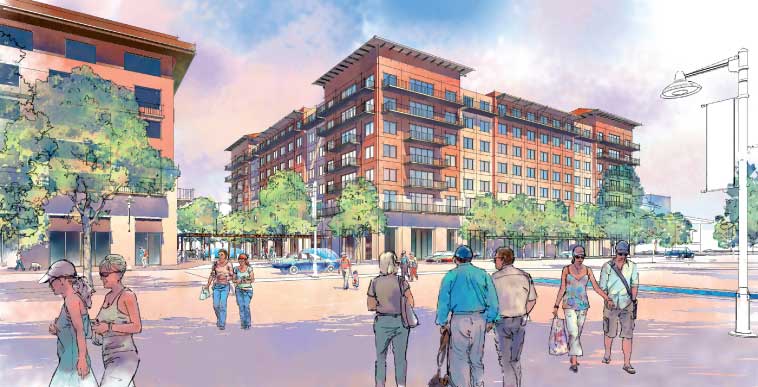
They like the idea of a multipurpose event venue, the MPEV. They like the notion of redeveloping Polk Street, turning it into an entertainment district. They like the idea of a downtown convention hotel which, quite naturally, will require additional parking.

They didn’t speak to council members Tuesday about the nuts and bolts of funding. They spoke instead of the concept.

I’m not a young person. I do agree, though, with our young residents.

Some other, older residents, said they disapprove of what’s being promoted. While the young folks like the idea of emulating, say, Austin, at least one other said the city should retain its current flavor, its ambience and whatever else it currently boasts.

Well, so much for “thinking outside the box” for some folks.

Me? I’m willing to take a chance on turning Amarillo into something more than a tad more vibrant than it has been.

I’ve been helping produce a weekly newspaper in Tucumcari, the Quay County Sun. I just finished editing some stories that told of that community’s weekend festival, called Rockabilly on the Route — that would be Route 66, which runs through Tucumcari, just as it runs through the heart of Amarillo.

Isn’t there an opportunity for Amarillo, with its own Route 66 heritage and its own arts and music community, to capitalize in such a manner? Sixth Avenue runs right through the city’s central district, connecting with Historic Route 66 west of the central district.

How about not letting such an opportunity slip through our fingers?

That, I believe, is what the young people said they want for their city.

I’m glad they spoke out. I now hope the council members heard them.


‘Numbers don’t lie’

I’ve known Walter Riggs for a number of years. We served in the same service club together. He’s a banker and a smart fellow devoted to Amarillo.

He’s been on a tear lately, bemoaning the negativity surrounding the campaign relating to downtown redevelopment efforts in Amarillo. He posted this item the other day on Facebook:

“These metrics demonstrate why your city achieved a Triple A Bond Rating, one of only two municipalities in Texas to boast this. And what’s more amazing is it happened in 2009, in the depths of the 2nd worst recession in the history of the U.S. So to those that spread chicken little, sky is falling propaganda our city is poorly run, including political candidates trying to scare voters into voting for them, numbers don’t lie.”

He seeks to make a critical point about Amarillo’s current standing and its future.

Riggs notes that the city has acquired a AAA bond rating, which is about as good as it gets. I remember former City Manager Alan Taylor telling me with great pride that the city had achieved that rating. Taylor took a lot of credit for it, and deservedly so.

Yet we keep hearing from a faction — and I don’t think it’s much greater than that — that gripes about the city being “poorly run.” How can that be?

I ran into lame-duck City Councilman Ron Boyd today and railed to him about the complainers. Obviously, I was “preaching to the choir,” as the saying goes. The city can boast of its excellent bond rating; it can be proud of its low tax rate; it can take pride in the huge new infrastructure improvements planned for the western corridor of Loop 335.

The city, moreover, has laid the groundwork for a downtown renovation strategy that, to my way of thinking, makes sense. It is doable. It can be done without burdening property taxpayers. It will rely on revenue generated by people visiting here from elsewhere who pay hotel-motel taxes.

And yet there are those who contend the city is run poorly?

What in the name of civic pride is going on here?