Tag Archives: US Senate

Planned Parenthood: classic political football

Oh, how I wish there were more U.S. Senate Republicans like Susan Collins of Maine. Or Lisa Murkowski of Alaska.

These two GOP moderate lawmakers are standing firm in their desire to see Planned Parenthood retain its federal government support. They dislike the Senate Republicans’ draft of a bill to overhaul the Affordable Care Act because it cuts money for Planned Parenthood for a year.

You see, we now have the makings of a political football game, with Planned Parenthood being the ball and competing forces within the Republican Party — not to mention the Democratic Party — kicking it all over the proverbial field.

Debate will get heated.

“There are already longstanding restrictions on the use of federal funds for abortion, so this is not what this debate is about. And Planned Parenthood is an important provider of healthcare services, including family planning and cancer screenings for millions of Americans, particularly women,” Collins said.

Abortion, that’s the kicker. Which means that abortion is at the epicenter of this particular discussion.

Senate and House conservatives detest Planned Parenthood because it does provide abortion referrals to women seeking to end their pregnancies. Last time I looked, it’s a legal activity. According to the “true believers,” though, Planned Parenthood is sanctioning the “murder of unborn children” and therefore its mission is steeped in evil intent.

Collins, though, is correct to point out two things about Planned Parenthood. One is that Congress already has written into law restrictions on federal funding for abortion; two is that Planned Parenthood provides a number of vital health care services for Americans.

But the organization is going to get kicked around, mauled, chewed up and spit out as competing legislative factions argue over whether the new health care legislation should use taxpayer money to keep it functioning.

I’m on Sen. Collins’s side.

Get set to watch further politicization of federal judiciary

Now there are “reports” that Anthony Kennedy is considering an end to his judicial career.

The Supreme Court associate justice’s retirement, if it comes next week as some are thinking it might, is going to produce something I suspect the nation’s founders didn’t anticipate when they wrote the U.S. Constitution.

That would be the extreme politicization of the judicial selection process.

Those silly men. Sure, they were smart. They weren’t clairvoyant.

The present-day reality is that the process has become highly political. When did politics play such a key role in selecting these jurists? It’s hard to pinpoint the start of it all. Some might suggest it began with President Reagan’s appointment in 1987 of Robert Bork to succeed Lewis Powell, who had retired. The Senate would reject Bork largely on the basis of his vast record of ultraconservative writings and legal opinions.

Clarence Thomas’s nomination in 1991 by President George H.W. Bush also produced plenty of fireworks, owing to the testimony of Anita Hill, who accused Thomas of sexual harassment and assorted acts of impropriety.

On and one it has gone, through Democratic and Republican administrations ever since.

The founders wrote a provision into the Constitution that allows federal judges to get lifetime appointments. The idea was to remove politics from their legal writings. Indeed, some judges have taken seats on the U.S. Supreme Court with their presidential benefactors expecting them to toe a philosophical line, only to be disappointed when they veer along uncharted judicial trails.

It’s too early to tell whether Justice Neil Gorsuch will fall into that pattern. He was Donald J. Trump’s initial pick for the high court. The president might get to make another appointment quite soon. Then again, maybe not.

Whenever that moment arrives, you can take this to the bank: The next Supreme Court pick is going to ignite a whopper of a political fight if one side of the Senate sees a dramatic shift in the court’s ideological balance.

Something tells me the founders might not have anticipated these judicial nominations would come to this.

Health care is ‘hard,’ yes, Mr. President?

What once was “easy” has become “hard.”

So said the president of the United States. Yep, Donald J. Trump has told TV interviewers that efforts to overhaul health care legislation is a “hard” task, that it’s going to take time.

Who knew?

Certainly not the man who, while running for president, called it “easy.” He boasted from many campaign podiums that he would repeal the Affordable Care Act almost immediately upon taking office and replace it with … um, something else.

“It’s easy!” he bellowed.

Sure thing, bub.

It’s not so easy. The American Health Care Act barely cleared the House of Representatives. Now it’s the Senate’s turn to discuss and debate this matter. Except that only Republicans are doing the dickering; Democrats aren’t in the game.

And, oh yes. Now we have five Republican senators saying they dislike the current Senate legislation “in its current form.” The Senate, with a 52-48 GOP majority, can afford to lose only two votes; that would result in a tie and Vice President Mike Pence could cast the deciding vote, as he did when the Senate confirmed Education Secretary Betsy DeVos to her Cabinet job.

So, the president bragged and blustered about the ease of overhauling one-sixth of the nation’s economy. Today’s reality is telling him the hard truth, which is that legislating is a complicated job.

It’s hard, man!

13 men writing major legislation — affecting women

There’s a certain sense of astonishment at this bit of news.

Thirteen members of the U.S. Senate have written a draft of a bill that affects one-sixth of the nation’s gross domestic product.

They’re all Republicans; no Democrats are allowed.

They’re all men.

And here’s the astonishing part of it: The draft legislation seeks to eliminate all federal funding for Planned Parenthood, a leading provider of health care services for women.

Where are the women of the Senate? Why are none of them working on this bill?

It’s like the Senate has become a boys’ club. I am now waiting for the sign on the conference room door that tells us “No girls allowed.”

This is how you produce legislation affecting such a huge portion of the national economy? This is how the Senate Republican leadership is developing a bill that seeks to repeal and replace the Affordable Care Act.

It’s un-democratic. It’s un-American.

If you’re going to craft legislation that has a tangible impact on more than half of the nation’s population, it should be incumbent on lawmakers to include members of that demographic — the women of this nation — in putting it together.

Let’s get to the heart of this hacking matter

As a frequent critic of Donald J. Trump, I want to set the record straight on a key issue that’s threatening the man’s presidency.

I do not give a rat’s rear end about whether alleged attempts by Russian agents to influence the 2016 presidential election actually created a Trump victory. I accept the notion that Trump would have won the election anyway.

What is troubling me is the question of what role — if any — the Trump campaign had in assisting the Russians.

Former FBI Director James Comey told U.S. Senate committee members today that he is certain of Russian meddling in our election. I accept the FBI director’s opinion on that, too.

I keep circling back to the question of whether Trump’s team actively aided the Russian hackers. If they didn’t aid them, did they know about any attempts to influence the election? If they knew and did nothing, that to me is tantamount to collusion — even if it doesn’t fit the legal definition of the word.

We keep hearing reports of key Trump campaign advisers meeting with Russians during the campaign and then during the transition. It all gets back to the Watergate-era question posed by then-Sen. Howard Baker: What did the president know — and when did he know it?

As for the whether the hacking/meddling actually proved decisive, that they changed enough votes to swing the results in favor of Trump and away from Hillary Rodham Clinton, it doesn’t matter to me. What does matter is that they have done what all those intelligence agencies have said they did. The former director of the FBI has confirmed it to my satisfaction.

If the Trump campaign colluded, dear reader, we are looking at a charge of treason.

Cornyn pulls out of FBI search … good!

John Cornyn issued a statement today that says this: “Now more than ever the country needs a well-credentialed, independent FBI director. I’ve informed the administration that I’m committed to helping them find such an individual, and that the best way I can serve is continuing to fight for a conservative agenda in the U.S. Senate.”

The Republican U.S. senator from Texas had been considered a prime candidate for the FBI directorship. After all, he had served as a trial judge in Bexar County, a justice on the Texas Supreme Court and Texas attorney general before being elected to the Senate.

He would have been a terrible pick for Donald Trump to make to replace the fired FBI boss James Comey. Cornyn is too partisan, too political, too friendly — I only can assume — with the president to be the kind of “well-credentialed, independent FBI director” the agency needs in this critical time.

He has pulled his name out of the running for the FBI job. Good deal.

Many Americans’ hope now is that the president will find someone who fits the description of a tough-minded independent law enforcement official to lead the FBI.

Let’s get busy, Mr. President.

Castro clears the decks for Beto O’Rourke

I swear I thought I could hear the faint chants way off in the distance.

“BE-TO, BE-TO, BE-TO … “

And on it goes.

They could be coming from breathless Texas Democrats who have worked themselves into a tizzy over news that U.S. Rep. Joaquin Castro has decided to forgo a challenge to U.S. Sen. Ted Cruz in next year’s mid-term election.

Thus, the way is cleared among Democratic Party loyalists to rally behind the candidacy of U.S. Rep. Beto O’Rourke, who’s been barnstorming our massive state of late, acquainting himself with Democrats who want little better than to oust Cruz, the fiery Republican senator who I’ve dubbed — in not-so-friendly terms — the Cruz Missile.

O’Rourke, who hails from El Paso, stopped in Amarillo over the weekend for a meet-and-greet at a local restaurant. From what I have heard, the crowd to meet him was enormous, meaning that O’Rourke’s advance team — with a lot of social media help from a group called Indivisible Amarillo — did a good job of filling the room.

But let’s not get ahead of ourselves and let’s heed a dose of sobering reality — if you’re a loyal Democrat we used to refer to in this state as “Yellow Dogs,” meaning they’d rather vote for a yellow dog than vote for a Republican.

Texas flips from D to R.

Texas is a seriously Republican state. It has flipped just in the span of a few years from being reliably Democratic. The Cruz Missile represents the colossal strength of the state GOP. He is one of a complete slate of statewide elected officials who wear the Republican label.

Cruz will be difficult to beat, so let’s not believe that just because there might be an attractive and articulate challenger from the other party that it guarantees a neck-and-neck race. Do you remember another Democrat who was thought to be a serious challenger to the GOP vise grip in Texas? Her name is Wendy Davis, the former state senator from Fort Worth. She was supposed to present a serious challenge to then-Texas Attorney General Greg Abbott in the 2014 race for governor; she lost by 20 points.

I am not crazy about one-party control at any level. I prefer a competitive two-party system. A healthy minority party puts the majority party on notice to defend its positions; a competitive environment makes incumbents accountable for the statements and the decisions they make on our behalf.

Maybe we can restore some level of competitiveness to the Texas political battleground. For the sake of those anxious Democrats around the state — and in the Texas Panhandle — I hope it’s O’Rourke who can make Cruz answer for his grandstanding and his transparent self-centeredness.

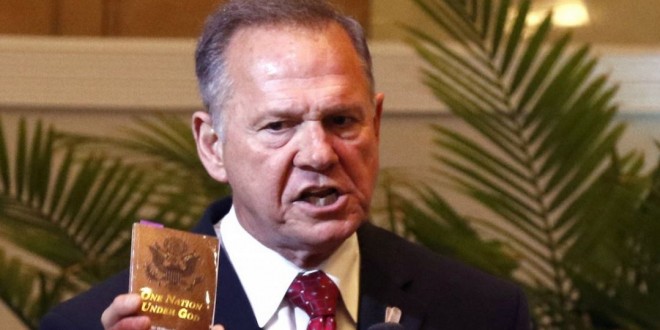
‘Ayatollah of Alabama’ seeks U.S. Senate seat

This ought to be fun to watch, even if it’s occurring way over yonder in Alabama.

The state has a vacant U.S. Senate seat, now that Jeff Sessions is serving as attorney general of the United States. That means the state has to conduct a special election to fill the seat.

A fellow named Roy Moore has just entered the contest.

Moore is the suspended Alabama Supreme Court chief justice who got himself into a jam because he told county clerks in his state that they didn’t have to abide by federal law and approve marriage licenses for gay couples.

Oops. Can’t do that!

Now he wants to run for the Senate. Why does this matter to people outside of Alabama? Well, if this guy is elected it means he’ll take part in making law for the rest of us. That includes those of us in the Texas Panhandle.

Moore is a fiery conservative. He once refused to remove a Ten Commandments tablet from the court grounds in Montgomery, Ala. He disagreed with decisions that the tablet violated the First Amendment rule prohibiting government sanctioning of religion.

“My position has always been God first, family, then country,” the Republican Moore said while announcing his candidacy for the Senate. OK, he’s a man of deep faith. I understand it. I have faith in God, too.

The Southern Poverty Law Center — which routinely battles with the judge over his rulings — calls Moore the “Ayatollah of Alabama.”

However, here’s the kicker: The oath he would take as a senator is a good bit like the one he took as a judge; it commits him to be faithful to the laws of the land, the U.S. Constitution, which — if you’ll pardon the pun — is the Bible of secular documents.

All I can assure anyone, though, is that the special election in Alabama is bound to be a hoot.

We’re about to see how it will affect the rest of the country.

Executive authority now becomes OK, yes, Mr. President?

I recall hearing time and again during the 2016 presidential campaign that Barack H. Obama’s use of executive authority was somehow a bad thing.

The president shouldn’t govern by executive fiat, said many of his critics, such as the Republican nominee for president, Donald John Trump.

Hmm. Well, times have changed, haven’t they?

Trump is now the president. He’s assumed the role of chief executive of the federal government. By golly, the man has found that executive authority isn’t such a bad thing after all.

Indeed, as that supposedly “phony” 100-day threshold approaches, the current president is left to proclaim the only victories of his new term have come via executive order.

Oh, and he’s also suffered some embarrassment through this activity as well, such as when the federal judiciary knocked down two of his travel bans for those coming here from Muslim-majority countries.

Through executive authority, Trump is demonstrating his ability to use the power granted to him by virtue of his election. I get that. I respect the authority granted to the president and I won’t condemn him for using it, per se.

What boggles my mind is how he continues to get away with the rhetorical gymnastics he performs routinely and how he manages to bluster his way out of what he said earlier.

He said while campaigning he wouldn’t have time for golf; he said would be at the White House 24/7 working to bring back all those jobs that have gone offshore; he promised to repeal the Affordable Care Act and replace it with something else.

He’s done essentially two things during his first 100 days as president: He nominated a Supreme Court justice, who was confirmed by the U.S. Senate and he ordered a missile strike against Syrian military targets in response to Syrians’ use of chemical weapons against civilians.

Legislative accomplishment? Nothing, man. The president has relied almost exclusively on his executive authority — which he condemned when another president did the same thing.

O’Rourke trying to make a fight of it for U.S. Senate

I am going to give credit to a young member of Congress who wants to upgrade his status as a public official.

Beto O’Rourke is a Democratic congressman from El Paso. He’s running for the U.S. Senate seat occupied by Republican Ted Cruz.

What deserves a word of praise is that O’Rourke is coming here, to Amarillo, the unofficial “capital city” of the most Republican region of one of the nation’s most Republican states.

He’s scheduling a meet-and-greet this coming Saturday at Abuelo’s Restaurant. He’s going to shake a few hands, get his picture taken with individuals, perhaps answer some questions from those coming to meet the young man.

OK, I get that the election is more than a year away. O’Rourke might not even win his party’s primary next spring; another young up-and-comer, U.S. Rep. Joaquin Castro of San Antonio is thinking about challenging Cruz.

That’s a decision to be made by others.

But I’m struck by the idea that a Democrat would come here. I understand this isn’t the first time O’Rourke has ventured this far north since announcing his candidacy. I’ve long lamented the idea that Democratic candidates have given up on the Panhandle while Republican candidates take this region for granted.

This ain’t necessarily a battleground region within Texas, if you get my drift.

Am I going to assert that some back-slapping at a popular eatery in Amarillo is going to turn this region into a critical front in the fight for political supremacy? Oh, no.

I do have to give Rep. O’Rourke some props, though, for spending some time among Panhandle partisans. Just maybe we can restore some competitiveness to these statewide races.

There once was a time, as the late U.S. Sen. Lloyd Bentsen used to say, that “politics in Texas is a contact sport.” It hasn’t been that way for more than two decades, since the last time a Democrat was elected to a statewide office here.

I am left to wonder — indeed, hope — that Beto O’Rourke is ready to return some of the rough-and-tumble to Texas politics.