Tag Archives: AGN Media

Hey, AISD board . . . will you speak to your ‘bosses’?

I want to stand with my friend and former Amarillo Globe-News colleague Jon Mark Beilue, who is demanding answers from the Amarillo Independent School District board of trustees.

The AISD board accepted the resignation of a highly valued girls volleyball coach who quit because of pressure she was getting from the mother of one of her athletes.

The coach, Kori Cooper Clements, lasted one season. The Amarillo High girls volleyball program is among the best in Texas history. What Clements has alleged is shameful interference by a parent.

The school board has remained silent. The school district’s constituents — the board’s “bosses” — deserve an explanation on what has been alleged.

What’s more, the chatter all over Amarillo implicates Renee McCown, an AISD board member, as the offending parent.

So, as Beilue has suggested, it is past time for the board to speak to the constituents. Explain its action or it inaction on this matter.

Here is what Beilue posted the other day on Facebook. Take a moment or two to read it. It’s worth your time.

***

So it’s been one week since the Amarillo ISD school board heard from an angry public at its regularly scheduled meeting, including two Amarillo High volleyball players among 10 there to support head coach Kori Clements, voted to accept Clements resignation, and then has publicly done what anyone who has been paying attention to this board expected.

Nothing.

No word of support for fellow board member Rene McCown who’s been twisting in the wind, no admonishment of allegations of her misuse of her school board position, no announcing they are looking into this troubling situation and will issue their findings as soon as possible.

Nothing.

It’s as if Amarillo voters elected a bunch of Marcel Marceaus, the famous French mime.

To recap quickly, promising young coach Kori Cooper-Clements resigned earlier this month in her first year with the storied program, and also her alma mater. She publicly accused a board member – read, McCown, who has two daughters on the team – of what appears to be greatly overstepping her bounds as a board member with regard to playing time for her daughters, and an administration who did not back the coach and played the political game of siding with the board member.

It has ignited a community firestorm that far exceeds the interest level of a high school volleyball program for the bigger picture of what appears to be a violation of the public trust of a board member, an administration that caved and a board that sits in stubborn silence.

There’s an old axiom in coaching when bad behavior, or lack of discipline on a team, occurs: “You’re either coaching it or allowing it to happen.”

Since I doubt the board is coaching it, let’s just vote for allowing it to happen. Board members can stiffen their backs all they want, but what conclusion should reasonable people reach when a board’s response seems to be just wishing it would go away?

At this moment, the entire public trust of the board from those who vote is about as low as it gets. If they disagree, they need to get out more.

This is not some run-of-the-mill parental interference of an athletic program that occurs frequently. This is not a parent who works at – oh, I don’t know – Owens-Corning who’s raising a stink. No, a board does not need nor should it get involved in those instances.

This is much different. This is one of your own who has allegedly inserted herself into the process almost from the moment Cooper-Clements was hired last March and attempted to use her position for personal gain that is not in the best interest of AISD.

That demands an internal investigation and public accountability to a public that put this board in that position in the first place. It demands transparency and getting on top of this instead of sticking their heads in the nearest Sod Poodle hole. To not do that is an insult to Amarillo and reeking of arrogance.

This goes beyond the tepid statement last week of a policy that “AISD does not comment on personnel matters out of confidentiality and respect for our employees.” This is a bigger matter than that, and the board knows it. Or should know it.

So as the board continues to play the public for a fool by remaining silent and invite even more questions, and the same public is left to wonder if board members can just play by their own rules, maybe the question is exactly that: Is the board coaching it or allowing it to happen?


Regional commentary: it’s spreading!

I am so sorry to report that Amarillo and Lubbock aren’t the only two communities in America where newspaper editorial policy is suffering from the urge to combine resources under a combined “regional” approach to commentary.

A friend sent me a link telling me that Charlotte and Raleigh in North Carolina are combining their editorial pages, that they’ll be supervised by a regional editor who will oversee editorial policies in both communities.

Here is the link.

Oh, my goodness! The deterioration of editorial autonomy is deepening.

GateHouse Media, which owns the Amarillo Globe-News and the Lubbock Avalanche-Journal recently announced hiring a guy who will serve as a “regional director of commentary.” He’ll live in Lubbock and then commute to Amarillo on occasion during the week, I suppose to try to read the pulse of the community.

The early returns aren’t too promising. The Texas Panhandle no longer has a newspaper that provides leadership on local issues; nor does the South Plains region.

As to what is happening in North Carolina, I predict a similar fate befalling those Charlotte and Raleigh. McClatchy Newspapers runs the Charlotte Observer and the Raleigh News  & Observer. Those cities also are even more diverse and disparate than Amarillo and Lubbock. They both are cosmopolitan cities; they are highly sophisticated. Raleigh is part of that Research Triangle region that brims with high-tech expertise; Charlotte is the state’s largest city and is a bustling financial center.

The release I read about the N.C.-merger reads, in part: The move is the latest in a series of changes that combine McClatchy’s North Carolina operations. Presumably, this will mean the board will focus more on statewide news and less on local news specific to Charlotte or Raleigh.

There you have it . . . more than likely. Both communities’ newspaper editorial pages are likely going to look away from those issues of specific interest or concern to them individually.

Oh, the demise of newspaper editorial leadership continues. It is painful for this former opinion writer/editor to watch.

Time of My Life, Part 12: Whom or whether to ‘endorse’

We have entered an era of enhanced distrust or mistrust of the media. That wasn’t always the case and I was proud to practice a craft that the public held in much higher regard than it does now.

We weren’t universally adored and admired, but come election time we had politicians lining up — quite literally — waiting for a chance to be interviewed by those of us who comprised an “editorial board.” They sought our “endorsement” for the campaign they were waging for whatever public office was on the line.

It’s a bit different these days. Politicians are forgoing those meetings with editorial boards. The most memorable “snub” occurred in 2010 when Texas Gov. Rick Perry decided he wouldn’t speak to any editorial boards in the state. He said he preferred to take his re-election message “directly to the people.” We got the message. What did we do? The Amarillo Globe-News decided to invite his Democratic Party challenger, former Houston Mayor Bill White, to talk to us. White accepted. He came to Amarillo and sat down for an hour or so talking about issues affecting his campaign and the state.

The paper then recommended White for election as governor. We were far from alone. However, judging from the response we got from our readers, you would have thought we had just endorsed Satan himself. The anger was palpable based on the mail we got from our heavily Republican-leaning readership.

It didn’t matter. Gov. Perry was re-elected in a breeze. And he established a trend for others to follow:

https://highplainsblogger.com/2014/10/ernst-follows-perry-model-who-needs-editorial-boards/

One of the more fascinating after effects of these editorial endorsement interviews — particularly with candidates running for local offices — was that every election cycle proved to be a learning experience for me. I always learned something at some level about the community where I lived that I didn’t know. Whether it was in Oregon City, Ore., or Beaumont or Amarillo in Texas, I learned something new about the community.

I was able to interview candidates who were invested deeply in their communities and they would share their often heartfelt experiences growing up there. I tried to take something new away from those encounters. Did I learn all there was to know about Clackamas County, Ore., or the Golden Triangle or the High Plains region? No. However, I did know a lot more about all those areas when I left them than I knew going in.

I was privileged to meet a future president of the United States, U.S. senators, members of the U.S. House, movers and shakers of all stripes, men and women who wanted to serve on city councils, or county commissions, they sought legislative office, various statewide public offices, school boards . . . you name it, we met ’em.

It always was a privilege to get to know these individuals, even those who weren’t serious in their quest. Believe me, we encountered our share of those as well.

They were willing to subject themselves to the grilling we provided them. They withstood our sometimes-difficult questions. There is something good to be said about them, too — and the process in which we all took part.

Kliff Kingsbury channels Forrest Gump

I want to offer a salute and a “well done” to my friend Jon Mark Beilue for a fascinating commentary on a former Texas Tech University head football coach who has redefined how one can land on his feet.

Beilue calls Kliff Kingsbury the “real life version of Forrest Gump.” Beilue knows of which he speaks. He’s a Tech grad, a longtime West Texas journalist (including several years as sports editor of the Amarillo Globe-News). The man knows his business.

Kingsbury has managed to parlay a mediocre college coaching career into a head coaching gig with the NFL’s Arizona Cardinals.

Beilue noted this: Over the next five seasons, Kliff has ONE winning season despite having a QB who will likely be the NFL MVP. He’s 35-40 overall, 19-35 in the Big 12, and by the time he was fired in November 2018, Tech was ahead of only Kansas in the Big 12 pecking order. Oh, and he’s getting TWO MILLION DOLLARS from Tech to leave. 

That brings me to the point of this blog item. I do not understand a lot of things, and one of them is how athletic coaches can fail to do their job and still get big-time money after they get fired for non-performance at their jobs.

As Beilue points out, Kingsbury took a header as Tech coach. He didn’t win half of the games he coached. Yet he still gets $2 million for departing a job from which he was fired. He now will get another well-paying gig coaching a team of multimillionaire athletes.

Oh, boy.

***

Here’s Beilue’s essay, posted on Facebook:

Kliff Kingsbury is the real-life version of Forrest Gump. Both are likable guys that have seen timing and great fortune shine on them in their storybook life. Don’t believe me?

Start with:

1. After his record-setting career as a Texas Tech QB, Kliff didn’t really have the skill set for the NFL. He was drafted in 2003 by the New England Patriots in the sixth round. He hurt his arm, and was put on injured reserve. He was ineligible to play, but in his one year, he still got a Super Bowl ring.

2. After bouncing around the NFL briefly and in NFL Europe, he decides to go into coaching. He hooks up with Kevin Sumlin at the University of Houston as quality control assistant. The next year, he’s the QB coach and offensive coordinator just in time when talented QB Case Keenum is a senior.

3. Sumlin goes to A&M and takes Kliff with him in 2012. Who’s there but Johnny Manziel, a generational college QB. Kliff I’m sure refined some of Johnny Football’s play, but Manziel basically ran around like his hair was on fire, and made plays with his legs or threw it up and let WR Mike Evans make a play. Manziel, in Kliff’s only year there, wins the Heisman.

4. Tech is looking to unite a fan base fractured by the firing of Mike Leach and the rocky tenure of Tommy Tuberville, who abruptly left. They go to favorite son Kliff, and give him the keys to the convertible, head coach of your alma mater at age 33 with a whopping THREE YEARS of coaching experience.

5. In his first year in 2013, with the previous staff’s recruits, Kliff goes 7-0, and then loses the next five. In the Holiday Bowl, Tech beats a disinterested Arizona State. Based off that, Tech AD Kirby Hocutt gives Kliff a lucrative contract extension. His $3.7 million salary is 30th highest in the country and has a huge buyout.

6. Over the next five seasons, Kliff has ONE winning season despite having a QB who will likely be the NFL MVP. He’s 35-40 overall, 19-35 in the Big 12, and by the time he was fired in November 2018, Tech was ahead of only Kansas in the Big 12 pecking order. Oh, and he’s getting TWO MILLION DOLLARS from Tech to leave.

7. Six weeks later, he signs a four-year contract to be a head coach in the NFL.

Life is like a box of chocolates.

City set for a smashing new year

Beth Duke is a longtime friend of mine; I’ve known her since January 1995 when I first moved to Amarillo, Texas, to become editorial page editor of the Amarillo Globe-News, where she was serving as features editor and later as city editor.

Thus, I feel safe in saying that Duke is doing what she now is getting paid to do: She is talking ever so positively about the prospects for the city’s downtown business and entertainment district. As director of Center City, that’s her job.

There. Having said that, I totally agree with her assessment that 2019 is shaping up as a potentially Earth-shattering year for the city’s downtown district, as work continues full throttle on projects aimed at injecting new life into the district.

I no longer live in Amarillo, but my interest in the progression of the city’s downtown rebirth hasn’t abated in the least. I am delighted at what I see happening there and to be candid, Duke and her organization have played a significant role in that effort.

According to the Globe-News: “Last year, 2018, was a great year for Center City with the construction of the MPEV (multipurpose event venue),” Duke said. “People can finally see what venue is a catalyst project.”

The Amarillo Sod Poodles, the city’s new AA minor league baseball team, opens its Texas League season in early April. My hunch is that the ballpark under construction on Buchanan Street will be full on opening day. The “catalyst” hopefully will ignite lots of related activity downtown and, thus, boost the city’s image, fatten its wallet with sales tax revenue and provide the city with additional resources to develop other parts of the city.

Businesses are slated to begin filling the ground-floor storefronts at the parking garage that was erected across the street from the MPEV. Work has begun on the Barfield Building, turning that rotting structure into a Marriott hotel. It will join the Courtyards by Marriott at the Historic Fisk Building as a place that has breathed new life into a historic structure. The Embassy Suites hotel across from the Civic Center is attracting conventions.

Polk Street is coming back to life. Potter County’s refurbished courthouse is a thing of beauty and the county now is beginning to discuss openly options related to replacing the Courts Building.

Yes, I hear about some of the grumbling from those who want the city to invest in other neighborhoods and quit concentrating on downtown. I am empathetic to their concerns. My hope today is that City Hall is listening.

However, none of that should disparage the progress that’s been made downtown. My mantra remains the same as it always has been: Show me a city on the move and I am virtually certain that the city possesses a vital downtown district.

Amarillo clearly is on the move. Its downtown business district is setting the pace.

Local media ‘voice’ is being stilled

My concern about the future of local print journalism in the community where I lived and worked for 23 years appears to be bearing fruit — and it saddens me.

The Amarillo Globe-News, where I served as editorial page editor for more than two decades, looks for all the world as if it is morphing into something I don’t recognize. Its editorial page isn’t examining local issues, isn’t looking critically at local concerns and those who shape policy. It has become part of a “regional voice” that speaks in unison with another newspaper ensconced 120 miles straight south, in Lubbock.

Today’s editorial — in both papers — tells me this. They are the same. The Globe-News and the Lubbock Avalanche-Journal, both owned by the same company, have expressed identical opinions on what they hope for the “community” looking toward 2019.

That’s right. GateHouse Media, which owns the papers, believes (apparently) that Amarillo and Lubbock have identical concerns. The regions have matching issues they need to confront.

Hmm. Well . . .  they don’t. They are different communities. They used to have newspapers that addressed their unique circumstances through their opinion pages. Residents of those communities used to look to their newspapers for leadership, possibly some guidance — or maybe just as places to hurl their gripes over editorials with which they disagreed.

The media are changing before our eyes, folks. We’re all seeing it. It ain’t pretty, at least not to me, a retired ink-stained wretch.

I was on duty at the Globe-News when the media climate began changing. The company that formerly owned the newspaper, Morris Communications, sought to deal with the changes. It reduced staff, tried to redirect its emphasis to a more “digital presence.”

On the editorial page, I tried to employ a new strategy. I discussed with my publisher at the time an idea to focus our editorial page on local, regional and state matters. My thought was that our readers didn’t care what we thought about national or international issues; their minds were made up and they were getting their “editorial guidance” from other media sources. Given that we served a politically conservative region, it didn’t take a genius to figure out that our readers were dialed in to Fox News, Rush Limbaugh and other assorted conservative voices.

So we sought to write about local matters. The right-wing media geniuses weren’t going to discuss City Council votes, or local public education matters, or whether their county commissioners courts were spending their money wisely; we would fill that void.

We had some success in keeping our voice relevant to the community mood.

I left the Globe-News in August 2012 and went on to “pursue other interests.” The newspaper abandoned the local-only strategy I had developed. Morris sold the Globe-News and the A-J — along with all its newspaper properties — to GateHouse. The new owners changed publishers and brought in a guy to run both papers, an executive editor to oversee both newsrooms and a “director of commentary” to write editorials for both communities.

Therefore, the local voice in each community has been muffled.

I quit relying on my ol’ trick knee to make political predictions, but the knee is throbbing again. It’s telling me the West Texas media landscape — from the Panhandle to the South Plains — is going to have a single voice speaking for the entire region.

Welcome to the new world. Wow!

This ink-stained wretch is saddened by what is happening.

Two quick Bush stories tell a bit about these men

I want to share two quick stories I have about men named Bush.

The first one is about George H.W. Bush, the 41st president of the United States who died Friday at age 94.

President Bush went to Amarillo in 2007 to speak to the community about leadership. They had a reception and lunch at the Globe-News Center for the Performing Arts. Because I worked as editorial page editor of the Amarillo Globe-News at the time, I got invited. We had lunch, then we got to stand in a long line.

At the head of that line was President Bush. He was meeting and greeting those who got to stand in that line. It was your classic “grip and grin” session.

My time came. I walked up to Bush and said simply as I extended my hand, “I just want to thank you, Mr. President, for your long and distinguished service to this country.” He bowed his head slightly as he said, “Thank you for that, sir.” We exchanged a couple more thoughts, then we turned to face the photographer who took our picture.

We were gripping and grinning at the camera. I cherish that picture to this day. Why? I had this feeling in the moment that the former president actually appreciated the expression of thanks from a complete stranger — me. Believe this: I offered it sincerely and with maximum gratitude.

A dozen years earlier, in 1995, I had the pleasure of meeting the newly elected governor of Texas, George W. Bush. I flew from Amarillo to Austin to meet with Gov. Bush in his Capitol Building office.

I arrived at the Capitol and found my way to the governor’s office. I was shown the way to the governor’s receiving room just outside the actual office. We shook hands, exchanged pleasantries and I told him that one of my sons had expressed many times his admiration for the governor’s father, the former president.

Gov. Bush nodded and said, “Your son has picked a wonderful man to admire.”

I was told I would get 30 minutes with the governor. I interviewed him on the record for about an hour plus 20 minutes.

The younger Bush clearly adored his father, whose pride in his son was well-known.

Now, to give you an idea of how effective a politician George W. Bush had become, there’s this addendum:

Gov. Bush was running for re-election in 1998. He came to Amarillo to be interviewed by the Globe-News editorial board. He walked briskly into our conference room, pointed at me and said in a loud voice, “There’s a good man. So, tell me, how’s your son?”

“W” learned well from Bush 41.

Media leadership takes another hit

The new owners of two West Texas newspapers appear to be watering down their commitment to the communities the papers serve.

Now, I say this from afar. I no longer live in West Texas. I have watched all this play out from my new residence in Collin County. However, I have a keen interest in the future of one of those communities and, yes, of the other one as well.

GateHouse Media purchased the Amarillo Globe-News and the Lubbock Avalanche-Journal from Morris Communications in the fall of 2017. GateHouse made some promises about its commitment to community journalism. Morris, meanwhile, got out of the newspaper publishing business totally.

So, what has happened to the new owners’ commitment to community journalism? A friend of mine sent me a note informing me today that the Globe-News and the Avalanche-Journal now have a “regional associate editor” who’s in charge of running both papers’ opinion pages.

Follow me here: Amarillo and Lubbock are 120 miles apart at both ends of Interstate 27. The new “director of commentary” lives in Lubbock. He’s going to continue to live there, or so I gather; that means he’ll drive to Amarillo during part of the week. I suppose he’ll need to show himself in Amarillo to pretend to be a member of the community.

The days he spends away from either community, though, is going to diminish the each paper’s editorial voice. It will water down its leadership in both communities. The editorial page of the G-N and the A-J will be muffled to a significant degree. One individual cannot pretend to know all there is to know about two communities that have disparate interests, differing power structures, different sets of movers and shakers, varying concerns.

This is an absolute shame.

I long have subscribed to the belief that newspapers that pursue a cogent and lively editorial policy are an essential element to any community’s well-being. Sure, readers complain about what a newspaper thinks about an issue; they take the editor and publisher to task. Or, they might agree and applaud with whatever position the opinion page has staked out.

Opinion pages promote community discussion and debate.

The West Texas newspapers already have a “regional” publisher who lives in Lubbock and commutes to Amarillo, along with a “regional” executive editor who lives in Amarillo and commutes to Lubbock. Now they have what used to be called an editorial page who lives in Lubbock.

GateHouse Media’s so-called commitment to the communities it pledged to serve is facing a serious challenge with the way it is structuring the leadership of two once-stellar voices for their respective regions.

Man, I hope I am wrong. If I am, I’ll swallow the crow whole.

I fear I am not.

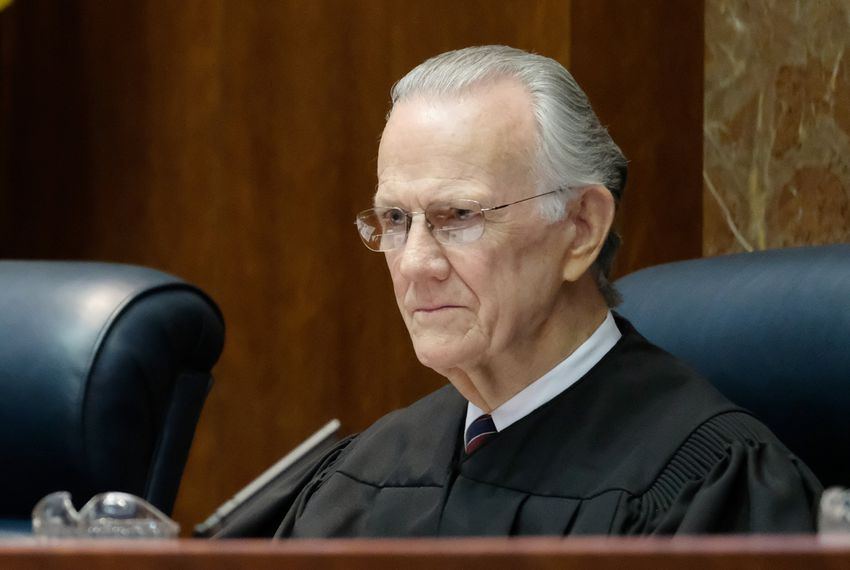
Thank you for your service, Justice Johnson

It is with a touch of sadness and a bit of pride as well that I have just learned that a member of the Texas Supreme Court is retiring at the end of the year.

Justice Phil Johnson is calling it a career.

I’ve known Johnson for several years. I worked as editorial page editor of the Amarillo Globe-News and Johnson was chief justice of the 7th Court of Appeals based in Amarillo. Thus, he became a source for me. We developed a nice relationship over the years.

Why the sense of pride?

Well, it goes like this. When the vacancy occurred on the state’s highest civil appeals court 13 years ago, I authored editorials for the newspaper urging Gov. Rick Perry to look past the I-45/I-35 corridor from where all Supreme Court justices hailed. I checked out the histories all the remaining eight justices and learned they all came from communities within that swath that runs through Central Texas.

The newspaper urged Gov. Perry to look westward. Johnson expressed an interest in getting appointed.

To his credit, Perry did appoint Johnson to the court.

Now, I am not going to take credit for the appointment. It’s likely no more than a coincidence. After all, Johnson did have one powerful friend in the Texas Senate, fellow Republican Bob Duncan — a former law partner of Johnson in Lubbock — who very likely made it known to the “right people” that Gov. Perry needed to appoint Johnson to the Supreme Court.

So, I’ll take all the credit I deserve for Justice Johnson’s appointment.

I also want to wish this good man well as he rides off into retirement.

Wanting to share some wisdom from a friend

I feel an overwhelming need to share something that a friend and former colleague posted on social media.

Her name is Beth Butler. We worked together for a few years at the Amarillo (Texas) Globe-News. She left quite a few years ago. I stayed on until Aug. 31, 2012.

Beth posted this item on Facebook:

I have never met a single person who believes we should throw the borders wide open, much less give cars to immigrants (legal or not). I have never talked to anyone in real life who thinks no more newcomers should be allowed into the U.S. I have never met a Democrat who thinks it’s great that Steve Scalise got shot. I’ve never met a Republican who thinks mailing pipe bombs is a good way to solve political disagreements. These people are extremists. They are not rational. They do not represent America. Why are we letting them set the tone?

Please, please, please let’s stop reacting emotionally. We will not agree on everything. None of us can have everything our way, but we can work together to find workable solutions. If we keep letting the lunatic fringe define our positions, we will destroy this country and one another.

Republicans running for public office are “defining” the views of Democrats, but they are lying their backsides off in the process.

The nation’s top Republican, Donald Trump, is leading the amen chorus of lies.

My friend’s brief message is calling them out. I want to thank her for doing so.