Tag Archives: World War II

‘Pocahontas’ crack continues to blow back

https://www.youtube.com/watch?v=PLJLGJ8m5dE

I wish I could say I am surprised and shocked at what Donald John Trump said today in a White House ceremony.

I’m not. It’s almost becoming an expected event.

Some distinguished Americans gather for a ceremony honoring them for their service to the nation and the president of the United States — who had zero public service experience before being elected to his high office — cheapens it beyond all recognition.

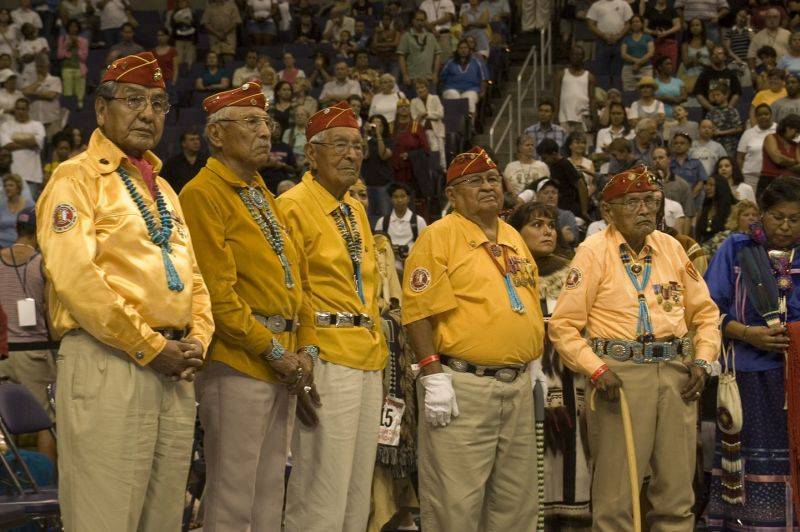
Trump welcomed some Native Americans today. These were 90-something men who when they were much younger were called to duty to defend the nation against tyranny during World War II. They are the legendary Code Talkers, who communicated in their native tongue, which the enemy could not decipher.

Then the president makes the “Pocahontas” crack, disparaging U.S. Sen. Elizabeth Warren, D-Mass., who has contended Native American ancestry is in her background. Trump has been savaging Warren for years over her assertion that she has Cherokee ancestry in her family background.

Warren called it a “racial slur.” Navajo leaders have issued a statement that said the president’s remarks demonstrated “racial insensitivity.”

Are you surprised? Neither am I.

All the president had to do was offer a nation’s thanks to these brave men — all of whom are former U.S. Marines — for the gallantry they exhibited during our nation’s desperate struggle. All he had to do was honor these men and praise them to the hilt for the bravery they demonstrated while defending this nation against forces that sought to destroy it.

He couldn’t do that. No, all the president did — with his careless and idiotic quip — was destroy a moment that by all rights should have belonged exclusively to a group of American heroes.

Disgraceful.
Trump sure has a way with words

Donald John “Quipster in Chief” Trump Sr. is the master of context and impeccable timing.

The president welcomed some Navajo veterans of World War II. They were the legendary Code Talkers who helped win the U.S. combat effort in the Pacific Theater of Operations.

The White House event was set up to honor those veterans, all gallant Marines. So what does the president do? The idiot in chief decided to shoot a barb at a Democratic member of the U.S. Senate.

According to The Hill: Trump said the Code Talkers “were here long before any of us were here,” referencing, I suppose, their Native American heritage. Then the said, “Although we have a representative in Congress who they say was here a long time ago. They call her Pocahontas.”

What a knee-slapper!

His reference is to Sen. Elizabeth Warren, who Trump has been deriding for years because Warren claims to have some Native American ancestry in her background.

The former Marines didn’t react to Trump’s dig. Hmm. Imagine that. They are too dignified to get snookered into that kind of childishness.

Read The Hill story here.

For the record, the Code Talkers were deployed in the Pacific Theater to communicate battle plans and intelligence in their native language, which the enemy couldn’t decipher. Precious few of these brave men are left.

The president simply couldn’t salute these men’s valiant service to their country during its darkest time without offering a stupid remark about a contemporary political opponent?

Is this what his fans call “telling it like it is”?

I prefer to call it a demonstration of stupidity.

Vets are bound together by common experience

I heard an interesting analysis on National Public Radio about the dysfunction that has troubled the U.S. Congress in recent years.

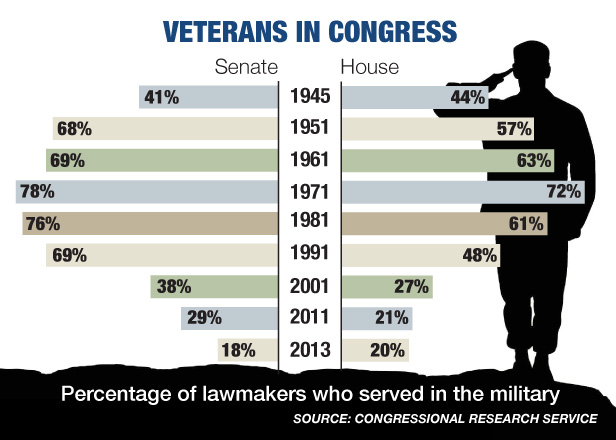
It is that so few members of Congress — House members and senators — are veterans. The analyst noted that today, about 20 percent of congressmen and women are veterans; that total used to be around 70 percent.

Do you see where this is going?

We’re about to celebrate Veterans Day and I thought that observation was worth noting as a way to suggest that military service has contributed to a better-functioning Congress than what we have today.

I think of the World War II veterans who came home from completing their mission to save the world from tyranny. They went about rebuilding their lives. Some of them chose careers in public service. The ran for the U.S. House and the U.S. Senate. They won and were thrown together on Capitol Hill.

They forged partnerships and friendships. They had a common bond. Their friendship crossed the partisan divide. Democrats and Republicans all had been to battle. They all had fought a common enemy.

Congressional lore is full of legendary friendships that bridged that partisan divide: Republican Bob Dole and Democrat Daniel Inouye; Republican Richard Nixon and Democrat John F. Kennedy; Republican Barry Goldwater and Democrat George McGovern. These men were political opponents, but they each respected each other. They had earned their mutual respect because of their service in defense of the nation they all loved.

The Vietnam War produced a similar bond among brothers. Republican John McCain and Democrat John Kerry became good friends during their time in the U.S. Senate. They worked together to craft a normalization of relations between the United States and Vietnam. Republican Chuck Hagel returned from ‘Nam to serve in the Senate, along with Democrat Bob Kerrey.

The Vietnam War generation, along with the World War II and the Korean War generation, contributed mightily to a government that actually worked.

That kind of camaraderie appears to be missing today. Yes, Congress is sprinkled with vets coming home from Iraq and Afghanistan. They, too, belong to both major political parties. I don’t sense that they have yet made their mark on the larger governing body. Perhaps it will come in due course.

The veterans who have served first in the military and then in both chambers of Congress have done demonstrated the value of common experience. It translates into political comity and collegiality … a lot more of which we can use today.

Hoping we don’t pervert Veterans Day

The nation is going to celebrate Veterans Day soon.

There will be parades, speeches, statements of gratitude and expressions of pride and thanks for those who have served in the military.

Our oldest veterans are in their 90s now. They saved the nation from tyranny. Those who answered the call in the decades since World War II also served to protect our national rights and liberty and the aspects that make this country so unique and special among the roster of nations around the world.

Of late, we’ve seen a perversion of what we’ve all sought to honor and salute. I was one of those vets who spent some time in the Army. My country sent me to Vietnam during a much different time, when we weren’t so grateful for the service performed by those of us who did our duty.

We all served to protect our special liberties. They include the right to protest our government policies. That right is protected stringently by the U.S. Constitution. The perversion has come from those who have castigated U.S. citizens who happen to be profession athletes; those athletes have chosen to protest certain government policies by “taking a knee” during the playing of the National Anthem at the start of sporting events.

Even the president of the United States has weighed in, saying those athletes are “disrespecting” the flag, the nation and those who served the nation in the military.

I beg to differ with the president. There’s no disrespect being shown toward any of what’s been described. As a veteran, I take not one ounce of personal affront to those who kneel to express their political point of view.

Indeed, I believe we all served to guarantee them the right to do what they have done … and continue to do.

So, as we prepare to honor our veterans yet again this year, let us be mindful of the rights we have and of the Americans who have fought — and died — to guarantee we can exercise them without fear of recrimination.

Honoring a new ‘Greatest Generation’

I am re-reading a book I’ve owned for a couple of decades.

The great broadcast journalist Tom Brokaw penned “The Greatest Generation” to pay tribute to the men and women who saved the world from tyranny during World War II.

Brokaw’s thesis is one that I still accept, that those 16 million Americans who answered the call to fight a global war on two fronts — in Europe and the Pacific — exhibited unparalleled devotion. They served “for the duration” of the war. They finished the job and came home to start their lives.

I’m reading the book, though, with a slightly different take than I had when I picked it up the first time.

The current generation of fighting men and women is rising to the level of devotion and dedication that my father’s generation did more than 70 years ago.

Under vastly different circumstances, to be sure.

They are fighting an enemy that is every bit as cunning and resourceful as the Nazis were in Europe and the Japanese were in the Pacific. These terrorists against whom we keep sending these young Americans to fight are ruthless and dedicated to the perverted principles they are following.

Today’s generation of young American warriors is facing multiple deployments onto the battlefield in Afghanistan and other places — some of which are undisclosed. Four Army Special Forces troops died recently in Niger, bringing into the open a deployment few Americans knew was under way.

I long have saluted my father for his contribution to fighting tyranny during World War II. I am proud of what he did as a sailor who saw more than his share of combat in the Mediterranean Theater of Operations.

I also want to salute other members of my family who’ve thrust themselves into harm’s way during the current war against international terror. My cousin served multiple Army tours in Iraq and Afghanistan. I have a nephew who drove an Army tank into Iraq when that war broke out in March 2003; he would return to Iraq for a second tour.

The war on terror just might be a conflict that has no end. There might not be any way for the United States to declare total victory as this country was able to do in 1945. The enemy surrendered unconditionally, giving The Greatest Generation of Americans its ticket home.

Can we achieve a similar end to the current war? I am trying to imagine how that gets done.

Meantime, the current generation keeps fighting. These young Americans have earned their status as the newest Greatest Generation.

I am proud of them beyond measure.

Now … for a moment of ethnic pride

I make no apologies for the hyphenated nature of my U.S. citizenship.

I am a Greek-American, which was bred in me by my grandparents, all four of whom were proud old country Greeks. One of them, my paternal grandmother — Katina Kanelis — once informed me of a historical military action about which I knew nothing at the time. I must have been around 9 or 10 years of age.

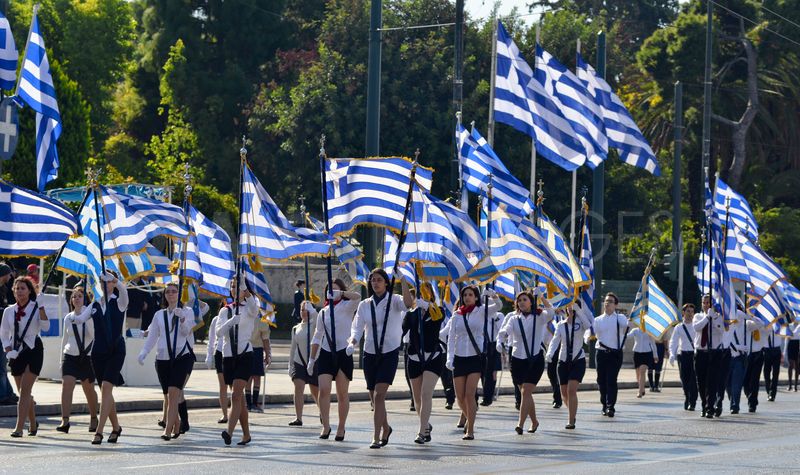
It produced something of a national holiday in her native Greece. It’s called “Ohi Day.” What is that? I’m about to tell you.

My grandmother and I were sitting in her kitchen one day when she told me of when, on Oct. 28, 1940, Italian dictator Benito Mussolini issued an ultimatum to the Greek prime minister, Ioannis Metaxas: Let the Italian military use Greek bases from which to conduct operations in the Mediterranean Theater of Operations or else face the prospect of war.

Legend has it that Metaxas replied with a simple “ohi!” which is Greek for “no!” Grandma told me he said it with emphasis, meaning I suppose it was taken as “hell no!”

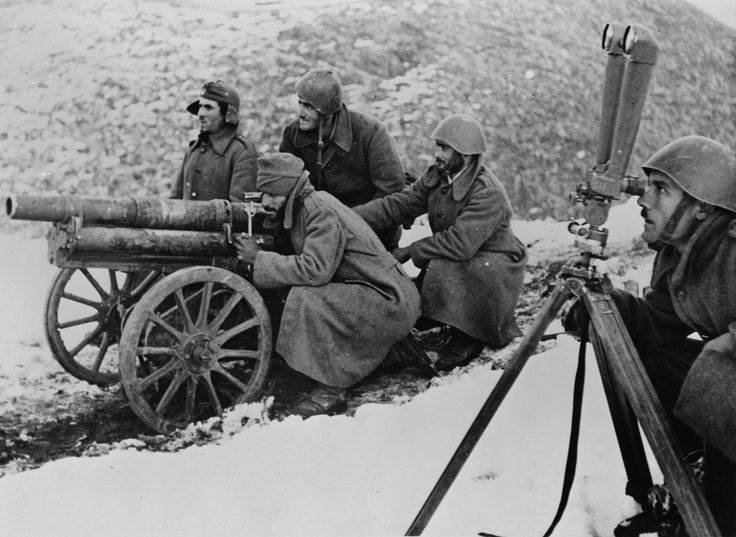
The Italians invaded Greece from Albania. Grandma said with great pride that the Greek army responded with such ferocity that they drove the Italians out of Greece. Mussolini’s forces supposedly were better equipped, better trained, more seasoned. They ran into a ruthless enemy in the Greeks.

I’ve done some research in the decades since I heard that anecdote from my dear, beloved grandmother. I learned that the Greeks essentially let the Italians storm into their country, then cut them off in the Pindus Mountains in northwest Greece — and then slaughtered them.

It was warfare at its ugliest. The Greeks then drove the Italians out of Greece, just as Grandma told me. The opposing forces fought to a stalemate in Albania, prompting the Nazi Germans to invade Greece in April 1941. The Axis forces eventually conquered Greece — but they would pay dearly for their occupation until they were driven out in 1944. The Greek resistance was among the fiercest of any in Europe during World War II.

I bring this to you courtesy of my late grandmother, who became a proud American, too, by choice.

Happy Ohi Day, everyone! Have a glass of ouzo to commemorate it.

Ride on, convoy

NEEDLES, Calif. — As the saying goes about some places on Earth, this place isn’t the end of the world but if you get up on tippy toes, you can see it from here.

But it’s not without its charms. Tall mountains loom in the distance; palm trees dot the landscape. The weather’s pretty nice, too — except during the heat of the summer.

But my wife and I encountered a most interesting group of fellow travelers. They belong to a club that restores military vehicles. We noticed about a dozen of them at an RV park where we parked overnight.

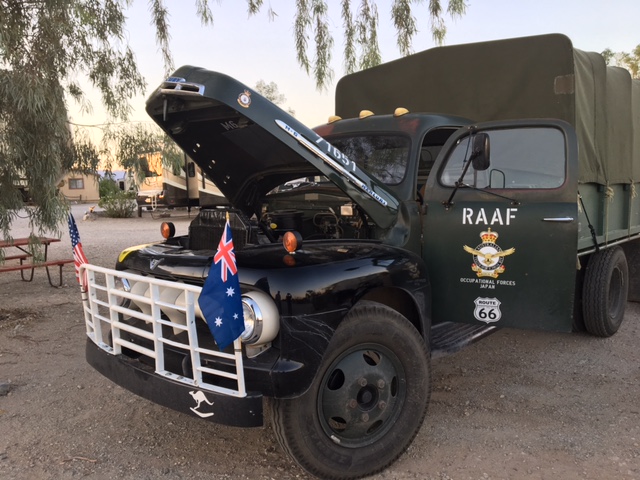
One of them was a Royal Australian Air Force Mercury truck. (See picture with this post.) The gentleman who owns the truck, an Aussie from Queensland who now lives in Abilene, Texas, said the Merc is a 1951 model that was assigned to the Australian occupation force in Japan from 1946 to 1953.

Another fellow traveler, a woman from Truckee, Calif., said the group was traveling along Route 66 from Chicago to Los Angeles. Needles is near the end of their journey. “So, you must have gone through Amarillo,” I said to her. “Oh, yes. Lovely place,” she answered.

Most of the vehicles were half-ton or three-quarter ton trucks.

My thought was twofold: How cool to save these military vehicles and how what a marvelous journey to embark with friends and acquaintances across the country.

Our own journey continues as well. We’ve been more or less winging it as we work our way north from “the end of the world.”

More bombs did not produce ‘victory’ in Vietnam

“The Vietnam War” is coming to a close this week. I refer, of course, to the landmark public television series, not the actual war.

What are the takeaways from this epic production directed by Ken Burns and Lynn Novick and broadcast on PBS? I have so many of them, but I think I’ll focus briefly here on just one of them.

It is that the Vietnam War required us to redefine victory.

We fought the communists in Vietnam for more than a decade. We killed many more of the enemy than we lost so very tragically. We emerged victorious from many more battlefield encounters than the Viet Cong or the North Vietnamese. As we have learned in the Burns-Novick epic, U.S. commanding Gen. William Westmoreland was obsessed with “body count”; he insisted that the media report that the enemy suffered far worse than our side did.

Merrill McPeak, a fighter pilot during the Vietnam War who later became Air Force chief of staff, noted correctly in the documentary that the United States dropped more ordnance on the enemy than we did in all the combat theaters of World War II. Think of that for a moment. American air power dropped more explosive tonnage on the Vietnam communists than we did against the Nazis, the Italians and the Japanese.

What we didn’t do and the reason we “lost” the war was because we lost our political will. The Vietnamese were fighting on their turf, defending their homeland, battling an enemy they considered to be “invaders.” They had more to lose — and to gain — than we ever did. Thus, it was their fight to win.

Are there lessons to carry forward as we continue to fight an even more elusive enemy, those terrorist organizations that have declared “death to America!”? Yes, certainly.

One profound lesson should be for U.S. politicians — or one in particular — to cease implying that defeating an enemy is “easy.”

We cannot just keep dropping bombs and sending young Americans into cities, killing enemy fighters and then expect the enemy simply to give up. We tried that in Vietnam. It didn’t work out well for us.

Ken Burns and Lynn Novick have provided a masterful piece of documentary television. Just as Vietnam was the first war to be fought “in our living rooms,” my hope is that the educational benefit that’s being delivered to us via PBS will assuage some of the pain we felt as the fighting raged.

***

Politico has provided a fascinating look at a conversation involving President Lyndon Johnson and U.S. Sen. Richard Russell. The Burns-Novick documentary doesn’t report on it.

Take a look at the story here.

Swastikas are back in the news … for the wrong reasons

The “Greatest Generation” of Americans marched off to war in 1941.

Millions of them went off to fight the Empire of Japan in the Pacific; millions of others went in the other direction, to take up arms against the Third Reich and its fascist allies in Italy.

The Nazis who governed Germany did so under the banner featuring the swastika, which has remained the symbol of unequivocal evil over the decades since the end of World War II.

Events of the past few days have brought that symbol back to the fore in the United States. It’s good to ponder for just a moment the very notion that Americans would associate themselves with that symbol in any fashion.

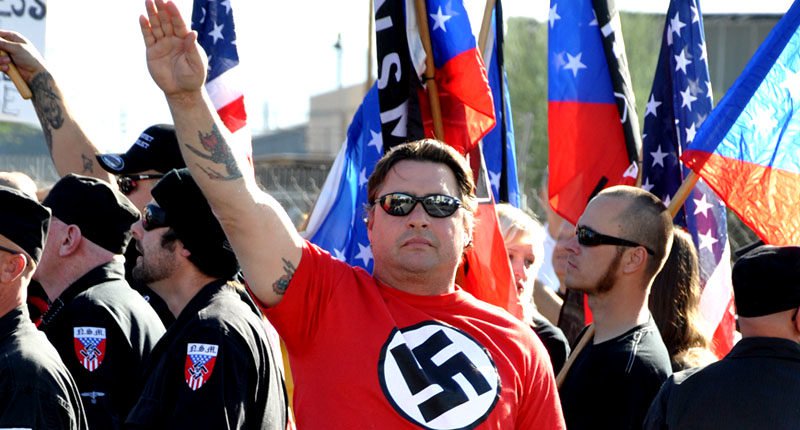
The Charlottesville riot over the weekend involved Nazis who marched under that very banner yet again. They wore the swastika on their t-shirts, on arm bands. They adhere to the very philosophy that perhaps their grandparents or great-grandparents fought. Perhaps they lost ancestors in that conflict.

How in the name of all that is holy can anyone associate themselves with that philosophy? How can they in good conscience stand with that symbol of evil? Oh, wait! I guess I assumed that such sociopaths even have a conscience. Silly me.

I have my own deep-seated bias against that symbol. My late father enlisted in the Navy in early 1942, not long after our country entered World War II. He wanted to get into the fight right away and Uncle Sam obliged, sending him to Europe to wage war against that swastika.

And he did. His involvement in the Mediterranean theater of operations was intense. It was brutal. Men who fought under that swastika tried to kill my father — repeatedly and I am quite certain with maximum malice. Dad responded with equal intensity.

Quite obviously, he was able to come home at the end of the war. He got on with the rest of his life.

Over time, he talked occasionally about his war experience. He didn’t hate Germans. He did hate the symbol under which those young men fought against him. As I grew up, I was imbued with the feeling of hate as well for that swastika.

As we’ve seen over many years, though, not all Americans share that hatred. Some of us embrace that symbol. For the life of me I cannot fathom it.

But here we are, talking to each other once again about an emblem that symbolizes the very worst in our human existence.

And to think that the president of the United States has just elevated those who today are marching yet again under that evil symbol effectively to the same level of those who oppose them.

How would Dad react to these Nazi sympathizers?

I introduced you some time ago, dear reader, to my favorite veteran.

He’s my father. Dad served in the Navy during World War II. He saw plenty of combat throughout the Mediterranean theater of operations. Dad took part in three land invasions: Oran in North Africa, Sicily and in Salerno, Italy.

His ship got sunk during the Sicilian campaign. He shot a German bomber out of the sky while manning a deck gun.

I have thought of Dad during the past couple of days as national reaction poured forth about the neo-Nazis who took part in that Charlottesville, Va., protest; actually, I think of Dad — and Mom — every single day. The Nazis joined other hate groups — Ku Klux Klan and white supremacists — to protest the taking down of a statue of Confederate Gen. Robert E. Lee.

U.S. Sen. Orrin Hatch, a Utah Republican, spoke for a lot of World War II veterans and their families when he said his brother “didn’t die fighting Hitler” just to let these neo-Nazis’ actions “go unchallenged.”

Dad died in September 1980. I don’t recall then the emergence of these neo-Nazi groups getting the kind of exposure they get today. How would he respond to them? How would Dad react to the hideous rhetoric that comes from individuals wearing the swastika symbols worn by those who sought to kill him in 1943 and 1944?

To be candid, I don’t recall having that discussion with Dad when he was among us.

However, I knew my father pretty well. He was a proud American. He was proud of his service defending the nation during its darkest time. Dad was one of the millions of Americans who comprised the Greatest Generation.

I believe he would be angry as hell at those who rise up to tear at the nation’s fabric. Although the name “Donald John Trump” wasn’t on anyone’s radar when Dad died, I believe he would be enraged at the seeming timidity from the president when it involves neo-Nazis.