Category Archives: legal news

‘Five unelected lawyers’ have lots of power

Supreme_Court_US_2010

I saw a news clip last night that, frankly, stunned me.

I’d seen it before, but had forgotten how ill-informed the person featured in it seemed to be when he made a particular statement.

Sen. Ted Cruz is a smart guy. Harvard Law grad. Former law clerk to the current Supreme Court chief justice. Solicitor general for Texas.

He’s running for the Republican nomination of president of the United States.

But when the Supreme Court voted 5-4 this past year to legalize gay marriage throughout the country, Cruz said it was wrong for “five unelected lawyers” make such profound decisions. He sought to make the case, it appears to me, that the federal judicial system — as established by the founders of this country — was fatally flawed.

See Cruz’s statement.

I do not intend to lecture this bright young lawyer about the Constitution, but I do want to make this point.

The nation’s government framework gives the Supreme Court enormous power. That’s why making appointments to that court is arguably the most important decision a president ever makes during his time in office. Cruz knows that . . . I’m sure.

When the court rules on the constitutionality of issues, its word is final. That’s how the framers set it up. They entrusted the highest court in the land to make these decisions without qualification. Yes, some of these decisions have been reversed over time. By and large they’ve been overturned with good reason.

However, one shouldn’t trivialize these court rulings as being the mere opinions of “five unelected lawyers.” They’ve been given a huge responsibility by the very government for which Sen. Cruz, himself, works as a legislator.

The court has made decisions over the years with which I disagree. However, I honor and accept those decisions as part of the constitutional process.

At least, though, the nation’s Supreme Court comprises nine lawyers, individuals who’ve studied the law and know it pretty well. The founders didn’t require justices on that court to be lawyers in the first place.

I trust Sen. Cruz knows that to be the case as well.


Gay marriage . . . it’s back

moore

Let’s see if we can clarify something.

The U.S. Supreme Court comprises nine individuals who are charged with interpreting the constitutionality of laws. They decide whether certain laws are in keeping with the nation’s founding governing document. The justices are diverse in their thinking. Their judicial philosophies cover the entire length of the judicial/political spectrum.

The highest court in the land ruled not long ago that people are entitled under the equal protection clause of the Constitution to marry others of the same sex. The court, therefore, legalized gay marriage in all 50 states.

That settles it, right? The nation’s highest court ruled that gay people are entitled to marry whoever they love with no regard to sexual orientation.

Not so fast. An Alabama state supreme court chief justice — Roy Moore — has told probate judges in his state that they shouldn’t issue marriage licenses to gay couples. Why? Chief Justice Moore said the nation’s highest court’s ruling is inconsistent with Alabama court rulings on the subject.

OK, then. Which court’s rulings carry more weight? The U.S. Supreme Court, which is where the judicial buck stops? That court’s rulings are supposed to be final, definitive. Or does a state court have the authority to overrule the nation’s highest court?

Chief Justice Moore is not new to notoriety. He once thrust himself into the limelight over whether to display the Ten Commandments on public property.

This time, he has spoken out of turn . . . in my humble view.

The U.S. Supreme Court has settled the issue about gay marriage. The Constitution, a majority of justices ruled, grants all Americans the same protection under the law. It doesn’t single out heterosexual people, granting protections to them and not to homosexuals.

Can we simply just allow the nation’s highest judicial body’s ruling stand?


Are all rights absolute?

barack

Barack Obama made a number of interesting points today as he laid out his strategy to use his executive authority to reduce gun violence.

One of them dealt with the First Amendment and whether we should treat it as an absolute right. Yes, the president said, we have the right of free speech, but we cannot yell “fire!” in a crowded theater.

We also have the right to religious freedom, but the law prohibits human sacrifice.

The Second Amendment is seen by many in this country as being an absolute right. The men who wrote the constitutional amendment meant that all Americans had the right to “keep and bear arms.”

Sure thing. I, too, have read the amendment and I get it.

I keep asking, though: Aren’t there measures that we can take that regulate the sale of these weapons while protecting the integrity of the Second Amendment? Gun-owner-rights groups — namely the National Rifle Association — keep insisting that the two principles are mutually exclusive. You can’t regulate firearms in any manner without watering down the Second Amendment, they say.

I guess I’ll just have to disagree with such a notion.

President Obama isn’t seeking to “legislate” through executive order, as his critics suggest he’s seeking to do. He has a team of constitutional lawyers who are advising him on what he can do legally. He wants to make it tougher for criminals or mentally disturbed individuals to put their hands on firearms and said today he has no intention of stripping law-abiding Americans of their constitutional right to own a gun.

Doesn’t that goal protect the amendment while trying to make the nation safer from bad guys with guns?


Yes, impeachment was about sex

bumpers

Now that Donald Trump has dredged up the Bill Clinton impeachment travesty, it’s good to take a brief moment to remember someone who arguably had the best sound bite of all regarding that tawdry political episode.

Dale Bumpers was a former governor and U.S. senator from Arkansas, President Clinton’s home state. Bumpers died this week at the age of 90.

He once described himself as the “best lawyer in a one-lawyer town.” His self-deprecating wit would be welcome today in an era when too many politicians take themselves as seriously — if not more so — than their public service calling.

Well, it was Bumpers who offered up a fascinating quote regarding the president’s impeachment. You’ll remember that special counsel Kenneth Starr started looking at a real estate deal involving President and Mrs. Clinton. He expanded his probe to include a wide range of issues.

Lo and behold, he discovered that the president had improper relationship with a White House intern. A federal grand jury questioned Clinton about it; the president was less than truthful. Thus, came the ostensible grounds for impeachment.

Bumpers, though, told the truth about it.

“When they say this impeachment isn’t about sex,” Bumpers said, “it’s about sex.”

He was right.

The impeachment itself turned out to be a political travesty of the first order.

The House did its job by impeaching the president. The Senate — which included Bumpers — did its job as well by acquitting him.


Yes, Mr. Justice, ‘religious neutrality’ is in the Constitution

No-religious-test-of-office-320x1241

I am about to do something that gives me the heebie-jeebies. I am going to challenge a premise by one of the nine people who serve on the U.S. Supreme Court.

Justice Antonin Scalia told a group of high school students this weekend in New Orleans that the U.S. Constitution does not compel “religious neutrality.”

Well, Mr. Justice, I believe it does.

Scalia, a deeply religious Roman Catholic, told the students that the Constitution prohibits government from adhering to a specific religion, but it does not compel government to ban references to religion in general.

He said it’s all right for government officials to invoke God in public.

Sure it is. Presidents of both parties have been ending public speeches for as long as I can remember — and that goes back a ways — with the words ” . . .  and may God bless the United States of America.”

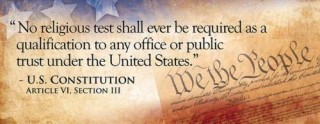
But I have been reading the Constitution since I was old enough to read anything and I can find precisely two uses of the word “religion” or “religious” in that document. It’s in Article VI, where it says there shall be “no religious test” required of any individual seeking any public office at any level in the United States of America; and it’s also in the very First Amendment, where it says Congress “shall make no law respecting an establishment of religion or prohibiting the free exercise thereof . . . ”

The rest of it is secular by design.

I agree with Justice Scalia that “God has been good to us” as a nation. But he seems to be getting a bit ahead of himself when he implies that “religious neutrality” seems intended to deprive Americans the right — or the desire — to worship as they see fit.

The individuals who founded this nation knew exactly what they were doing when they created the Constitution. They meant for it to be free of religious dogma. Yes, some have taken that intent too far by suggesting that we should remove “In God We Trust” from courtroom walls or from our currency.

However, I happen to quite comfortable with “religious neutrality” as it relates to our government.

I’m still free to go to church and pray to God. I will do so again today.


Is it the end of the line for Cosby?

2011_Bill_Cosby

Andrea Constand says Bill Cosby sexually assaulted her.

The alleged crime, though, occurred a long time ago. Ten years ago, to be exact.

The authorities have arrested the iconic comedian/actor/social commentator and he posted bond on $1 million bail.

It’s looking like the end of the line for Cosby. His public image is in shambles. Universities that bestowed honorary doctoral degrees have pulled them back.

Then again …

The allegations from Constand and seemingly countless other women have ravaged Cosby’s once-stellar reputation as a role model. He was seen as the consummate family man. He portrayed one on a long-running television show, blazing trails for other African-American entertainers in the process.

Then came the accusations from women that he drugged them, forced himself on them without their consent.

These allegations are troubling — and disgusting — in the extreme.

It’s fair to ask one simple question of Andrea Constand and perhaps all the others: Why did you wait so many years before leveling these horrendous charges?

It is the delay in coming forward that troubles me to a large extent, although not to the extent that the allegations themselves have troubled me.

If any of these cases ever get heard in a courtroom, I am quite sure an inquisitive public will hear plenty of reasons why these women waited so long.


Throw book at ‘Affluenza Teen’ mom

affluenza

Ethan Couch is in custody … again.

So is his mother.

The so-called “Affluenza Teen” has been found in Mexico, where authorities are preparing to send him back to Texas.

Why the big deal? This is the nimrod who piled into a pickup in 2013 — when he was 16 years of age — and while roaring drunk plowed his vehicle into another vehicle, killing four people.

The kid got 10 years probation largely on the testimony of a shrink who blamed his ghastly behavior on the upbringing he received from his wealthy Fort Worth parents.

Thus, the term “affluenza” was born.

Then the kid — who’s now 18 — was seen taking part in a drinking game in violation of his probation; and after that, the kid failed to report to his probation officer. Can’t do that, young man.

So, Mom and Ethan went on the lam, ending up on the Mexican Riviera before the cops found them.

Texas law limits the amount of time Ethan can serve in jail; he faces a maximum of 120 days in the slammer.

Mom, though, ought to spend some serious time in The Joint.

What’s so ironic about all of this is that the “affluenza defense” has taken an odd turn toward validity.

Ethan Couch never should have been too drunk to drive. Did his parents enable his terrible behavior?

It seems that Mommy Couch’s accompanying her little pride and joy to another nation suggests that she truly has enabled Ethan’s criminal activity.

She deserves some hard time if a Texas court convicts her of aiding in her son’s flight from the law.


‘Affluenza’ teen may be in trouble again

beer pong

The case of Ethan Couch introduced America to a new term: affluenza.

It was coined by a psychologist who testified in Couch’s defense after the then-16-year-old Fort Worth teenager got roaring drunk, climbed into a motor vehicle and then killed four people and injured several others, at least two of them critically.

Couch dodged some serious prison time and received a probated sentence and was ordered to participate in a drug rehab program.

The psychologist had argued that Couch’s wealthy parents had enabled the boy’s behavior and, therefore, the youngster wasn’t totally responsible for what he did that night.

The state had sought to put the boy behind bars for a long time.

Now it turns out that the cops are looking for Couch, who’s now 18, after a video surfaced that seems to reveal he is participating in a game of “beer pong,” which is a game involving participants hitting a ball into a cup and then drinking the contents of whatever cup the ball lands.

Sound like fun? Uhh, not really.

The issue, though, is whether Couch has violated the terms of his probation, which was for 10 years and which prohibits him from drinking alcohol.

Did I mention that Couch’s blood-alcohol content was three times the legal limit for an adult at the time of his horrific accident?

The nation was shocked by the stunningly lax sentence handed down in that Tarrant County courtroom in 2013.

Something tells me that when the police catch up with Evan Couch that the young man will get the justice he deserved when he killed those people in the first place.


Scalia recuse himself from race cases? Not a chance

pelosi

U.S. House Minority Leader Nancy Pelosi is angry at Supreme Court Justice Antonin Scalia.

She’s mad at remarks that Scalia made during oral arguments involving an affirmative case involving the University of Texas. Scalia contended that African-American students might not do as well academically at UT as they would in “slower-track schools.” The statement has drawn much criticism against the outspoken justice.

Pelosi thinks Scalia now must recuse himself from future discrimination cases because of his bias.

Let’s hold on, Mme. Minority Leader.

Don’t misunderstand me. I dislike Scalia’s world view as much as the next progressive. But calling for him to recuse himself from these cases goes way too far. According to Politico: “It’s so disappointing to hear that statement coming from a justice of the Supreme Court. It clearly shows a bias,” Pelosi said. “I think that the justice should recuse himself from any case that relates to discrimination in education, in voting, and I’m sorry that he made that comment.”

Consider something from our recent past.

The highest court in the land once included two justices who were philosophically opposed to capital punishment. The late Justices Thurgood Marshall and William Brennan voted automatically in favor of capital defendants’ death sentence appeals. If a death row inmate’s case made it to the Supreme Court, he or she could depend on at least two votes in favor of the appeal.

In fact, Justice Marshall was particularly blunt about it. He said repeatedly that he opposed capital punishment, yet he took part in those appeals.

Did he ever recuse himself? Did pro-death penalty forces make the case that he should? No to the first; and unlikely to the second.

Federal judges — and includes the nine individuals who sit on the highest court — all have lifetime jobs. That’s how the Constitution set it up. Presidents appoint then; the Senate confirms them and then they are free to vote their conscience.

Scalia need not recuse himself. He is free — as he has been since President Reagan appointed him to the court in 1986 — to speak his mind. He has done so with remarkable candor — and even occasionally with some callousness — ever since.


Always a political back story

refugees

I am a strong believer in what the Founding Fathers intended by creating an independent federal judiciary.

They gave the president the authority to nominate federal judges for lifetime jobs, pending approval by the U.S. Senate. The intent, as I’ve always understood it, was to de-politicize the judicial branch of government.

It works.

Judge blocks order

Then again, politics always seems to be part of the subplot of every federal judicial decision.

U.S. District Judge David Godbey, for example, today struck down Texas Attorney General Ken Paxton’s ban on Syrian refugees coming to Texas. Paxton cited security concerns in asking for the temporary restraining order. Godbey ruled within hours of the request that Paxton had failed to demonstrate that the refugees posed any kind of threat.

Godbey wrote, according to the Texas Tribune: “The Court finds that the evidence before it is largely speculative hearsay,” the judge wrote. “The [state] has failed to show by competent evidence that any terrorists actually have infiltrated the refugee program, much less that these particular refugees are terrorists intent on causing harm.”

So, it’s fair to ask: Is this judge sitting on the federal bench because a liberal Democratic president, Barack Obama, appointed him? No. He was selected in 2003 by Republican President George W. Bush to serve the Northern District of Texas. Paxton, let’s point out, is a Republican as well.

Does it really matter, then, whether a judge gets picked by a Democrat or a Republican? It shouldn’t. Judges take an oath to uphold the Constitution without regard to political favor. They do, remember, have a lifetime job.

But the politics of this particular issue — the refugee crisis and the political debate swirling all over it — causes one to look carefully at who’s making these decisions.

Judge Godbey appears to have put the law above his political leanings.