Category Archives: State news

Getting to know the political lay of the land

A move to another region of Texas gives bloggers such as yours truly a chance to get acquainted with the political movers and shakers of the community.

I’ve been sniffing around the Collin County legislative lineup and have discovered that the 2019 Legislature will be received two rookies from this suburban county.

Texas House District 89 will be represented either by Democrat Ray Ash or Republican Candy Noble. We all know this about Texas politics, which is that it’s highly likely the Republican will win the House race to seat the new state representative.

How do I know that? I don’t know it, although it’s important to note that Collin County voters gave Donald J. Trump 55 percent of their ballots cast in 2016.

The race for the Texas Senate had piqued my interest a bit more. Angela Paxton is the GOP nominee; she’ll face off against Democrat Mark Phariss this fall. Paxton is an interesting candidate, in that she is married to Texas Attorney General Ken Paxton, who is going to stand trial later this year on charges of securities fraud.

But here’s the question that needs to be dealt with head on: Will a Sen. Angela Paxton be able to vote on budget matters that involve salary matters relating to her husband’s income? That seems to smack of conflict of interest. I believe Paxton would need to tread carefully on that matter if she gets elected, presuming of course that her husband gets acquitted of the felony charges that have been leveled against him.

With all this chatter about Texas “turning blue” in this election cycle, I am not yet holding my breath. We have moved from the deeply red, fiery conservative Texas Panhandle to the doorstep of a county — Dallas County — that voted overwhelmingly for Hillary Clinton in 2016. Given my own political bias, I feel a bit more at home politically in this region of Texas.

The learning curve about the politics of these new surroundings remains fairly steep. I’ll need to catch my breath and keep climbing.

Trying to understand non-helmet law in Texas

INTERSTATE 35 NORTH OF AUSTIN, Texas — Normally, the sight of four women on motorcycles speeding past us in heavy traffic wouldn’t be worth a comment on this blog.

But I noticed something about these individuals when they zoomed on past: All of them were wearing helmets.

That elicited a comment to my wife and we drove along in our Prius. “You know, it seems that women motorcyclists appear to be far more likely to wear those helmets than men,” I said. It didn’t draw much of a response from my wife.

Hey, maybe it isn’t worth much of any comment.

However, it does bring to mind a couple of thoughts I want to share.

One is that women motorcyclists — and this is just an anecdotal observation on my part — are much smarter than men when it comes to motor vehicle safety. I’ll have to check some traffic studies to validate that observation. Or, perhaps I’ll just let it stand on its own.

The second thought is that I don’t know why the Texas Legislature decided in 1995 to repeal the motorcycle helmet requirement in the first place.

Legislators did that also while increasing the speed limit on Texas highways from 55 to 70 mph, a move made possible when Congress that year removed the federal mandate, giving states the option of setting their own speed limits. Texas legislators and the governor at the time, George W. Bush, jumped all over it.

I’ve seen the studies about how helmets save lives. They help prevent traumatic head wounds. Yet the state said motorcyclists 21 years of age and older need not wear them. The state would require a $10,000 insurance policy, instead. Do you know how quickly a serious injury would gobble up that amount of money? Just … like … that!

The state requires everyone in automobiles to wear seat restraints. It tells us to fasten our young children into approved safety-seat. Just this past year, the Legislature banned the use of hand held telephones and texting devices while operating a motor vehicle.

Good for them. On all counts.

Motorcyclists, though, are given the freedom to expose themselves to grievous injury or death.

I don’t get it. Nor will I ever understand that bit of so-called “logic.”

He can’t stop giving back

J.J. Watt just can’t get enough of doing good for others.

First, the stalwart Houston Texans defensive end went about raising money for Hurricane Harvey victims this past summer. He set the bar at about a quarter-million dollars; he ended up raising tens of millions of dollars for those who suffered grievous loss from the deluge that inundated Houston and the Golden Triangle.

Then there’s more.

Watt is going to pay for the funerals of the 10 people killed in the Santa Fe High School massacre that erupted the other day. Of the victims, eight of them were students; the other two were teachers.

J.J. Watt isn’t content with just letting his immense athletic talent pave the way toward notoriety. Oh, no. He exhibits his huge heart and compassion for others who are in pain.

Bless this generous young man.

‘Our teachers are part of that well-run militia’

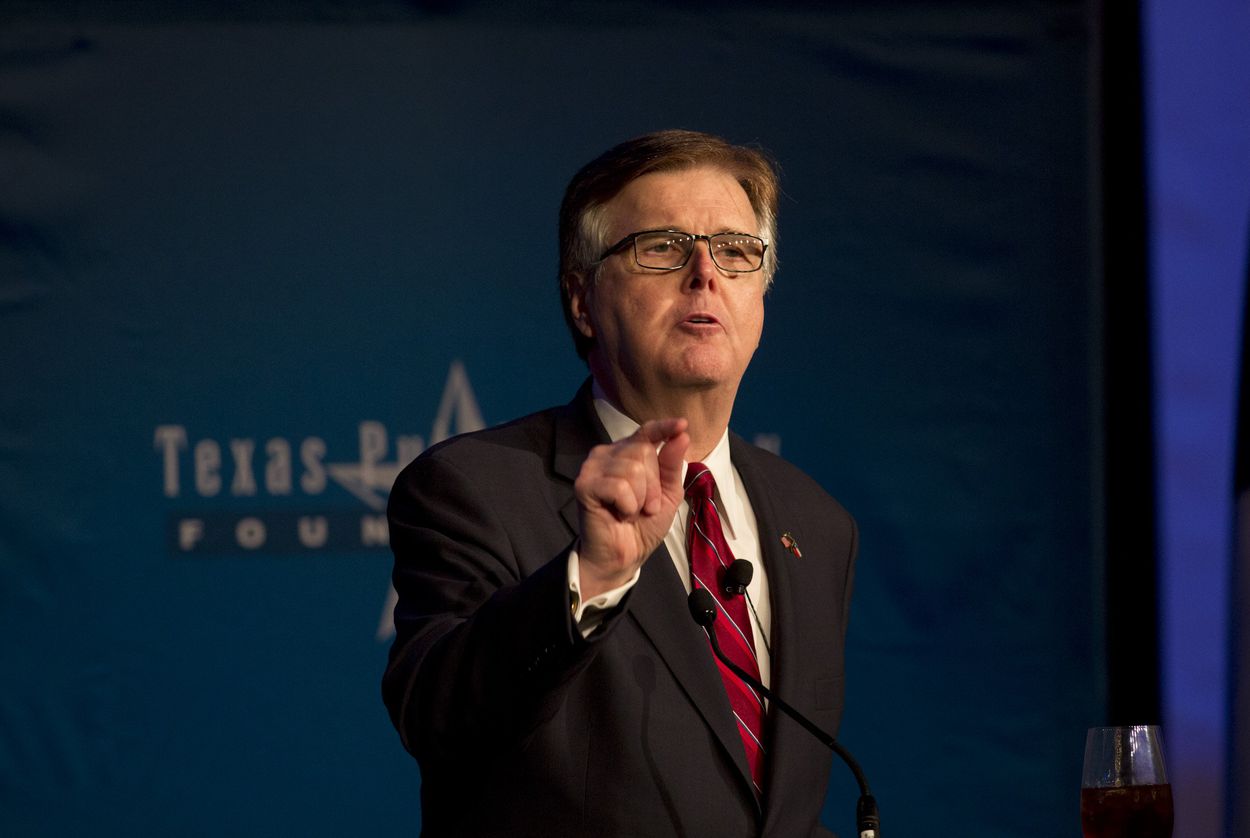
Texas Lt. Gov. Dan Patrick wants to put guns in our teachers’ hands.

He thinks a well-armed teacher could have stopped the shooter from slaughtering those 10 victims in Santa Fe, Texas, the other day.

Sure thing, Mr. Patrick. Or … a heat-packing educator could have missed the shooter and wounded — or killed! — other students or fellow educators.

Patrick told ABC News’s “This Week” that teachers “are part of that well-run militia” spelled out in the U.S. Constitution’s Second Amendment.

Sigh …

In truth, the amendment refers to a “well-regulated militia.” My own view is that teachers are tasked exclusively to educate children; they are not asked to provide armed response to violence in the classroom or in the halls, or the cafeteria or the gymnasium or the school yard.

This notion of arming teachers keeps getting revived every time a gunman opens fire in our public schools. There has been so much of it these days we have become numb — or so it seems — to the news that keeps erupting.

Patrick did say something that rings true while he was on TV this morning: “We have devalued life, whether it’s through abortion, whether it’s the breakup of families, through violent movies, and particularly violent video games which now outsell movies and music.”

Yes, this is a societal issue that needs careful examination. However, none of that will be solved merely by putting more guns into our public schools.

What are we going to do about it, Mr. POTUS?

Donald Trump continues to exhibit a remarkable command of the obvious.

Ten people — nine of them students — were shot to death in Santa Fe, Texas, the other day. The nation is grief-stricken yet again by a spasm of gun violence in a public school.

The president spoke to the nation and said he intends to do all he can to protect our students, to make our schools safer.

This gun violence has been going on for “too long,” he said.

Yes, sir. It has. Several of your predecessors could have said the same thing. Indeed, I’m quite sure many of them did say that very thing, that this gun violence has been going on far too long.

What did they do about it? What did Congress do about it? What did governors or state legislators do about it? Nothing! Not a damn thing!

So now it falls on the current president to do something. It falls also on Congress. Texas Gov. Greg Abbott declared his intention to hold a round table discussion in which “everything” is on the table.

I have heard the president say the same thing, that he would be willing to discuss any issue put forward.

We have to stop this madness, Mr. President. Our children need to be feel safe. Their parents need to send them to school with the full expectation that they will return home at the end of the day.

Gov. Abbott said it well. “Thoughts and prayers” no longer are enough. The time for action has arrived. Hell, it arrived at the previous mass shooting, and the one before that, and the one before that one …

Do something!

Reduce access at schools? No thanks

Texas Lt. Gov. Dan Patrick has tossed out an idea worthy of discussion in reaction to the Santa Fe High School massacre of nine students and a teacher by one of the students at the school near Galveston.

The discussion, though, should be brief.

Patrick believes schools are too open, that they contain too many doors. Access is too easy. Gunmen can walk in and blast away, according to Patrick.

His solution? Let’s “harden” the schools, reduce the number of doors.

According to the Texas Tribune: “We may have to look at the design of our schools moving forward and retrofitting schools that are already built. And what I mean by that is there are too many entrances and too many exits to our more than 8,000 campuses in Texas,” he said, citing security at office buildings and courthouses. “Had there been one single entrance possibly for every student, maybe he would have been stopped.”

OK. That’s enough of that.

Schools need those doors to enable students can escape in case of fire and, oh yes, in case someone does open fire in classrooms or in the halls.

Patrick’s idea appears to be well-intentioned. I’ll give him that much. However, it is entirely impractical, given the myriad other hazards that can confront students, teachers and school staffers.

At least, though, Lt. Gov. Patrick has started the discussion.

Here is why early voting sucks

A major Texas newspaper has just validated my reasons for hating early voting.

The Dallas Morning News has rescinded an editorial endorsement it had made because a candidate for a Dallas County Commissioners Court seat was revealed to have set up a trust fund for his children if they married white people.

The candidate is Republican Vickers Cunningham. The revelation came to light on the eve of the runoff election for the commissioners court seat. The Dallas Morning News was so incensed at the racially loaded matter that it pulled its endorsement.

This is what I’m talking about! I have said for many years that — banning my actual absence from my voting precinct on Election Day — I always choose to vote on that day. Why? Because I hate being surprised by learning something terrible about my candidate after voting for him or her.

The matter involving Vickers Cunningham falls into that category of unwelcome surprise.

The Morning News said it backed Cunningham because of his experience as a district court judge. It didn’t know about the compact he made with his children until “the final days of this campaign.”

I know that Election Day voting doesn’t prevent such surprises. I merely want to minimize to the best of my ability the impact of such a surprise by waiting until the last day of an election campaign to exercise my right as a citizen.

Please, let’s not arm teachers

We’re heading into another “national conversation” about how to make our schools safer, about how to protect our children from gunmen who open fire in public school classrooms.

Santa Fe High School in Galveston County, Texas, has become the latest — and certainly not the last — flashpoint in that discussion.

Ten people are dead and 10 more are injured. A student has been taken into custody and has been charged with capital murder. He faces the death penalty if he’s convicted.

The president of the United States, Donald Trump, vowed to make our “schools safer.” Yes, Mr. President, we’re all for it.

Does that include arming teachers? For the umpteenth time, this blogger wants to say not just “no,” but “hell no!”

I am at a loss as to what the solution is. I remain convinced that there can be a legislative remedy found that keeps faith with the Second Amendment to the U.S. Constitution. I am not smart enough to concoct a solution from this keyboard.

However, I merely want to implore the president and other public officials to steer far, far away from a discussion about putting guns in teachers’ hands.

The National Rifle Association keeps harping on the notion that “the only way to protect us from bad guys with guns is to put guns in the hands of good guys.”

So, that’s the answer? The way to end gun violence is to put more guns out there? Such nonsense makes me want to scream.

I do not want to hear that. Instead, I want to hear some possible solutions that place reasonable — and constitutional — restrictions on individuals capable of doing harm to the rest of us.

Tragedy strikes another school

Texas Gov. Greg Abbott said today what many of us already believe: It’s not enough to offer “thoughts and prayers” to communities stricken by a spasm of gun violence. The time for action is at hand.

Yes, governor. You are so right.

Santa Fe High School near Galveston is reeling today in the wake of another school shooting. Ten people — most of them students — are dead; another 10 are injured, with a couple of the injured victims suffering life-threatening injuries.

The shooter, a student at the high school, is in custody.

By all means we offer our prayers. Now comes the hard part. What are we going do to stop this insanity?

Abbott said today that everything is on the table. Everything? Yep. That’s what he said. Everything. I’m going to presume he means what he says.

Putting something on the “table” does not guarantee anything substantive will arise from a serious discussion.

Gov. Abbott wants to convene a town hall meeting. He wants to talk to constituents. He said he is open to anything they have to offer.

The shooter’s father owned the weapons, a shotgun and a .38-caliber revolver. Here’s a thought for the governor to ponder: Stiffen liability punishment for parents who fail to do all they can to keep the guns out of the hands of their children. OK, that’s just a thought off the top of my noggin.

Is this yet another turning point? Has it supplanted the Parkland, Fla., carnage as the catalyst that will bring action in place of rhetoric?

I cannot wrap my head around all of this at the moment.

Lord have mercy on us all.

Lawmaker to lobbyist: an unfair advantage

Blake Farenthold has left one job in Washington, D.C., and has immediately cashed in with another one.

It makes me wonder as I have in the past: Why can’t there be a built-in revolving door clause that requires former lawmakers to spend some time on the outside before they become lobbyists?

Farenthold left Congress amid a sexual harassment scandal that took him down. He dipped into a taxpayer-funded cache of money to shell out $84,000 to settle some of the sexual harassment claims.

It was not a graceful end to this man’s congressional career.

What does he do now? He lands a job as a “legislative liaison” for the Port of Port Lavaca, near Corpus Christi, which is where he represented in Congress.

Why does this stink? Because it allows an immediate past member of Congress to parlay his contacts, relationships and friendships with members of Congress on behalf of interests he is representing.

It gives him a leg up or an unfair advantage over other lobbyists.

I have nothing against lobbying, per se. It provides special interests with valuable access to those who can benefit them tangibly. I get it, man! It’s the American way.

However, I’ve never liked this idea of legislators or members of Congress instantly becoming lobbyists after their public careers have come to an end.

I would prefer a two- or three-year required waiting period. It enables some additional congressional turnover to occur, which might tend to level the playing field for all the lobbyists who hound, harangue and hassle members of Congress on behalf of their clients.

As the Texas Tribune reported: In a statement provided to the Caller-Times, the Calhoun Port Authority, which oversees the Port of Port Lavaca-Point Comfort, confirmed that Farenthold would serve as the port’s full-time legislative liaison. The port did not return a phone call from the Texas Tribune requesting comment Monday.

“Blake has always been a strong supporter of the Calhoun Port Authority and is familiar with the issues facing the Port,” the statement said. “The Board looks forward to the services Blake can provide in assisting the Port with matters in Washington, D.C.”

Yeah. Do ya think?

Aww, what the heck. Maybe with his new source of income, he can pay back that 84 grand he took from taxpayers to settle those bad conduct lawsuits.