Category Archives: political news

Another ‘family values’ official takes a fall

Robert Bentley got elected governor of Alabama partly on the basis of his belief in what he defined as traditional family values.

But wait! The Republican got involved romantically with a senior staffer. He got re-elected and then tried to cover the affair up. His wife of 50 years then divorced him after learning of text messages revealing the affair hubby was having.

Now he’s out of office.

This isn’t a huge deal in terms of what it means for the entire nation. Kay Ivey, another Republican, took the oath of office as governor today. State government will go on. Bentley will serve two years of probation and then he’ll disappear from the public stage.

What gives this story its legs, I suppose, is the sight of another moralist/politician going down for the count. We see this kind of thing on occasion.

Two pols stand out in my memory.

Do you remember John Edwards, the former Democratic senator from North Carolina? He used to talk publicly about the love he had for his late wife, Elizabeth, all while he was taking a tumble with a woman who was assigned to put his life story on film.

Then we had the former Republican speaker of the U.S. House, Newt Gingrich, ranting and railing about President Clinton’s sexual misdeeds as he, too, was cheating on his wife with a staffer.

During the nadir of Clinton’s presidency there were candidates for public office who would proclaim their sexual fidelity as a reason to vote for them. Imagine that, will ya? As if that’s something about which you should boast.

Bentley quit just as Alabama legislators began filing impeachment procedures on the basis of evidence that Bentley violated state campaign rules in covering up this episode.

The late President Nixon taught the nation graphically a particular lesson about political scandals. It’s rarely the deed itself that brings the politician down; it usually is the cover-up.

Governor pleads guilty, then quits

There might be a lesson, too, for future politicians to heed. Don’t try to sell yourself as a “family values” champion if you have any predilection to violate a sacred pledge.

Potentially monumental municipal election on tap

Amarillo is less than one month away from what looks like a potentially landmark municipal election.

Think of this for a moment.

Three members of the five-member City Council are not seeking new terms: Mayor Paul Harpole is retiring from public life; Place 2 Councilwoman Lisa Blake won’t seek election for the seat to which she was appointed in 2016; Place 3 Councilman Randy Burkett is forgoing a shot at a second term.

That leaves two council members, Elisha Demerson in Place 1 and Mark Nair in Place 4 seeking re-election to second terms. But get this: They both are facing serious challenges from serious challengers.

That means the entire council could flip on May 6.

Oh, and then there’s another element. The city has a new manager, a new chief administrator, Jared Miller, who was hired by the current council, but who might find himself working for five brand new council members with entirely different priorities.

Don’t get me wrong. The current City Council needed to act when it hired Miller and I applaud council members for moving with relative speed after dawdling for more than a year to find a permanent city manager after Jarrett Atkinson resigned shortly after the 2015 municipal election. They brought in an interim manager, Terry Childers, who right away seemed to be a poor fit, given some temperament issues that surfaced with that silly “Briefcasegate” matter involving his misplaced briefcase and that ridiculous 9-1-1 call in which he berated an emergency dispatcher. Oh, and then he called an Amarillo constituent a “stupid son of a b****”.

B’bye, Mr. Childers.

I’ve got my choices for the City Council. I frankly think a wholesale change in the council’s makeup is in order.

This election would seem to demand a huge turnout at the polls. It should compel a rigorous examination of the candidates and the platforms on which they are running. It should require voters to pay careful attention to each candidate’s views on the direction they want to lead the city.

Amarillo is in the midst of a massive makeover in its downtown district. We still have to get that baseball franchise relocated to Amarillo and to secure a major tenant for that ballpark officials hope to build across the street from City Hall.

I remain optimistic it will occur. The next City Council must ensure the city keeps moving forward.

At minimum we are guaranteed to elect a new majority on our council. A better outcome would be to start with a fresh approach across the board. My choices? Ginger Nelson for mayor; Elaine Hays for Place 1; Freda Powell for Place 2; Eddy Sauer for Place 3; Howard Smith for Place 4.

Are we ready?

Time for a town hall meeting, Rep. Thornberry? Hmmm?

Welcome home, Mac Thornberry.

I know you’re a big shot in the U.S. House of Representatives, chairing the House Armed Services Committee and all of that.

You and I have some shared history here in the Texas Panhandle. You took office the same week I reported for duty at the Amarillo Globe-News in January 1995. In a way, we kind of “grew up together.”

But you’ve disappointed me at times. We differ on public policy matters. That’s OK with me. We have maintained a friendly relationship, which I sincerely appreciate.

What I cannot yet fathom is why you are forgoing town hall meetings with your constituents during this Easter/Passover break Congress is taking. Surely you know about the unease among many Americans about what Congress might do with the Affordable Care Act, the law you GOP lawmakers and other critics blithely call “Obamacare.”

Y’all tried to scrap it and replace it with something else. It didn’t work. The effort failed.

But you aren’t planning any town hall meetings. You met with business leaders in Amarillo and, I presume, in Wichita Falls. I understand you talked about the government’s rules and regulations that affect business operations; I also am quite certain you heard a lot of agreement from those constituents over your own belief that the feds are too hard on private enterprise.

Others out there aren’t entirely in sync with what you want to do. They dislike efforts to repeal and replace the ACA. Indeed, many of your colleagues — including your fellow Republicans — have gotten a gutful of gripes from constituents. I applaud them for taking the heat.

I do not applaud members of Congress who decline to face their constituents and to answer their questions and deal with their anxiety.

You need not to be reminded, Mac, that you work for us. We are your bosses. Not the speaker. Not the House majority leader. Not the president. It’s us, sir.

Talk to us. Listen to us.

Senate sees the end of collegiality

There once was a time when the U.S. Senate could be a place where senators disagreed but remained friends.

I believe those days are over. They perhaps have been gone for a lot longer than I realize. The confirmation battle over Judge Neil Gorsuch closes the deal.

Say goodbye to Senate collegiality.

Battle changes the dynamic

Gorsuch’s confirmation came on a fairly narrow vote. All Republicans voted to seat him on the U.S. Supreme Court; all but three Democrats voted against his confirmation.

Some of us — including yours truly — used to believe the federal judiciary somehow was insulated from partisan politics. Not true. Maybe it’s never been true.

Senate Republicans tossed the filibuster rule into the crapper to get Gorsuch confirmed. The Senate used to require 60 votes to quell a filibuster. Democrats launched a filibuster to block Gorsuch’s confirmation; Republicans answered by invoking the so-called “nuclear option” and changing the rule to allow only a simple majority to end a filibuster.

Democrats are angry that Donald J. Trump got elected president in the first place. Their anger metastasized with Trump’s appointment of Gorsuch after Republicans blocked Barack Obama’s nomination of Merrick Garland to succeed the late Antonin Scalia.

I’m not at all confident that either side is going to find a way toward some common ground — on anything!

I recall a story that former Republican U.S. Rep. Larry Combest once told me about his former boss, the late U.S. Sen. John Tower; Combest served on Tower’s staff.

Tower, a Texas Republican, was a fierce partisan. One day, as Combest recalled it, he and another equally ferocious partisan debater, the late Democrat Hubert Humphrey, were arguing on the Senate floor about some legislation. They were gesturing and shouting and saying some angry things while arguing their points, Combest remembered.

After a lengthy floor debate, the presiding officer gaveled the session closed, Combest said, and Sens. Tower and Humphrey walked toward the middle of the floor, shook hands — and walked out the door with their arms around each other.

My gut tells me those moments are long gone.

End of judicial filibuster? A mixed blessing

I’ve long had a terrible conflict of emotions as it regards the filibuster, a tactic employed in the U.S. Senate designed to stall the progress of legislation … and appointments.

The Senate this week did away with its 60-vote rule to end filibusters. The rule change allowed the confirmation of Judge Neil Gorsuch to the U.S. Supreme Court.

But it’s the filibuster itself that gives me pause.

My own political bias clouds my view of what the Senate did as it regarded Gorsuch’s nomination. Given that the Republican-controlled Senate blocked an earlier high court nomination because a Democratic president had put a name forward to succeed the late Antonin Scalia, I saw some justification in what Senate Democrats sought to do with Gorsuch’s nomination.

But is the filibuster really an essential element of governance? I’ve long questioned it. A filibuster occurs when senators object to an issue before the body. They can filibuster in a number of ways, but the classic method is to hold the floor for hours, days, weeks — however long it takes — to talk about anything under the sun.

The Senate has had some champion filibusterers. I think of the late Wayne Morse from my home state of Oregon and the late Strom Thurmond of South Carolina. Those fellows could bluster seemingly forever on anything in order to talk a bill to death.

We operate our government on the principle of “majority rule.” The word “majority” doesn’t imply “super majority,” which is what the former Senate filibuster rule required. Majority means one vote greater than half. The Senate comprises 100 members; therefore, 51 votes constitute a majority. Shouldn’t that be enough to settle a policy argument on the floor of the Senate?

We elect presidents with a simple majority of the Electoral College. All it takes is 270 electoral votes, out of 538 total, to elect a president. Is there a more important electoral decision to be made than that? We don’t require in the U.S. Constitution a super-majority of electoral votes to choose a president. So, why do senators insist on filibustering and then require 60 votes to end it.

The filibuster seems to be an obstructionist’s tool. As one who believes in “good government,” this activity appears to me to work against that principle.

That didn’t take long

Media are reporting possible big shakeups within the White House high command.

The White House — no surprise here — is denying it. Yet the signs seem to be unmistakable.

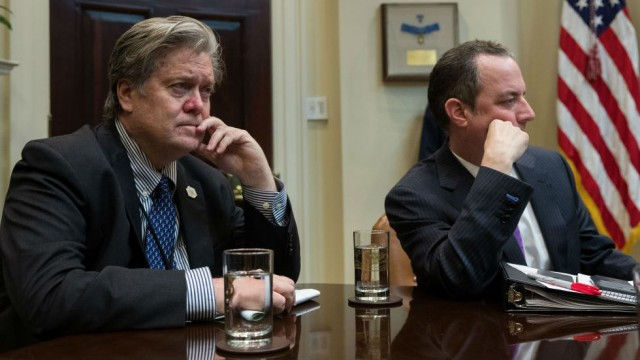
Senior strategist Steven Bannon has lost his job on the National Security Council. He’s fighting with Donald J. Trump’s son-in-law, Jared Kushner. Meanwhile, White House chief of staff Reince Priebus appears to be his way out … along with Bannon.

Trump’s White House flack machine no doubt is considering all this to be “fake news.”

But is it?

Trump’s executive machinery has been creaking along ever since the president took office. There can be no doubt about what we’ve all witnessed.

Shakeup taking shape in White House

At some level, the notion that Priebus would be placed into some kind of shakeup bubble troubles me. I’ve considered Priebus — the former Republican Party national chairman — to be one of the few grownups Trump brought in. But he might be shown the door. Why? My guess is that he cannot stop the reports of palace intrigue within the White House.

Chiefs of staff are supposed to keep a tight rein on everyone else within the West Wing. That’s how the best of them function. Jim Baker did so within the Bush 41 administration; Dick Cheney ran a tight ship during the Ford administration.

Trump, though, brings a whole new dynamic to executive branch governance. He has surrounded himself with amateurs in many posts. Yes, he has some fine men and women serving in his Cabinet.

This notion, though, of putting his son-in-law — not to mention his own daughter, Ivanka — in the middle of policy decisions creates a tension that goes far beyond the “creative” kind that can work in an executive’s favor.

The president has just encountered his first major foreign policy crisis and answered it with clarity and precision with the air strikes against Syrian targets. He’ll need strong, steady leadership and counsel within his top White House staff if he is going to move forward.

If he’s going to shake things up in the West Wing, he’d better do it quickly and tell his flacks to stop denying the increasingly obvious.

How can Trump deny Syrian refugees?

Donald J. Trump expressed appropriate outrage over the Syrian government’s use of chemical weapons against civilians — including children.

The president is right. Syrian dictator Bashar al Assad has committed war crimes and crimes against humanity. And I do support the decision to launch Tomahawk cruise missiles at military bases believed to be where the Syrians launched the chemical weapons against their fellow citizens.

However …

How does the president justify his decision to ban refugees fleeing the civil war in Syria because they happen to originate from a Muslim-majority nation?

His statement condemning the casualties inflicted on children seems to fly directly against his heartless decision to ban refugees.

How do you balance one against the other, Mr. President?

Tax returns, anyone? Anyone?

Indulge me for a moment or three.

I remain stuck on an issue that has gnawed at my gut since the moment Donald John Trump rode down the escalator at Trump Tower to announce his campaign for the presidency of the United States.

That’s right. Tax returns.

We haven’t seem them. We need to see them. Trump needs to produce them. We need to know a lot about this individual’s business empire and what about it — if anything — is built on Russian interests.

It’s been nearly two years since the escalator ride. Trump has said many things about those returns. He’ll release them when the Internal Revenue Service completes its audit; then he said he won’t; then his campaign flacks said he would, then they said he wouldn’t.

The IRS says audits don’t prevent release of tax returns. Trump ignores that disclaimer. He did release some single-year returns showing that he paid a lot of money in federal taxes. They showed that, yep, he’s really rich. That’s it.

For that matter, we don’t even know with absolute certainty that the IRS is even auditing the president. The IRS doesn’t comment on individual audits. That means we’re left to take Trump at his word that the audit is ongoing.

Given the liar in chief’s penchant for prevarication, are we really and truly expected to take this man’s word as gospel? I … think … not.

This clown entered the political arena in July 2015. Presidential candidates from both parties have released complete tax returns every election cycle since 1976. Four decades later, we still don’t know about the current president’s tax returns.

It’s time, Mr. President. Come clean.

Trump and Perry: national security BFFs?

How in the world do these things happen?

Political foes say some amazingly harsh things to and about each other. Then when the fight is over, they declare a winner, all is forgiven and forgotten. It’s just politics, man. Which means that we didn’t really mean all those angry things we said to the other guy.

I just caught up with a story published in the Texas Tribune that seems to illustrate all of that quite nicely. Former longtime Texas Gov. Rick Perry — who now serves as secretary of energy in the Donald J. Trump Cabinet — is now joining the National Security Council. Perry has become one of the president’s more trusted national security advisers.

Did they cure the ‘cancer on conservatism’?

Rick Perry once challenged Trump for the Republican Party’s presidential nomination. He was one of a thundering herd of GOP hopefuls seeking to succeed President Obama.

Perry didn’t make the grade — again! But before he stepped off the stage, he did manage to launch a scathing, blistering attack on Trump, whom he called a “cancer on conservatism.” He said the cancer needed to be “excised” from the party, meaning, I suppose, that Republicans needed to do all they could to avoid nominating Trump.

Lo and behold! Trump wins the election and then selects Perry to run the DOE, which in itself is soaked in irony. You’ll recall that Perry ran for president in 2012 and during a primary debate sought to name the three federal agencies he would eliminate. He mentioned the departments of Education and Commerce, but then forgot the Energy Department, producing that infamous “oops” moment that likely will live forever.

I get that energy policy is a national security matter and that the energy secretary deserves to be included in national security discussions on the NSC.

It still does boggle my mind to see Rick Perry — of all people — elevated to this exalted place during this troubling time.

It makes me ask: Did he really mean that stuff about curing the conservative movement of its “cancer,” or was he making it all up?

How will we know when he’s speaking from the heart or whether he is merely pandering?

Make recusal permanent, Rep. Nunes

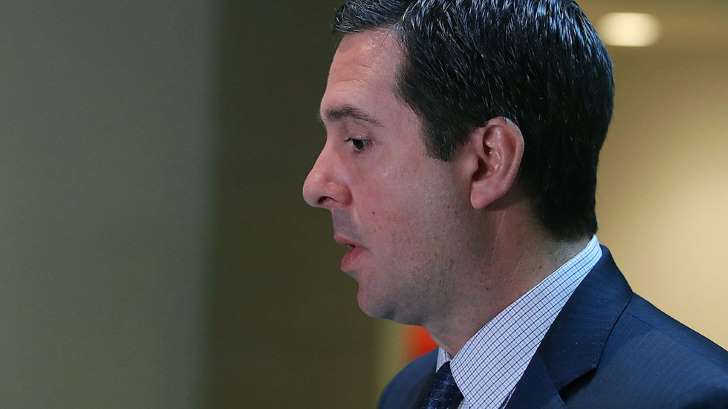
U.S. Rep. Devin Nunes has recused himself “temporarily” from the House Intelligence Committee investigation into Donald Trump’s alleged connection to Russian government hackers.

Fine. Let’s make the recusal permanent, shall we?

Moreover, let’s work to institute an independent investigation into the potentially grave matter and take it completely out of the hands of partisan politicians.

Nunes chaired the Intelligence panel. Then he revealed he had some knowledge of “incidental surveillance” being done on Trump campaign officials. He ventured to the White House secretly and met in private with the president.

The former chairman managed to compromise his independence completely. After all, he had served on Trump’s transition team. From where I sit, he is too close to the subject of his committee’s investigation.

The Intelligence Committee chairmanship now falls to Mike Conaway, a Texas Republican. He pledges to carry the investigation forward.

I fear that won’t be good enough.

This matter is beginning to swallow up Congress as well as the White House. Politics is threatening to get in everyone’s way while the questions continue to surround the president, his campaign staff and even his governing administration.

Did the campaign collude with the Russians to influence the 2016 presidential election? Did the president defame former President Obama by accusing him falsely of ordering a wiretap prior to Trump taking office?

Republicans tend to give the president a pass on all of this; Democrats are quick to convict him of all of the above.

Independence is required to produce a thorough and unbiased investigation.

Nunes’ recusal is a start toward that end. Let’s finish it by handing it over to an independent counsel.