Category Archives: media news

Community journalism takes another gut punch

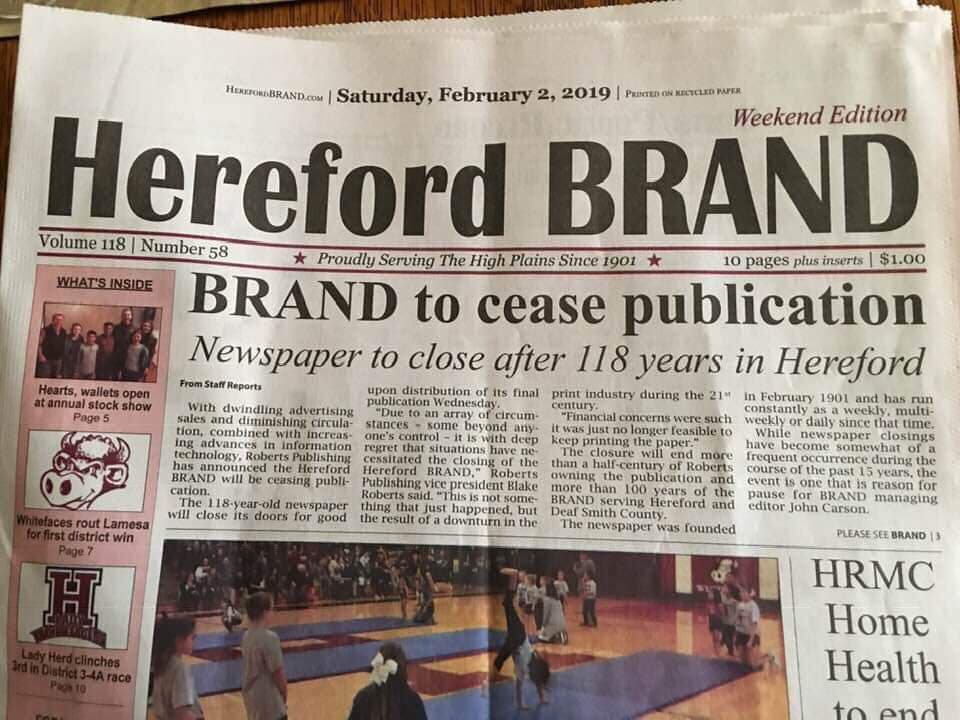
To those of you who aren’t familiar with the Texas Panhandle, this picture might not mean all that much to you.

Those of us who call the place home — or used to call it home — and worked in the field of print journalism, the photo speaks volumes.

It saddens me greatly.

The picture announces the closing of a community institution in a Texas Panhandle community that once relied on its local newspaper to chronicle its stories, to be the “first draft of history” in the town’s on-going evolution.

Hereford, Texas, sits about 30 miles southwest of Amarillo. The Brand has covered the community for 118 years. It’s going out of business. The owners of the paper cite declining circulation, declining advertising revenue and the unspoken issue of “declining relevance” in the lives of those who once read The Brand.

Man, this really stinks. It’s a continuation, I fear, of what is happening in rural communities all across the nation. The “Digital Age” is inflicting more casualties constantly on once-proud community institutions.

Even in Amarillo, where I worked for nearly 18 years, the Globe-News has vacated its historic location and moved into non-descript offices in a bank tower downtown. It has ceased printing the newspaper in Amarillo; that’s being done in Lubbock. It has hired a regional publisher, a regional executive editor, a regional “director of commentary” and a regional “distribution director.” The emphasis is now on centralizing its daily operations. The newsroom no longer employs photographers, its copy desk functions are being done out of a centralized operation center.

Do you get my drift?

Now this new age of “journalism” has claimed another victim.

The Texas Panhandle has a long and rich tradition of kick-a** journalism. The Amarillo Globe-Times once earned the Pulitzer Prize for Meritorious Public Service, for crying out loud! Communities scattered across the Panhandle’s spacious landscape have been served well by mom-and-pop newspapers that over time have morphed into “group ownership” organizations.

Those communities very soon will have one less newspaper among their ranks.

Sad days, indeed.
Voters retain ultimate power

Two political incidents in the Texas Panhandle have provided significant evidence of just who holds the power in these disputes.

I refer to two dustups: one involving Texas state Sen. Kel Seliger, R-Amarillo, and Lt. Gov. Dan Patrick; the other one involves the Amarillo Independent School District Board of Trustees.

In both instances, the voters are getting the shaft by those in power.

First, the Seliger-Patrick battle.

Patrick is angry with Seliger because the Amarillo Republican lawmaker doesn’t always vote the way Patrick prefers. What the lieutenant governor needs to understand — and I am sure he does at some level — is that Seliger works for West Texans, not for Dan Patrick.

Patrick yanked the chairman’s gavel from Seliger, who chaired the Senate Higher Education Committee. Seliger said something supposedly unkind about a Patrick aide. Patrick then responded by pulling Seliger out of the chairmanship of the Senate Agriculture Committee.

Seliger owes his allegiance to the voters of the sprawling Texas Senate District 31. As for Lt. Gov. Patrick, he is acting like a legend in his own mind.

Now, the AISD board.

An Amarillo High School volleyball coach, Kori Clements, resigned after one season. She cited parental interference as the reason she quit; she also said the school district administration didn’t back her.

The chatter around the school district is that the offending parent is a member of the AISD board of trustees.

The board has been silent. It has refused to speak to the issue directly. It needs to do exactly that. Why? Because the board works for the public, which pays the salaries of the administrators and educators and which pays to keep the lights on at all of AISD’s campuses.

The voters are the bosses. The AISD board answers to them, not to each other, or to the superintendent.

There needs to be a public accounting for what happened to make Coach Clements pack it in after just a single season as head coach of a vaunted high school volleyball program.

The public needs to know. It has every right to demand answers.

Another critic says ‘goodbye’

I have written on this blog and in other forums about the need to read and listen to opinions that differ from our own.

I’ll stand by that belief for as long as I write this blog.

That said, I got a scolding overnight from a (former) reader of High Plains Blogger. He didn’t like a post I published that stood up for House Speaker Nancy Pelosi in her ongoing battle with Donald Trump over funding for The Wall and, well, other matters.

My critic said he once thought I harbored some “common sense.” Now he is convinced I have none. He’s done reading the “crap” I post on the blog.

Dang it! That means he won’t read this item. Supposedly. That’s if he can resist the temptation to get his dander up all over again. I’ll assume he means what he said.

Here’s my point . . .

I welcome criticism of this blog. I make no apologies for my own political bias. You know where I stand regarding the president of the United States; you understand my partisan leaning; I make my political orientation clear.

Yes, I do read the opinions of other bloggers and commentators. Some of my favorite opinion writers happen to be folks with whom I have strong disagreements. They include folks such as Jonah Goldberg, Peggy Noonan, William Kristol, the late Charles Krauthammer.

I admire those who can express themselves as brilliantly as they do.

I do not begin to pretend I am in their league. I am just a schmuck blogger who fires off these posts when the spirit moves me. Since I am retired these days, I have plenty of time to devote to this blog. Which I do.

The world would be pretty damn boring if all we read were thoughts and beliefs that agreed with our own. Don’t you think?

I’ll keep on keepin’ on with this blog. I might lose some more readers along the way. Or . . . I might gain a few, too.

It’s all part of the process of learning about this great big world of ours and about this wonderful country that enables us to speak our minds, even when it angers others.

Time of My Life, Part 15: Name-dropping

You’ve known a name-dropper, right? He or she is the individual who isn’t bashful about mentioning the names of individuals who cross their path.

For 37 years — or so — as a print journalist I was able to meet some mighty big names. I usually resist the urge to drop their names in casual conversation. I will succumb to that urge for the purposes of writing this blog post.

I cannot possibly list all the names of big hitters my career allowed me to meet along the way. I’ll mention a tiny handful of them just to give you a smattering of the good times that I enjoyed while reporting on and commenting on issues of the day and the people who influenced them. It was during an era when politicians and other public figures wanted to be seen talking to newspaper journalists.

George W. Bush was governor of Texas from 1995 until 2000. A higher office took him out of the governor’s office, but in the spring of his first term as governor, I was able to meet him and interview him at some length in his office in the Texas State Capitol in Austin.

He had summoned editorial page editors from around the state earlier that year. Bad weather in Amarillo prevented me from attending that meeting; I called to let the governor’s staff know of my predicament, but asked that they call me if he chooses to have another one of those meetings.

A few weeks later, they called. The governor wanted to meet me. I asked, “Who else will be there?” They said “Just you.” So, I made arrangements, flew to Austin and spent more than 90 minutes quizzing the future president of the United States about this and that issue.

It was a wonderful experience and I learned a great deal about the governor.

Phil Gramm served in Congress first as a Democrat and then as a Republican. He was a friend and ally of President Reagan, the nation’s top Republican. He was so friendly that the House Democratic caucus ousted him from key budget and tax committees because he reportedly was leaking Democrats’ strategies to GOP members.

Gramm then resigned his House seat, changed parties and then got elected to the House again as a member of the Republican Party. I thought that was a courageous step to take. It surely was a highly principled step.

My favorite quip from Gramm, who was elected to the Senate in 1984, came during a visit he paid to us at the Amarillo Globe-News. My colleague and I interviewed him at length. Gramm was fond of quoting his “Grandma” along with the guy from Mexia named Dickie Flatt. He would mimic Grandma in an affected Deep South drawl.

My colleague mentioned a criticism that came from the late liberal columnist Molly Ivins about something that Gramm had said. His response was classic.

“Molly Ivins likely cried when the Berlin Wall came down,” he quipped. It wasn’t very professional of me . . . but I laughed out loud.

One final name . . .

Georgie Packwood once was married to former U.S. Sen. Bob Packwood, an Oregon Republican. Sen. Packwood was running for re-election in 1980. Georgie Packwood campaigned on her husband’s behalf and along the way she managed to visit us at the Oregon City Enterprise-Courier, where I served as editor.

Mrs. Packwood was a smart, erudite and articulate public policy advocate for her husband. We visited for more than an hour, covering all the issues important to Sen. Packwood. We finished, I bid her goodbye and went back to doing whatever it was I had to do.

Several days later, I received a note from Georgie Packwood. It was a brief “thank you” to me for taking the time to meet with her.

Then she offered a specific word of thanks for “not asking about my favorite color.”

Ah, yes. Those were the days.

Happy Trails, Part 140: Retirement journey takes surprising turn

COMMERCE, Texas — Life is a journey that is full of surprises. Some of them sadden us. The one that has just presented itself to my wife and me, however, fills me with excitement.

We came to this college town today to discuss an opportunity that fell out of the sky. We met with Mark Haslett, a friend and former colleague of mine. We worked briefly together at the Amarillo Globe-News, but I knew him before that, when he was news director at High Plains Public Radio in Amarillo.

He now is news director at KETR-FM, the public radio station headquartered on the campus of Texas A&M University-Commerce.

What’s the surprise? Haslett has asked if I would be interested in writing for the station’s web site. The potential assignment that awaits me is quite similar to the first part-time freelance gig I scored shortly after quitting my post at the Globe-News; I wrote blogs for Panhandle PBS for a time.

This project is still a work in progress. Haslett and I haven’t yet set a start date. I’ll go out on a limb and suggest that it’s not far off at all. Yes, we still have some more details to work out.

My wife and I — along with Toby the Puppy — are getting ready to move into a new home in Princeton, in eastern Collin County, which Haslett told us over lunch today is in the KETR-FM coverage area. He prefers that I write about issues pertinent to Collin County and the area surrounding Princeton, which is a growing community in what — for the time being — sits in one of the few remaining rural areas of the Dallas-Fort Worth Metroplex.

OK, so here we are. Retirement remains a wonderful life for my wife and me. It does present some opportunities that we cannot foresee. This is one of them.

I don’t yet know where this particular journey will take us. I am grateful that my friend believes I have something of value to contribute to his listenership at KETR. There also might be some radio air time to discuss this new project and where we intend for it to go..

Meanwhile, I’ll be able to write about whatever moves me as we get settled in at our new digs in Princeton.

And so . . . the journey continues.

Happy Trails, Part 139: The fun has no end

I discovered something quickly not long after my career in print journalism came to a screeching halt.

It was that separation anxiety from work is vastly overrated. I also discovered — if you’ll pardon the cliché — that when one door slams shut in your face other doors open widely.

My career as a full-time editorial writer and editor ended on Aug. 31, 2012. I was the “victim” of a changing media landscape. My wife and I departed that very day on a vacation on the East Coast.

We returned a couple of weeks later and opportunity knocked. Amarillo College’s public TV station, KACV, called me with the opportunity. Would I like to write a blog for the Panhandle PBS web site? Of course I would! So I did for a little more than year.

I was given the task of writing on public affairs programming that aired on KACV-TV. They would post it on the web site. The idea was to call attention to programming that discussed news of the day, or on prevailing public issues.

That job lasted a while. Changes at the station brought changes in philosophy and management style. We parted company.

Then another media opportunity came along. My wife and I ran into the general manager of KFDA News Channel 10. He asked me: Why don’t you write for us? I wasn’t sure that was a serious query. I called him later and asked him, “Was that a serious question?” He said it was. We worked out a deal later in the year and I was given the chance to write about “Whatever happened to …” stories that News Channel 10 had covered. That series of features morphed into another series telling the stories of all those historical markers one sees along the highways of West Texas.

Again, I wrote those features for the station’s web site. The news anchors would call attention to the stories on the air and reporters would provide a two-minute summary of the story during the station’s even news broadcasts.

Eventually, that gig played itself out, too.

Then came another media-related opportunity. A longtime friend and a former colleague offered me a chance to earn some scratch working from home. Would I be willing to edit the copy of a reporter who worked for the Quay County Sun, a weekly newspaper in Tucumcari, N.M.? I could do it from my home in Amarillo. I then could proof-read pages as they were assembled by the young man in Quay County.

What a blast that turned out to be as well! However, that chapter closed eventually, too.

Retirement, thus, hasn’t always been what it has become for my wife and me most recently. I spend my time these days writing this blog and commenting on things such as this post and — quite naturally — on issues of the day.

We have settled into a new life in Collin County. It’s a quiet life these days, although the pace is going to pick up soon as we prepare to move into a new home we are purchasing in a more rural part of the county. We get to spend more time with our granddaughter and we get to come and go as we please. Of course, there’s also travel in our RV that we have enjoyed and will enjoy in the future.

But . . . there well might be another media opportunity knocking. I mean, it’s what I do. Who knows what’s in store?

Twitter use? Sure, why not? ‘Fake News’ epithet? Unacceptable

I have learned to accept that Donald Trump is going to use Twitter to express himself whenever he wants. I don’t like it, but that’s his way of communicating, so I’ll let that aspect ride.

What I cannot let stand is his continual use of the term “fake news” to describe media with which he disagrees.

He said this regarding the Davos economic summit, which he decided to skip  because of the partial government shutdown:

Last time I went to Davos, the Fake News said I should not go there. This year, because of the Shutdown, I decided not to go, and the Fake News said I should be there. The fact is that the people understand the media better than the media understands them!

C’mon, Mr. President! Knock off the “fake news” epithet.

He throws that term out whenever he describes media outlets that report news he finds objectionable, which is another way of saying he dislikes media that report the news accurately.

Moreover, the president of the United States is the uncrowned king of fake news. He foments lies continually. He has continued to speak untruths about current events, about his political foes, about the media. He promotes “fakes news” whenever he opens his trap and says things such as:

Barack Obama was ineligible to run for president because he wasn’t a U.S. citizen; he witnessed thousands of Muslims cheering the collapse of the Twin Towers on 9/11; millions of illegal immigrants voted for Hillary Clinton in 2016; the “caravan” of refugees fleeing Central America contained many “Middle Eastern” terrorists intent on killing Americans.

That’s just a sample of what I am talking about. The president is the master of “fake news.” For him to accuse the media of promoting “fake news” is just, well, another example of Donald Trump’s penchant for prevarication.

Time of My Life, Part 13: The sign is gone!

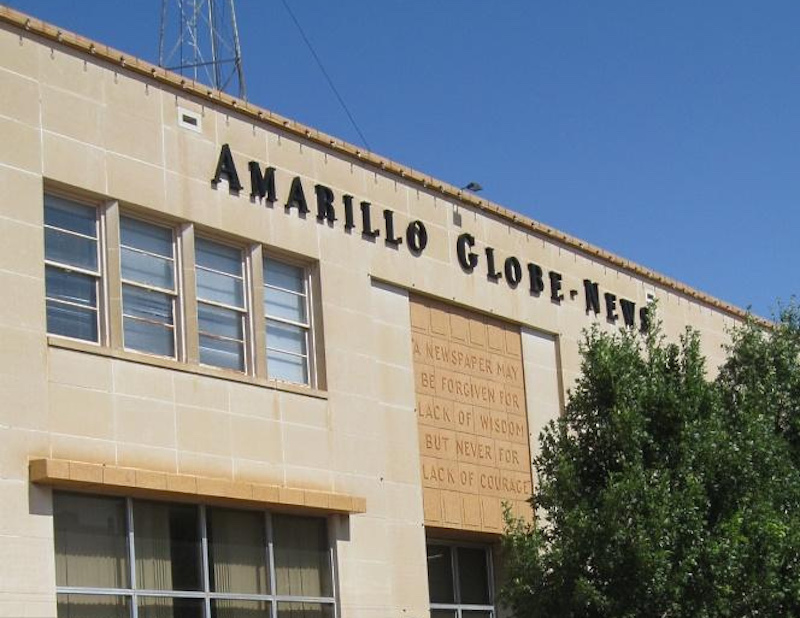
AMARILLO, Texas — I wish I had taken a picture of this building Tuesday when I drove past it en route to a meeting with a friend.

For some reason, I didn’t think to snap it with my smarty-pants cell phone. This building is where I used to work for nearly 18 years. I had a blast here for most of that time.

The sign you see on the front of this iconic structure is gone. It’s been peeled off by the newspaper’s owners, GateHouse Media, which purchased the newspaper from Morris Communications in October 2017. GateHouse has vacated the building and relocated its gutted news/editorial and advertising staff to a bank tower a few blocks away.

I won’t talk about that.

I came to work at this building in January 1995. An opportunity presented itself with an opening that occurred on the editorial page staff. I interviewed with the publisher in late 1994. He called me a few days after the interview and offered me the job.

I arrived a few weeks later and thought I had died and gone to heaven. I inherited a fine staff of two editorial writers, an administrative assistant and a part-time editorial cartoonist.

We published two newspapers back then: the morning Amarillo Daily News and the afternoon Amarillo Globe-Times. I also inherited a legacy of journalistic excellence, as the Globe-Times was awarded the Pulitzer Prize for Meritorious Public Service in 1961. The late legendary editor Tommy Thompson had uncovered corruption at county government and revealed it to the community. The Pulitzer board thought enough of that work to bestow print journalism’s highest honor.

We published separate editorials those days in each newspaper. We ran separate syndicated columns. Letters to the editor were submitted exclusively to either the morning or the afternoon papers.

We had a talented staff of writers and thinkers then. Our administrative assistant was a premier gatekeeper and a marvelous editor of the letters we received from readers. She had this inherent ability to make the correspondents’ words sing — without changing their intent. 

Those were the days. I got asked on my most recent visit to the Texas Panhandle if I “missed working” at the newspaper. My response was candid: I would miss it only if that work had remained as it was when I first got here. It didn’t.

Oh, but what a ride it was!

Regional commentary: it’s spreading!

I am so sorry to report that Amarillo and Lubbock aren’t the only two communities in America where newspaper editorial policy is suffering from the urge to combine resources under a combined “regional” approach to commentary.

A friend sent me a link telling me that Charlotte and Raleigh in North Carolina are combining their editorial pages, that they’ll be supervised by a regional editor who will oversee editorial policies in both communities.

Here is the link.

Oh, my goodness! The deterioration of editorial autonomy is deepening.

GateHouse Media, which owns the Amarillo Globe-News and the Lubbock Avalanche-Journal recently announced hiring a guy who will serve as a “regional director of commentary.” He’ll live in Lubbock and then commute to Amarillo on occasion during the week, I suppose to try to read the pulse of the community.

The early returns aren’t too promising. The Texas Panhandle no longer has a newspaper that provides leadership on local issues; nor does the South Plains region.

As to what is happening in North Carolina, I predict a similar fate befalling those Charlotte and Raleigh. McClatchy Newspapers runs the Charlotte Observer and the Raleigh News  & Observer. Those cities also are even more diverse and disparate than Amarillo and Lubbock. They both are cosmopolitan cities; they are highly sophisticated. Raleigh is part of that Research Triangle region that brims with high-tech expertise; Charlotte is the state’s largest city and is a bustling financial center.

The release I read about the N.C.-merger reads, in part: The move is the latest in a series of changes that combine McClatchy’s North Carolina operations. Presumably, this will mean the board will focus more on statewide news and less on local news specific to Charlotte or Raleigh.

There you have it . . . more than likely. Both communities’ newspaper editorial pages are likely going to look away from those issues of specific interest or concern to them individually.

Oh, the demise of newspaper editorial leadership continues. It is painful for this former opinion writer/editor to watch.

Community media presence still morphing

My concerns about the future of print journalism in the community I used to call “home” are mounting.

The Amarillo Globe-News just announced the hiring of a new “regional” distribution director. His name is David Morel. The Globe-News published a nice story today extolling his experience and all that kind of thing.

Then it quotes him expressing how he is “extremely grateful to be pat of the (Lubbock) Avalanche-Journal team. He spoke about his commitment to informing “the Lubbock community.”

I thought, “Hmm. No mention of Amarillo. What’s up with that?”

Upon reflection, I think I know. GateHouse media, the owners of the Globe-News and the Avalanche-Journal, seem to be moving toward some sort of media merger. The future of West Texas print journalism is going to be headquartered in Lubbock, it appears to me. The Globe-News, if it is going to exist in any form, is going to play second-fiddle to the A-J.

The recent hire of a regional director of commentary, who also is based in Lubbock, was enough of a signal of the future. Doug Hensley seems like a nice enough fellow, but I have yet to see an editorial posted in the G-N that even looks with a remotely critical eye at local issues, expressing local concerns, appealing directly to the local community.

The newspaper shrouds its editorial commentary in a more global context, talking about the joint concerns shared by folks on the High Plains and the South Plains. That’s when the paper decides to publish an editorial that speaks to anything that could be construed as being of local interest.

The papers have a regional publisher and a regional executive editor. Now they have a regional circulation director to go along with their regional director of commentary. Of the four regional execs, one of them — the executive editor — lives in Amarillo; the other three reside in Lubbock.

What does that tell you? It tells me where GateHouse is investing its resources in Lubbock. I now officially fear for the future of daily print journalism in the Texas Panhandle.

For those of us who invested time, energy and committed ourselves to the life of the community we loved, I believe this is a sad time.