Category Archives: Uncategorized

Step aside, George Stephanopoulos

I hope it doesn’t come to this, that the Republican National Committee forces George Stephanopoulos to do the right thing.

My hope is that he does it himself.

http://thefederalist.com/2015/05/14/the-rnc-should-ban-george-stephanopoulos-from-participating-in-2016-debates/

Stephanopoulos, host of the ABC-TV weekend news-talk show “This Week,” has revealed that he gave $50,000 to the Clinton Foundation. Hillary Rodham Clinton, of course, is running for president of the United States. Stephanopoulos’s credibility as an impartial journalist has been compromised beyond repair and he must not cover any aspect of the political campaign that’s beginning to unfold.

He didn’t reveal the donation until he was forced to do so by conservative media organizations.

This doesn’t look good for someone I’ve always trusted to be impartial — and bipartisan — in his questioning of political figures.

His contribution to the Clinton Foundation ties him directly — and monetarily — to the Democrats’ leading presidential candidate. He cannot possibly be seen as a neutral participant in any debate involving Hillary Clinton.

Surely he knows that. Just as surely he knows what he has to do.


Should we set John Hinckley free?

Allow me to answer the question posed in the headline.

Yes, sort of.

John Hinckley has been housed in a psych ward since a jury found him innocent by reason of insanity after he shot President Ronald Reagan, White House press secretary James Brady and two law enforcement officers in March 1981.

Brady — nicknamed The Bear by the press corps — died a year ago from the grievous head wound he suffered at Hinckley’s hand.

http://www.npr.org/sections/itsallpolitics/2015/05/12/406175445/reagan-shooter-john-hinckleys-lawyers-say-hes-ready-to-be-free

Hinckley’s lawyer says he’s ready to be set free. And even the government prosecutors suggest he is able to be released from the hospital. The feds, though, say he needs constant supervision and must be monitored closely.

I concur with the feds’ assessment, although if I were King of the World, I’d be reluctant to let him out.

Why? Well, the man sought to murder the president of the United States. He wounded him with a gunshot wound in the chest and as we would learn after the chaotic day the president could have died from the wound had the bullet lodged an inch or so toward the president’s heart.

What’s more, a jury ruled that Hinckley was insane when he committed the crime. How many people usually go from being insane to, well, sane?

I am one who doesn’t trust John Hinckley to never do something so crazed again.

That’s why if he gets out of the psych ward he needs careful and never-ending scrutiny.


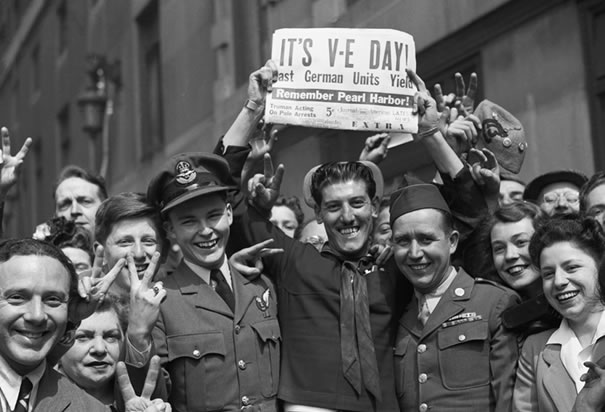
V-E Day still resonates 70 years later

v-e-day-snapshot2

Seventy years ago a huge chapter in the world’s greatest armed conflict came to a close.

The Red Army reached Berlin on its march from what was then known as the Soviet Union. It had beaten back the Third Reich and in a race to the German capital city with the force led by American and British troops advancing from the west, they crossed the “finish line.”

They accepted the Germans’ surrender and the war in Europe came to a close.

It’s called Victory in Europe Day. V-E Day.

The millions of men from allied nations performed acts of heroism against the Nazi war machine that cannot be forgotten.

Those men are all old now. They’re in their late 80s and 90s. They’re dying by the thousands daily. Those who remain — be they American, British, French, Russian or from any of the nations allied in the fight against tyranny — deserve our eternal gratitude.

It’s been said in the seven decades since the surrender that our side — the Americans and Brits — should have gotten to Berlin first.

But the Red Army got the jump on the American-led forces advancing from Normandy. They turned back the Nazis at Stalingrad in winter of 1942-43. Our forces wouldn’t land on the French coast until June 6, 1944. By the time our men slogged ashore, the Red Army had begun its advance on Germany.

As it turned out, the Soviets were able to claim Berlin as their captured capital and the carving up of Germany into western and eastern regions — independent of each other, with the east being controlled by the communists in Moscow — would become a source of tension that helped trigger a Cold War that lasted until 1991.

But the struggle that engulfed Europe had come to an end. There would be smaller conflicts that flared immediately after World War II. Greece fought a civil war between royalists and communists. Hungary would erupt in rebellion against the Soviets in 1956. Czechoslovakia would do the same in 1968.

But on May 7, 1945 — with Adolf Hitler dead in his bunker under the ruins of his city — the good guys defeated the 20th century’s most evil tyranny.

World War II wouldn’t end until September 1945. We still had another enemy to fight in the Pacific. The European fight, though, was over.

The task of rebuilding a shattered continent would begin.


We 'lost' the war … 40 years ago

In a couple of days, many Americans are going to look back four decades at the end of a chapter that turned terribly tragic, not just for the United States, but also for an ally with whom we fought side by side for seemingly forever.

Saigon fell to North Vietnamese Army troops on April 30, 1975. They rolled into the capital city of South Vietnam, took down the defeated nation’s flag at the presidential palace and raised the flag of North Vietnam.

Twenty-five years ago, I had the pleasure of meeting Bui Tin in Hanoi, the man who accepted the surrender of the Army of the Republic of Vietnam. He was in the tank that had smashed through the gate at the presidential palace and accepted the surrender of South Vietnamese president Duong Van “Big” Minh.

I was among a group of journalists touring the country and Bui Tin was among the dignitaries we got to meet. He told us his memories of the end of the Vietnam War.

Bui Tin, of course, was on the winning side.

His memory is different from that of some of the journalists who questioned him that day. A handful of us had served in Vietnam during the war. But what a marvelous encounter it was to talk candidly with a key player in that long and tragic struggle.

I wrote a blog for Panhandle PBS, which tonight broadcast a special, “The Last Days in Vietnam.” It tells the story of the end of that war. It was inglorious for our side.

http://www.panhandlepbs.org/blogs/public-view-john-kanelis/last-days-in-vietnam-recalls-true-heroism/

For our former enemy, well, it meant something quite different. The “American war” had ended. The enemy outlasted us, even though military historians have noted for decades that we actually prevailed on the battlefield. We inflicted far more casualties on them than they did on us. We scored military victory after military victory against the NVA and the Viet Cong.

Talk about losing the battles but winning the war.

They had the patience we didn’t have.

I ran across this quote, from North Vietnamese Prime Minister Pham Van Dong, who in December 1966 said this to New York Times reporter Harrison E. Salisbury:

“How long do you Americans want to fight? … One year? Two years? Three years? Five years? Ten years? Twenty years? We will be glad to accommodate you.”

Yes, they were glad.

It was being fought on their ground, in their homes … and on their terms.

And we haven’t gotten over it yet.
Repeal 'Obamacare'? Are conservatives nuts?

Congressional conservatives have rocks in their heads. They’ve gone ’round the bend. They need some smelling salts.

They’re angry with House Speaker John Boehner who they believe is stalling their effort to get a bill that repeals the Affordable Care Act to the desk of the president of the United States — who hails the ACA as his signature domestic legislative achievement.

http://www.politico.com/story/2015/04/conservatives-obamacare-repeal-republicans-117364.html?hp=t1_r

Gosh, what do you suppose President Obama is going to do when he receives a bill repealing the ACA?

Sign it into law? Guess again.

Put it on ice? Hardly.

Veto it outright? Yes.

The ACA happens to be working. It’s gaining popularity among millions of rank-and-file Americans — particularly those who now can afford health insurance whereas before they couldn’t.

Their effort is doomed to fail. As Politico reports: “House Republicans have already voted more than 50 times to try to defund, alter or overturn the health care law that conservatives despise. The latest effort, if it happens, would no doubt fail, too — and there are some indications that GOP leaders are ready to move on. But getting a bill to President Barack Obama’s desk and forcing him to veto it would send a powerful symbolic message to the Republican base that House conservatives haven’t given up on scuttling the law.”

That’s the point, I guess: make the base happy.

They want the law repealed, no matter what. The rest of the country? Well, the tide appears to be pulling in the opposite direction.

Non-endorsement sends dubious message

Let’s talk about newspaper endorsements and what they intend to accomplish.

Editors and publishers will tell you they aren’t intended to make voters cast ballots in accordance with what the newspaper management wants. The folks who run these media outlets seek to stay on the moral high ground. “We just want to be a voice in the community,” they say. “It’s enough just to make people think. We know we cannot make people vote a certain way and that’s not our intention.”

It’s all high-minded stuff. I used to say such things myself when I was editing editorial pages for two newspapers in Texas — one in Beaumont and one in Amarillo — and at a paper in my home state of Oregon.

But the reality, though, is that newspaper executives — publishers and editors — never would complain if elections turn out the way they recommend.

Is there a dichotomy here? I think so.

Which brings me to the Amarillo Globe-News’s non-endorsement today in the upcoming election for mayor. The paper chose to remain silent. It wouldn’t endorse Paul Harpole’s re-election to a third term as mayor, nor would it recommend voters elect Roy McDowell as mayor.

The paper did express a couple of things about Harpole. It said it is disappointed in the missteps and mistakes that have occurred on Harpole’s watch and it also predicted that Harpole would be re-elected on May 9.

Newspapers fairly routinely encourage community residents to get out and vote. They encourage them to make the tough choices. Pick a candidate, the newspaper might suggest. Hey, none of them might not be statesmen or women, but they’re committing themselves to public service.

Suppose for a moment that Amarillo voters — all of them — took the Globe-News’s non-recommendation to heart. What if no one voted for mayor? What if no voter decided that one of the two men seeking the office deserved their vote? Would the paper declare that a victory? Or would it lament the chaos that would ensue?

This is why I disliked non-endorsements back when I toiled for daily newspapers. I’ve always believed voters expect the newspaper to recommend someone in a race, even if no candidate deserved a ringing endorsement. If nothing else, some voters do rely on newspapers to provide some guidance to voters who might not have sufficient knowledge of all the issues that decide these important elections.

Recommending no one? That’s their call. However, it’s fair to wonder whether a newspaper should ask voters to do something its management wouldn’t do, which is make a choice on whom to support at the ballot box.


Umm, heads up: Earth revolves around the sun

Nicolaus Copernicus is spinning in his grave.

This is not a matter of “may be spinning.” I’m convinced he’s actually doing it. Surely, wherever he is, the Renaissance mathematician and astronomer has heard the latest from National Public Radio, which is that 26 percent of Americans believe the sun revolves around Earth.

http://www.npr.org/blogs/thetwo-way/2014/02/14/277058739/1-in-4-americans-think-the-sun-goes-around-the-earth-survey-says

The National Science Foundation conducted a survey and discovered what — I believe at least — to be a shocking lack of knowledge about one of the basic foundations of our world.

Copernicus formulated the theory about Earth’s role in the solar system, dispelling what had been common “knowledge” for many previous centuries. The ancient Greeks — who had their own cadre of scientists and mathematicians — had thought the sun circled Earth. Along came the Romans, who bought into the Greeks’ notion of our solar system.

The Dark Ages settled in after the fall of the Roman Empire. Then came the Renaissance and the emergence of the likes of Copernicus, who hailed from what we know now as Poland.

It is utterly amazing that six centuries later, after Copernicus’s theory has been so well-established and taught in virtually every elementary, middle, junior high and high school in the nation, that slight more than a fourth of Americans apparently don’t get that the sun is the center of our solar system.

Isn’t it interesting that we call it the “solar system,” which carries by its very name the connotation that the sun is at the center?

As a friend of mine noted while sharing this tidbit on Facebook, “We have some work to do.”


Maybe, just maybe, the genes aren't so pure

I blogged earlier today about my hyphenated heritage and how I like referring to myself as a Greek-American.

My parents were Greek. My grandparents, all four of them, were Greek. My grandparents came to this country in the early 20th century.

The object of the blog, actually, was a comment from Louisiana Gov. Bobby Jindal — an Indian-American — who’d said he disliked hyphenated ethic designations for Americans. That’s fine. He’s entitled to his view, I am to mine.

https://highplainsblogger.com/2015/04/19/proud-of-my-hyphenated-heritage/

Then the thought occurred to me. It’s really occurred to me many times over the course of my life, but I’ll share it here.

My mother’s parents came to the United States from Turkey. They were ethnic Greeks. My grandfather was a merchant sailor who traveled the world before settling in Portland, Ore. My grandmother joined him later, making the arduous journey from Turkey, through Athens, then on to New York. She boarded a train for the West Coast.

The thought? It’s this: Were Mom’s parents really and truly pure Greek?

They lived on a small island in the Sea of Marmara. It was a primitive place. I don’t know this for a fact, but my assumption has been that Turks populated the island as well as Greeks. Yes, Greeks and Turks loathed each other, but some comingling among people of rival ethnicities does occur.

The villages kept no record of births. For all I know, my grandparents’ parents, and their grandparents — and this dates back to, oh, the turn of the 18th century, might have quenched their desires with people of Turkish heritage.

It’s entirely possible.

I don’t dwell on this, given that I cannot prove any of it. Thus, I’ll continue to proclaim my Greek heritage until someone, somehow, in some fashion, can prove that my ethnicity isn’t as pure as I’ve been saying it is.


OKC bombing memorial: That's how you do it

My wife and I have visited the Oklahoma City memorial to the April 19, 1995 bombing many times since its completion.

We come away each time with the same reaction: Anyone wishing to memorialize a tragic event needs to visit with the planners who executed this memorial to see how to do it correctly, in exquisite taste and decorum.

It’s on the edge of downtown OKC, where the Alfred P. Murrah Federal Building stood before Timothy McVeigh detonated the truck bomb that destroyed the structure and killed 168 innocent victims.

It has two outstanding features: a pool of still water and 168 chairs positioned to the side of the pool. Of the chairs, 19 of them are smaller than the rest. They honor the lives of the children McVeigh killed when the bomb went off. The children were attending a day care center inside the Murrah Building. McVeigh drew a figurative bead on those innocent, precious babies when he committed his heinous act.

One wall from the Murrah Building is preserved at the end of the pool. On another wall is an inscription, “9:03,” when the bomb exploded on that horrifying morning.

The good people of Oklahoma City did it right.

If you’re ever traveling through Oklahoma’s capital city, you owe it to yourself — and your children — to see this memorial.

It will move you in a way you might not expect.

President, Congress head for rocky stretch run

There ought to be little doubt left that President Barack Obama’s final laps at the White House are going to be full of bitter quarrels with another “co-equal branch of government,” the U.S. Congress.

It didn’t need to come to this. But it has.

http://www.politico.com/story/2015/04/barack-obama-delaying-loretta-lynch-vote-embarrassing-gop-117081.html?hp=b1_r1

The president took particular umbrage the other day at the Senate’s inexcusable delays in confirming Loretta Lynch to become the next attorney general.

“Nobody can describe a reason for it beyond political gamesmanship in the Senate,” Obama said during a news conference with Italian Prime Minister Matteo Renzi. “I have to say that there are times where the dysfunction in the Senate just goes too far. This is an example of it.”

As Politico reports, part of the reason for this dysfunction appears to be that the previous Congress opted out of deciding Lynch’s nomination, preferring to hand the job over to the current Congress. I’ll admit to supporting that view, given that the 113th Congress was leaving office. I put some measure of faith in the 114th Congress being able to do right by Lynch, the president and the cause of ensuring that we have a fully functioning Justice Department.

I guess I should have known better. My bad.

The delay now has nothing to do with her qualifications, which are superlative. It has everything to do with side issues that Senate Republicans have concocted as a pretext.

And the president calls it an “embarrassment.” Do you think? I do.

And get this, also from Politico: “Lynch was approved by the Senate Judiciary Committee on Feb. 26, so her nomination has lingered on the Senate floor for 50 days. That is longer than the previous seven attorneys general had to wait from committee approval to floor confirmation vote — combined.”

No wonder the president is angry.

It’s not going to get any better, Mr. President. Bet on a rough ride until the end of your presidency.