A Texas Senate race may start smoldering soon

Well, well, well …

Not only are there three men setting up a stout challenge for a Randall County court at law judge this coming spring, it turns out that a veteran West Texas state senator is going to be “primaried” as well in 2018.

The potential Senate contest poses an interesting political dynamic worth watching verrry closely.

Republican state Sen. Kel Seliger has represented Senate District 31 since 2004. He is a former Amarillo city commissioner and mayor who once ran — with his brother — a steel company in Amarillo. Seliger has risen to a significant leadership position in the Texas Senate, chairing the Senate Higher Education Committee for the past couple of legislative sessions.

He’s a solid legislator who picked up the unique language of legislation right away upon his first election to the Senate. He is nuanced, detail-oriented and smart. Yes, he’s also a friend of mine. So there, I’ve laid out my bias.

He’s got two challengers — presuming he chooses to seek re-election next year.

One of them is former Midland Mayor Mike Canon, who ran against Seliger in the GOP primary in 2014. Canon’s a nice enough fellow. He’s a lawyer by training. I had a chance to visit with Canon prior to a Panhandle PBS candidate forum in the spring of 2014; I was among the journalists who questioned Canon and Seliger.

My primary takeaway from that forum was pretty straightforward: Canon’s TEA Party affiliation became apparent as he answered our questions with talking points, platitudes and clichés. Seliger’s answers were far more detailed and he exhibited a keen understanding of the complexities of legislation.

Still, Canon’s Permian Basin base stood behind him when the primary votes were counted and he came within fewer than 5 percentage points of defeating Seliger, whose Panhandle base turned out even more strongly behind the incumbent.

Enter another challenger to Seliger. That would be Victor Leal, an Amarillo business owner and a fellow with fairly high name recognition throughout a decent portion of Senate District 31. Why is that? He once served as mayor of Muleshoe. Plus, he ran for Texas House District 87 in 2011 in an effort to succeed David Swinford, who bowed out of a re-election campaign.

But an issue emerged with Leal’s candidacy. His residency came into question. He had resided for several years in Randall County, which is not part of House District 87. He rented a small house in Potter County, but there remained some question about whether he actually was residing in the Potter County dwelling.

Leal lost the GOP primary that year to Amarillo lawyer Four Price, who’s still serving in the Texas House (and who himself has a GOP primary challenger). The residency issue won’t come up in this Senate race, as District 31 includes both Randall and Potter counties.

I’m curious about the possible impact Leal’s candidacy is going to have on this campaign mix. Leal figures to bite a bit into Seliger’s Panhandle base of support. The question, too, is whether he’ll also be able to siphon enough votes from the Permian Basin to make life uncomfortable for Canon.

Seliger’s reputation as a GOP moderate just might — in Canon’s mind and perhaps in Leal’s too — present an inviting target for primary challengers seeking to appeal to the hard-core conservative wing of the Republican Party.

We’ll now wait for word on Seliger’s intentions. I’m a tiny bit anxious to know what the senator plans to do.


Plenty of stirring in this Randall County judge contest

A highly unusual political event appears to be shaping up in little ol’ Randall County, Texas.

It involves a trial judge who’s drawn three — count ’em, three — challengers to the seat he has occupied since 2007.

I’ve been watching county-level contests in Texas for more than three decades, first in Beaumont and then here in Amarillo. It’s a rare event when an incumbent judge who’s doing a good job on the bench gets this kind of election-year challenge.

Court at Law No. 2 Judge Ronnie Walker is the man in the hot seat. Three lawyers are running against him. I know one of the legal eagles fairly well, Stewart Werner of Amarillo; I don’t know the other two, Matt Martindale and James Abbott.

All of them are planning to run in the Republican Party primary next spring, which of course is no surprise, given that no Democrat ever runs for anything these days in Randall County — the unofficial capital of the GOP in West Texas.

I won’t pass judgment on any of the candidates — including Judge Walker. I have been out of the game officially for five years now, so my local political radar likely needs some fine-tuning.

What I have witnessed regarding local politics in two disparate regions of Texas over these many years, however, tells me there might be some issues about the incumbent that need some serious examination.

Trump-Putin ‘bromance’ renews

What in the world gives with Donald Trump?

He took the floor today at the White House for a brief press encounter with the president of Finland. He took questions from reporters gathered in front of the two leaders.

One of them asked, “Does Russia pose a national security threat” to the United States.

The president’s response boggles the mind.

He said “a lot of nations” pose threats to our security. Not Russia, which was the precise subject of the reporter’s question.

“A lot of nations … “

This kind of obfuscation and thinly veiled verbal trickery is maddening in the extreme. Although it shouldn’t surprise any of us these days.

The president has continually refused to:

* Criticize the Russians for taking the Crimea back from Ukraine.

* Concur with intelligence agencies that Russia acted alone in trying to influence the 2016 outcome.

* Agree that Russian President Vladimir Putin is a killer.

He keeps soft-shoeing around the obvious assertions by almost everyone else in Washington that Putin is a real bad dude and that he governs a country that poses a serious threat to this nation’s security.

He keeps yammering about the need to craft better bilateral relations.

It’s seemingly obvious, though, that the Russians do threaten us. It’s also obvious that they launched an attack on our electoral process.

When is the president of the United States going to own up what has become patently obvious to the nation he was elected to lead?

When, oh when will the water recede … and to where?

I’m having what I guess you could call a 9/11 Moment as I watch the heartache associated with the cataclysmic flooding throughout Southeast Texas.

Over the years since 9/11 it has become harder for me to watch the Twin Towers collapse. Or to watch the jetliners fly into them.

It’s taken a fraction of the time for me to shudder at the sight of the flooding in Houston and in Beaumont. You see, I have this connection with that part of the world.

My family and I moved to Beaumont in 1984. I had taken a job as an editorial writer at the Beaumont Enterprise and my boss at the time me I would be sitting “in the catbird seat” in the midst of a great “news town.” He was right.

We stayed there for nearly 11 years. My sons graduated from high school and went off to college before my wife and I pulled up stakes and left Beaumont for Amarillo in early 1995.

I learned a couple of things about the Texas Gulf Coast rather quickly.

One is that it rains a lot there. We occasionally would get about 6 or 7 inches of rain in the span of about, oh, an hour. It would produce local flooding. Storm ditches would fill up and the water would run into ponds built for the purpose of holding rain water.

I also learned that the water table along the Gulf Coast is not far at all below Earth’s surface. I don’t know the precise measurement, but I became aware that it takes virtually no time at all for water to fill the spongy, goopy soil throughout the region.

All that is worth mentioning as we watch the horror that continues to play out in Houston and in the Golden Triangle today. Those folks are receiving epic amounts of water. Fifty inches are expected to fall on the region by the middle of the week.

I look at the video on TV and wonder: Where in the world is that water going to go? How long will it take to recede? How does that much rain water recede in a region that (a) sits only about 30 feet above sea level and (b) is as flat as it can possibly get? The Gulf of Mexico only is about 20 miles south of Beaumont; I believe Houston is a little farther inland, but not much.

The misery that is unfolding down yonder is far from over … and it is shattering my heart in a way it hasn’t been broken since 9/11.

Happy Trails, Part 36

I’m staring a big anniversary — if you want to call it such — in the face. It’s two days away, but I thought I would share a thought or two today and then call it good.

First, I wish to make this declaration: Separation anxiety from a professional career is vastly overrated. I am living, breathing proof of that reality. It’s true and I’ll tell you why.

I won’t belabor you with many details of my sudden departure from daily journalism, which occurred on Aug. 30, 2012. Two days short of five years ago, I was told — in the midst of a “company reorganization” — that I no longer would be doing my job at the Amarillo Globe-News, which was to edit the paper’s opinion pages. Someone else — a colleague who formerly worked under my supervision — would do that job. We competed for my job and my employer decided to go with him.

Thus, a career that produced untold joy and satisfaction for yours truly for nearly 37 years came to screeching halt. I worked at the Globe-News for nearly 18 years and I thought I was doing a pretty good job. Silly me.

I walked out of my office, went home, came back the next day, cleared out my office — and was gone. I decided to quit immediately.

But I moved on. I stayed in the game, more or less, over the next few years. I was able to land part-time freelance gigs: writing a blog for Panhandle PBS; writing news features for KFDA NewsChannel 10’s website; helping edit a weekly newspaper in Tucumcari, N.M. I worked for six months as a juvenile supervision officer at the Randall County Youth Center of the High Plains. I worked as a customer service greeter at Street Toyota for about three years.

One by one those jobs went away. The Street Toyota job was the last one. Then in March, I decided to walk away from that.

I’ve been a full-time retiree ever since.

I also have spent little time looking back on the career that in many ways defined me. I have many more pleasant memories of those many years than negative ones. I got to travel around the world. I was honored to meet and interact with the most fascinating characters imaginable. I helped chronicle the stories that make communities tick. I got to help shape public opinion on pressing issues of the day.

I used to joke that I had the “best job in town, because I am allowed to foist my opinion on thousands of people every day.”

That was then. My final years as a journalist became a lot less fun than the earlier times. The Globe-News fell victim to the changing pressures being put on print publications. The top management didn’t do nearly enough to salvage employees’ morale as the paper struggled to build a new business model in this changing climate.

I’ve discovered this truth, too. It is that full-time retirement is all that it’s cracked up to be. My wife and I have been able to continue traveling. We’ll do much more of it in our fifth wheel RV — while we prepare to relocate to another community so we can live closer to our adorable granddaughter.

The Globe-News has been purchased by another corporate media company. Morris Communications, which owned the paper for more than four decades has decided to get out of newspaper publishing. They’re saying all the correct things publicly about how sad they are, and how GateHouse Media will continue its commitment to “community journalism.”

We’ll see about that.

I’m left, then, to offer a word of backhanded thanks to the company that told me five years ago that its plans to enact — in Globe-News publisher Lester Simpson’s words — “radical change” wouldn’t include me. It dawned on me some time ago that he spared me from the misery many of my former colleagues have endured.

I appreciate the freedom — and the time — to write this blog. I’m unfettered, unchained, unrestricted, unleashed, unencumbered … you name it. I can speak my mind.

Separation anxiety from daily journalism? Pfftt!

Life is great, man!

Trump seeks to spend political capital he doesn’t have

The nation is full of Republicans who identify closely with the Grand Old Party — and who don’t identify with the nation’s top Republican.

The president of the United States, Donald Trump, has done his level best to strip the bark off the hides of leading GOP politicians. To what end remains one of the major questions of the moment.

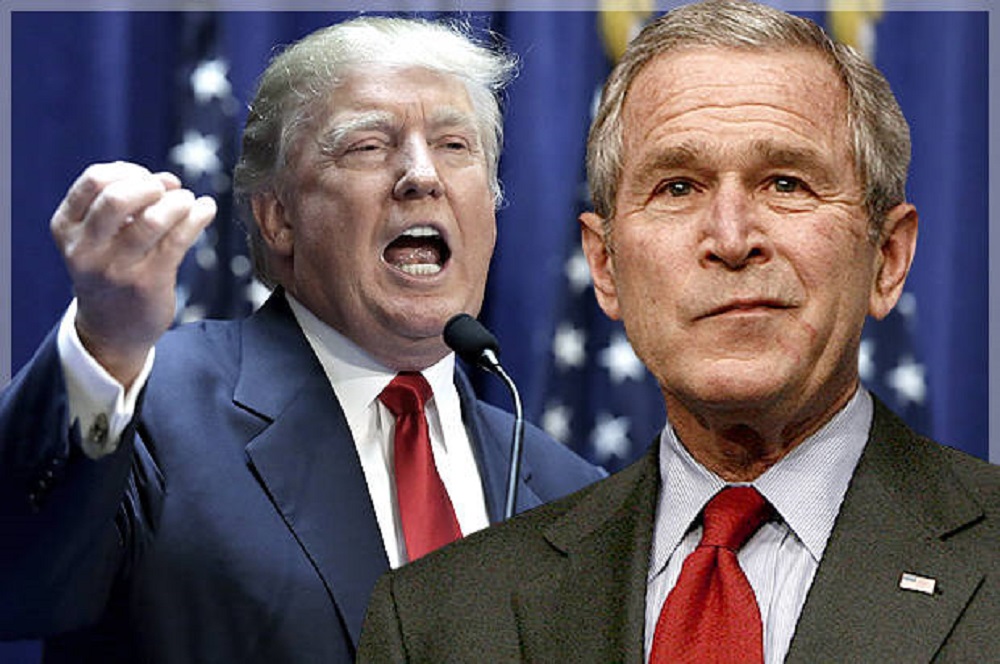
Matthew Dowd is a true-blue Republican. He’s a Texan with close ties to former President George W. Bush. He’s also a Never Trump kind of Republican. Dowd is a seasoned political operative who knows his way around the Republican Party pea patch.

He said something quite instructive about how these two Republican presidents — Bush and Trump — sought to get their terms in office off and running.

Dowd, speaking Sunday on “ABC This Week,” talked of how President Bush was elected under shaky circumstances. He lost the popular vote in 2000 to Albert Gore Jr. and earned enough Electoral College votes through a U.S. Supreme Court ruling.

What did the president do, knowing he lacked political capital? Dowd recalled how Bush reached across the aisle to work with Democrats on key legislation. He cited President Bush’s partnership with the late Democratic U.S. Sen. Ted Kennedy on education reform. He sought out Democrats to craft an immigration reform package as well.

As Dowd noted, that’s how presidents lacking in capital seek to build on their shaky political base.

How has Trump responded? Quite the opposite. He lost the popular vote to Hillary Clinton by nearly 3 million ballots. He won the Electoral College majority by a total of 80,000 votes in three key swing states that voted twice for Barack Obama.

Trump’s strategy has been to thumb his nose at congressional Democrats. He has sought a Republican-only legislative agenda, except that he cannot manage to bring all the members of his own party — given the wide diversity of ideology within the GOP — under the same roof.

Therein lies a critical difference between Bush and Trump.

President Bush was able to work with Democrats who ran the Texas Legislature during the years he served as Texas governor from 1995 to 2000. He knew how to legislate and he took that government experience with him to the White House in January 2001.

Donald Trump has none of that experience. Zeeero! He ran on his record as business mogul and said he would govern the country the way he ran his business empire. No … can … do, Mr. President.

Nor can the president govern a nation with a population that voted for his opponent by appealing exclusively to his core supporters.

Will the president ever learn that lesson? Uhh, probably not.

‘Law and order’ boast gets doused by pardon

Donald Trump promised to be “the law-and-order president,” which harkened back to the call issued in the late 1960s by Richard Nixon’s campaign for the presidency.

The way I see it, though, Trump’s pardon of former Sheriff Joe Arpaio douses the president’s law-and-order pledge bigly.

Arpaio once served as sheriff of Maricopa County, Ariz. He made a big name for himself by his tough policies on illegal immigration. He would racially profile individuals he assumed were entering the country illegally; he would detain them, often in brutal conditions.

A federal judge ordered Arpaio to cease that round-up policy. He refused. The judge put him on trial. The sheriff was convicted. Oh, and then he lost his re-election bid along the way.

How does this comport with the president’s pledge to be the law-and-order guy? It doesn’t.

The president stuck his thumb in the eye of the federal judicial system. He, in effect, said the rule of law doesn’t apply. The pardon clearly is within the president’s realm of power. Some arguing that the pardon might be illegal; I won’t go there.

A pardon’s legality doesn’t necessarily make it right. In this case, it pulls precisely against the pledge the president made to emphasize law and order.

By flouting the rule of law, therefore, the president has declared war as well on any semblance of order.

POTUS agrees to stay out of the way

There’s word of a good decision coming out of the White House as Donald Trump prepares to see first hand the destruction brought to Texas by Hurricane Harvey.

It is that the president will forgo a visit to Houston. Instead, he plans to tour devastated areas in the Corpus Christi-Rockport area, where the storm has exited — but which received a huge dose of severe wind damage from Harvey as the storm blasted ashore this past week.

I heard Houston Police Chief Art Acevedo answer a question from National Public Radio about the timing of Trump’s visit to the area. He spoke calmly and with reason. “He’s damned if he does and damned if he doesn’t,” Chief Acevedo said of the president’s planned visit. He noted that presidents travel with a huge logistical load and an entourage commensurate with the requirements of the head of state.

Going to Houston while residents and first responders in the nation’s fourth-largest city are still battling catastrophic flooding just isn’t in the cards for the president. So, he’s planning to take a look at where the storm has done its damaged and has moved on.

That’s a very good call.

Storm brings misery — and prompts the best in humanity

Harvey is hanging around. The storm won’t dissipate. It won’t fizzle out and become a memory.

The one-time hurricane that is still ravaging the Texas Gulf Coast appears to be backing up over the Gulf of Mexico, where it is expected to recharge and bring even more misery to the battered residents of Southeast Texas.

What on God’s Earth do we do about this? Well, humanity is left to do what it can to help those who are stricken. It’s the human thing to do.

There’s no good news to be gleaned from this event. I won’t pretend to gloss over any single bit of the tragedy that has befallen that region. My heart, though, is lifted — if only just a tiny bit — by news of the aid that is pouring in from neighboring communities. It is arriving to assist storm victims with transportation, shelter, food, money — even good wishes and prayer.

It’s what we do for those who are caught by the storm’s wrath.

Here we are, roughly 700 miles north-northwest of the battered region. My own feeling of helplessness remains, although we do have a certain sense of empathy for the friends we left behind when we departed Beaumont for the High Plains in January 1995.

I dare not pretend to understand, though, the extent of the misery from which they are suffering. I am left to sit in my safe haven and salute those who are able to assist in any way they are able.

It’s what their sense of humanity and compassion compels them to do. They are answering the call.

God bless you all.

Glad you’re coming, Mr. President, but please …

I’ll be brief with this blog post.

I already have applauded Donald Trump for agreeing to visit the ravaged regions of Texas that are still battling the aftermath of Hurricane — and now Tropical Storm — Harvey.

Allow me this request of the president.

When you come, Mr. President, please refrain from calling attention to yourself. Please do not remind us that you’re here and that you’re just a great guy for taking time away from your job in Washington to lend aid, comfort and support for the first responders and the victims; it’s part of your job. Do not say a word about anything other than the suffering you might get a chance to witness.

This is part of the gig you signed up for, Mr. President. It’s what Americans have come to expect of the men who hold the nation’s highest and most exalted office.

Treat this visit with the seriousness it deserves and refrain from slapping yourself on the back. 

Commentary on politics, current events and life experience