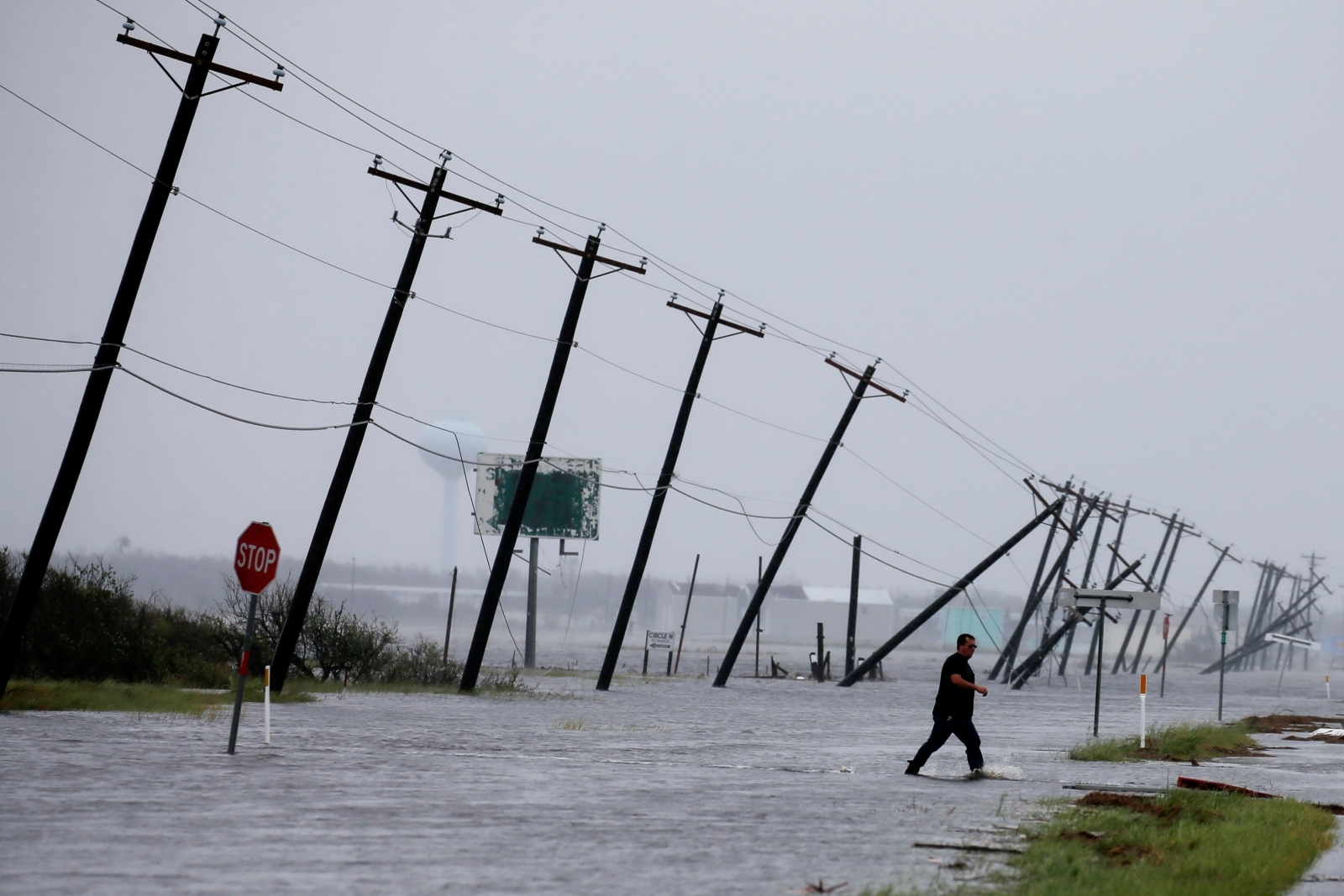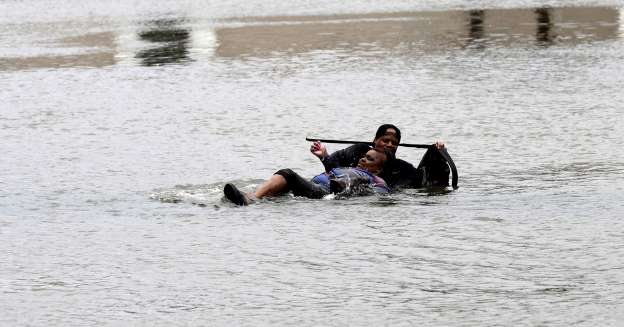
Does the sound of rain now frighten our friends?

I cannot stop thinking about something a former colleague of mine once told me about how an extreme weather event changed his view of what used to comfort him.

We were working in Beaumont, Texas, together at the time. He was an editor at the Beaumont Enterprise, where I worked as editor of the opinion pages.

I think of him now as we watch the horror continuing to unfold in the Golden Triangle and in nearby Houston.

My friend lived at the time in a suburban Beaumont community near Pine Island Bayou. The Golden Triangle is known to get a lot of rain in a major hurry. One such event occurred. My friend, his wife and their two small sons got caught in the rain.

The bayou spilled over. Roughly two feet of water poured into my friend’s home. They had to evacuate. I cannot recall nearly three decades later where they ended up, or even how long they were displaced from their home.

The water eventually receded. They repaired the damage. They moved back in.

“You know there once was a time,” my friend said — and yes, I am paraphrasing — “when the sound of rain would lull me to sleep. These days, after what just happened to us, the sound of rain now scares me half to death.”

It’s impossible for me to believe that millions of Texans who are battling the devastation brought by Hurricane Harvey aren’t now frightened for life at that very sound.

My heart breaks for them.

I lost touch with my friend many years ago as we went our separate ways. I just hope by now he’s gotten over his fear of rainfall.

Are mainstream Republicans wising up to Trump?

Peter Wehner is no Republican in Name Only.

Neither is John Danforth, or Mitt Romney, or Jeb Bush, or John McCain. They are among an increasing number of serious-minded individuals — some of whom have been in public service for decades — who are speaking out finally against another prominent member of their political party.

I refer to the president of the United States of America, Donald John Trump.

I mention Wehner in this post because I want to include an essay he’s written for the New York Times.

Here it is.

The overarching issue for the president seems, in my mind, to be fairly clear cut. He’s not a Republican. He’s a classic RINO. He attached himself to a political party because it suited his personal ambition. Besides, he had spent years defaming a Democratic president, Barack Obama, suggesting he wasn’t a “natural born” American, that he was born overseas and, therefore, wasn’t qualified to hold his high office.

It didn’t stop there. He questioned President Obama’s academic credentials. He suggested that the president really didn’t earn Harvard law degree, or that he didn’t excel academically. He said Obama was a fraud.

So, he sought the Republican presidential nomination in 2016. Then, of course, he was elected.

But he’s no Republican. Wehner, who has served under three GOP presidents, laments the wreckage that Trump has brought to the presidency. It’s almost as if Trump has formed a sort of de facto political party that is neither Republican or Democratic. As Wehner writes in the Times:

“The more offensive Mr. Trump is to the rest of America, the more popular he becomes with his core supporters. One policy example: At a recent rally in Phoenix, the president said he was willing to shut down the government over the question of funding for a border wall, which most of his base favors but only about a third of all Americans want.”

Yes, his base — even though it is shrinking — still loves the guy. They cheer his idiotic rants. They proclaim their adherence to an individual who “tells it like it is.” They dismiss any notion that he doesn’t know what he’s doing, that he doesn’t understand how government works, that he has spent his entire adult professional life with one mission only: to enrich himself.

I have conceded many times that this guy has defied the laws of conventional political gravity. The idea that he could be elected after hurling the insults, defaming his foes, and lying virtually daily is in itself a stunning testimony to the national mood — which Trump managed to mine.

Peter Wehner’s essay, though, is worth reading. It reminds us — or at least it should remind us — that governance requires a depth of knowledge and an understanding of history that the 45th president has demonstrated repeatedly that he lacks.

Just think, too, that this criticism is coming from a member of the president’s own political party.

Stop the excuses for this hideous pardon, already!

I wish my friends on the right would stop diverting attention from Donald Trump’s hideous pardon of “Sheriff Joe” Arpaio.

The former Maricopa County (Ariz.) sheriff had been convicted of flouting a federal judge’s order. It was contempt of court charge. The judge ordered Arpaio to cease rounding up individuals he suspected of being illegal immigrants and then subjecting them to brutal conditions while under detention.

Arpaio thumbed his nose at the judge. He disrespected the rule of law. He said the judge’s order didn’t matter. He’d keep doing what he was ordered to cease doing.

He got convicted. He was awaiting a sentence.

Then the president intervened. He pardoned “Sheriff Joe,” reportedly without clearing it with Justice Department policies. He acted, yet again, on his own — which of course is his right; the Constitution gives the president the power to issue full and unconditional pardons.

The diversion occurs from those on the right who keep looking backward at the pardons issued by he likes of, oh, Barack Obama and Bill Clinton. I will concede that those presidents issued controversial pardons, too. They got hammered pretty damn hard for them as well. I just choose not to revisit those actions, preferring instead to focus on the here and now.

Trump’s pardon of Arpaio gives aid and comfort to those on the right and the far right who think it’s OK for law enforcement officials to rough up anyone they think is entering this country illegally.

The pardon further divides an already deeply divided nation.

The president said Arpaio was “convicted for doing his job.” That is utterly ridiculous on its face.

He was convicted because he has demonstrated zero acceptance of the rule of law. The president of the United States has just endorsed that dangerous concept.

That’s why this pardon matters.

Where has Dick Cheney been hiding?

Paging the former vice president of the United States, Richard Bruce Cheney!

You might recall — as I do — that Dick Cheney was a vocal, frequent and occasionally obnoxious critic of President Barack H. Obama. Yes, throughout Obama’s two terms as president, Cheney was making himself available on TV and radio talk shows to tell us how the president was endangering the nation, that he was the “worst foreign policy president” in U.S. history.

So, Obama leaves office. Donald John Trump Sr. takes over. Trump has made a mess of a lot of things.

The Russia matter? Allegations of collusion with the Russians? North Korea? Declaring that an aircraft battle group was steaming toward Korea when it actually was traveling in precisely the opposite direction, from Australia into the Indian Ocean?

Then we have the domestic stuff: Charlottesville and the president’s seeming cozying up to Nazis and Klansmen; the transgender ban in the U.S. military.

Where is Cheney? Mr. Vice President, have you nothing at all to say about the new president? You were pretty damn quick on the verbal trigger when Barack Obama was the man in charge.

It’s not that I necessarily want to hear what the former vice president has to say. It’s just that the current political debate seems so quiet without his voice.

POTUS ‘speaks for himself’

Those who like to parse the words that come from public officials have been handed a serious bit of homework to ponder.

It comes from Secretary of State Rex Tillerson, who offered up a potentially provocative assertion on a Sunday news/talk show.

Tillerson was interviewed by “Fox News Sunday” moderator Chris Wallace and the discussion turned to the Charlottesville, Va., riot and Donald J. Trump’s various responses to the tragic event.

According to Politico: “Tillerson said Sunday that the nation’s commitment to combating discrimination should be without question.

“’We express America’s values from the State Department. We represent the American people, we represent America’s values, our commitment to freedom, our commitment to equal treatment of people the world over and that message has never changed,’ Tillerson said. ‘I don’t believe anyone doubts the American people’s values or the commitment of the American government or the government’s agencies to advancing those values and defending those values.’”

Wallace then asked: “And the president’s values?” To which Tillerson answered: “The president speaks for himself, Chris.”

“Are you separating yourself from that, sir?” Wallace asked.

“I’ve spoken — I’ve made my own comments as to our values as well in a speech I gave to the State Department this past week,” Tillerson said.

Well …

If I were a betting man — and if I were in the business of reading someone’s mind — I might suggest that the secretary of state has just put some distance between himself and the tirade that poured forth from the president of the United States with regard to Charlottesville.

I also might wonder if the clock has just started ticking on Tillerson’s tenure at the State Department.

Hating the feeling of utter helplessness

You know the feeling, I’m sure.

Mother Nature levels her immense power onto a region of this great country and you are left only to wish the very best for those who are being affected.

I won’t suggest that “All I can do is pray.” A clergy friend of mine has reminded us many times over the years that “Prayer isn’t the least we can do; it’s the most we can do.”

So we are left to pray and hope for the very best for those being devastated by Hurricane Harvey’s unthinkable rage.

Social media have offered a pretty good device for those in harm’s way to tell the rest of us that they’re safe and sound. My Facebook news feed is full of such assurances and for that I am grateful on behalf of our many friends throughout the Houston and Golden Triangle areas of Southeast Texas.

Here we sit, though, a good distance away from the havoc. We’re perched way up yonder on the Caprock, high and dry and enjoying the sunshine at nearly 3,700 feet above sea level. The Texas Department of Transportation is advising motorists to avoid travel to the Gulf Coast. If only we could transport ourselves into the storm to lend a hand to the friends we have retained many years after leaving Beaumont for a new life in Amarillo.

And, no, I don’t intend to ignore the misery that has befallen all the good folks who are coping with the storm’s wrath.

So … what is there to do? Except pray.

I can do that. However, it does nothing to assuage my feeling of helplessness.

Trump takes wise course, plans to stay out of the way

I will be going to Texas as soon as that trip can be made without causing disruption. The focus must be life and safety.

With that statement, the president of the United States — delivered via Twitter — has demonstrated finally an awareness of the awesome public relations power of his office.

Donald Trump, along with the rest of the pertinent federal government agencies, is standing at the ready to deliver assistance to the battered regions of Texas, which is suffering the ravages of Hurricane Harvey.

The deluge that’s inundating Houston — and only God Almighty knows where the storm is heading — has caused untold misery, heartache and grief.

I’m glad to know the president will tour the pummeled areas of South and Southeast Texas. As he noted in his tweet, a presidential visit does carry some risk. Presidents intend to do good when they show up. Their entourage, though, can create tremendous logistical problems for local authorities struggling to reassemble the lives of stricken victims.

Texas Gov. Greg Abbott says the storm is unpredictable in its path. There’s little certainty in trying to track its journey. To that end, the president’s emergency management response team needs to keep all eyes on the board in trying to determine when — and where — the president should go to demonstrate he has the backs of Americans in deep trouble.

Be smart about it, Mr. President. Whatever you do, sir, listen to the advice you’re getting from your storm-watch team.

Arpaio pardon no ‘profile in courage’

Donald John Trump Sr.’s pardon of former “Sheriff Joe” Arpaio is likely to haunt the president well beyond the foreseeable future.

Trump this week pardoned the bad-ass former Maricopa County (Ariz.) sheriff who had been convicted of contempt of court; Arpaio refused to obey a federal court order to cease rounding up people he suspected of being illegal immigrants.

Arpaio disobeyed a lawful federal order, from a duly sworn federal judge. For that, the president pardoned him. His pardon speaks to Trump’s penchant for appealing to the nation’s divisiveness.

I doubt seriously that this president is going to be honored — ever! — for this callous decision.

With that … I want to look back briefly at another presidential pardon that at the time drew enormous political push back. In the four-plus decades since, though, it has been seen as a courageous act by a president seeking to bind the wounds of a nation.

President Richard Nixon resigned his office on Aug. 9, 1974. His successor, Gerald Ford, took the oath and declared that “our long national nightmare is over.”

President Ford wasn’t quite right. A month later, the new president issued the pardon that most assuredly cost him election as president in 1976.

Many years passed and President Ford’s stature grew slowly over time. Americans who were critical of the decision to pardon President Nixon began to think differently about it. I was among those who went through a change of heart.

In 2001, the John F. Kennedy Library did something quite extraordinary. It gave President Ford its annual Profile in Courage Award, honoring the president for the courage he showed in issuing the pardon, knowing the consequences it would have, but looking out only for the national good.

As the New York Times reported at the time: “Senator Edward M. Kennedy of Massachusetts told the audience at the John F. Kennedy Library: ‘I was one of those who spoke out against his action then. But time has a way of clarifying past events, and now we see that President Ford was right. His courage and dedication to our country made it possible for us to begin the process of healing and put the tragedy of Watergate behind us.”’

And this, also from the Times: “Mr. Ford said: ‘President Kennedy understood that courage is not something to be gauged in a poll or located in a focus group. No adviser can spin it. No historian can backdate it. For, in the age-old contest between popularity and principle, only those willing to lose for their convictions are deserving of posterity’s approval.”’

Time has allowed us to re-examine why President Ford acted as he did. Time also might provide us the same opportunity to take a fresh look at what Donald Trump has just done.

Then again, I doubt it. Seriously.

This storm hits close to the heart

Watching the ongoing drama down yonder on the Texas Gulf Coast leaves me with a dizzying mix of emotions.

* My family and I moved to Texas in 1984 and settled in Beaumont, the heart of the Golden Triangle. Hurricanes blow through the region.

Indeed, we endured a couple of major storms during our nearly 11 years on the Gulf Coast. One of them was Hurricane Bonnie, which wasn’t nearly as strong as Hurricane Harvey, but it did hit Beaumont directly; the other was Tropical Storm Allison, which has gotten some discussion from the weather experts reporting on the devastation being brought by Hurricane Harvey.

Allison didn’t reach hurricane status. It did, however, bring  a lot of rain in June 1989. It slogged over Beaumont on its way north; then it decided to back up and do it some more.

Hurricane Harvey, according to some of the TV weather talkers, is looking a bit like Allison as it meanders ever so slowly across the Gulf Coast region.

Harvey brings forth another bit of familiarity for yours truly.

* A couple of years ago, my wife and I pulled our fifth wheel south to Beaumont for a few days; then we traveled southwest toward Corpus Christi. We spent a few more nights at Goose Island State Park, in Rockport — which is where Hurricane Harvey made landfall late Friday.

I shudder to think what Goose Island SP looks like at this moment as Harvey continues to march its way to who knows where.

Local  emergency management officials report at least one fatality in Rockport. Quite clearly, all of our hearts break for lives lost.

* And at yet another level, I caught up early this afternoon with a good friend who lives in Houston with his wife and their two young sons. As we spoke over the phone, our friends were getting pummeled by the deluge brought by Harvey.

He joked about the forecast of as much as 20 to 30 inches of rain. “If it rains like that we’re going to flood,” he said. “Hey, we’ve got a two-story house,” he said with the calmness I would expect from him.

* And that brings to mind a final thought: Is it my imagination, or do those affected most calmly by nature’s wrath seem the calmest of anyone? The media have been reporting with an urgency that at times seems to border on hysteria about Hurricane Harvey’s arrival on land and the destruction it’s bringing. I don’t doubt that the storm will do a lot of damage.

My friend said simply this: “I have less fear of the rain than I do of the wind.” He — and I presume his family as well — are ready for whatever comes.

Still, we are going to continue to worry about all of our friends — and everyone else as well — along the coast.

GOP taken over by ‘this hateful man’

We haven’t heard much from John Danforth since he left the U.S. Senate.

The highly respected former lawmaker — who also happens to be an Episcopal minister — has weighed in heavily against the president of the United States.

Sen. Danforth is urging the Republican Party — to which he is a member — to toss aside the principles espoused by Donald John Trump Sr., who he described as “this hateful man” who promotes division and disunity in the nation he governs.

One must accept that political figures from opposing parties are going to criticize those in high office. Danforth’s critique, which he offered in an essay published in the Washington Post, is another of a stunning array of criticism coming from politicians within the president’s own party.

It makes me ponder whether Trump actually is seen by Republicans as one of their own. Or is he a major-league anomaly, a political freak who elected president by a series of flukes that no one saw coming?

Danforth has laid down an important marker for his fellow Republicans. He writes of Trump: “He stands in opposition to the founding principle of our party — that of a united country.”

Read Danforth’s essay here.

Look back just a few days to the rhetoric he has spouted. He talked of “many sides” being responsible for the violence in Charlottesville. He doubled down a few days later by declaring that “both sides” were at fault and that “both sides” had “good people” clashing in the Virginia community, which brings to mind the question: What kind of “good person” marches with Klansmen, Nazis and white supremacists?

Such language from the president drives huge wedges between groups of Americans, which is what I believe Sen. Danforth seeks to underscore in his essay.

“For the sake of our party and our nation, we Republicans must disassociate ourselves from Trump by expressing our opposition to his divisive tactics and by clearly and strongly insisting that he does not represent what it means to be a Republican,” Danforth writes.
Nor does he “represent” anything about the presidency of the greatest nation on Earth.

Commentary on politics, current events and life experience