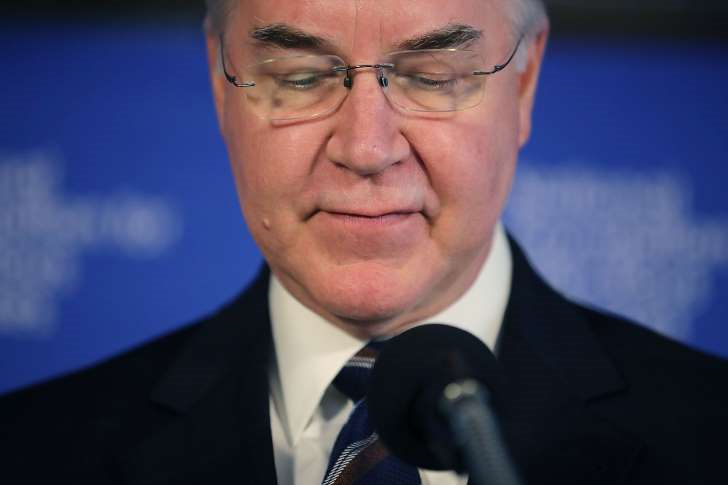
The ‘swamp’ is draining … finally?

Tom Price is not a political whippersnapper. He’s not wet behind the ears. He’s been around Washington, D.C., first as a member of Congress and then — until today — as secretary of health and human services.

Dr. Price quit his HHS Cabinet job in the wake of boiling controversy involving his use of private aircraft that taxpayers paid for. It smacked of a spendthrift philosophy that smacked Donald Trump’s promise to “drain the swamp” in D.C. squarely in the face.

Price’s travel expenses ran into the hundreds of thousands of dollars. He had promised to pay back $52,000, which amounted to a fraction of the bill he ran up flying aboard private charter jets rather than commercial airlines, which had been the custom over many previous administrations.

Price is now gone. He resigned today. Is the proverbial “swamp” now starting to drain? Well, I’m not holding my breath just yet.

Price once complained loudly against then-House Speaker Nancy Pelosi’s use of “luxury jets” while she flew around the country. Then he gets caught doing something quite similar, if not identical, to what he accused Pelosi of doing.

It all kind of reminds me of how another House speaker, Newt Gingrich, wailed and railed against President Bill Clinton for his affair with the White House intern in the late 1990s — while at the same time Newt was taking a tumble with a congressional staff member while he was married to someone else.

Sigh …

Where do we go from here? The president has made precious few wise moves since stepping into the Oval Office. One of them is his hiring of John Kelly as White House chief of staff. Indeed, it appears quite likely that Gen. Kelly had a hand in Dr. Price’s resignation. Moreover, it also is being reported that Kelly’s fingerprints appear to be all over a new White House directive that mandates that all Cabinet officers and senior staffers clear their travel plans with Kelly and White House legal counsel.

Price’s departure is not a surprise, given the president’s own expressions of anger over the revelation about the former secretar’s travel habits.

The Trump administration, though, needs to pull a lot more plugs at the bottom of that “swamp” to ensure it gets drained.

Remember the time Kim Davis … you know?

Someone out there has brought back an earlier episode involving politics in the workplace, so I’ll just jump on that horse and ride it briefly here.

Kim Davis is the Rowan County (Ky.) clerk who once defied a U.S. Supreme Court ruling that declared that gay marriage is a protected right under the 14th Amendment to the U.S. Constitution.

She said her religious beliefs wouldn’t permit her to issue marriage license to gay couples. She violated the oath of her office; she had vowed to obey the Constitution and, you know, follow the law of the land.

She brought her personal political beliefs into the workplace. Bad, Kim … bad!

So now there’s some argument being kicked around in social media about those pro football players who are doing that very thing. They’re bringing their politics into their workplace, which happens to be on a field surrounded by tens of thousands of paying fans and millions more of them watching them do their jobs on television.

Some of those players are “taking a knee” when “The Star-Spangled Banner” is sung before games. Others are locking arms with teammates. Critics of this practice say that the athletes are acting inappropriately by politicizing their profession, not to mention that they’re “disrespecting the Constitution,” which I believe is a ludicrous assertion.

I’ll stipulate once more that I am not pleased by the nature of the protests by pro football players. I wish they had found another way to protest against police brutality against African-Americans, which is the initial reason for the protests.

That all said, if it’s OK — in the minds of many Americans — for Kim Davis, who serves the public in a public office, to bring her political beliefs into her workplace, why is it not OK for pro football players to do the same thing?

Huge municipal resource calls it a career

They came on a rainy evening to honor a man who’s given four decades of his life to public service.

I was one of the hundreds of Amarillo residents who flocked tonight to a brand new hotel downtown to honor Gary Pitner. I didn’t get too much face time with my friend, as he was pretty busy schmoozing with a lot of others in the reception room.

But I do want to write a few good words about this fellow I’ve known almost from Day One upon my arrival around the corner from his office. In January 1995 I came to work as editorial page editor of the Amarillo Globe-News. Almost immediately I came to know the executive director of the Panhandle Regional Planning Commission. That would be Pitner.

The PRPC is a bit of a mystery to a lot of folks. Its duties include coordinating a whole array of issues involving communities throughout the 26 counties that comprise the Texas Panhandle. Pitner has worked as head of PRPC for 32 of his 40 years in local government.

So, why the big outpouring of affection, respect and admiration for this fellow who’s retiring from his lengthy career that sought to make our communities better? It’s because he was so good at it. Moreover, he became the go-to guy years ago when it came to Amarillo’s future growth issues.

There was some discussion this evening at the Embassy Suites hotel, where the retirement reception took place, that Pitner’s presence at PRPC positioned him to become a huge player in the downtown Amarillo planning. He became a voice of wisdom and knowledge; some have suggested he became the voice of all that.

Pitner never would presume to know all there is to know. I’ll say what he won’t say about himself: He knows a lot about this city’s history and how it arrived in the present day. He also is able to offer knowledgeable analysis about where he believes the city is heading and how it ought to get to the finish line.

I’m happy for my friend that he’s entering this next phase of his life. He’s still a young man and has much to offer anyone who’s looking for knowledge about local government.

He stood up to his armpits in downtown planning, in water conservation, in urban growth planning, in reasonable land use. He became a valuable resource for municipal, county and state officials who were looking for a strong base of knowledge about Amarillo and the Panhandle.

Pitner possesses all of that.

I am proud to have known him professionally and am proud to call him a friend. I did manage to speak a fundamental truth to Pitner this evening during my too-brief visit with him.

“There are damn few people I would drive all the way downtown in this hideous weather to pay respects to at an event like this,” I told him. Pitner laughed.

Go ahead and laugh, Gary. But here’s the deal: I wasn’t kidding.

Amarillo’s downtown no longer recognizable

I made what I consider to be a startling discovery in downtown Amarillo, Texas.

After parking my car on a lot behind the brand new Embassy Suites hotel, I walked along Fillmore Street and turned the corner onto Sixth Avenue. I glanced across the street at a row of mostly empty storefronts along a shiny new wall — which I realized after a second or two was the north face of a new parking garage.

I glanced eastward toward the Civic Center just to be sure I hadn’t become disoriented. There it was. The Civic Center restored my bearings.

The discovery? It is that downtown Amarillo bears next to zero resemblance to the district I’ve come to know during my 22 years living in this Texas Panhandle community.

The Embassy Suites is now open for business. The parking garage is finished; indeed, I saw vehicles parked inside the structure.

My reason for venturing downtown this evening — in the rain — was to attend a retirement reception for a longtime friend and source I relied on when I worked for the Amarillo Globe-News. Gary Pitner is retiring as head of the Panhandle Regional Planning Commission; I’ll have more to say about Gary in a later blog post.

My point with this post is to take note of the immense change that has occurred in downtown Amarillo — and the change that is still occurring.

Downtown Amarillo’s evolution is a highly positive event. I sort of think of it as a butterfly that emerges from some sort of cocoon. I don’t want to sound mawkish here, but that moment as I made the turn toward the Embassy Suites door also was a realization that the evolution is real.

There’s much more to come, of course. That ballpark is going to be built across the street from City Hall. They’ll take about a year to build a 4,500-seat multipurpose event venue. By April 2019, the MPEV will be done and they’ll toss out the first pitch for a AA minor-league baseball season.

I’m beginning to think when that time arrives that downtown Amarillo will be even less recognizable then that it is today.

That will be a very good thing.

Ex-presidents look so, so relaxed

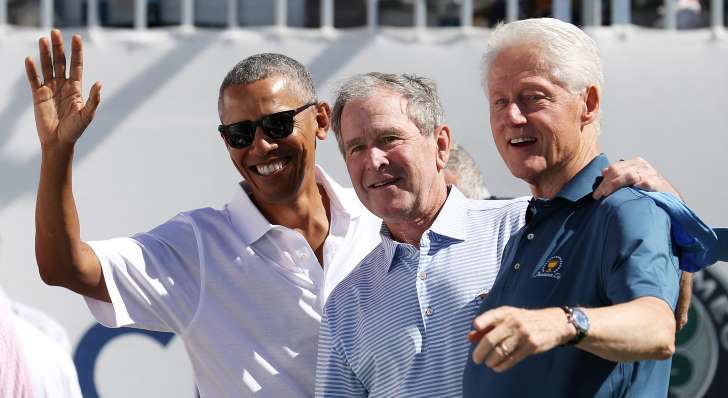
This picture makes me happy.

It shows the three most immediate past presidents of the United States of America: Barack H. Obama, George W. Bush and William J. Clinton.

Look at those men. Don’t they look happy? Relaxed? Chummy?

They opened the President’s Cup golf tournament today in Jersey City, N.J., the first time three ex-presidents have opened the event that pits American golfers against an international team.

It’s a big deal.

For some time after he left office, I was left pining for former President Obama. I missed him terribly. At one or two levels, I still do. But seeing this picture reminds me of how much he and Presidents Bush and Clinton have earned the right to look so damn relaxed.

The same can be said of former Presidents George H.W. Bush and Jimmy Carter. They weren’t there. President Bush is in poor health. President Carter is likely building a house somewhere for Habitat for Humanity; indeed, President Carter hasn’t stopped working since he left office … in 1981!

And, oh how I wish I could be a fly on the wall as these three former heads of state talk about the guy who holds the office these days.

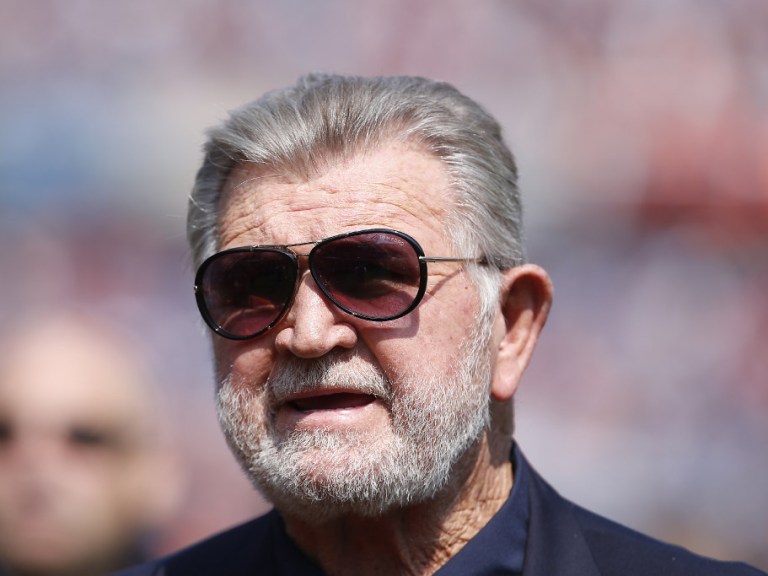
Ditka: ‘Don’t demonstrate against the Constitution’

Mike Ditka was a damn good professional football player and coach.

He is a strong supporter of Donald J. Trump. He has strong opinions on the recent controversy regarding NFL players “taking a knee” while they listen to the National Anthem at the start of football games.

But he needs to take a breath and maybe rethink what he told the Chicago Sun-Times. He said:

“But I don’t believe you demonstrate against the American flag. I believe in the American flag. Or demonstrate against the Constitution. I believe in the Constitution. I’m old fashioned. There are other ways to get your point across. But I don’t believe one should demonstrate against our country. Just play football.

“And that’s the way I feel. And now I’d like to go back to my card game.”

Here’s more of what he said.

Old-fashioned Mike should examine the Constitution and what it means. It guarantees the right of citizens to do precisely what he’s arguing against. These football players and their coaches are doing it peacefully. Their initial protest — which started this past season with quarterback Colin Kaepernick — has been aimed at police treatment of African-Americans.

Do I agree with the tactic they’ve employed? No. I wish they would protest differently. But I take no offense at what they’re doing. I do not believe these young men are disrespecting “the flag” or “the Constitution.”

I believe in the flag as much as Coach Ditka. I also believe that the cherished flag symbolizes a nation founded on the very principle of dissent and protest.

Mission accomplished! Trump waives Jones Act

I’ll take all the credit I deserve for this one.

Donald Trump has waived an obsolete and arcane rule that inhibited the free flow of relief supplies to a stricken U.S. territory. The president acted less than a day after an obscure blogger out here in Flyover Country — that would be yours truly — urged him to do so.

He did. Good job, Mr. President.

The Jones Act, enacted in 1920 during the Woodrow Wilson administration, restricts shipping between U.S. ports. It requires ships to be U.S.-owned and that they must comprise crews that are American citizens.

Puerto Rico is in desperate straits. It is without power, potable water, food and other supplies because of the savagery brought to the island by Hurricane Maria. It comprises 3.5 million U.S. citizens who need help — immediately!

The president had signaled an initial reluctance to waive the Jones Act, citing concerns among shipping interests that contended it helps preserve American jobs.

The president, of course, has vowed to “put America first.”

Fine. Then let’s remember that Puerto Ricans are Americans, too. They need the nation’s help. Now. Lifting the Jones Act is a needed boost to a piece of this country in the midst of a serious humanitarian crisis.

‘Vietnam War’ finally brings a lump to the throat

Ken Burns and Lynn Novick did it. Finally.

On the second to last night of their epic PBS documentary film, “The Vietnam War,” they brought a lump to my throat. They made me swallow hard. As in swallow real hard.

The moment struck me as I listened to a former Vietnam War prisoner tell of his release from captivity by the Viet Cong and the North Vietnamese.

His name is Hal Kushner. He was an Army physician who was taken captive by the Viet Cong in South Vietnam. He then was taken to Hanoi.

Kushner would be released in March 1973, two months after President Nixon announced the signing of the ceasefire that ended our combat involvement in the Vietnam War.

Kushner told of being greeted at Clark Air Force Base, The Philippines by an Air Force officer who said, “Welcome home, doctor.”

Kushner’s voice choked up as he remembered looking at the jet transport that would fly him and his fellow former POWs across the Pacific Ocean. He saw the letters “USAF” painted on the plane. “I saw this big C-141, this beautiful white bird, with the American flag emblazoned on the tail,” he said. They were going home.

The sight of those men hugging each other, toasting each other and kissing the flight nurses aboard the aircraft made my eyes well up as I watched this landmark series march toward its conclusion.

“The Vietnam War” has filled me with many emotions. Some nostalgia over my own meager involvement in that war; some anger at the way our returning warriors were treated when they came “home”; more anger at the sight of Jane Fonda yukking it up with North Vietnamese soldiers while sitting in an anti-aircraft weapon they used to shoot down our aviators; revulsion at the sight of all the carnage that occurred throughout the war.

The sight of those POWs coming home? That evoked another feeling altogether. I’m prone to sappy reactions at times, even when I watch actors portraying human emotion. I tend to forget that they’re pretending.

Not this time. What we saw was real. Man, it was good.

Meanwhile, Texas still cleans up after its own tragedy

The nation is rightfully horrified and increasingly concerned about the humanitarian crisis that is unfolding in Puerto Rico.

It is, though, the latest in a savage series of events that have thrown millions of Americans into varying states of misery.

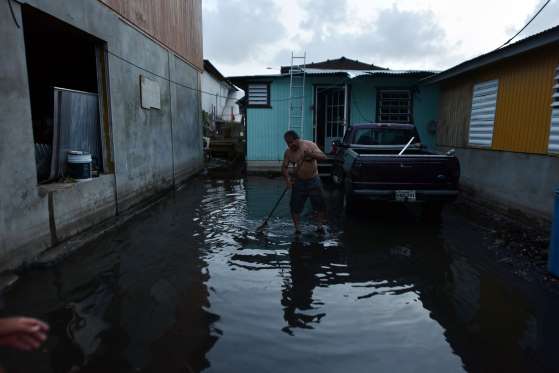
The Texas Tribune has published a gallery of photographs from a region which I have some intimate familiarity. The Golden Triangle also is recovering, albeit slowly, from its own battle with Mother Nature’s unspeakable force and fury.

Here are the photos from the Texas Tribune.

The picture above was taken in Port Arthur, one of the cities comprising the Golden Triangle; the other two are Orange and Beaumont, where my family and I lived for nearly 11 years.

All three cities, along with Houston, were pummeled by the deluge that poured out of the sky from Harvey, which made its initial landfall at Rockport along the Coastal Bend.

Texas has rallied behind the many thousands of Golden Triangle residents who today are still seeking to reassemble their shattered lives. Some of them are friends of my wife and me and former colleagues of mine. Our hearts break for them.

We intend to visit our former haunts. We hope it is sooner rather than later. Our time today is occupied by our effort to prepare to relocate eventually from our home in Amarillo.

Still, I think daily of my friends who are still struggling to regain their equilibrium in the wake of the monstrous storm.

My hope is that the rest of Texas — and the nation — will keep them in their thoughts and prayers, too. I know we’ve got a lot on our minds these days. Puerto Rico is in desperate straits. Florida also is recovering from its own tragedy, the one named Hurricane Irma.

We all possess big enough hearts to wish well for all of our stricken fellow Americans.

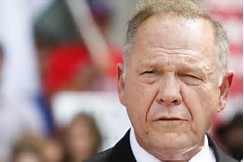
Roy Moore would bring a scary element to U.S. Senate

I don’t have a vote in Alabama. Whatever I say about that state’s U.S. Senate race is worth, well, damn near nothing to the voters there.

But if Roy Moore gets elected to that state’s Senate seat, then he’s going to be involved in legislation that affects citizens far beyond the Alabama state line.

Moore is the Republican nominee. He beat a sitting senator, Luther Strange, in the Republican primary this week. Strange was appointed to the seat after Jeff Sessions left the Senate to become U.S. attorney general. Moore now is going to run against Democratic nominee Doug Jones, a former federal prosecutor.

Why does Moore give me the heebie-jeebies? He’s a religious zealot, that’s why.

He says homosexuality is an abomination and goes against God’s will. He once said that “homosexual activity” should be made illegal. He operates under the premise that “God’s law” takes precedence over the law of the land. He has said that Muslims should not be allowed to serve in the U.S. Congress; he made that assertion specifically about Rep. Keith Ellison, D-Minn., one of two Muslims now serving in the U.S. House.

He was removed twice as chief justice of the Alabama Supreme Court. The first time was because he removed a Ten Commandments monument from the court’s grounds; the second time was when he refused to obey a U.S. Supreme Court ruling that made gay marriage legal in the United States.

His reasons for both actions? Fealty to the Old Testament.

Moore went to law school, so he knows what the U.S. Constitution says about religion. It declares, among other things, that there shall be “no religious test” required of anyone seeking public office.

If he’s elected to the Senate this fall, he will be required to take an oath that commits him to obeying and defending the Constitution. I feel the need, therefore, to remind Judge Moore that the Constitution is a secular document. 

***

Here’s what I wrote about Moore earlier this year:

https://highplainsblogger.com/2017/04/ayatollah-of-alabama-seeks-u-s-senate-seat/


Commentary on politics, current events and life experience