Tag Archives: Barack Obama

Obama should have decided to attend funeral

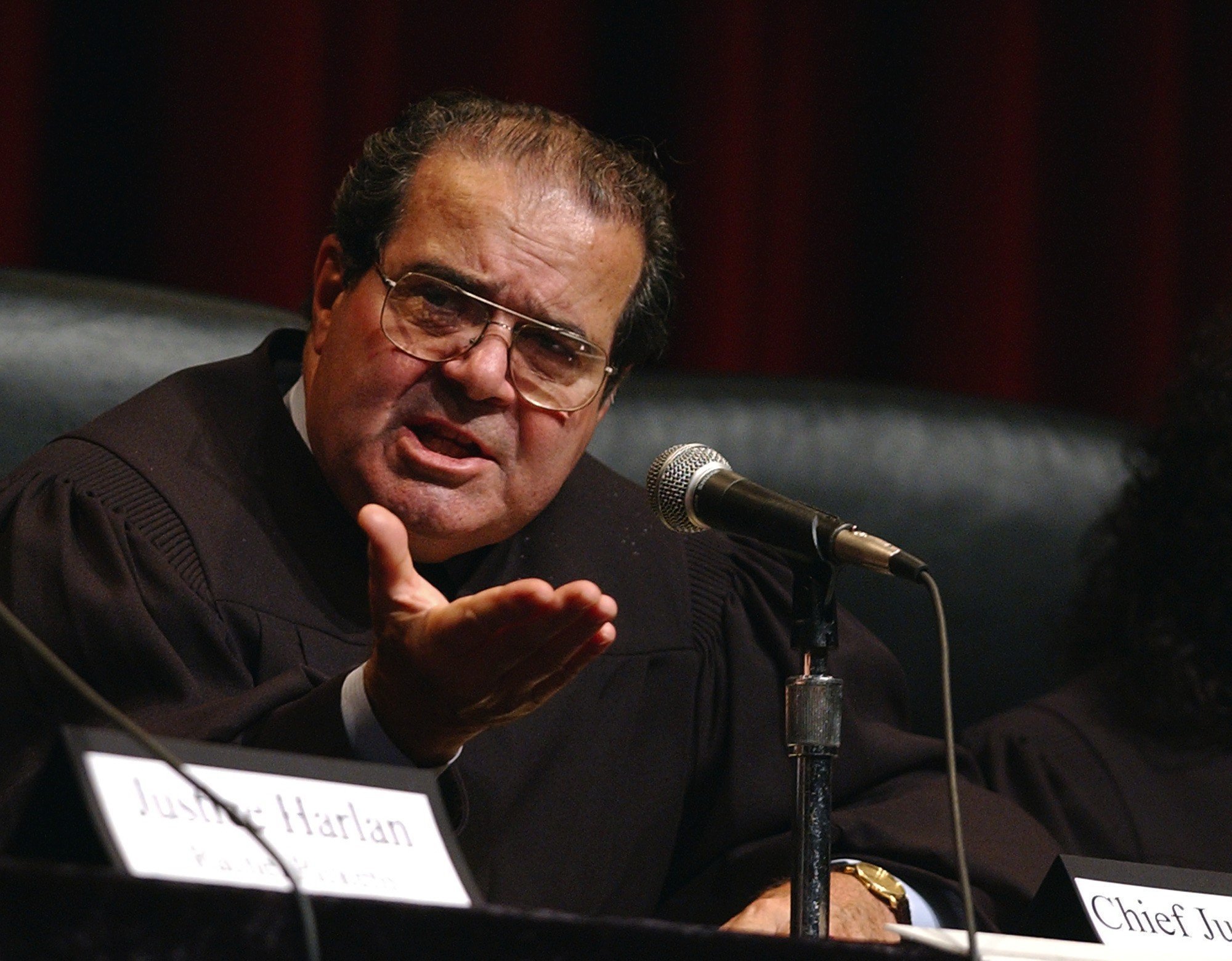
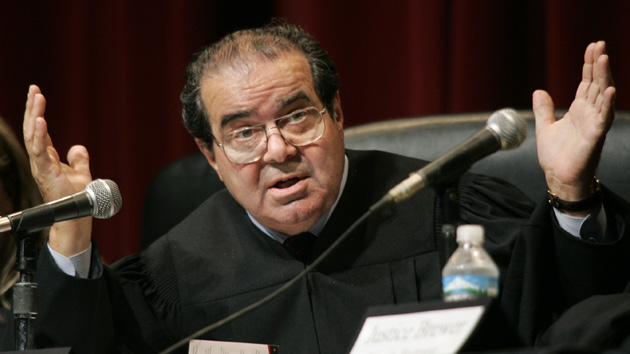
chapman.0830 - 08/29/05 - A Supreme Court headed by Supreme Court Justice Antonin Scalia has questions for Chapman University Law School professor John Eastman as he and California Attorney General Bill Lockyer argue the 1905 ''Lochner v. State of New York'' case during a re-enactment Monday afternoon at Chapman University. (Credit: Mark Avery/Orange County Register/ZUMA Press)

No one asked me for advice on this, but I’ll offer it unsolicited — and without reservation.

President Obama should have decided to attend the funeral this weekend for the late Supreme Court Justice Antonin Scalia.

To me, it’s a no-brainer.

The president will not attend. Vice President Joe Biden and his wife, Jill, are going to attend, as they share Scalia’s Catholic faith.

But look at it this way. The optics of seeing the president of the United States paying his respects at the funeral of someone with whom he had profound political and judicial disagreements are invaluable.

Yes, the president will attend a ceremony at the Supreme Court building to honor the late justice. He also has been quite gracious in his public comments in reaction to the shocking news of Scalia’s death while on a hunting trip in West Texas.

Indeed, some on the right have given Obama a pass on attending. Scalia’s own son even has suggested that the president made the right call by deciding against attending the justice’s funeral.

However, Obama has given his fierce critics in the conservative media ammunition now to fire at him for declining to attend the funeral. White House press officials haven’t disclosed how the president will spend Saturday while much of official Washington and the nation’s legal community is honoring the memory of Justice Scalia. My hope is that he lays low and spends it quietly.

He’s got a huge decision to make — possibly within the next few days. It involves his choice to succeed Scalia — a gigantic and booming voice for conservatives on the court. Senate Republicans don’t even want to consider an appointment. Others insist that the president make the choice. I am one of those who believes the president should fulfill his duties by selecting a nominee for the high court.

OK, so no one asked me for my opinion about the funeral. Why should they? I’m way out yonder in the political peanut gallery far from the government epicenter.

It’s just that as someone noted in the link attached to this blog post indicated, if you’re questioning whether you should go to the funeral … go to the funeral.

‘Lame duck’ needs finer point . . . perhaps

Lame-Duck-Congress-a

An acquaintance of mine asked an interesting question regarding President Obama’s upcoming battle over how he intends to fill a key vacancy on the U.S. Supreme Court.

He wondered how one should define the term “lame duck”?

His understanding of the term meant that an officeholder became a lame duck when his or her successor in office had been determined.

Here’s how the American Heritage Dictionary defines the term: “An elected officeholder continuing in office during the period between and election and inauguration of a successor.”

My reaction was that the definition of the term has become a bit more “fluid” these days.

Senate Republicans say they don’t want Obama to fill the vacancy created by the death of Supreme Court Justice Antonin Scalia because he’s a “lame duck” president. They want the next president to make the call.

I tend to have a broader view of the term “lame duck.” I suppose one could argue that any president who wins a second term becomes a lame duck the moment the election returns are finalized. The Constitution prohibits the president from running again, so the clock begins ticking on the president’s term. If that reasoning holds up, then the American Heritage dictionary definition could be interpreted as being germane.

Whatever the case, or however one defines the term, there remains an indisputable truth. The president is in office until the very moment the successor takes the oath of office.

Therefore, the president is entitled — lame duck or not — to all the perks, privileges and power that the office commands.

President Obama is entitled to appoint someone to fill the late Justice Scalia’s seat on the Supreme Court. The Senate, thus, is entitled — and obligated, in my view — to consider that appointment in a timely manner and then vote on whether to approve it.

The president’s lame-duck status should not be an issue.

But it has become one, thanks to the obstructionists who are now in charge of the U.S. Senate.


Obama, GOP both spoiling for a fight to the finish

founders

Here’s where we appear to be standing with regard to that vacancy on the U.S. Supreme Court.

President Obama said today he intends to select an “indisputably qualified” person to fill the seat vacated by the sudden death of Justice Antonin Scalia.

U.S. Senate Republicans say they intend to block anyone the president nominates.

Who’s on the right side? In my view, it’s not even close.

The president is right. GOP senators are wrong.

Indeed, it’s looking now as though that no matter who gets the call from the president that he or she is going to face a serious fight.

My hunch now is that Barack Obama welcomes the fight. Why? He will wage it from a position of strength.

He’s got the Constitution on his side.

This appointment could change the makeup of the court, which has a slim conservative majority among its members.

Right there is the crux of Republican obstructionism.

Justice Scalia was the shining light among the conservatives serving on the court. He led what’s been called a “conservative renaissance.” His brilliance was beyond question. So was his commitment to conservative principles.

President Obama has another year left in his term. Some have suggested that if Republicans were to get their way, they effectively would eliminate the fourth year of the president’s term. They oppose — on some made-up principle — the idea of a lame-duck president making an appointment to the Supreme Court. They want the next president to make the call.

Well, as Obama said today, those who claim to adhere to strict constitutional principles are creating them out of thin air. The Constitution says the president should nominate people to the federal bench and that the Senate should vote up or down on those nominations.

Both sides are spoiling for a fight. So, let’s have at it.

Barack Obama is set to throw the first punch when he nominates someone to the highest court in the land.

Go for it, Mr. President.


It’s wrong now … and was wrong then

Sen. Chuck Schumer, D-N.Y., expresses his dismay at Russian Vladimir Putin leader granting asylum to American secrets leaker Edward Snowden, at a news conference at the Capitol in Washington, Thursday, Aug. 1, 2013. Defying the United States, Russia granted Edward Snowden temporary asylum on Thursday, allowing the National Security Agency leaker to slip out of the Moscow airport where he has been holed up for weeks in hopes of evading espionage charges back home. (AP Photo/J. Scott Applewhite)

I believe it was that great fictional Native American sidekick — Tonto — who said to the Lone Ranger, “Two wrongs don’t make a right.”

Thus, it amuses me when I hear critics of this blog and others take note of Democratic U.S. Sen. Chuck Schumer’s declaration in 2007 that the Senate shouldn’t approve any of President Bush’s Supreme Court appointments.

They bring that up to — more or less — justify a statement by Republican U.S. Sen. Mitch McConnell to do the same thing regarding the vacancy on the U.S. Supreme Court.

If Schumer can make a wrongheaded declaration then it’s OK for our guy to do it, they seem to suggest.

Schumer was wrong then and McConnell is wrong now.

Neither man has distinguished himself on this matter of constitutional authority and presidential prerogative.

So, Schumer’s assertion in 2007 got past me. He absolutely was wrong to say what he said. The U.S. Constitution gives presidents the authority to make appointments to the federal bench and I’ve long given deference to the presidents’ prerogative on these issues. If the president nominates a qualified individual to these posts, then the Senate should grant the appointee a fair hearing — and then vote.

George W. Bush was re-elected in 2004 with voters knowing he would appoint conservative judges to the federal courts. His final Supreme Court appointment came in 2006 when he selected Samuel Alito. Thus, Schumer’s ill-advised admonition a year later became a moot point.

It doesn’t give Senate Majority Leader McConnell any license to erect barriers to the current president doing what he was re-elected to do.


Mitch McConnell: chief obstructionist

Supreme-Court-blue-sky

Mitch McConnell declared out loud and in public shortly after Barack Obama became president that his top priority would be to make Obama a “one-term president.”

His wish went unfulfilled when the president won re-election in November 2012.

Now that McConnell is the Senate majority leader, he’s made another pledge. He is going to oppose the president’s next appointment to the U.S. Supreme Court.

Does he know who the president will nominate? No. Does he have any inside information on Obama’s short list? Again, no.

But without the faintest idea who the president will select, the Senate’s leading Republican is going to obstruct the president. He vows to prevent the president from doing what the Constitution empowers him to do. For that matter, he and other Republicans are going to prevent the Senate from doing what the Constitution requires of that body.

Obama is going to nominate someone to replace the late Antonin Scalia on the U.S. Supreme Court. He’s entitled to put someone forward. The Senate also has the power to consent to the nomination.

There’s much that boggles the mind about the eruption that has occurred since Scalia’s untimely death. I cannot quite rank them in order, but McConnell’s declaration that he intends to block any nomination to be considered must rank near the top.

Yes, the stakes are huge. The president is a liberal/progressive politician who likely will select someone who is a good bit to the left of the man who led the Supreme Court’s conservative movement. Thus, Senate conservatives are vowing to protect their court majority — as best they can — by seeking to hold up this confirmation until after the November election. Their hope is that a Republican will win the presidency.

We have a president with one year left in his term. As they say, elections have consequences. A majority of Americans re-elected President Obama understanding full well how he would fill a vacancy on the highest court in the land if he was given the chance to do so.

He now has that chance.

Meanwhile, the nine-member high court has been reduced to eight members. The even split among the justices could produce some tie votes on key cases yet to be argued before the court.

This is not good governance.


Election-year vacancies . . . all the rage

ap_mitch-mcconnell_ap-photo9-wi-640x427

As long as we’re talking about filling a Supreme Court vacancy during an election year . . .

Republican senators don’t want to consider a potential nominee who’ll be offered by President Obama. They want the next president to send someone for their consideration. Barack Obama is a “lame duck,” they say.

The last lame-duck president to send a nominee to the Senate was Ronald Reagan. The Senate confirmed Anthony Kennedy to the Supreme Court in 1988.

So, you might be asking: Is it a common occurrence for the president to send a Supreme Court nominee to the Senate during an election year, lame-duck status or not?

I looked it up. Here’s what I found.

Franklin Delano Roosevelt nominated Frank Murphy, who was confirmed in 1940.

Dwight Eisenhower recommended William Brennan; the Senate confirmed him in 1956.

Richard Nixon sent two nominees to the Senate during an election cycle: Lewis Powell and William Rehnquist; the Senate confirmed them in 1972.

Let’s go back a bit farther. William Howard Taft nominated Mahlon Pitney, who was confirmed in 1912. Woodrow Wilson nominated Louis Brandeis and John Clarke, both of whom were confirmed in 1916.

This election-year moratorium nonsense being promoted by the likes of Senate Mitch McConnell and other Republicans should be revealed for what it is: a cheap political ploy to deny a Democratic president the opportunity to fulfill his constitutional duty.

Granted, all the examples I cited here — except for President Reagan’s nomination of Justice Kennedy — do not involve “lame duck” presidents.

The phoniness of McConnell’s desire to block any attempt by Obama to fill a vacancy created by Justice Antonin Scalia’s tragic death is transparent and obvious, given what has transpired in the past 100 years.

How about allowing President Obama to do the job to which he was elected twice to perform?


Unanimous picks loom as favorites for high court

untitled

Politics rules on Capitol Hill. It swings both ways, influencing both political parties.

Consider what might be about to happen.

President Barack Obama, a Democrat in the final full year of his second term and final term, is likely to name someone to fill a vacancy created by the death of Supreme Court Justice Antonin Scalia.

The U.S. Constitution grants him the authority to do so. It also grants the Senate the authority to approve anyone nominated to the court.

The Senate is controlled by Republicans.

Democrats and Republicans don’t like each other much these days. Republicans really dislike the Democrat in the White House and the feeling appears to be quite mutual.

What’s the president going to do about this high court vacancy?

One theory getting kicked around in the hours and days after Scalia’s death is that the president could name an appellate judge who’s already been approved by the Senate. One name has emerged as a possible favorite, Judge Sri Srinivasen, an Indian-American who was approved unanimously the Senate before he took his federal appeals court seat.

He’s apparently thought of as a moderate. He doesn’t lean far left. He surely doesn’t lean far right. He shoots straight down the middle, according to a number of legal experts.

So, will this fellow breeze through the confirmation process as he did when the Senate considered him for a lower court?

OK. You can stop laughing.

Republicans are vowing to deny the president any action on a pending nomination. They want to wait until after the November presidential election in which they hope a Republican wins the White House.

Democrats will have none of that. They want the president to make a nomination and they want the Senate to vote on it. Quickly.

Why not select someone who’s already been vetted by the Senate? Would a judge like Sri Srinivasen be just as qualified to sit on the Supreme Court as he is on a lower court?

Well, in my version of a perfect world, it would seem like a natural for the president to find a moderate judge who’s already been approved. Except that he would be succeeding a towering figure of the judicial conservative movement.

Scalia led what has been called a “conservative renaissance” on the Supreme Court. Anyone — regardless of credentials, standing among peers or legal brilliance — is going to be run through a political sausage grinder.

Politics. Sometimes it’s downright ugly.

And sometimes it doesn’t serve the nation well.


Is this the year the U.S. gets hit?

ISIL%20fighters

Well before the sun set on Sept. 11, 2001, defense analysts and terror experts were almost unanimous in their assessment of our nation’s future.

If was not a matter of “if” we would be hit again, but “when.”

The head of the Defense Intelligence Agency, Lt. Gen. Vincent Stewart, told the U.S. Senate Armed Services Committee, that he believes this is the year it will happen.

The Islamic State, he said, is going to continue to hit Europe and well might plan a coordinated attack on our shores.

When will it occur? The general didn’t say. He cannot know.

In reality, though, he didn’t provide a serious scoop on what’s been understood since the terror attacks of 9/11.

That attack on the World Trade Center and the Pentagon was so daring, so audacious, so brilliantly executed that it prompted President Bush and his national security team to create an entirely new Cabinet agency assigned to protect us. The Department of Homeland Security has been on the job ever since.

Now, the question always has been: Will this country be able to protect itself forever against the next terror attack? There can be zero guarantee against another attack that could rival the horror that al-Qaida brought to our shores on the beautiful Tuesday morning in New York and Washington.

But then again, had we been fully alert to the dangers that always have lurked, perhaps we shouldn’t have been so totally shocked at what transpired that day.

The Bush administration — once it gathered itself after the horror of that day — managed to keep us safe for the remainder of its time in office. The Obama administration has kept up the fight and has continued to keep the terrorists at bay.

But Gen. Stewart’s prediction of another terror attack — this time by the Islamic State — shouldn’t be seen as a big-time news flash.

Al-Qaida managed to get our guard up. Our task always has been to ensure we stay on the highest alert possible.

The enemy, though, is as cunning as they come. Many of us will not be surprised when they strike again.


Get ready for the biggest fight of all

Supreme-Court-blue-sky

The fight over immigration?

Or the Affordable Care Act?

Or budget priorities?

How about gay marriage?

All of those battles between President Barack Obama and the U.S. Congress are going to pale in comparison to what’s coming up: the battle to find a suitable nominee to the U.S. Supreme Court.

Justice Antonin Scalia’s sudden and tragic death Saturday has caused political apoplexy in both sides of the divide in Washington.

Democrats want the president to nominate someone sooner rather than later. Republicans want the nomination to wait until after the election, with the hope that one of their own will occupy the White House beginning Jan. 20, 2017.

President Obama indicated last night he’s inclined to move forward, to nominate someone and to insist on a “timely vote.”

He is correct to insist that he be allowed to fulfill his constitutional responsibility and that the Senate fulfill its own duties.

One of the Republican candidates, Sen. Marco Rubio, said last night that no one has been appointed during an election year. He’s half-right. President Reagan appointed Anthony Kennedy to the high court in 1987; a Democratically controlled Senate confirmed him in 1988, which certainly was an election year.

Consider this, though: Justice Kennedy succeeded another GOP nominee, the late Justice Lewis Powell (picked by President Nixon). Kennedy’s appointment and confirmation did not fundamentally change the balance of the court.

This vacancy is different. By a lot.

Justice Scalia was a towering figure among the conservative majority that serves on the court. Whoever Obama selects surely will tilt to the left.

Therein lies the fight.

Senate Majority Leader Mitch McConnell, a Republican, said the vacancy should be filled after the election, adding that the “American people deserve a voice” in determining who sits on the court.

He could not be more off base. Yes, the voters deserve a voice. However, they spoke decisively about that in November 2012 when they re-elected Barack Obama as president.

Indeed, elections have consequences. There can arguably no greater consequence than determining who gets to select candidates to sit on the nation’s highest court.

The president — whoever he or she is — has a constitutional responsibility to act on a timely manner when these vacancies occur. Moreover, the Senate has an equal responsibility to vote up or down on anyone nominated by the president.

I’ve long believed in presidential prerogative — and my belief in that has never wavered regardless of the president’s party affiliation.

So, let’s mourn the death of a distinguished and, in the president’s words “consequential” justice. Then let us allow the president to do the job allowed by the Constitution and then let us demand that the Senate do its job by voting on whoever the president selects to fill this critical court vacancy.


A major battle now looms

chapman.0830 - 08/29/05 - A Supreme Court headed by Supreme Court Justice Antonin Scalia has questions for Chapman University Law School professor John Eastman as he and California Attorney General Bill Lockyer argue the 1905 ''Lochner v. State of New York'' case during a re-enactment Monday afternoon at Chapman University. (Credit: Mark Avery/Orange County Register/ZUMA Press)
)

Supreme Court Justice Antonin Scalia’s sudden death today has stunned the nation.

As President Obama said this evening, the 30-year member of the nation’s highest court was one of the “most consequential” legal minds of our time.

The president now faces arguably the “most consequential” appointment of his time in office.

To say that Justice Scalia’s passing upsets the ideological balance of the highest court would commit the supreme understatement.

And, oh yes, the partisan divide opened wide immediately upon news of Scalia’s death. Senate Majority Leader Mitch McConnell, a Republican, said the Senate should wait until after Barack Obama leaves office to vote on a replacement; meanwhile, Senate Minority Leader Harry Reid, a Democrat, wants the Senate to act quickly.

Who could have seen that coming?

The president said he’ll make the appointment “in due time.” He wants a thorough, fair hearing and a “timely vote.” As the president — lame duck nor not — Barack Obama deserves the chance to nominate someone of his choosing.

Indeed, the appointment coming from a left-of-center president to fill a vacancy created by the death of a right-of-center Supreme Court justice sets up a huge battle that likely will dwarf any of the many fights Barack Obama has waged already with the U.S. Senate.

The court’s narrow balance has just been shaken to its very foundation.