Tag Archives: Golden Triangle

Time of My Life, Part 24: Some fights are worth having

My career in print journalism, while providing me with unforgettable experiences and much joy, also provided some angst, heartburn and at times a touch of dread.

Now and again I would encounter situations that compelled me to look more deeply into the affairs of public officials I respected. Such was the case about 30 years ago while I worked as editorial page editor for the Beaumont Enterprise in the Golden Triangle region of Texas.

I went to work one morning and while reading that day’s edition I came across a story about a Jefferson County Commissioners Court meeting. Near the end of the story, we reported that “In other business,” commissioners approved a contract involving the opening of a café in the courthouse that would be run by a state district judge, Larry Gist.

It caught my eye. I took it up with my boss, the executive editor, and inquired about looking further into that matter. It didn’t seem appropriate for a state official to be operating a private business inside a county courthouse.

I’ll give you the Cliff’s Notes version of what I learned.

Judge Gist had prepared a bid to operate the courthouse café with a friend and business partner of his. He communicated with the county auditor, a young man named Jerry Ware, about his interest in running the café. He used what he told me later was “facsimile” county stationery, meaning he paid for the letterhead that would go atop the documents he was submitting for the auditor to consider.

But he signed the documents, “Larry Gist, judge.”

Here is where it got real sticky. Ware was appointed to his office as auditor by the district judges. So he considered a bid by one of his employers, one of the individuals to whom he answered. State law, interestingly, does not require a county to accept the lowest bid on projects such as this; it gives the county discretion to determine the “best bid” offered.

So, Ware — who works for Larry Gist (among other judges) — selected Gist’s bid to operate the café on the ground floor of the Jefferson County Courthouse.

That seemed strange. I thought it smacked of conflict of interest. I talked with Judge Gist, asked him about the stationery and quizzed him about whether he put any undue pressure on the county auditor to look favorably on his bid. I talked to Jerry Ware, and asked him whether he might have been influenced by the facsimile letterhead and the signature that contained the word “judge” alongside the name of the individual who was bidding on the courthouse business.

We published an editorial that questioned whether the county was adhering to all the proper ethical standards by allowing the judge to bid on a project to be housed inside a courthouse where he worked and whether the auditor was applying objective standards to all the bidders who had sought the contract.

Quite obviously, Judge Gist and Jerry Ware were unhappy with the newspaper and with me. Ware hated my guts for the rest of his life. He died of cancer not too many years later.

As for Gist, I learned through other channels that he sought to sue me and the paper for libel. The only sticking point for Gist in his pursuit of a legal challenge was that nothing we published was untrue. As you might know, truth is the first and last line of defense in any libel lawsuit.

Judge Gist and I endured a frosty relationship for the rest of my time on the Gulf Coast. I am happy to say, though, that it thawed over time. I had occasion to talk to Judge Gist on another matter once I made the move from Beaumont to the Texas Panhandle.

I don’t know the status of the courthouse café. That was then. The here and now allows me to look back on that episode with just a touch of relief that it never got past the threat of a lawsuit.
Time of My Life, Part 23: Welcome to the ‘catbird seat’

I grew up in Oregon. A career opportunity beat on my door in late 1983. The knock on the other side of that door came from a former boss of mine, Ben Hansen, who had gone on to become executive editor of the Beaumont Enterprise in the Golden Triangle region of Texas.

I had been a full-time journalist for about seven years when Hansen called with an offer for me to come to Texas to interview for a job as an editorial writer for the Enterprise.

He told me over the phone that Beaumont was a fabulous “news town,” that there was much happening there and that as editorial writer, I would be perched in the “catbird seat” from which I could comment on the issues of the day.

Hansen hired me and I started working there in April 1984.

Ben Hansen was so very correct about Beaumont, about the liveliness of the news there.

My culture shock was fairly profound as I packed up from the community I knew well, Portland, and headed for a whole new environment. Beaumont was a world away from what I knew. Adding to the stress of that change was the absence of my wife and my still-young sons; they stayed behind while my wife sought to sell our house. They joined me later that summer, just in time for the start of the school year.

However, a couple of things happened to relieve me of the stress of being without my family.

One was the amazing pace of news that unfolded that spring. Beaumont is a racially diverse community, roughly 50 percent white and 50 percent black. The first month of my employment at the Enterprise featured an election that resulted in the election of an African-American majority on a newly reconstituted Beaumont Independent School District board of trustees. Also on the ballot was a referendum to rename a major Beaumont thoroughfare after the Rev. Martin Luther King Jr.

The street renaming effort failed narrowly. The new BISD school board took office amid a palpable sense of tension in the community. Beaumont was late in the school integration game. A federal judge ordered the merger of the Beaumont and South Park school districts; the “old” BISD was mostly black, while the South Park district was mostly white.

Tension anyone? They had it!

Ben Hansen’s description of Beaumont was spot on. I was thrilled to be part of it, to watch it up close and to be able to offer some commentary that sought to lead the community through its travails.

The second aspect that lessened the impact of missing my wife and sons was the amazing embrace I received from my colleagues at the Enterprise. They knew of my circumstance. They went out of their way to include me in their after-hours fellowship.

The friendships I developed among many of those individuals are among the most solid I have forged with anyone I’ve ever met over my many years on this Earth.

My love for them is deep and is indelible.

We all shared a love of our craft and we would laugh and occasionally argue over what that day had brought.

Man, it was more fun sitting in the catbird seat than I ever deserved.

Happy Trails, Part 143: ‘Forever’ comes into view

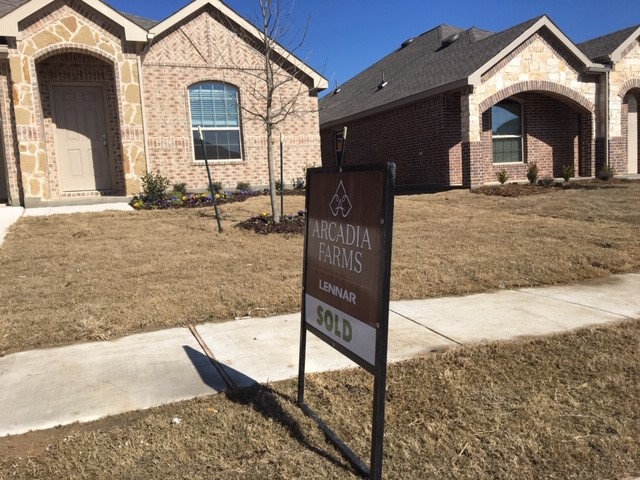
PRINCETON, Texas — This picture reveals to you where my wife, Toby the Puppy and I plan to live . . . hopefully for the duration, if you get my drift.

The “Sold” sign means we are in the process of purchasing it. Our retirement journey is taking a gigantic step forward this week. We will “close” on our house purchase in Princeton, about 6 miles or so east of McKinney in Collin County. We’ll lay down some cash, sign a large stack of papers, accept our “smart house” keys and we’ll be on our way.

My wife plans to start immediately laying down shelf liners in the kitchen. We’ll start moving the next day. We’ll take our time, but we won’t dawdle.

Yes, dear reader, this is our final stop.

What fascinates me as I think about it is that Princeton was one of the towns we considered when we first started pondering our move from the Texas Panhandle to the Dallas/Fort Worth Metroplex. The thought process came right about the time our son and daughter-in-law informed us that “You are going to be grandparents.”

That was more than six years ago. It took some time for us to make this move, but we did.

I already have told you about how we came upon his dwelling.

I only want to affirm once more the idea that even old folks — such as me — are able to adapt to new surroundings. I long thought of myself as a staid fellow, resistant to change. Then career opportunity knocked in 1984 and we moved our young family from a suburban community near Portland, Ore., to Beaumont, Texas. We stayed in Beaumont for nearly 11 years; our sons graduated from high school and were finishing up their college educations when my wife and I packed up again and moved from the Golden Triangle to the Texas Panhandle. We stayed in Amarillo for 23 years. The arrival of our granddaughter in March 2013 precipitated the move that is about to conclude in very short order in the house you see pictured with this blog post.

This is going to be a huge week for us.

I await it with great joy and excitement. Retirement is no time for complacency.

Time of My Life, Part 18: Serving as a judicial watchdog

Every so often reporters and editors encounter public officials who actually appreciate the work of holding those officials accountable for their actions.

I met a few of those folks along the way during my 37 years as a journalist. One of those individuals stands out. I want to discuss him briefly to demonstrate that some individuals do not view the media as “the enemy of the people.”

I arrived at the Amarillo Globe-News in January 1995 after spending nearly 11 years as editorial page editor of the Beaumont Enterprise way down yonder in the Golden Triangle region of the Gulf Coast.

We got into our share of scrapes in Beaumont. One fight we had was with a couple of state district judges in Jefferson County. They presided over courts with criminal jurisdiction, meaning that they only tried criminal cases; the civil caseloads were sent to other judges in Jefferson County.

Well, these two judges had to face the Texas Commission on Judicial Conduct, which had received a complaint about the judges’ sentencing practices. These two jurists were in the habit of backdating sentences for individuals convicted of crimes. Example: If someone committed a crime on Jan. 1, but was convicted on Dec. 30, the judge would sentence the individual to a prison term that began prior to the commission of the crime. Such a sentencing practice dramatically reduced the amount of time the individual would serve behind bars.

Such sentencing policies don’t sit well with prosecutors. The judicial ethics commission got a complaint and it dropped the hammer on the two judges. It issued a public reprimand, which in the world of judicial punishment is a real big deal.

We at the Beaumont Enterprise editorialized in support of the Commission on Judicial Conduct’s ruling. We were highly critical of the backdated sentences that were handed down. Our criticism of the local judges obviously angered the two men, but that didn’t dissuade us from calling it the way we saw it.

My time in Beaumont ended and I gravitated to the Panhandle in early 1995. I quickly made the acquaintance of one of the judges who punished the two judges in Beaumont. He was John Boyd, chief justice of the 7th Texas Court of Appeals headquartered in Amarillo.

Justice Boyd knew of my background and for years after our first meeting he would invariably bring up the editorial support we gave to the judicial conduct panel on which he served. He would tell others with whom we would meet of the position we took to endorse the punishment handed out to those backdating judges.

I always appreciated — and still do! — the recognition that we sought only to hold judges accountable for their actions. If any of “our” judges got stepped on, well, so be it.

Time of My Life, Part 17: Revealing a little secret

I want to reveal a little secret about newspaper editorials, particularly those that “endorse” political candidates or issues.

I lost count a long time ago of the number of editorial endorsement interviews I conducted. Despite all the high-minded talk we used to offer about our motivations, our intent was to persuade readers to buy into whatever opinion we expressed.

I wrote editorials for three newspapers in my career that spanned more than 37 years. One in Oregon and two in Texas. I interviewed likely hundreds of candidates for public office. We always used to say on our opinion pages that our intent never was to persuade readers to adopt our view. To be candid, that was baloney!

Part of the fun I had writing editorials was helping lead the community we served. Whether Oregon City, Ore., or in Beaumont or Amarillo, Texas, we sought to provide a beacon for the community to follow. By definition, therefore, our intent was to persuade readers of our newspaper to accept that what we said was the truth as we saw it. If you did, then you would follow our lead.

Isn’t that a simple concept? Sure it is! It’s also one we avoided confronting head-on while we published editorials endorsing candidates or supporting issues that were placed on ballots.

I never was naïve to think that readers of our newspapers would be malleable creatures whose minds could be changed by what they read in the newspaper. But by golly, we never stopped trying to change minds.

We used to say publicly on our pages that we recognized and accepted that our readers were intelligent enough to make up their own mind and were able to cobble together rational reasons for the point of view they held. I’ll stand by that principle even though I no longer write for newspapers, but write only for myself.

I was having the time of my professional life interviewing those individuals, who came to us in search of our editorial endorsement or, if you’ll pardon the term, our blessing.

However, when you hear an opinion writer say with a straight face that he or she doesn’t intend to change anyone’s mind with an editorial, well . . . just try to stifle your laughter.

You want big sky? Try this

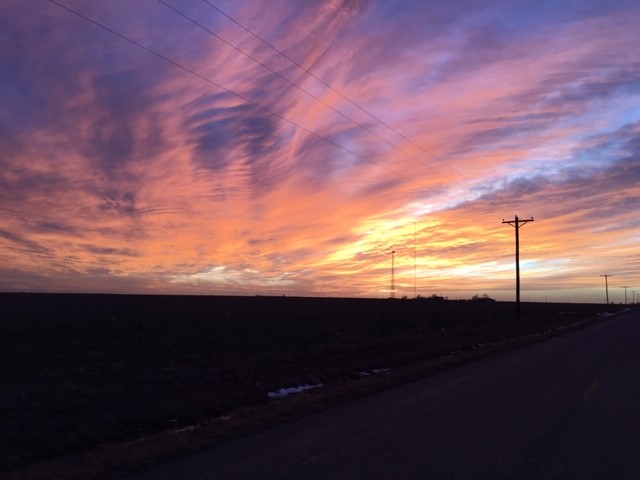
AMARILLO, Texas — We came back to the Texas Panhandle — and got a look at this!

Let me be clear: I have talked already on this blog about how God gave the Panhandle the kind of sky that makes jaws drop. It is the Almighty’s payback for declining to give the region towering mountains and tall trees.

But I don’t care that you’ve heard it already. It bears repeating.

The sunrises and the sunsets are two of the reasons we enjoyed living here. They reminded us frequently that natural splendor isn’t contained in snowcapped peaks or endless miles of virgin forest.

Indeed, we moved to Texas in 1984 from a part of the country — the Pacific Northwest — that contains plenty of both tall mountains and tall timber.

We settled initially in the Golden Triangle along the Gulf Coast, where we were treated by thunderstorms that roared incessantly.

We ventured to the Top of Texas nearly 11 years later. Sure, we had our share of thunder and lightning. We learned early about Palo Duro and Caprock canyons. We discovered how you can lose sight of your location on that flat terrain called the Caprock when you ventured into the floors of those chasms.

That sky, though . . .

It ignited again tonight with the sunset that took my breath away. As a matter of fact, at the very moment I snapped this picture the voice on the radio made specific mention of that “gorgeous Texas Panhandle sunset.”

So, there it is. I’ve said it again. Who knows? There might be more to say the next time the day ends in such spectacular fashion.

Happy Trails, Part 136: Planning our destinations

I have decided that perhaps the coolest aspect of retirement is thinking of places to see and then just deciding when we’ll get there.

We have so many places we still want to see on this continent of ours. We are planning an April excursion that will end up in New Orleans. We’ll hitch up our RV in Amarillo and then haul it to the Hill Country, to the Golden Triangle and then through the Atchafalaya Swamp en route to the Big Easy.

But then the thought came to me tonight: I want to see Monument Valley, Ariz. I told my wife and she agreed, just as I agree with her travel-destination ideas.

I don’t know when we’ll get over there. I am betting it will be soon after we return from New Orleans.

But my point is that retirement has given us the freedom to just think of these places we want to see. All that is left for us to do is decide when to shove off.

Do we have a “bucket list” trip we want to take? You bet we do.

The Big Journey will take place across Canada. Our plans call for us to haul our fifth wheel to Vancouver, British Columbia, from where we will trek east. We intend to haul our RV across Canada, perhaps as far as Nova Scotia. Then we’ll come south along the Eastern Seaboard of the United States, visiting friends and family in Virginia and in Washington, D.C.

Yes, retirement for us has opened up so many opportunities. In a strange way all the travel destinations we have laid out before us remind me of how busy my work as an editorial page editor had become, especially after 9/11.

That was the date when all hell broke loose. There was so much on which to comment, my task each morning was to decide which issue we would tackle for the next day’s newspaper edition — and which issues we could set aside for another day.

The United States and Canada comprise between them more than 7.5 million square miles. Surely that means we have enough destinations awaiting us to last for the rest of our lives.

Time of My Life, Part 12: Whom or whether to ‘endorse’

We have entered an era of enhanced distrust or mistrust of the media. That wasn’t always the case and I was proud to practice a craft that the public held in much higher regard than it does now.

We weren’t universally adored and admired, but come election time we had politicians lining up — quite literally — waiting for a chance to be interviewed by those of us who comprised an “editorial board.” They sought our “endorsement” for the campaign they were waging for whatever public office was on the line.

It’s a bit different these days. Politicians are forgoing those meetings with editorial boards. The most memorable “snub” occurred in 2010 when Texas Gov. Rick Perry decided he wouldn’t speak to any editorial boards in the state. He said he preferred to take his re-election message “directly to the people.” We got the message. What did we do? The Amarillo Globe-News decided to invite his Democratic Party challenger, former Houston Mayor Bill White, to talk to us. White accepted. He came to Amarillo and sat down for an hour or so talking about issues affecting his campaign and the state.

The paper then recommended White for election as governor. We were far from alone. However, judging from the response we got from our readers, you would have thought we had just endorsed Satan himself. The anger was palpable based on the mail we got from our heavily Republican-leaning readership.

It didn’t matter. Gov. Perry was re-elected in a breeze. And he established a trend for others to follow:

https://highplainsblogger.com/2014/10/ernst-follows-perry-model-who-needs-editorial-boards/

One of the more fascinating after effects of these editorial endorsement interviews — particularly with candidates running for local offices — was that every election cycle proved to be a learning experience for me. I always learned something at some level about the community where I lived that I didn’t know. Whether it was in Oregon City, Ore., or Beaumont or Amarillo in Texas, I learned something new about the community.

I was able to interview candidates who were invested deeply in their communities and they would share their often heartfelt experiences growing up there. I tried to take something new away from those encounters. Did I learn all there was to know about Clackamas County, Ore., or the Golden Triangle or the High Plains region? No. However, I did know a lot more about all those areas when I left them than I knew going in.

I was privileged to meet a future president of the United States, U.S. senators, members of the U.S. House, movers and shakers of all stripes, men and women who wanted to serve on city councils, or county commissions, they sought legislative office, various statewide public offices, school boards . . . you name it, we met ’em.

It always was a privilege to get to know these individuals, even those who weren’t serious in their quest. Believe me, we encountered our share of those as well.

They were willing to subject themselves to the grilling we provided them. They withstood our sometimes-difficult questions. There is something good to be said about them, too — and the process in which we all took part.

Fear not, others will step up

The news of the death this week of Wales Madden Jr. in Amarillo hit me hard, as it hit others who knew him equally hard.

As sad as I am at this good man’s passing, I find myself resisting the urge to wonder: How will the community replace him? How does any community full of giant men and women replace those who pass from this good Earth?

Well, I have what I hope is an acceptable answer.

I don’t know how a community replaces someone of Wales Madden’s immense stature. I only know that Amarillo, Texas, will move forward.

Amarillo is like any community in this great country of ours. It comprises roughly 200,000 residents. It has a long and storied tradition of embodying the pioneer spirit. Trail blazers settled on what was seen as a desolate landscape in the 19th century. They built a thriving community of farmers and ranchers that has grown into the unofficial “capital” of the High Plains region that includes parts of four states.

They endured hardship the likes of which few communities have ever experienced. The Dust Bowl? The misery of that terrible time in the 1930s was centered in the High Plains. Many of them fled. Many others stayed. They powered through it. They rebuilt their shattered lives. That’s how communities learn to thrive past their hardship and sadness.

Other communities with which I have some familiarity also have suffered grievous loss. Civic giants pass from the scene and somehow other emerge to take their place.

Before I moved to Amarillo, I lived and worked for nearly 11 years in Beaumont, Texas, another wonderful community along the Gulf Coast. It, too, is full of dedicated citizens who are the direct descendants of those who built that oil and petrochemical refining community into what it has become. Men and women pass from the scene and others step up, they fill the breach.

Amarillo is going to gather Saturday at the church where Wales Madden worshiped with his beloved wife, the late Abby Madden. Folks will hug each other, talk about Wales and Abby, remembering their philanthropy, their love for each other and for the community. They’ll remember Wales’ passion for climbing all those “14ers” — the peaks that exceeded 14,000 feet — in Colorado and California.

They need not worry for an instant whether anyone will emerge to replace the great man.

Great communities find a way to keep moving forward even as they bid farewell to those who helped build them.

National Climate Assessment: Harvey wasn’t a one-time event

Get ready, my fellow Texans. It’s quite likely, according to the National Climate Assessment, that Hurricane Harvey wasn’t a one-time catastrophe; there might more of them perhaps in the near future.

Hurricane Harvey delivered in the late summer of 2017 a one-two punch never seen before along the Gulf Coast. It roared in as a monstrous hurricane at Corpus Christi and Rockport, delivering huge storm surges off the Gulf of Mexico along with heavy wind.

It backed out over the water, then meandered up the coast and came in — again! — as a tropical storm. The second hit delivered 50 inches of rain over Houston and the Golden Triangle, putting vast stretches of the upper Texas coast under water.

Well, the National Climate Assessment says we can expect more of the same, or perhaps even worse. Why? Earth’s climate is changing. And, yes, the assessment delivered by the federal government is in direct contradiction to the half-baked pronouncements delivered by the president of the United States, Donald John “Stable Genius” Trump.

Trump says climate change is a “hoax.” He doesn’t accept the scientific community’s findings about the changing climate and the warming of the planet.

What’s more, scientists are concluding that human activity is a significant contributor to these changes.

According to the Texas TribuneThe White House downplayed the findings of the report, saying in a statement that it was “largely based on the most extreme scenario.”

But the report makes a compelling case for the reality of disastrous climate change impacts — in large part because they are already occurring. The report highlights Hurricane Harvey, wildfires in California and other recent extreme weather events, describing them as consistent with what might be expected as the planet warms. It also details the crippling impact a multi-year drought had on Texas agriculture from 2010 to 2015, thanks not only to less direct rainfall but to the reduction of water released to farmers for irrigation.

Who are you going to believe, a politician — Trump — with no background in science, let alone public service or scientists who make their living studying and determining these things?

I’m going to stand with the scientists.