Tag Archives: Watergate

What does it take for GOP to grasp what Trump is doing?

I live in the middle of Trump Country. My congressman is a young Republican from Plano, Van Taylor; he’s in his first term on the job. My two GOP U.S. senators, John Cornyn and Ted Cruz, have been on duty in Washington for some time now.

All three of these gentlemen have been silent on what we now have heard from the president of the United States himself, that he has asked at least two nations — China and Ukraine — to launch investigations into the business dealings of a potential 2020 rival, Joe Biden.

Donald Trump today has confirmed in full view of the entire world what has been alleged for years, that he has sought and accepted re-election help from foreign governments.

Democrats are outraged. Republicans are, um … silent.

What in the world is it going to take for these men and women in Congress to understand the gravity of what the president of the United States has done?

Watergate unfolded more than 40 years ago. A Republican president, Richard Nixon, fought the impeachment battle against Democrats. Then members of his own party began abandoning him. A GOP delegation trooped to the White House to inform President Nixon that he had no support in the Senate to stave off conviction in a trial once the House impeached him. The president then resigned.

We see no evidence of such courage from the current Republican caucus. They are silent. They dismiss not just what a whistleblower has said, but now — with their silence — are turning a deaf ear to what the president himself has acknowledged.

What the hell … ?

How should an impeached POTUS fare on Election Day?

Donald J. Trump is facing an extraordinary political hurdle as he campaigns for re-election as president of the United States.

It has been revealed that Trump and Ukrainian President Volodymyr Zellenskiy chatted by phone and that Trump sought to hold up a pledge for military aide to Ukraine over a “favor” that would provide dirt on Joe Biden, a potential political rival.

Trump has been accused now of jeopardizing national security because the president is abusing the power of his office.

Congressional Democrats are hurtling toward impeaching the president. What happens if the House actually impeaches him by, say, Thanksgiving?

Here’s where the hurdle stands in his way: What happens if the House impeaches Trump while he is in the midst of a re-election campaign? This unprecedented territory!

President Nixon won re-election in a landslide in 1972 and then quit the presidency in 1974 as the House was preparing to impeach him over the Watergate burglary/cover up. President Clinton won re-election in 1996 and then got impeached in 1998 because he lied to a grand jury about his relationship with a young White House intern; he, like Nixon, had no more campaigns to wage.

Donald Trump’s predicament is unparalleled. If the House impeaches him, he might be forced to run for re-election while shrouded under the darkest of political clouds.

None of this, of course, presumes what the Senate will do were it to receive the formal complaint against the president. I am wondering whether it will move to conduct a trial quickly or wait until after the election … for reasons I don’t quite understand.

I remain a bit reluctant — although decreasingly so — to push the House to proceed with an impeachment. I still would prefer an election to determine whether Donald Trump stays in office. However, the evidence of wrongdoing, corruption and frightening abuse of power well might compel the House to act rapidly.

Will it impeach the president as he prepares to run for re-election?

If it does, I will wait with bated breath to see how Donald Trump seeks to use an impeachment as a reason to re-elect him.

Hold on. This well might get mighty rough.

Happy Watergate Day, everyone!

I want to wish everyone who gives a crap a happy Watergate Day.

It was 45 years ago today that President Nixon walked out of the White House for the final time as the nation’s leader. He boarded the helicopter, flashed that goofy “V for Victory” salute and then lifted off into oblivion.

Nixon quit the presidency on Aug. 9, 1974 rather than face certain impeachment by the House of Representatives for — dang! — obstruction of justice and other crimes related to the Watergate burglary at the Democratic National Headquarters in June 1972.

Actually, it fell to some Republican heroes to deliver the bad news to the president about his political future. Sen. Barry Goldwater — Mr. Conservative — led a GOP congressional delegation to the White House to tell the president he didn’t have the support to withstand a trial in the Senate. He was toast. A goner. His political goose was being cooked in that moment.

So, Nixon cut his losses and quit.

Thankfully, he had chosen a decent and honest man in Vice President Gerald Ford to succeed him. Ford got the call after another crook, VP Spiro Agnew, quit in the wake of a growing bribery scandal.

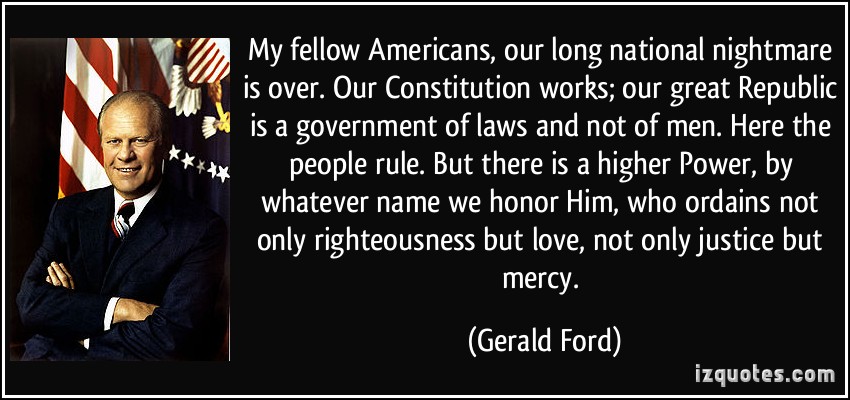
President Ford told us “our Constitution works” and that our “long national nightmare is over.” It did and it was. Sadly, we’re in the midst of another nightmarish circumstance that likely won’t end the way the earlier trauma ended 45 years ago. Why? The party of the president lacks the guts it exhibited when those senators spoke “truth to power” to Richard Nixon.

That was then. The here and now is still playing out.

I believe I’ll pray for the country.

Watergate Day has arrived, heralding ‘most stupid scandal’ ever

Happy Watergate Break-in Day, ladies and gentlemen.

It was 47 years ago today that some burglars got caught breaking into the Democratic National Committee headquarters in Washington, D.C. It turned out eventually that the burglars were acting on behalf of the Committee to Re-Elect the President — aka the hilarious acronym “CREEP.”

The scandalous nature of the burglary took time to unfold before the nation. When it did, all hell broke loose. We learned about how President Nixon sought to, um, “obstruct justice” by seeking to stop the FBI investigation. There were those infamous tape recordings. The Senate seated a select committee to get to the bottom of it.

Once it did, then the House Judiciary Committee launched impeachment proceedings. Then it voted to impeach the president, with several Republican members joining their Democratic colleagues.

Nixon then quit the presidency.

Why is this remarkably pertinent today? Because another scandal is growing in Washington that well could result in another presidential impeachment. As stupid as the current troubles surrounding Donald Trump might seem, they fail the Stupid Test standard established by CREEP.

When the burglars broke into the DNC office on June 17, 1972, the Republican president already was headed toward a smashing re-election victory. The Democrats later that summer nominated Sen. George McGovern, who then went on to lose to Nixon in a landslide. Nixon carried 49 states, rolled up 521 electoral votes, trounced McGovern by 23 percent in the balloting.

Yet the CREEP moguls thought it was worth their time to rifle through the DNC files to look for additional dirt on the Democratic Party and on McGovern.

I cannot fathom a more stupidly conceived crime than the one concocted by CREEP and the Republican Party establishment.

There can be no way yet to determine how the Donald Trump drama is going to end up. I want him out of office at the earliest possible opportunity. Whether it’s through impeachment and conviction in a Senate trial or by the next presidential election that is still about 500-some days away, it makes no difference to me.

In the annals of stupid scandals, though, the stupidity standard was set 47 years ago when those bozos broke into the DNC, only to allow Richard Nixon’s penchant for paranoia to doom his presidency.

Dean testimony provides a preview of what we might see

John Dean sat before the U.S. House Judiciary Committee today to offer the panel some historical context. He wasn’t there as a “fact witness” with specific knowledge of the matters involving Donald Trump’s conduct during the most recent presidential campaign.

However, he was there to provide some historical perspective gleaned from his role as White House counsel during the Watergate scandal of 1973-74.

I agree that Dean was a dubious “expert,” given his own culpability in the crimes committed during President Nixon’s administration.

However, we might have gotten a preview of what we could expect if the House Judiciary panel decides to launch a full-blown impeaching proceeding against Donald Trump.

What might that include? It might — indeed, it likely will — include Republicans on the panel who will seek to denigrate the credibility of every Trump critic who seeks to make the case for impeaching the president.

We heard it today from GOP members who sought to ridicule Dean’s appearance. By “ridicule,” I mean to suggest that they inferred that since Dean wasn’t there to discuss the “facts” of the Trump matter, they would ask him questions about subjects that had nothing to do with the issues at hand. They sought to suggest that as a convicted felon who lost his law license he had no credibility on anything.

Did we hear anyone of the GOP members defending Donald Trump’s character? Did they speak to the president’s honesty, his integrity, his courage, his commitment to public service?

Umm. I didn’t hear it. Did you?

What I heard was an effort to denigrate, disparage and disrespect a witness who took an oath to tell those members of Congress the truth.

I believe it’s good to keep this conduct in mind if the House Judiciary Committee decides to launch impeachment proceedings yet again.

What does John Dean know about all of this?

John Dean was a key player in the previous great constitutional crisis facing the United States of America.

He served as White House counsel during the Nixon administration. He went before the Senate Watergate Committee and declared there was a “cancer growing” on the presidency. The nation got all worked up over that testimony.

Dean eventually would be convicted of crimes and would serve time in prison for his role in covering up the Watergate scandal.

So what does the House Judiciary Committee, which plans this week to open more hearings on the current crisis? It’s going to summon John Dean to testify about what he knows about Robert Mueller’s findings on Donald Trump’s presidential campaign.

That’s it! A former Watergate-related criminal is going to talk to us about an investigation into which he has next to zero personal knowledge.

Robert Mueller concluded his probe into alleged collusion between Trump’s campaign and Russians who hacked into our electoral system. He said Trump didn’t “conspire” to collude; he left the door open on matters relating to obstruction of justice.

Dean has expressed dismay at Mueller’s findings. He has emerged as a Trump critic. So, on that score I’m on his side.

Still, my questions remain: What does John Dean bring to this matter? What unique expertise does he have? What is the Judiciary Committee going to hear from Dean that it hasn’t already heard from other peanut-gallery spectators?

Here’s a thought: Forget about Dean and bring Mueller himself to Capitol Hill.

Who will be the GOP ‘hero’?

Bill Press is old enough to remember the Watergate scandal. He also is a fierce Democratic partisan who cheered the resignation of President Nixon in 1974.

He’s now a Democratic Party “elder” who writes commentaries on occasion and speaks for Democrats who are engaged in a fight with another Republican in the White House, Donald Trump.

He wonders now whether there are any Republicans who will stand up to Donald Trump the way they stood up in 1974 to Richard Nixon. Press isn’t holding his breath. Neither are many of the rest of us.

Trump is fighting with House and Senate Democrats over the president’s assertion of executive power/privilege at the expense of the legislative power. Congress is demanding that Trump turn over his tax returns; Democrats want to talk to key White House aides; they are insisting on seeing the full, unredacted report filed by special counsel Robert S. Mueller III.

Trump is having none of it.

Press wonders whether any of the Republicans in the House and Senate who are standing up for Trump will begin standing up to him if he continues his assault on the constitutional concept of “co-equal power” shared by those three branches of government: Congress, the White House and the courts.

He fears the worst. Press concludes in an essay: “The difference is, under Watergate, there were brave Republicans willing to stand up to their president: Bill Cohen of Maine and Lawrence Hogan of Maryland in the House; Barry Goldwater of Arizona and Hugh Scott of Pennsylvania in the Senate. Today, especially among cowardly Senate Republicans, we’re waiting for the first one with enough guts to stand up against Trump. It looks like it’s going to be a long wait.”

It took a GOP congressional delegation to troop to the White House to tell President Nixon he didn’t have the votes to withstand a Senate trial once the House impeached him. That’s when Nixon quit.

Is there a hero among the current crop of GOP lawmakers? I fear not.

Chairman Nadler: We are in a constitutional crisis

I believe I will stand with U.S. House Judiciary Committee Chairman Jerrold Nadler, who today declared that the United States of America has become ensnared in a “constitutional crisis.”

Is it worse than, say, the crisis that led to President Clinton’s impeachment in 1999? Or worse than the Watergate matter that came within one House vote of impeaching President Nixon, before the president resigned in 1974?

I do not know how bad this has gotten.

However, I believe Chairman Nadler is correct. We are in a crisis of a highly serious nature. The Judiciary Committee had just voted to hold Attorney General William Barr in contempt of Congress before Nadler made his “constitutional crisis” declaration.

Donald John Trump has stuck it in the ear of Congress, invoking “executive privilege” and denying lawmakers access to anything — or anyone — involved in matters relating to The Russia Thing.

The president is suggesting Congress has no power to carry out its constitutional duties. Attorney General William Barr has refused to release the complete and unredacted report filed by special counsel Robert Mueller — and has refused to testify before Nadler’s committee.

The fight is on!

Where it goes remains anyone’s guess at this point. House Speaker Nancy Pelosi continues to oppose immediate impeachment procedures against the president. Why? She knows the danger of impeaching the president, only to have him walk away with an acquittal in a Senate trial. Pelosi can count votes as well as — or better than — most members of Congress. I happen to concur with her view about the impossibility of an impeachment, at least at this juncture.

None of that lessens the dangerous territory into which the nation is heading, according to Chairman Jerrold Nadler.

House Democrats are furious. Trump is angry with them. It has become a monumental game of chicken between the two co-equal branches of government. Neither side is likely to blink.

The end game well could produce the ugliest battle any of us have ever witnessed.

I don’t know about you, but I do not yet have the stomach to witness it. The potential for permanent damage to our system of government is scaring me sh**less.

Trump tempts political fate by ordering witnesses to stay silent

I just have to ask: Is Donald Trump committing an act of potential political suicide by refusing to allow witnesses from his administration to testify before congressional committees?

Another president, Richard Nixon, sought to play the same card in 1974. It cost him bigly. President Nixon told House Judiciary Committee Chairman Peter Rodino he would get nothing more from the administration regarding the Watergate matter.

Rodino wouldn’t accept that. He was able to force the president to turn over pertinent material related to the break-in of the Democratic National Committee headquarters in June 1972. The rest, as they say, is history. The Judiciary panel approved articles of impeachment and then the president resigned.

Forty-five years later, Donald Trump is seeking to play the same hand. He is telling the current House Judiciary chairman, Jerrold Nadler, that he will withhold information from that panel as it seeks to uncover the truth into allegations of obstruction of justice into the Russia matter that’s been in all the papers of late.

Nadler doesn’t strike me as being any more likely to cave in to this president’s demands than Rodino was in 1974 when Richard Nixon tried to bully him.

I among those Americans who does not favor impeaching Trump. I want the House and the Senate to do their work. Special counsel Robert Mueller appears headed to Capitol Hill eventually to talk to both legislative chambers.

I want Mueller to state on the record whether he believes Trump committed a crime, whether he obstructed justice. If he won’t say it, well, we need to accept what we won’t get. Then again, if he says that president did commit a crime of obstruction, but that Mueller just couldn’t commit to issuing a criminal complaint, well . . . then we have a ballgame.

Richard Nixon’s stonewalling ended badly for his presidency in 1974. Donald Trump’s reprise of that strategy well could doom his own presidency.

Sen. Graham embodies GOP hypocrisy on impeachment

I want to stipulate up front that I do not favor impeaching Donald J. Trump, at least not at this moment. I need more “proof” that he has committed an impeachable offense than what we’ve seen to date.

However, I am laughing out loud at the talk we’re hearing from Republican members of Congress who are performing a remarkable act of duplicity while ignoring the issues surrounding Trump’s troubles. These matters mirror in many instances the same issues that drove them to impeach President Bill Clinton in 1999.

The star of this duplicitous comedy is Sen. Lindsey Graham.

Two decades ago, he was a House member from South Carolina. He “managed” the GOP impeachment effort on the floor of the House; Graham, after all, is a lawyer who at the time of President Clinton’s impeachment served as a judge advocate attorney in the U.S. Air Force Reserve.

He argued passionately that lying was an impeachable offense. Yes, the president committed perjury by swearing to tell a grand jury the truth, but then lied about his relationship with what’s-her-name.

The much younger Rep. Graham, though, took it farther. He said that efforts to block congressional inquiry into those matters were impeachable. Yes, he said that the Clinton team’s alleged effort to impede the congressional inquiry constituted a “high crime and misdemeanor” worthy of impeachment.

Isn’t that precisely what is happening now? Donald Trump has instructed his entire White House team to resist subpoenas being issued by various House committees. He even is seeking to block someone who no longer works in the White House — former WH counsel Don McGahn — from testifying. The president — to borrow a time-honored term born during the Watergate scandal of the 1970s — is “stonewalling” Congress on various matters that lawmakers deem important.

Where does Sen. Graham and most of his GOP colleagues stand on all of that?

Huh? Oh! The silence is deafening.