Tag Archives: US Senate

Mitch McConnell: chief obstructionist

Supreme-Court-blue-sky

Mitch McConnell declared out loud and in public shortly after Barack Obama became president that his top priority would be to make Obama a “one-term president.”

His wish went unfulfilled when the president won re-election in November 2012.

Now that McConnell is the Senate majority leader, he’s made another pledge. He is going to oppose the president’s next appointment to the U.S. Supreme Court.

Does he know who the president will nominate? No. Does he have any inside information on Obama’s short list? Again, no.

But without the faintest idea who the president will select, the Senate’s leading Republican is going to obstruct the president. He vows to prevent the president from doing what the Constitution empowers him to do. For that matter, he and other Republicans are going to prevent the Senate from doing what the Constitution requires of that body.

Obama is going to nominate someone to replace the late Antonin Scalia on the U.S. Supreme Court. He’s entitled to put someone forward. The Senate also has the power to consent to the nomination.

There’s much that boggles the mind about the eruption that has occurred since Scalia’s untimely death. I cannot quite rank them in order, but McConnell’s declaration that he intends to block any nomination to be considered must rank near the top.

Yes, the stakes are huge. The president is a liberal/progressive politician who likely will select someone who is a good bit to the left of the man who led the Supreme Court’s conservative movement. Thus, Senate conservatives are vowing to protect their court majority — as best they can — by seeking to hold up this confirmation until after the November election. Their hope is that a Republican will win the presidency.

We have a president with one year left in his term. As they say, elections have consequences. A majority of Americans re-elected President Obama understanding full well how he would fill a vacancy on the highest court in the land if he was given the chance to do so.

He now has that chance.

Meanwhile, the nine-member high court has been reduced to eight members. The even split among the justices could produce some tie votes on key cases yet to be argued before the court.

This is not good governance.


Unanimous picks loom as favorites for high court

untitled

Politics rules on Capitol Hill. It swings both ways, influencing both political parties.

Consider what might be about to happen.

President Barack Obama, a Democrat in the final full year of his second term and final term, is likely to name someone to fill a vacancy created by the death of Supreme Court Justice Antonin Scalia.

The U.S. Constitution grants him the authority to do so. It also grants the Senate the authority to approve anyone nominated to the court.

The Senate is controlled by Republicans.

Democrats and Republicans don’t like each other much these days. Republicans really dislike the Democrat in the White House and the feeling appears to be quite mutual.

What’s the president going to do about this high court vacancy?

One theory getting kicked around in the hours and days after Scalia’s death is that the president could name an appellate judge who’s already been approved by the Senate. One name has emerged as a possible favorite, Judge Sri Srinivasen, an Indian-American who was approved unanimously the Senate before he took his federal appeals court seat.

He’s apparently thought of as a moderate. He doesn’t lean far left. He surely doesn’t lean far right. He shoots straight down the middle, according to a number of legal experts.

So, will this fellow breeze through the confirmation process as he did when the Senate considered him for a lower court?

OK. You can stop laughing.

Republicans are vowing to deny the president any action on a pending nomination. They want to wait until after the November presidential election in which they hope a Republican wins the White House.

Democrats will have none of that. They want the president to make a nomination and they want the Senate to vote on it. Quickly.

Why not select someone who’s already been vetted by the Senate? Would a judge like Sri Srinivasen be just as qualified to sit on the Supreme Court as he is on a lower court?

Well, in my version of a perfect world, it would seem like a natural for the president to find a moderate judge who’s already been approved. Except that he would be succeeding a towering figure of the judicial conservative movement.

Scalia led what has been called a “conservative renaissance” on the Supreme Court. Anyone — regardless of credentials, standing among peers or legal brilliance — is going to be run through a political sausage grinder.

Politics. Sometimes it’s downright ugly.

And sometimes it doesn’t serve the nation well.


Get ready for the biggest fight of all

Supreme-Court-blue-sky

The fight over immigration?

Or the Affordable Care Act?

Or budget priorities?

How about gay marriage?

All of those battles between President Barack Obama and the U.S. Congress are going to pale in comparison to what’s coming up: the battle to find a suitable nominee to the U.S. Supreme Court.

Justice Antonin Scalia’s sudden and tragic death Saturday has caused political apoplexy in both sides of the divide in Washington.

Democrats want the president to nominate someone sooner rather than later. Republicans want the nomination to wait until after the election, with the hope that one of their own will occupy the White House beginning Jan. 20, 2017.

President Obama indicated last night he’s inclined to move forward, to nominate someone and to insist on a “timely vote.”

He is correct to insist that he be allowed to fulfill his constitutional responsibility and that the Senate fulfill its own duties.

One of the Republican candidates, Sen. Marco Rubio, said last night that no one has been appointed during an election year. He’s half-right. President Reagan appointed Anthony Kennedy to the high court in 1987; a Democratically controlled Senate confirmed him in 1988, which certainly was an election year.

Consider this, though: Justice Kennedy succeeded another GOP nominee, the late Justice Lewis Powell (picked by President Nixon). Kennedy’s appointment and confirmation did not fundamentally change the balance of the court.

This vacancy is different. By a lot.

Justice Scalia was a towering figure among the conservative majority that serves on the court. Whoever Obama selects surely will tilt to the left.

Therein lies the fight.

Senate Majority Leader Mitch McConnell, a Republican, said the vacancy should be filled after the election, adding that the “American people deserve a voice” in determining who sits on the court.

He could not be more off base. Yes, the voters deserve a voice. However, they spoke decisively about that in November 2012 when they re-elected Barack Obama as president.

Indeed, elections have consequences. There can arguably no greater consequence than determining who gets to select candidates to sit on the nation’s highest court.

The president — whoever he or she is — has a constitutional responsibility to act on a timely manner when these vacancies occur. Moreover, the Senate has an equal responsibility to vote up or down on anyone nominated by the president.

I’ve long believed in presidential prerogative — and my belief in that has never wavered regardless of the president’s party affiliation.

So, let’s mourn the death of a distinguished and, in the president’s words “consequential” justice. Then let us allow the president to do the job allowed by the Constitution and then let us demand that the Senate do its job by voting on whoever the president selects to fill this critical court vacancy.


A major battle now looms

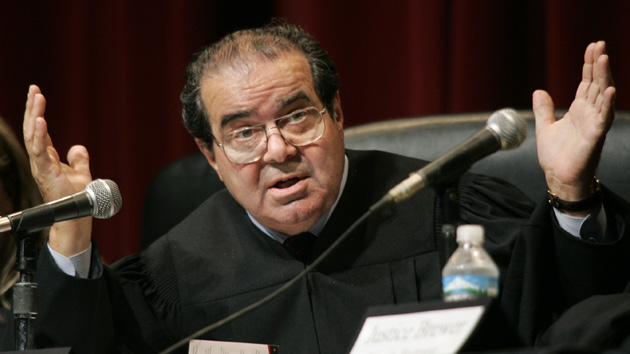
chapman.0830 - 08/29/05 - A Supreme Court headed by Supreme Court Justice Antonin Scalia has questions for Chapman University Law School professor John Eastman as he and California Attorney General Bill Lockyer argue the 1905 ''Lochner v. State of New York'' case during a re-enactment Monday afternoon at Chapman University. (Credit: Mark Avery/Orange County Register/ZUMA Press)
)

Supreme Court Justice Antonin Scalia’s sudden death today has stunned the nation.

As President Obama said this evening, the 30-year member of the nation’s highest court was one of the “most consequential” legal minds of our time.

The president now faces arguably the “most consequential” appointment of his time in office.

To say that Justice Scalia’s passing upsets the ideological balance of the highest court would commit the supreme understatement.

And, oh yes, the partisan divide opened wide immediately upon news of Scalia’s death. Senate Majority Leader Mitch McConnell, a Republican, said the Senate should wait until after Barack Obama leaves office to vote on a replacement; meanwhile, Senate Minority Leader Harry Reid, a Democrat, wants the Senate to act quickly.

Who could have seen that coming?

The president said he’ll make the appointment “in due time.” He wants a thorough, fair hearing and a “timely vote.” As the president — lame duck nor not — Barack Obama deserves the chance to nominate someone of his choosing.

Indeed, the appointment coming from a left-of-center president to fill a vacancy created by the death of a right-of-center Supreme Court justice sets up a huge battle that likely will dwarf any of the many fights Barack Obama has waged already with the U.S. Senate.

The court’s narrow balance has just been shaken to its very foundation.


Absence same as 'no' vote? No … it isn't

I really do like having Ted Cruz in the U.S. Senate.

He offers so much grist for folks like me on which to comment.

The freshman Republican senator said this the other day about his absence on a vote that confirmed Loretta Lynch as the latest U.S. attorney general: “Absence is the equivalent of a ‘no’ vote.”

http://www.politico.com/story/2015/04/ted-cruz-loretta-lynch-no-vote-explanation-117528.html?hp=l2_4

There you have it. He missed the vote because he had a prior commitment to attend a fundraiser back home in Texas. Cruz had voted earlier on a motion to end a filibuster on Lynch’s nomination; he voted to keep the filibuster going.

The filibuster was broken, the vote took place, Lynch had the votes to win confirmation. So, what was the point of Cruz being there to cast his expected “no” vote on Lynch?

Well shoot, senator. It mattered because you didn’t put it on the record. It’s not part of the Senate’s official voting record.

I’m still uncertain precisely why Cruz disapproves so strongly of Lynch’s ascending to the office of attorney general, other than her support of President Obama’s executive order granting temporary amnesty to millions of illegal immigrants. I guess Cruz doesn’t much like the notion of an attorney general supporting the policies of the president who appoints her to the Cabinet, where everyone serves at the pleasure of the president of the United States.

That’s been the mantra of other senators who opposed Lynch, even those who said upon the announcement of her appointment that she is “highly qualified.” Some of those former supporters changed their mind when she declared her backing for the president’s action on immigration.

I think it’s strange. Then again, that’s just me.

What the heck. Sen. Cruz was entitled to attend the fundraiser. He’s running for president, after all. Let’s not assume, though, that this issue of non-voting on this confirmation — as well as other key votes he’s missed while campaigning for the White House — will disappear.

It’s the price a sitting member of Congress pays when he or she seeks the highest office in the land. Sens. Barack Obama and Hillary Clinton paid it when they ran in 2008. Sen. Cruz can expect the same thing in 2016.


Now it's Sen. Graham thinking about '16 bid

Oh boy, I can hardly contain my enthusiasm for the upcoming presidential campaign.

The potential Republican field just got another name to ponder: Lindsey Graham, the senior U.S. senator from South Carolina.

http://www.politico.com/story/2015/01/lindsey-graham-2016-elections-south-carolina-114362.html

Why is this such an interesting development?

Graham is a noted conservative from a deeply conservative state. He and fellow Republican Sen. John McCain of Arizona take turns bashing the dickens out of President Obama, particularly on foreign policy — which is understandable, given that the domestic economy is starting to rock along. Heck, sometimes Graham and McCain are singing together.

However, Graham has had this annoying tendency — if you’re a Republican — to say nice things about some of the appointees the president puts forward to fill key administration posts. While many other GOP senators were slamming Loretta Lynch as the next attorney general, Graham said she’s a solid pick, highly qualified and he indicated his intentions to vote to confirm her when the time comes.

This is the kind of thing that’s going to make him a target among other GOP White House contenders when they line up to debate — if Graham decides to run, of course.

He’s a sharp lawyer. Remember when, as a member of the House, he managed the Republicans’ successful effort at impeaching President Clinton? Well, the Senate decided correctly to acquit the president of those “high crimes and misdemeanors.”

So, as he told “Meet the Press” today, he’s thinking seriously about a presidential bid. He told NBC’s Chuck Todd that he has “set up a testing-the-waters committee under the IRS code that will allow me to look beyond South Carolina as to whether or not a guy like Lindsey Graham has a viable path.”

Just one request, Sen. Graham, if you take the plunge: Stop referring to yourself in the third person.

Farewell, Lt. Gov. Dewhurst

David Dewhurst has bid the Texas Senate farewell after serving 12 years as lieutenant governor and presiding officer of the 31-member legislative chamber.

It was an emotional good bye.

I’m glad the Senate approved the resolution honoring him for his service. Dewhurst did serve the state well.

That is until he got outflanked on his right by Ted Cruz in their campaign for the U.S. Senate in 2012. Then the lieutenant governor became someone that many of us no longer recognized. He got outflanked once more this past year as he lost the Republican primary to Dan Patrick.

The cause of good government has lost a one-time champion.

***

I recall when Dewhurst splashed onto the state political scene in 1998 when he ran for land commissioner. I’d never heard of this wealthy guy from Houston. He’d been a political insider downstate and was well-connected.

But he became land commissioner and did a great job expanding veterans home loan benefits, which is one of the office’s key duties.

Dewhurst was an occasional visitor to the Panhandle while serving in that office and later as lieutenant governor. He always seemed quite appreciative of the time we spent visiting about the issues of the day. And I think we forged a nice professional relationship over the years.

Dewhurst could talk forever about the tiniest details of legislation, which he did often either on the phone or in person. Indeed, I often heard from my sources in Austin that Dewhurst might have been the hardest-working state official in Texas.

He was elected lieutenant governor in 2002, succeeding Bill Ratliff who was appointed by the Senate to fill the term vacated when Rick Perry became governor — after George W. Bush was elected president.

Dewhurst ran the Senate the way most of his predecessors did, with a flair for bipartisan cooperation. He was unafraid to appoint Democratic senator as committee chairs, sharing the power with senators from the other party.

I always appreciated his adherence to Senate tradition.

Then came his failed bid to be elected to the U.S. Senate. Ted Cruz battered him for being too moderate. Dewhurst fought back — uncomfortably, it appeared to me — by saying in effect, “I’m no moderate. I’m as conservative as you are, Mr. Cruz.”

He didn’t wear the TEA party label well. Cruz beat him in the 2012 GOP primary.

Then came Patrick in 2014 to do the same thing to Dewhurst: painting him as some sort of squishy moderate Republican In Name Only. There’s nothing worse in the Texas GOP than to be called a RINO.

They fought through the primary. Patrick defeated Dewhurst in the runoff.

Now the new guy is set to take over. The Senate won’t be the same. Dewhurst has said farewell.

I am glad to have gotten to know Lt. Gov. Dewhurst. I wish him well in whatever future awaits him.


If you can't lick 'em, get rid of 'em

John McCain is getting ready, it seems, for yet another run for re-election to the U.S. Senate from Arizona.

What’s more, he’s launching a pre-emptive strike against the wing of the Republican Party that is likely to challenge him. I’m talking about the TEA party wing of the GOP.

McCain is making an effort to purge the Arizona Republican Party of TEA party activists and replacing them with mainstream Republicans — like himself.

Not that he cares what a Texas liberal thinks, but hey — go, John, go!

http://www.politico.com/story/2014/12/john-mccain-arizona-tea-party-113849.html?ml=po

As Politico reports: “The ambitious effort — detailed to POLITICO by nearly a dozen McCain operatives, donors, and friends — has stretched from office buildings in Alexandria, Virginia, where strategists plotted and fundraisers collected cash for a super PAC, to Vietnamese-American communities across Arizona, where recruiters sought out supporters eager to help the incumbent defeat the tea party.

“Team McCain’s goal? Unseat conservative activists who hold obscure, but influential, local party offices.”

I believe that’s how you play hardball politics in Arizona.

Arizona political rules are a bit strange, according to Politico. It allows for the election of precinct committee men, who then elect party chairs — who then assume powerful roles in recruiting candidates to seek public office. As of this past August, most of those party chairs and precinct committee folks were considered McCain foes. He’s working now to replace them with friends, allies, loyalists — those who favor his re-election to his umpteenth term in the Senate.

TEA party activists and other Republican conservatives consider McCain to be too moderate. He’s just not tough enough on immigration, for example. They want his head on a platter — so to speak, of course — because he’s just too darn chummy with some Senate Democrats. I would hasten to add that the media love McCain because he’s, well, quite quotable. He makes “good copy,” to use the journalist’s parlance.

Many conservatives consider McCain to be washed up, past his prime, part of the problem. He knows the Senate. He understands the art of legislation.

I hope he’s just getting warmed up.


Cruz becomes movement leader

It used to be said in Washington that the “most dangerous place in the world” was the space between U.S. Sen. Phil Gramm and a television camera.

Gramm has left public life and the owner of that title now happens to be another fiery Texas Republican, freshman Sen. Ted Cruz.

According to the San Antonio Express-News headline atop a blog post, the young senator has a movement that carries his name. Call it “Cruz conservatives.”

http://blog.mysanantonio.com/texas-politics/2014/12/cruz-conservatives-abandon-gop-leaders-on-anti-obama-vote/

His ability to muscle his way past more senior Senate Republicans to the center of the political stage in less than two years is utterly astounding. The Cruz Missile exploded on the scene with his GOP primary upset in 2012 of Texas Lt. Gov. David Dewhurst, after which it became a foregone conclusion he’d be elected to the Senate from such a heavily Republican state.

These days, if you want some “good copy,” turn to Ted; the glib gab machine is loaded with it. If you want to know what the TEA party wing of the GOP is thinking, ask the junior senator from Texas.

Whatever became of the GOP’s senior pols, such as Sens. Orrin Hatch of Utah, Lamar Alexander of Tennessee, Chuck Grassley of Iowa? Sure, the party has its share of media hounds, such as Sen. John McCain of Arizona, Lindsey Graham of South Carolina and Marco Rubio of Florida (I’ll throw Rubio into that mix, even though he’s been in the Senate only two years longer than Cruz).

To be fair, the Senate Democrats have their share of TV hogs. Sens. Chuck Schumer of New York and Claire McCaskill of Missouri come immediately to mind.

No one else — in either party — can match Ted the Canadian’s panache.

It used to be said that it took at least half of their first six-year term for senators to figure out the ropes, to earn their spurs and to find their way to the men’s room.

Not so with Ted. The young man is a force of nature — which makes me, at least, want to head to the storm shelter.


'Easy' confirmation ahead?

When a Republican curmudgeon like Sen. Jim Inhofe of Oklahoma says he would vote for a Democratic nominee for defense secretary, then you might expect the next nominee to have a relatively clear path toward confirmation.

Today, President Obama is going to nominate former deputy defense secretary Ashton Carter to run the Pentagon; he would replace outgoing Secretary Chuck Hagel. He’s been highly decorated and has been confirmed already by the Senate for his one-time post.

http://www.cnn.com/2014/12/05/politics/obama-ash-carter-defense-secretary/index.html

Carter is a well-known expert on weapons and their procurement. He knows the ropes inside the world’s largest office building and it appears he’s got support from at least one Republican senator who’ll get a chance to vote on his confirmation. Will there be more?

GOP lawmakers have been making a lot of noise lately about blocking Obama appointments as payback for his executive action on immigration. They’ve been careful to exclude national security posts from that petulant game.

Let’s hope they’re faithful to their pledge.

If there was a federal agency that needs leadership and cohesion in this troubled time, one would expect it to the be the Department of Defense.

Do not dilly-dally on this one, senators.