Tag Archives: Texas Legislature

Tech pulls plug on vet school in Amarillo

I was disappointed to hear the other day that the Texas Tech University Board of Regents has decided against seeking money to create a school of veterinary medicine in Amarillo.

The money would have come from the Texas Legislature, which I am quite certain has gotten its share of pressure from Texas A&M University to spend the money on, um, other priorities.

Tech had floated the notion of creating a veterinary school in Amarillo as a way to create a pool of medical professionals who would serve the cattle and horse industries that are so prevalent in this part of the world.

Tech, though, got some immediate push back from A&M, which has a first-rate veterinary medicine program already — but none in Amarillo or elsewhere in the Texas Panhandle.

The systems happen to be run by two men with extensive legislative experience, I hasten to add. Tech’s chancellor is former state Sen. Bob Duncan, the Lubbock Republican who gave up his Senate seat to take the chancellorship at his alma mater; the A&M chancellor happens to be John Sharp, a former Democratic state senator from Victoria who’s also held elected posts as a Texas railroad commissioner and comptroller of public accounts.

I don’t know what kind of relationship these men have, but they no doubt now are rivals for a depleted source of revenue that would pay for the establishment of a veterinary medicine school.

Let’s also acknowledge the presence of a third state senator with something to say about this notion. That would be Kel Seliger, R-Amarillo, who happens to chair the Senate’s Higher Education Committee. Didn’t the chairman see a need to fight for Tech’s veterinary school — which would serve his sprawling West Texas Senate district?

I believe a Texas Tech veterinary school would be good for the state, good for Amarillo and the region and good for the university system. A&M officials seemed intent on torpedoing the idea from the get-go, suggesting that there is insufficient demand for a veterinary medicine school to justify an Amarillo campus run by a competing university system.

So, Texas Tech’s regents say they won’t seek money this legislative session to finance development of a veterinary school in Amarillo. They have other pressing needs … they said.

Fine. I just don’t want this idea to get buried under a pile of manure.

‘Bestiality problem’ in Amarillo? Who knew?

Here’s a community problem no one wants to talk about in polite company. To be candid, this issue sickens me to the core.

Amarillo officials are looking at a way to make bestiality illegal.

What, you say? You mean it’s OK for a human being to have sex with an animal? According to a report on NewsChannel 10, bestiality is not an illegal act in Texas, which is one of about a dozen states with no such law on the books.

Yeah, I think the city ought to enact such an ordinance. In a hurry!

If only the punishment could be harsh.

The city apparently is hindered by statute. According to NewsChannel 10: “Animal Management & Welfare has been working to create a city ordinance that would make bestiality in city limits a Class C Misdemeanor. That’s the highest charge the department can give, and would mean a citation and fine for offenders.”

Jumpin’ jiminy, man! Citation and a fine? That’s it?

Although bestiality per se is not illegal in Texas, someone can be charged with “animal abuse” that covers apparently other acts of cruelty against animals. A man is being held in Potter County’s Detention Center on an animal abuse charge.

More from NewsChannel 10: “‘If someone does an act to an animal that is sexual in nature, and in the event the animal is hurt during the course of that act and they fail to render vet care to it is when the crime actually occurs that we can prosecute that individual,’ said Richard Havens, Director of Amarillo Animal Management & Welfare.”

Let’s try something else. How about petitioning our state legislative delegation to draft a bill that makes this hideous behavior illegal throughout the state? Oh, and let’s also make sure our City Council approves an ordinance that would punish an offender to the extent that it can.

Good ever-lovin’ grief. I feel dirty just writing about this.

Regretting a stance on Amarillo’s congressional alignment

Every now and then, as I wander through Amarillo, I encounter people I knew in my previous life as a journalist and with whom I maintain friendly relations to this day.

I ran into one of them today. He is former Bushland School Superintendent John Lemons. We chatted about this and that, about people we know and how they’re doing these days. Then the conversation turned to an old friend of his, former U.S. Rep. Larry Combest.

Our discussion pivoted to a position the Amarillo Globe-News had taken while I was working as editorial page editor of the newspaper: It dealt with congressional reapportionment.

I told John that I have grown to regret a position the paper had taken, and which I had expressed through editorials published on the matter. The G-N argued for the “reunification” of Amarillo into a single congressional district.

A brief history is in order.

***

The 1991 Texas Legislature, which was dominated by Democrats, redrew the state’s congressional districts. Seeking to protect Democratic U.S. Rep. Bill Sarpalius, the Legislature split Amarillo in half: Potter County would be represented by Sarpalius in the 13th Congressional District; Randall County’s congressman would be Republican Larry Combest.

The realignment outraged the G-N at the time. They paper began calling for the city to be made whole by being put back solely into the 13th District.

The gerrymandering worked through the 1992 election, as Sarpalius was re-elected to his third term in Congress; so was Combest. The paper kept up its drumbeat for unification. The city’s interests were being split between men of competing political parties, the G-N said.

Then came the 1994 election. Sarpalius ran into the Republican juggernaut. A young congressional staffer named Mac Thornberry defeated him. Thus, the city would be represented by two congressmen from the same party.

I arrived at my post in January 1995 — and the paper kept hammering away at the unification theme. Bring the city together, we said. I scratched my head a bit over that one. I couldn’t quite understand why we were so upset with divided representation, given that both Reps. Combest and Thornberry were of the same party. They were rowing in unison, singing off the same page, reciting the same mantra … blah, blah, blah.

I told Lemons today that the city was able to “double its pleasure, double its fun” with two members of Congress representing its interests. One of them, Combest, held a leadership position on the House Agriculture Committee.

But we kept it up.

I told my pal John Lemons today I regret not pushing my boss at the time to rethink the notion that Amarillo needed to be made whole.

So … now I’m sharing my regret here.

I had a wonderful — and moderately successful — career in daily print journalism. However, it wasn’t regret-free.

NFL vows to fight Texas’s ‘bathroom bill’

Texas legislators might have picked a fight they are destined to lose.

They are considering a so-called “bathroom bill” that targets transgender individuals, requiring them to use restrooms according to their “biological sex.”

Opponents of Senate Bill 6 call it discriminatory against transgender people, those who could be in the process of changing their sexual identity.

Here’s where it gets tricky, particularly in a football-crazy state such as Texas: The National Football League might not return the Super Bowl to Texas if the Legislature goes through with enacting Senate Bill 6.

Was this year’s Super Bowl the last one in Texas?

Houston just played host to Super Bowl LI, doing a marvelous job of staging the event seen by tens of millions of TV viewers around the world. It might be the last time a Texas city enjoys the glory that fell across Houston.

It’s a complicated issue. According to the Texas Tribune: “The legislation does exempt stadiums, convention centers and entertainment venues that are owned or leased by a governmental entity from having to follow the state’s bathroom policies. That would include NRG Stadium in Houston, where the Super Bowl was held.”

There’s more to it. As the Tribune reported: “But Senate Bill 6 would apply to most college stadiums, which would be required to prohibit transgender Texans form using the bathroom that matches their gender identity. Under the bill, if a private association, business or sports league leased out a publicly owned venue for an event, the state or local governments that oversee that venue would have no say in the bathroom policies there for that event.”

There well might be little stomach for the National Football League to go through this kind of hassle in the future, which would deprive the state of considerable revenue generated by such a mega-event.

What’s more, it involves football, too!

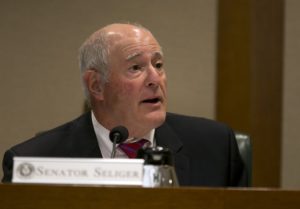
Seliger takes brief turn as governor of Texas

I have had the pleasure and the honor of knowing many honorable men and women in public life throughout my 37 years in journalism. This blog post is about one of the good guys I have had the honor of knowing professionally and personally.

I wrote it initially for another medium, but I have chosen to post it here. My interview with state Sen. Kel Seliger took place just before Donald Trump’s inauguration as president of the United States.

***

On a day just prior to the inauguration of President Donald J. Trump – when Gov. Greg Abbott and Lt. Gov. Dan Patrick were out of the state to attend the festivities in Washington, D.C. – Kelton Gray “Kel” Seliger had the task of serving as Texas’s acting governor.

It’s a responsibility – absent the perks of the job – granted to him by Patrick, who just days earlier had named him president pro tem of the Texas Senate. He was put in charge of the state in the absence of the two top statewide elected officials.

Seliger, a Republican who has served in the Senate since 2004, didn’t arrive this day with any Texas Rangers security detail in tow. There were no special arrangements made, no announcement of his arrival, no fanfare.

Seliger represents a district that stretches from the Texas-Oklahoma border about 100 miles of Amarillo to the Permian Basin, which is another 200 miles south. He maintains Senate offices in Amarillo and Midland and is now essentially a full-time legislator, having sold the steel business he owned with his brother, Lane, several years ago.

He is a native of Borger who graduated from Dartmouth College in Hanover, N.H., and who returned to the Panhandle to stake out his future. Seliger entered public service as an Amarillo city commissioner in 1989 and then served as mayor from 1993 until 2001 before joining the Senate after President George W. Bush appointed the late Sen. Teel Bivins to be U.S. ambassador to Sweden.

Seliger chairs the Senate Higher Education Committee and serves also on the Senate Education Committee.

We chatted for a time over lunch. Here is what I learned about Kel Seliger.

Should the state start over with its standardized testing requirement for public school students?

“There’s no need to start over,” Seliger said. “But we need to refine it. We need accountability. These tests are for adults, too,” he said, referring to educators. “Kids take tests all the time. Start over? No. Make it better.”

Are you getting special protection from the Texas Rangers while serving as acting governor?

“Not that I’m aware of,” he said. “They may be around, watching my back. I’m quite sure if they had the remotest sense my new temporary status created a situation, they’d be here in a heartbeat.”

Are you empowered to act fully as governor?

“If there is a situation that requires immediate action as governor, yes,” he explained, referring to a possible natural disaster or other catastrophic event. “But if there was something I would encounter that would require action of another sort, I would check with Gov. Abbott to see if he is OK with whatever I would do.”

But what if we have a natural disaster? Could you then act as governor?

“We have emergency people, first responders, on site. (Department of Public Safety) officials would tell me what’s happened. They then would put me in touch with the governor as quickly as possible” to coordinate the state’s response, Seliger replied.

Why are you serving?

“I love public policy,” Seliger said, “and this is the place to do public policy. If you have a good idea, you can work with people and get things done. In Washington,” he said, echoing the new president, “nothing gets done.”

What has been your greatest success in the Senate?

“I think I have made a meaningful contribution to things that matter. I have been able to focus on water policy and supporting water conservation districts,” he said.

What piece of legislation that has your name on it makes you most proud?

Seliger said he doesn’t have a “particular favorite,” but said he is proud of Senate Bill 149 which “allows kids who don’t pass the STAAR test, but who do all the rest of their course work and then stand before a committee of teachers and administrators to walk across the stage and get their diploma.” He also is proud of a bill he authored that the 2015 Legislature approved that set aside money for construction of buildings on 64 higher education campuses in Texas. “And that includes about $6 million for construction of West Texas A&M’s downtown campus in Amarillo.”

And your biggest disappointment?

“I had a bill that would have banned ‘dark money,’” Seliger said, explaining that “dark money” comprises funds that come from tax-exempt sources but which the public “has no idea who’s giving it” to politicians. “This bill was vetoed after the 2013 session by Gov. (Rick) Perry.” He said the then-governor’s reason for vetoing the bill “was not discernable.”

Do we pay state legislators enough to serve?

“We get paid enough so that people don’t have the impression we’re doing this for the money,” he said of the $600 monthly stipend, plus the per-diem expense paid to lawmakers while the Legislature is in session. “And contrary to what a lot of folks believe about the Legislature, we don’t get just rich people to serve,” he said. “Many legislators are working people who give up their regular jobs to serve in the Legislature.”

How does your Senate district benefit tangibly from your service in the Texas Senate?

“Others should be the ones to make that judgment. I like to think we’re working on issues relating to public education and higher education,” Seliger said. “Everyone who serves in elected office believes that they are making the world a better place. I’m just trying to work with people in our West Texas cities, towns and universities.”

Describe your relationship with Lt. Gov. Dan Patrick.

“We have an effective working relationship,” Seliger said of the man who presides over the Senate. “Look, he named me (Higher Education Committee) chairman. He didn’t have to do that.”

You almost lost your re-election bid in 2014. Are you going to run again in 2018?

“I don’t know,” Seliger said. As for his 2014 Republican Party primary challenge from former Midland Mayor Mike Canon, he responded, “I won with 52 percent of the vote. I don’t think that’s ‘almost losing’ the contest.” He continued: “I don’t intend to stay in the Senate until I’m a doddering old fool, drooling on my lapels.”

What did you see for yourself when you were 10 years old?

Seliger smiled broadly. “I saw myself as Roy Rogers,” he said. Why Roy Rogers? “Hey, I was 10 years old – living in Borger, Texas.”


 

Finally, a Trump policy worth endorsing

I told you I would say something positive if Donald J. Trump ever did something worthy of an endorsement while he is president of the United States.

Here it comes.

I like the ban he has placed on those who leave federal employment, meaning they cannot work for at least five years as lobbyists after they leave public office.

Some of them would face lifetime bans.

There you go. I’ve just broken my lengthy string of critical comments against Trump.

http://www.msn.com/en-us/news/politics/trump-sets-5-year-and-lifetime-lobbying-ban-for-officials/ar-AAmm1nh?li=BBmkt5R&ocid=spartandhp

According to The Associated Press: “Most of the people standing behind me will not be able to go to work,” Trump joked, referring to an array of White House officials lined up behind him as he sat at his desk in the Oval Office. The officials included Vice President Mike Pence, chief of staff Reince Priebus, senior strategist Steve Bannon and counselor Kellyanne Conway. “So you have one last chance to get out.”

I’ve long lamented the revolving door that separates public service from private lobbying. In Texas, for instance, legislators can leave public office and step virtually immediately into lobbying positions. It allows these ex-lawmakers to use their intimate contacts and their influence on government agencies to the benefit of their new employers: the firms they represent as registered lobbyists.

Trump says that won’t happen with those who work within his administration. This, I submit, is a welcome reform in the relationship between government agencies and the lobbying firms that seek to benefit from government money.

Butt out of couples’ lives, Texas Legislature

A bill being pitched for consideration in the 2017 Texas Legislature is getting a hit from a newspaper editorial page where I used to work.

The Beaumont Enterprise calls state Rep. Matt Krause’s bill the “early favorite” for worst legislation of the session.

Krause, a Fort Worth Republican, wants the state to force couples to live apart for three years before they divorce; he stipulates, though, that the state would exempt couples separating on the basis of domestic violence or adultery.

Ugghh! He wants to make no-fault divorce illegal.

Hold on here. What about the couples who discover after they get married that they just cannot live together? They are incompatible on one or more levels. They don’t like each other’s eating habits. Maybe one of them snores too loudly.

C’mon, Rep. Krause. Get real. As the Enterprise notes in its editorial, a three-year waiting period punishes the couples needlessly.

http://www.beaumontenterprise.com/opinions/editorials/article/EDITORIAL-Proposed-bill-is-divorced-from-reality-10841203.php

Yes, society should fight for the sanctity of marriage. I’m all for it. I’ve been a married guy for 45 years. I get it.

Legislating this kind of solution, though — shall we say — is ridiculous on its face.

Besides, I always thought conservatives fought against government intrusion into our lives.

Bathroom bill: solution in search of a problem

There they go again, finding solutions to problems that really don’t exist.

Texas Lt. Gov. Dan Patrick has announced plans to introduce a state bathroom bill to the Texas Legislature that would punish local school systems for failure to restrict access to restrooms to people who are born with certain anatomical accoutrements.

Transgender Texans will have to fend for themselves, therefore.

I don’t understand fully a lot of things. Transgenderism is one of them. However, I do get that some among us identify with the opposite gender; boys think of themselves as girls and vice versa. Many of them are undergoing surgical procedures to match how they perceive themselves.

I guess my question of Lt. Gov. Patrick is this: How in the world are you going to enforce this rule?

http://www.texasmonthly.com/burka-blog/patrick-unveils-long-awaited-bathroom-bill/

Let’s say you’re a young man who is undergoing procedures to become a young female. You have to use a public restroom. Do you use the men’s room because you have certain male anatomy parts? Or do you slip into a stall in a female restroom, close the door, do what you have to do and then exit without anyone being the wiser?

Let’s apply the same question to a young woman who’s going through the same change of identity. How does the state enforce such a rule?

According to Texas Monthly’s Burka Blog: “The bill—dubbed the Texas Privacy Act—would include penalties for public schools that do not restrict access to restrooms, changing rooms, and showers to match a person’s assigned gender at birth. But the bill also allows schools to provide single-person bathrooms for transgender students.”

Is this really a problem that requires the state to invoke a legislative remedy? Is it really a widespread issue that demands the state become involved in an issue that could be decided by local school boards, along with local educators and administrators?

‘War against women’ takes new turn in Texas

Let’s take a moment or two to connect a few dots.

* Democrats accuse Republicans of waging a “war against women.”

* Republicans deny such a thing.

* Republicans — many of them, at least — are adamantly opposed to Planned Parenthood, one of the nation’s leading providers of health care services for women. Yes, Planned Parenthood refers women to abortion clinics.

* The Texas Legislature, which has a GOP uber-majority, has now decided to cut Planned Parenthood off from the state’s Medicaid program, which enables low-income Texans to get medical assistance at a drastically reduced cost.

* Texas Gov. Greg Abbott, another Republican, has signed on to this effort.

* Oh, and the government does not provide any money for abortions.

So, Planned Parenthood is now in the Republicans’ sights because, the GOP leadership insists, the organization allegedly treats aborted fetuses cavalierly; there also have been unspecified allegations of billing fraud. The video recording shows staffers supposedly talking about harvesting “fetal tissue” for medical research — even though there’s been zero proof provided that it’s even occurring.

Planned Parenthood denies any wrongdoing and the activists who insist that there is haven’t produced evidence to back up their assertion.

Is there a “war against women” going on in the Texas Legislature?

Planned Parenthood has become the prime bogeyman among legislators who are enraged that the organization has anything to do with abortions.

Here’s the thing: The government doesn’t pay for the procedure. Planned Parenthood, though, does provide a wide range of other health-related services to women who need them. Medicaid is a state-run assistance program aimed at helping low-income women obtain medical services they otherwise couldn’t afford.

State health officials have delivered the bad news to Planned Parenthood. In about a month, the state is going cut off millions of dollars in aid, affecting thousands of Texas women.

The women who rely on state assistance to obtain medical advice from Planned Parenthood deserve better treatment than they’re getting from Texas legislators and the governor.

https://www.texastribune.org/2016/12/20/texas-kicks-planned-parenthood-out-medicaid/

According to the Texas Tribune: “In the final notice, Texas Health and Human Services Inspector General Stuart Bowen said the undercover videos — which depicted Planned Parenthood officials discussing the use of fetal tissue for research — showed ‘that Planned Parenthood violated state and federal law.'”

And there’s more from the Tribune: “Planned Parenthood has vehemently denied those claims, and it has criticized the videos the state is pointing to as evidence as being heavily edited to imply malfeasance. Its health centers in Texas have also said they do not currently donate fetal tissue for research. Their Houston affiliate did participate in a 2010 research study with the University of Texas Medical Branch.”

This is looking for all the world to me as though the Legislature has found a solution to an unspecified and unproven problem.

Meanwhile, thousands of Texas women will be chewed up in the political buzzsaw.

Is there a war against women being waged? Looks like it to me.

Texas might bind electors to vote for winner

7c2a3338_jpg_800x1000_q100

Is it a good idea for the Texas Legislature to enact a law that forces presidential electors to remain faithful to the oath they take?

Yes.

Another Texas Republican elector, Christopher Suprun of Dallas, has declared he won’t cast his vote next week for Donald J. Trump, who won the state’s 38 electoral votes. He hasn’t said for whom he’ll vote, but it has drawn a response from Lt. Gov. Dan Patrick, who said he’s going to look into whether the Legislature will write a law that binds future electors to their pledge.

I think that’s a reasonable requirement. Texas would join 29 other states that have similar laws on the books.

Suprun joins another GOP elector, Art Sisneros, in denying Trump their electoral votes. There’s a big difference, though, in the two men’s decision. Suprun will cast his vote; Sisneros, on the other hand, took the more noble approach and quit his post as an elector. Sisneros said he couldn’t in good conscience vote for Trump — but neither could he violate the oath he took when he signed on as an elector.

https://www.texastribune.org/2016/12/07/patrick-rogue-texas-elector-could-lead-binding-law/

I don’t suppose Patrick would seek a law that prevents electors from quitting, as Sisneros did. However, Suprun’s decision is a bit troublesome. The difficulty, in my mind, has nothing to do with Trump. I wouldn’t vote for Trump, either.

Instead, it’s related directly to the oath this elector took to keep faith with the state’s voters, who gave the president-elect a 9 percentage point victory over Democratic nominee Hillary Rodham Clinton.

These public oaths don’t by themselves bind those who take them to remain faithful. But they should. These electors sign on as loyal Republicans or Democrats. Trump won the GOP nomination fair and square and won the presidential election under the rules laid out by the U.S. Constitution.

Patrick and the Legislature cannot enact a law quickly enough to make Suprun toe the line. They ought to do so for future presidential elections. Fair is fair.