Tag Archives: U.S. Constitution

Change the federal judicial system? Please, no

What is it with some American politicians?

A court ruling or two doesn’t go their way and they want to toss aside one of the basic tenets of our federal government? They want to elect federal judges, make them stand for “retention” if they make a decision that upsets some of us?

That’s the view of a leading so-called “conservative” U.S. senator who’s also running for the Republican presidential nomination in 2016. Take it away, Ted Cruz of Texas.

http://www.politico.com/story/2015/07/ted-cruz-chris-matthews-supreme-court-119891.html

Cruz jousted this week with MSBNC’s Chris Matthews over the setup of the federal judiciary. Cruz doesn’t like the two recent Supreme Court rulings that (a) upheld the Affordable Care Act and (b) legalized gay marriage in the United States.

The junior senator from Texas now thinks Supreme Court justices should stand for retention to enable voters a chance to decide if they want them to keep their jobs.

Matthews, not surprisingly, went semi-ballistic — which is part of his shtick. He brought up the Bush v. Gore decision that settled the 2000 presidential election. The Supreme Court voted 5-4 to stop the Florida recount. Texas Gov. George W. Bush was leading by 537 votes at that moment over Vice President Al Gore. Gov. Bush was awarded Florida’s electoral votes, which were enough to elect him president of the United States by a single electoral vote.

The five Republican-appointed justices’ overruled the four dissents cast by the Democratic-appointed justices. Politics? Gosh, do you think?

Conservatives hailed that decision. And why not? It was all done according to precisely the manner allowed by the U.S. Constitution. Some of us might not have liked the outcome, but that’s how it goes. The justices made the call.

Cruz didn’t object then, Matthews reminded him.

The nation’s founders set up a system in which the federal judiciary is intended to be free of political pressure. The president appoints judges and Supreme Court justices, who then are subject to approval by the Senate. They get lifetime jobs and, therefore, are able to rule according to how they interpret the Constitution.

This idea that we should now subject justices to the political will of the people is simply not in keeping with what the founders intended when they wrote the Constitution.

Political conservatives, such as Sen. Cruz, keep harping on “original intent.” Well, the founders’ “original intent” was to separate the judicial branch of governmentĀ from the political tug-of-war that exists in the legislative and executive branches.

Cruz said he is ā€œreluctant to call for elections,ā€ and said itĀ ā€œmakes him sad.ā€ He added that he has made that call becauseĀ ā€œa majority of the justices are not honoring their judicial oaths.ā€

Yes they are, senator.

Let’s leave the judicial system alone.
Where was this voice on gay marriage?

Of all the voices heard across the United States of America that were commenting — pro and con — on the historic Supreme Court ruling that legalized gay marriage, one voice was conspicuously silent.

It belonged to the former vice president of the United States, Richard B. Cheney.

He’s been quick to lambaste the liberals ever since leaving office in January 2009. He calls Barack Obama the “worst president of my lifetime.” He’s leveled heavy fire on congressional Democrats on any number of foreign and domestic issues.

On this one, the issue that resonates on both sides of the political divide — for vastly different reasons, of course — he’s been silent.

The gay marriage debate hits the former VP squarely where he feels it. His daughter, Mary, is married to a woman.

In this instance, Vice President Cheney’s silence has been remarkable.

He dare not rile the base of his Republican Party, the folks who still adore him for his staunch conservative views, by endorsing how the Supreme Court has affirmed the Constitution’s equal protection clause contained in the 14th Amendment.

Then again, he dare not criticize the court out of concern that critics might jump all over him for condemning his very own daughter — who I amĀ absolutely certainĀ he loves without condition. Fathers do that, you know.

Man, it’s a dicey world when you have to decide which brand of loyalty wins out — loyalty to family or to political principle.

My hope is that family takes precedence.


A ‘Christian nation’? Never have been one

I heard it said over the weekend that “we aren’t a Christian nation … anymore.”

It took me aback.

We’ve been hearing a lot of that of late, particularly in the wake of the Supreme Court’s ruling that state bans on gay marriage violated the U.S. Constitution’s 14th Amendment and the “equal protection clause” contained within it. Therefore, gay marriage should be made legal in all the states, the court said.

Back to the point: Are we a Christian nation? Have we ever been one?

No and no.

I keep reading the U.S. Constitution and so help me, I cannot find the word “Christian” anywhere in it. Some of my friends on the right keep asserting that if the Constitution doesn’t say something specifically, then it’s not germane to a constitutional discussion. A former colleague of mine keeps asserting, for instance, that the Constitution doesn’t even mention “marriage,” but it does mention “the right to keep and bear arms.” That’s his way of affirming that the Second Amendment’s literal verbiage carries weight over the court’s broader interpretation of what’s allowed and what’s prohibited.

I am quite aware of the argument that the founders were driven by religious principles. I remain undecided, though, on the issue of whether they were devout believers in Jesus Christ, as some have asserted, or whether they were deists who believed in a more ecumenical God, or supreme being or “higher power.”

I also am quite aware that after considerable debate at the constitutional convention that produced our governing framework that they produced a document that is devoid of religious references … except for one mention. It says — in Article VI, Paragraph 3 — that there shall be “no religious test” for anyone seeking public office.

The founders’ immediate forebears fled Europe to escape religious persecution and to be free of state-mandated religion. That’s why they wrote a Constitution that spells out quite clearly that this would be a secular nation, governed by laws written by fallible human beings.

A Christian nation? Well, we’re a nation comprising citizens who are mostly Christian. They remain free to worship as they please. So are non-Christians, just as it’s always been since the beginning of this great republic.

God bless America.

Hats off to local county clerks

If I were wearing a hat at this moment, I’d tip it to two Texas county clerks: Randall County’s Renee Calhoun and Potter County’s Julie Smith.

All they did was agree to adhere to their oath of office and will issue marriage licenses to gay couples who seek them.

This is in accordance with a Supreme Court decision this past week that legalized gay marriage across the nation. It also resists the notion that they could refuse to issue licenses to same-sex couples, which Texas Attorney General Ken Paxton authorized them to do.

Given the extreme partisan divide across the land, it’s fair to make this point: Both women, Calhoun and Smith, are Republican county clerks. The state AG also is a Republican. They are defying the state’s attorney general, who contends that clerks could object if they had religious objections to issuing marriage licenses to same-sex couples.

The two county clerks plan to issue the licenses as soon as they get some paperwork matters straightened out.

Good for them.

Paxton’s decision to allow the clerks to refuse issuing the licenses has met with mixed response from county clerks across the state.

The attorney general’s approach to this matter is wrong-headed, as it seeks to allow these elected officials to disavow the oath of office they took, which is to follow the laws of the nation and the state.

The Supreme Court has determined — as the final arbiter of what is constitutional and what is not — that state bans on same-sex marriage violate the equal protection clause of the 14th Amendment to the U.S. Constitution.

Thus, gay marriage is now legal.

Constitution reads like … the Bible

The eruption of interpretations of the U.S. Supreme Court’s two blockbuster rulings this week brings to mind a thought about two quite famous pieces of writing.

The U.S. Constitution and the Bible have something in common. You can take from either document what you want to take from them.

The court affirmed the Affordable Care Act and gay marriage. It upheld the federal subsidies critical to the ACA and it declared that gay couples can marry legally anywhere in the United States.

“Strict constructionists” have declared that the court overstepped in both rulings. More liberal thinkers say the court ruled correctly.

It reminds a bit of the debate over Scripture between the fundamentalists and those who view the Bible a bit more, um, interpretatively.

You can read both documents in accordance with your own view of the law or of your own faith.

Furthermore, you can argue that your version of the truth is correct and the other side is wrong. How many times have you had that discussion about the Bible? I’ve had it more than a few times over many years.

I am guessing we’re entering a new phase of constitutional interpretation that will be just as fierce.

The court’s logic on gay marriage makes sense

I’ve never claimed to be — nor will I ever make such a claim to be — the brightest bulb on the Christmas tree.

At times I can be slow on the uptake. I occasionally lack intuition.

But the U.S. Supreme Court’s decision legalizing gay marriage makes crystal clear sense to me. It’s about the U.S. Constitution’s guarantee of equal protection under the law. That is it — as near as I can tell.

Thus, the hysteria being expressed by Texas Republican leaders — along with other GOP honchos across this great country — is boggling my mind.

http://www.texastribune.org/2015/06/26/cruz-perry-react-gay-marriage-ruling/

Of all the things I’ve heard from the opponents of the ruling, the most hysterical response belongs — and this is zero surprise to many of us — Sen. Ted Cruz, one of a thundering herd of candidates running for the GOP nomination in 2016.

As the Texas Tribune reports: “U.S.Ā Sen. Ted Cruz,Ā the first candidate for the GOP nomination for president, saidĀ the gay marriage ruling puts religious liberty ‘front and center in the target of the federal government.’ He called itĀ the ‘very definition of lawlessness. It is naked and unadulterated judicial activism.'”

Sheesh. Judicial activism? I wonder how he ranks the Citizens United ruling of 2010, which declared that corporations and rich fat cats could give unlimited amounts of campaign money, tilting the political playing field to the distinct advantage of those with the most money. Oh, but that’s another story.

The 14th Amendment to the U.S. Constitution says this, in part: “… nor shall any State deprive any person of life, liberty or property, without due process of law; nor deny to any person within its jurisdiction the equal protection of the laws.”

You know what that means to me? It means that states cannot deny someone the ability to marry whomever they love. It means to me that the U.S. Constitution, the one that all politicians swear to “protect and defend” is the law of the land. It means that all citizens shall not be denied “equal protection of the laws.”

Can it be any clearer than that?

The Supreme Court upheld the U.S. Constitution in a tightly worded majority opinion. It said that states cannot bar people from marrying someone if that someone happens to be of the same gender.

Judicial activism?

If I can understand what the court said and meant, why can’t The Cruz Missile? He’s the one with the Harvard law degree.

Three cheers for appointed federal judges

supreme court

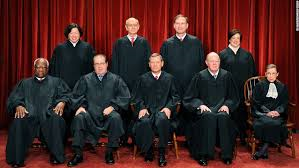
Take a good look at this picture. It shows the nine men and women who have upheld the Affordable Care Act’s federal subsidy provision.

The U.S. Supreme Court has protected health insurance for an estimated 6.5 million Americans.

But to hear the criticism from the right in this country, you would think these individuals have just destroyed the U.S. Constitution they took an oath to uphold and to interpret fairly and without bias.

Thank goodness for the constitutional provision that allows these individuals to hold lifetime jobs, free of the kind of political pressure that forces elected judges at times to tilt in favor of interests whose job is to put heat on politicians.

The 6-3 ruling crossed ideological lines. Two conservatives — Chief Justice John Roberts and Associated Justice Anthony Kennedy — ruled with the majority. The three dissenters — Justices Clarence Thomas, Antonin Scalia and Samuel Alito — held firm in their belief that the ACA violates the Constitution.

Six justices voted for the ACA; three of them voted against it.

Majority rule wins, yes?

Republican presidential candidates went ballistic. Mike Huckabee called the court majority “judicial tyrants.” Ted Cruz threw the “lawless” adjective out there — again.

The founders got it right when they made the federal judiciary an unelected branch of government. They intended for federal judges to be free of the pressure that can overwhelm elected politicians. Presidents feel it. Legislators feel it. They are elected to represent us all. We might not like all the decisions they make, but we have recourse: we can vote them out when the next election rolls around.

Not so with federal judges. They are appointed to lifetime jobs. Yes, they are appointed by politicians with particular biases and philosophies. The judges then are subjected to sometimes grueling hearings before the Senate, which has the authority to approve or reject their appointments.

Once they take their seat on the bench, though, all bets are off.

Occasionally, these appointees evolve into judges that their benefactors — the presidents who appoint them — might not like.

That’s part of the process the founders established.

And the irony of all the outrage being expressed by those who oppose the Supremes’ support of the ACA is that many of those on the right proclaim themselves to be “strict constructionists” of the Constitution. The way I read the Constitution, it states with crystal clarity that federal judges serve for as long as they want — or are able — to do the job.


Your guns are safe … honest

Given that social media commentary becomes part of the public domain once it’s posted, I want to share a thought from a friend of mine who put this out there.

“Is it just me, or did I miss the President saying he wanted to confiscate all guns? No one wants your f****** guns!!!! What I want is a conversation of whether or why gun violence is an epidemic in this country and what we can do about it. For beginners, you folks on the other side need to convince me why adding more guns is the answer. And I’m skeptical about defending yourself from the government, because right now quite frankly some gun owners scare me a helluva lot more than the government. Thanks for listening.”

My friend is a lawyer. He’s a smart fellow — and not just because I happen to agree with him.

Gun-rights advocates keep saying things that aren’t true, starting with their false claims that President Obama wants to take our guns away from us. After that, the lies spin off into fairy tales about martial law, seeking to suspend the Constitution and a conspiracy to get Barack Obama elected to a third consecutive term.

Another friend of mine actually told me — to my face — that he believes the third-term conspiracy actually has merit. I laughed out loud.

My friend’s request is a reasonable one, which is to have a rational conversation about whether there’s a way to stem the flow of guns in our society without doing harm to the Second Amendment, the one that guarantees Americans the right to “keep and bear arms.”

Can’t we have that conversation without the crazy talk that comes mostly from one side proclaiming that it’s all a plot to take away our guns?


Let’s now await high court ruling on gay marriage

Texas Gov. Greg Abbott knows when the Legislature has finished its work and there’s no need for “overtime.”

Thus, he has nixed the idea of a special session to deal with same-sex marriage, which legislative conservatives wanted to do.

To what end? Beats me.

http://www.texastribune.org/2015/06/08/abbott-no-special-session-same-sex-marriage/

Texas already has approved a constitutional amendment that says, by golly, marriage should involve a man and a woman. The amendment came on top of an existing statute that said the very same thing.

Now the stateĀ is awaiting — along with 49 other states — a ruling by the U.S. Supreme Court that well could render all of that action moot. The court is going to decide, more than likely, whether states’ bans on same-sex marriage violate the federal Constitution, the one to which all state governments must adhere.

Texas legislators considered a bill that dealt with religious freedom, a bill that resembled legislation approved in Indiana, but which attracteded a torrent of protest from gay-rights groups. The Indiana bill would have allowed businesses to deny serving same-sex couples on the basis of business owners’ religious convictions. Critics said the bill, in effect, permitted business owners to discriminate openly.

The Texas bill didn’t pass. Legislators, though, did approve a bill that, according to the Texas Tribune says this — and you’ll have to follow it closely to understand it: The bill protects those from being from forced to “solemnizeĀ any marriage or provide services, accommodations, facilities, goods or privileges for a purpose related to the solemnization, formation or celebration of any marriage if the action would cause the organization or individual to violate a sincerely held religious belief.ā€ The bill awaits action from Gov. Abbott.

Hey, all of this could be tossed aside if the high court rules that the 14th Amendment to the U.S. Constitution guarantees every American “equal protection” under the law, regardless of who they love or intend to marry.

I’m pretty sure that covers Texas.


Gay marriage may become campaign issue

Let’s play this out a few moves.

The U.S. Supreme Court is set to decide whether states can ban same-sex marriage. R.G. Ratcliffe, writing for Texas Monthly, thinks the court is likely to rule that statewide bans violate the U.S. Constitution.

So, what happens when county clerks are forced to issue marriage licenses to same-sex couples in Texas?

Do they follow the law? Or do they resign, as was the case over in Roosevelt County, N.M., when that state legalized same-sex marriages.

http://www.texasmonthly.com/burka-blog/social-conservatives-want-special-session-gay-marriage

Suppose, then, that Randall County Clerk Renee Calhoun and Potter County Clerk Julie Smith decide to follow the law. Will they face a stout challenge — likely within the Republican Party, to which they both belong?

Does the gay marriage issue become a campaign wedge issue here in the Texas Panhandle’s two largest counties?

Texas voters some years ago approved a Texas constitutional amendment that reiterated what was already on the books. The state has a statute that declares that marriage must involve a man and a woman. But, by golly, the Legislature referred the amendment to the voters to ensure that they said “Hell yes!” to a ban on same-sex marriage.

I’m betting that Ratcliffe is correct, that the Supreme Court is going to make all of this moot when it rules that the U.S. Constitution’s equal protection clause in the 14th Amendment cannot be violated.

I also am willing to bet that county clerks who issue marriage licenses to same-sex couples are going to face serious challenges in their next campaign for re-election.

Who would think a campaign for county clerk could be so, um, tumultuous?