Tag Archives: Capitol Hill

Mueller pick enables Congress, POTUS to get back to work

One of my first takeaways from today’s blockbuster news about the appointment of a special counsel to probe the “Russia thing” suggests that Congress and the president can get back to actual work.

You know … governing!

Robert Mueller is going to lead the investigation into whether Russia colluded with the Trump campaign to influence the 2016 election; he’ll look at whether Donald Trump asked former FBI director James Comey to shut down a probe into former national security adviser Michael Flynn’s Russia connection; he might even find some other things we haven’t even thought of … yet.

You’ll recall that a former special counsel, Kenneth Starr, was tasked initially with examining a real estate deal involving Bill and Hillary Clinton and discovered that the president was having an “inappropriate” relationship with a young White House intern. The rest became history.

Mueller, himself a former FBI director, is an excellent choice to lead this probe. I give Deputy U.S. Attorney General Rod Rosenstein high praise for making this choice.

Senators, House members and the president now can get back to arguing over some other things: health care, tax reform, infrastructure, immigration matters, North Korea, Syria, NATO.

We can argue ourselves hoarse over the merits of what Donald Trump wants to do. I don’t mind that debate continuing at full throttle.

This Russia matter and all its tendrils have strangled the government. For his part, Trump has made a mess of just about everything he has touched. Congressional leadership hasn’t acquitted itself much better, either.

Yes, House and Senate committees will continue to examine the “Russia thing” along with whatever Mueller uncovers. Let them pursue their charter as prescribed by congressional rules.

The rest of the House and the Senate — along with the guy who is president of the United States — ought to concentrate more fully on what they were sent to Washington, D.C., to do.

That is to govern.

Is Rep. Chaffetz the GOP answer man on impeachment?

Given that I am a red-blooded American male, which means that I am wrong a good bit more than I am right, I will advance this notion with some trepidation.

U.S. Rep. Jason Chaffetz could emerge as the stand-up congressional Republican who gets his GOP caucus members to see the unvarnished truth behind the president of their party.

Donald J. Trump might be in some serious political trouble with what we’re hearing now about what he allegedly “asked” FBI Director James Comey to do; he reportedly suggested that Comey shut down an investigation into national security adviser Michael Flynn’s ties to Russian government officials.

Obstruction of justice, anyone?

So, where does Chaffetz fit into all of this?

He chairs the House Government and Oversight Committee. He has announced he will not seek re-election to his Utah congressional district seat in 2018. He is a lame duck. He has no more pandering to do to get elected. He need not worry about his “base” of supporters.

Chaffetz said this week he is preparing to ask to see a memo that Comey wrote after meeting with the president shortly after Trump fired Flynn from his national security adviser job. The memo reportedly is part of a meticulous paper trail that Comey has left that details conversations he had with the president.

There could be much more to this than we know about already. Chaffetz might want to see all that Comey wrote down and which now is in the FBI files, presumably locked away somewhere inside the J. Edgar Hoover Building. If the FBI has its former director’s memoranda, then it belongs to the public. Chaffetz, therefore, would seem to be entitled to see them as a representative of a committee charged with examining “government operations.”

Chaffetz is set to chart a new life for himself away from Congress. The timing of these revelations — and of the chairman’s decision to step away from the House — suggest to me that Chaffetz has far less to lose politically than other congressional leaders who have been unable or unwilling to take decisive action against the president.

Mr. Chairman, are you up to the task of rooting out the truth, no matter where it leads?

GOP now reaping what it has sown

John Boehner was angry, man. He was furious when he took the floor of the U.S. House of Representatives.

The Republican congressman from Ohio was furious that Democrats had pushed a bill that sought to reform health care without even reading the massive piece of legislation.

He bellowed, blustered and berated his “friends” on the Democratic side of the floor for shoving this bill down the throats of their Republican colleagues.

Boehner’s anger was righteous.

The Affordable Care Act became law in 2010. Boehner would eventually become House speaker. He would file a lawsuit to get the law repealed. Speaker Boehner, though, bailed on public service after continuing to fight with the TEA Party wing of his Republican House caucus. He’d had enough.

Then the 2016 election occurred. Donald J. Trump was elected president. He promised to “repeal and replace” the ACA. This past week, the GOP-controlled House approved a bill we’ll call “Trumpcare.” It’s an alternative to the ACA. It passed by just four votes out of 430 cast in the House.

But wait! Did the GOP leadership know what was in the bill? Did they read the legislation? Did their GOP caucus members read it? Do they know all the nuts and bolts of it?

Hah! Hardly.

They’ve repeated the sin of their colleagues. Does it make their effort to “shove it down Democrats’ throats” any more palatable? Not in the least.

Instead, GOP House members are hearing loud and clear from their constituents a ringing message: The folks back home don’t like what they’ve passed and what they have foisted onto the Senate for its consideration.

Meanwhile, the president who has crowed about keeping his campaign pledge now has to persuade the Senate to follow the House’s lead. Trump, the guy with zero government experience or knowledge of how it works on Washington, D.C., is going to recieve yet another lesson in how Congress just doesn’t do the president’s bidding whenever he barks the order.

And those Republican members of the House of Representatives who voted for Trumpcare are going to get a taste of what they sought to deliver to Democrats in 2010.

Payback truly is a bitch … you know?

Talk to us, Rep. Thornberry

The fellow who represents me in Congress has made his point pretty clear: He doesn’t intend to conduct “town hall meetings” with constituents during these lengthy congressional breaks.

I beg to differ with Rep. Mac Thornberry’s reluctance to speak to groups of his constituents.

The Clarendon Republican lawmaker has just voted to repeal the Affordable Care Act and to replace it with a Trumpcare version of health care overhaul.

Congress is taking some time off. Its House members and senators have fanned out across the land. Some of them are facing their critics, namely their constituents, who are questioning them about their votes in favor of Trumpcare. Rep. Thornberry, to my knowledge, hasn’t scheduled any such public events.

He ought to rethink his schedule.

Do I expect him to get a dressing down from angry 13th Congressional District constituents? Well, I don’t know. He is considered a lead-pipe cinch for re-election in 2018; his district is as reliably Republican as any in the country. Then again, other GOP House members who are equally safe and secure have been getting pounded by their constituents.

I actually want to applaud those Republicans who have voted for Trumpcare to stand before their “bosses” and explain themselves. I think much less of those who have chosen other pursuits while they are at home, ostensibly tending to “constituent business.”

Thornberry’s been in Congress for a long time now. He took office in 1995. He chairs the House Armed Services Committee. He’s got a big job. He once led a GOP effort to come up with ways to protect us against cyber-crime. I’m hoping whatever he came up with is being employed by our spooks to protect our national security secrets against hackers from, oh, Russia!

However, health care is on people’s minds these days. Even, perhaps, out here in the 13th Congressional District.

We’ve been represented in Congress by someone who has aligned himself with those who want to throw out the Affordable Care Act. The Trumpcare replacement well could cost a lot of Thornberry’s constituents their health insurance.

I believe he owes them a thorough explanation of why he cast one of the House’s “yes” votes.

Cheers have ‘Mission Accomplished’ ring to them

All that back-slapping and high-fiving at the White House today seems a bit premature — to say the very least.

Congressional Republicans sauntered down from Capitol Hill to the White House to congratulate themselves for approving a measure that repeals the Affordable Care Act and replaces it with the American Health Care Act.

“Today we made history by taking the first important step toward rescuing hardworking families from the failures and skyrocketing costs of Obamacare,” House Majority Whip Steve Scalise,  R-La., said in a statement.

They all are members of the House of Representatives. The bill, which passed 217-213 — with zero Democratic votes — now must go to the Senate, where their fellow Republicans are sending signals that the House bill is dead on arrival. It’s a goner. The Senate is going to craft an entirely different bill.

As The Hill reported: “The bill, known as the American Health Care Act, repeals the core elements of ObamaCare, including its subsidies to help people get insurance coverage, expansion of Medicaid, taxes and mandates for people to get coverage.

“In its place, the bill provides a new tax credit aimed at helping people buy insurance, though it would provide less help than ObamaCare to low-income people.”

The Hill also reported: “The measure is expected to undergo a major overhaul in the Senate, especially on the Medicaid front, where several Republican senators from states that accepted the expansion are wary of cutting it off.”

Cheers are quite premature

I was reminded of another celebratory moment in recent U.S. history.

It was in 2003 and President George W. Bush flew onto the deck of an aircraft carrier, jumped out of the jet aircraft wearing a flight suit, changed his duds and then delivered a speech under a banner that declared “Mission Accomplished.”

The president was saluting the capture of the late dictator Saddam Hussein, who our troops pulled out of a spider hole in which he was hiding. The Iraqi dictator was put on trial, convicted and hanged.

The Iraq War, though, raged on … and on … and on. Thousands of American service personnel were killed and injured for years as they sought to bring the fighting under control.

The “Mission Accomplished” banner was premature in the extreme.

So was today’s GOP cork-popping at the White House.

Get set for next fight over health care overhaul

Congressional Republicans kept their vow to vote — no matter what — on repealing the Affordable Care Act.

It was a squeaker, 217 “yes” votes to 213 “no” votes. Every congressional Democrat voted “no,” which gives the minority a faint claim of bipartisanship, as some moderate Republicans joined them in voting against the Trumpcare health bill.

I want to make only a couple of observations about this effort.

First, Republicans yapped and yammered that Democrats shoved the ACA down the GOP’s throats in 2010. The GOP response was to do precisely the same thing to Democrats. Payback is a bitch, right?

The GOP throat-shoving, though, took on a little different tone than what the Democrats did in 2010. President Obama tried to get Republicans to sign on, but was unsuccessful. Donald J. Trump didn’t make that effort; neither did House Speaker Paul Ryan. Oh, no. They relied on their healthy Republican majority to win the day — barely, it turns out — in a now-or-never vote on the House floor.

Second, the initial effort to repeal the ACA and replace it with the American Health Care Act, ran into a Congressional Budget Office “score” that told a grim story of 24 million Americans losing their health insurance under the new plan.

This time the GOP didn’t bother to wait for the CBO to “score” this latest rendition of the replacement bill. Republicans forged ahead anyway. Damn the scoring! Who needs to know how this is going to affect Americans?

Oh, and the polls around the country indicate a growing base of support for the ACA. Hmm. Imagine that. The House of Representatives isn’t exactly representing its constituents.

The AHCA now heads to the Senate, where it faces an even steeper climb than it had in the House. The GOP majority in the upper chamber is pretty skimpy and the Republicans cannot afford to lose any support among their ranks. The initial signs don’t look good for final approval in the Senate.

House Republicans sought to win over reluctant conservatives by sweetening the pie for them; then they assuaged some moderate GOP concerns by tossing in some money to pay for those with pre-existing medical conditions.

What say you, senators?

Now it falls on the Senate to decide what to do with this legislation that doesn’t yet have any analysis on how much it will cost and how many Americans might lose their insurance.

Meanwhile, House Republicans are back-slapping each other like crazy. They said they’d cast that vote to repeal President Obama’s signature domestic achievement.

They got the job done. Now they can go home for their 11-day recess. I would bet real American money they’re going to run into a good bit anger among the home folks.

Who needs analysis of ACA repeal bill? Not the GOP

Did I hear this correctly?

Congressional Republicans are pushing a vote on a measure to repeal and replace the Affordable Care Act without knowing the “score.” Is that right? I guess it is. That’s what the “enemy of the American people” media are reporting.

Republicans got themselves into a jam the first time they tried to repeal the ACA when the Congressional Budget Office delivered some bad news about the American Health Care Act: The AHCA, according to the CBO, would toss about 24 million Americans off their health insurance programs.

That frightened enough Republican congressmen and women to forestall a vote on a repeal/replace measure.

So, the GOP leadership found a way around that. They made the new repeal/replace law more drastic than the previous one and have scheduled a House vote before the CBO has a chance to “score” it.

The conservative Freedom Caucus, which bucked the original bill, is now on board. Moderate Republicans, meanwhile, are the wild card in the vote that’s coming up.

Democrats? They hate this bill even more than the first one. They’re out. Forget about the Democrats.

Memo to GOP leaders: This is not how you build a “good government” environment.

To think, too, that Republicans were just furious that Democrats allegedly tried in 2010 to shove the Affordable Care Act down Republicans’ throats.

Who’s angry now?

ACA repeal vote illustrates what is wrong with Congress

Americans are now scheduled to receive an up-front view of what is so terribly wrong with their U.S. House of Representatives.

It is a body that doesn’t represent the nation. It represents political dogma.

House members are slated to vote Thursday morning on a repeal of the Affordable Care Act; yes, the vote also will include provisions on a replacement for the ACA.

Look at the polls, pols

Congress is dysfunctional in the extreme! Why? Because poll after poll shows that Americans support the ACA. Yet the Republicans who control the House — and the Senate — are hell bent in their determination to do away with it.

The vote Thursday won’t have any Democratic support and a few moderate Republicans are going to vote against the ACA replacement option. What we are seeing here is continuing fallout from enactment of the ACA in the first place. Congress enacted the ACA in 2010 with zero Republican support. Democrats had to go alone on this deal — despite concerted efforts from the White House to persuade Republicans to join in the effort to provide health insurance to Americans who couldn’t afford it.

Congressional Republican leaders said, “No way, man.”

Here we are, seven years down the road. President Obama is out of office. Republicans now control both congressional chambers and the White House. Has the new president sought to work with Democrats to bring them aboard? Umm. Nope.

Yet the congressional leaders have decided to blow the ACA apart because they contend it is a “disaster.” It isn’t. Independent analyses suggest that the ACA is continuing to stabilize and that Americans are signing up for health insurance.

Is it perfect? No. Premiums are still too costly. Insurance providers have bailed out.

I’m at a loss as to why Republicans cannot concede that much of the ACA is worth keeping, but that they could improve certain elements in it.

It can be mended without ending it, correct? Isn’t that how you legislate? You work with lawmakers from across the aisle, seek some common ground and then hammer out differences. Legislating is a complicated process at times. Providing health insurance for Americans has proved to be among the most complicated and contentious exercises we’ve ever witnessed.

OK, so here we go. House members will vote Thursday. The GOP leadership concedes the vote will be razor thin. If repeal fails Thursday morning, then the Republicans have nowhere else to go.

Once the details of the replacement legislation becomes more widely known, my trick knee tells me that our Republican congressional leaders are going to get a snootful from their constituents. Many of them have heard already at those raucous town hall meetings that voters are none too happy with what is likely to take place on Capitol Hill.

Yep. This is how you describe government dysfunction.

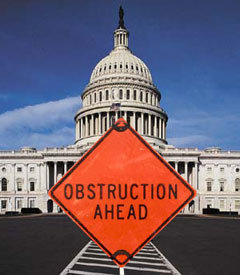
Hey Dems, don’t be obstructionists, too!

I’ve spent a lot of emotional energy with this blog bashing congressional Republicans for what I believe has been their obstructionist habits as they dealt with a Democratic president, Barack H. Obama.

My sense of fairness compels me to instruct congressional Democrats to avoid following their GOP colleagues’ lead as they now must deal with a Republican in the White House, Donald J. Trump.

I understand that the roles aren’t entirely parallel.

For much of Obama’s time as president, Republicans controlled at least one congressional chamber. They took control of the entire Capitol Building after the 2014 elections. I remember, too, when Sen. Mitch McConnell, then the minority leader, declared his No. 1 priority was to make Obama a “one-term president.”

The GOP fought the president along every step. Republicans opposed the president’s economic stimulus package right out of the chute in 2009; they opposed the Affordable Care Act; they — along with a handful of Democrats — resisted calls for new laws on guns even after the Sandy Hook Elementary School massacre of 20 first- and second-graders.

The GOP now controls Congress and the White House.

What’s left for Democrats? They’re angry (a) over the way Republicans treated Barack Obama and (b) that they lost the 2016 election that every pundit in the country seemed to think was in the bag for them.

Is obstructionism the way to go? No. For one thing, Democrats are operating from a much weaker position this time than Republicans had when Barack Obama took office.

Still, some congressional Democrats are insisting that they intend to block the president and his fellow Republicans in Congress. They don’t intend to work with their “friends” on the other side. Some Democratic lawmakers have declared their intention is to ensure that Trump gets impeached.

Government isn’t supposed to be an ideological battleground. It’s supposed to serve the people whose votes put politicians in office. There surely ought to be ways for Democrats can look for common ground with Republicans. Need they surrender their principles? Not any more than Republicans should surrender theirs.

I feel as though I should remind Democrats — just as I reminded Republicans during the Obama years — that many of us out here want government to be a functioning body. We want government to enact smart legislation. We insist that members of the House and Senate hue to the principle of good government.

And good government, by definition, means that it works on behalf of those of us who pay for it.

Wishing for days of ‘pork barrel’ bickering

My late mother had a retort when I would say, “Mom, I’ve been thinking.”

“Oh, beginner’s luck?” she would ask … rhetorically.

I’ve had a rash of beginner’s luck lately. I’ve been thinking about the good ol’ days of politics in Washington, D.C., when we used to single out politicians who had this habit of being champions for “pork barrel spending projects,” or those projects that benefit a specific area.

These days, worries about pork barrel spending has given way to rank ideology, where one side calls the other side “evil.” Liberals think conservatives have evil intent; the feeling is quite mutual coming from the other side.

Frankly, I prefer the old days when politicians used to bitch at each other because of all the money they funneled to their states and/or their congressional districts.

The former Republican U.S. senator from Texas, the loquacious Phil Gramm, used to boast about all the “pork” he brought home. “I’ve carried so much pork back to Texas,” he would say, “I think I’m coming down with trichinosis.”

Gramm, though, was a piker compared to some of his Senate colleagues. The late Democrat from West Virginia, Robert Byrd, was known as the king of pork barrel spending. He would attach riders onto amendments to bills that had dough for this or that federal project. As a result, Byrd’s name is on more buildings and bridges in West Virginia than one can possibly imagine.

However, is pork barrel spending a bad thing?

Look at it this way: Politicians do what their constituents want them to do. That’s the nature of politics in a representative democracy, as near as I can tell. We elect pols to represent our interests. If it means carving out a few bucks for this project or that back home, well, then that’s what we send them off to do for us.

These days we hear from rigid ideologues in the U.S. Senate and House. Texas’ two senators — Republicans Ted Cruz and John Cornyn — offer prime examples. One won’t likely accuse Cruz especially of being loaded down with pork; he’s too busy promoting rigid conservative ideology to worry about rebuilding highways and bridges back home in Texas; Cornyn, too, has this leadership role among Republicans in which he seeks to elect more of them to the Senate.

The House features much the same sort of ideology. My congressman, Mac Thornberry, R-Clarendon, once criticized President Obama for considering air strikes against Syria; then he praised Donald J. Trump for doing that very thing. Thornberry isn’t the least bit interested in pork barrel spending, which seems to fit the desires of his constituents; if they insisted on him bringing home more money to the 13th Congressional District, my hunch is that he’d do their bidding.

Where am I going with this?

I guess I’m trying to suggest two things.

One, I long for a return to the late House Speaker Tip O’Neill’s maxim that “all politics is local.” Why not argue the merits of this or that spending program and whether our member of Congress — in the House or Senate — is doing what we want him or her to do on our behalf?

Two, let’s quit the purely ideological battles and demonization of each other just because they happen to be of a different stripe. From where I sit, I still consider good government to be a team sport where each team respects the other side.