Tag Archives: Mitch McConnell

Justice Sandoval, anyone?

sandoval

You’ve got to hand it to the White House media machine.

It puts out a report that has Washington all a-flutter, even if it appears to be the longest of long shots.

Or is it?

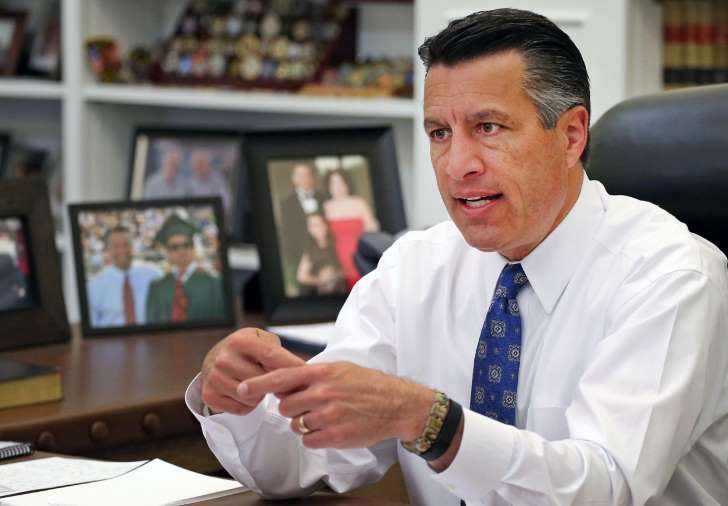
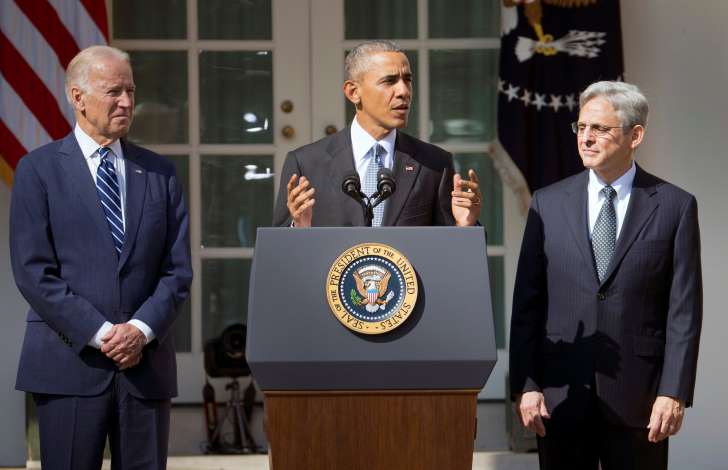
Nevada Gov. Brian Sandoval is being considered for that coveted spot on the U.S. Supreme Court.

Two things about Sandoval make this a remarkable consideration.

One: He is a former U.S. district judge whom the Senate confirmed overwhelmingly.

Two: He is a Republican.

Sandoval being vetted

It’s the second part of Sandoval’s resume that is most intriguing.

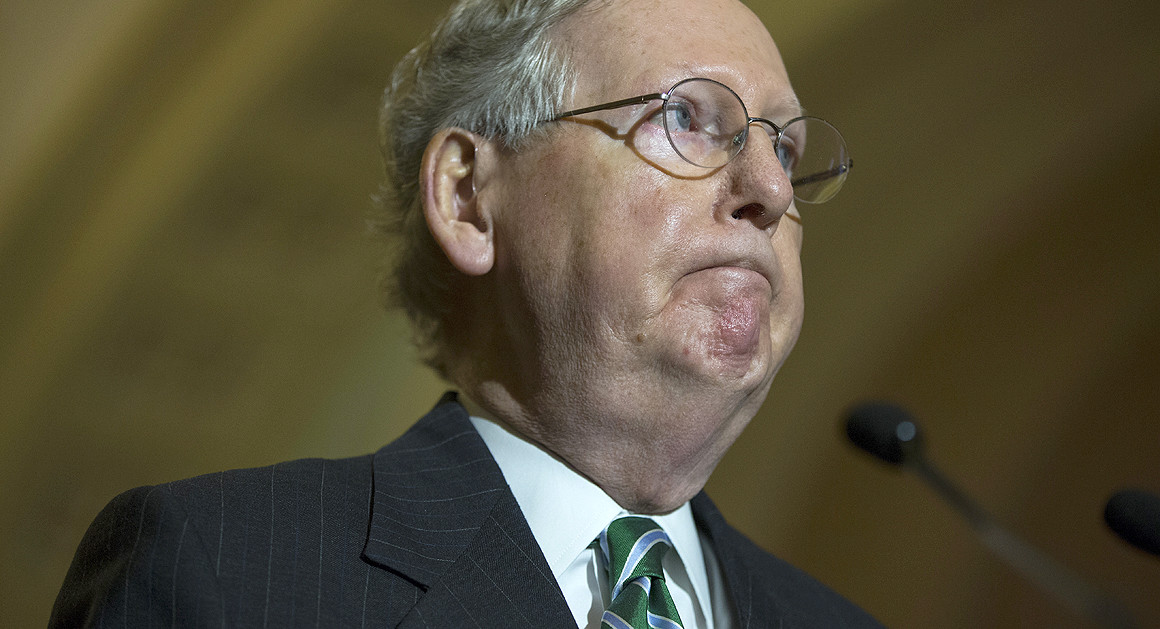
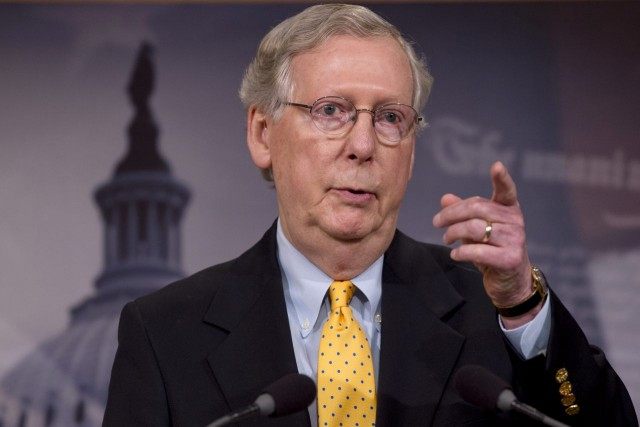
GOP senators, led by Majority Leader Mitch McConnell, have said they won’t consider anyone for the spot that President Obama wants to fill to replace the late Justice Antonin Scalia.

But are they really and truly going to slam the door shut on one of their own Republicans, someone they’ve endorsed already for a lower court post?

Sandoval is reportedly a moderate Republican. That, of course, doesn’t fit the profile desired by so many of the hard-right senators who will have to vote on whomever the president selects.

The chatter already has suggested that the president is going to nominate a centrist. He’ll forgo an ideological battle in order to get someone seated.

Gov. Sandoval is a long way from being nominated, let alone being considered for the job.

It makes me wonder: Is the president trying to stick it in the ear of the folks with whom he’s been fighting throughout his entire presidency?


Americans have already decided who gets to choose

Senate Majority Leader Mitch McConnell, R-Ky., center, is joined by, from right to left, Majority Whip John Cornyn, R-Texas, Sen. John Thune, R-S.D., Sen. John Barrasso, R-Wyo., and Sen. Roger Wicker, R-Miss., as he speaks with reporters following a closed-door policy meeting on Capitol Hill in Washington, Tuesday, Feb. 23, 2016. The Senate will take no action on anyone President Barack Obama nominates to fill the Supreme Court vacancy, Senator McConnell said as nearly all Republicans rallied behind his calls to leave the seat vacant for the next president to fill. His announcement came after Republicans on the Senate Judiciary Committee ruled out any hearing for an Obama pick. (AP Photo/J. Scott Applewhite)

What part of the American electoral process don’t U.S. Senate Republican leaders understand?

Majority Leader Mitch McConnell said “the American people should decide” who gets to make the next appointment to the Supreme Court.

Texas Sen. John Cornyn of Texas, a member of the Senate Judiciary Committee, has echoed that sentiment.

McConnell said the Judiciary Committee will not conduct any hearings to decide whether to confirm whomever the president nominates. It’s malarkey, man.

OK, this isn’t an original thought, but it’s the best one I can come up with.

Americans already have decided who gets to fill the vacancy created by the sudden death of Justice Antonin Scalia. They decided it in two presidential elections.

Barack H. Obama won them both. He won the 2008 election by nearly 10 million votes; he was re-elected in 2012 by nearly 5 million votes.

Both times the young man gave every indication he would find someone to sit on the court with whom he — as a progressive Democrat — was ideologically comfortable. Two of his picks, Sonia Sotomayor and Elena Kagan — already have taken their seats on the court.

He gets to nominate a third individual to succeed Justice Scalia.

Yeah, he’s a “lame duck.” What difference does it make? None. He’s still the president. The Senate is still functioning.

So … let the president propose and let the Senate dispose.

Senators can stop hiding behind the cheap canard that the “American people” deserve a voice.

The people’s voice has been heard. Twice!

It’s all about the court balance

90

President Obama picked up the phone today and made a couple of important calls.

One of them went to Senate Majority Leader Mitch McConnell; the other went to Senate Judiciary Committee Chairman Charles Grassley. Both men are Republicans. The president is a Democrat.

The president informed the senators he intends to make a pick for the U.S. Supreme Court. And, according to White House press secretary Josh Earnest, Sens. McConnell and Grassley both voted in favor of President Reagan’s “lame duck” selection of Anthony Kennedy to join the court in 1988, which was just as much of an election year as 2016.

McConnell, though, says the current president should notpick the next justice. That task belongs to the next president, he said.

What has changed?

It’s the balance of the court. It means everything. Every single thing.

You see, the late Justice Antonin Scalia, the man Obama wants to replace, was a conservative stalwart on the court. The president is not a conservative; therefore, his appointee won’t echo the judicial philosophy of Justice Scalia.

The next justice — if he or she is approved by the current Senate before the end of this year — is likely to change the fundamental balance of the court, which has comprised a thin conservative majority.

Senate Republicans don’t want the court balance to change. They’ll do whatever they can to prevent the president from making the pick.

There’s just this one little issue that, by my way of thinking, should matter more than anything else. The Constitution grants the president the authority to make the appointment, which this president said he’s going to do. It also grants the Senate the authority to vote whether to approve or deny the appointment. It doesn’t require the Senate to act.

If the Republican-controlled Senate is going to stymie the president, then it faces a serious charge of obstruction. Senate Republicans keep denying the obstructionist label.

A failure, though, to act in a timely fashion on this appointment gives even the casual observer ample cause to suggest that, by golly, we have just witnessed a case of political obstruction.

If the president selects someone who is eminently qualified and who has a proven record of judicial moderation — which conservatives still will see a serious break with the conservative judicial record built by the late Justice Scalia — then shouldn’t the Senate give that nominee a fair hearing and a timely vote?

I would say “yes.” Without equivocation.


It’s wrong now … and was wrong then

Sen. Chuck Schumer, D-N.Y., expresses his dismay at Russian Vladimir Putin leader granting asylum to American secrets leaker Edward Snowden, at a news conference at the Capitol in Washington, Thursday, Aug. 1, 2013. Defying the United States, Russia granted Edward Snowden temporary asylum on Thursday, allowing the National Security Agency leaker to slip out of the Moscow airport where he has been holed up for weeks in hopes of evading espionage charges back home. (AP Photo/J. Scott Applewhite)

I believe it was that great fictional Native American sidekick — Tonto — who said to the Lone Ranger, “Two wrongs don’t make a right.”

Thus, it amuses me when I hear critics of this blog and others take note of Democratic U.S. Sen. Chuck Schumer’s declaration in 2007 that the Senate shouldn’t approve any of President Bush’s Supreme Court appointments.

They bring that up to — more or less — justify a statement by Republican U.S. Sen. Mitch McConnell to do the same thing regarding the vacancy on the U.S. Supreme Court.

If Schumer can make a wrongheaded declaration then it’s OK for our guy to do it, they seem to suggest.

Schumer was wrong then and McConnell is wrong now.

Neither man has distinguished himself on this matter of constitutional authority and presidential prerogative.

So, Schumer’s assertion in 2007 got past me. He absolutely was wrong to say what he said. The U.S. Constitution gives presidents the authority to make appointments to the federal bench and I’ve long given deference to the presidents’ prerogative on these issues. If the president nominates a qualified individual to these posts, then the Senate should grant the appointee a fair hearing — and then vote.

George W. Bush was re-elected in 2004 with voters knowing he would appoint conservative judges to the federal courts. His final Supreme Court appointment came in 2006 when he selected Samuel Alito. Thus, Schumer’s ill-advised admonition a year later became a moot point.

It doesn’t give Senate Majority Leader McConnell any license to erect barriers to the current president doing what he was re-elected to do.


Mitch McConnell: chief obstructionist

Supreme-Court-blue-sky

Mitch McConnell declared out loud and in public shortly after Barack Obama became president that his top priority would be to make Obama a “one-term president.”

His wish went unfulfilled when the president won re-election in November 2012.

Now that McConnell is the Senate majority leader, he’s made another pledge. He is going to oppose the president’s next appointment to the U.S. Supreme Court.

Does he know who the president will nominate? No. Does he have any inside information on Obama’s short list? Again, no.

But without the faintest idea who the president will select, the Senate’s leading Republican is going to obstruct the president. He vows to prevent the president from doing what the Constitution empowers him to do. For that matter, he and other Republicans are going to prevent the Senate from doing what the Constitution requires of that body.

Obama is going to nominate someone to replace the late Antonin Scalia on the U.S. Supreme Court. He’s entitled to put someone forward. The Senate also has the power to consent to the nomination.

There’s much that boggles the mind about the eruption that has occurred since Scalia’s untimely death. I cannot quite rank them in order, but McConnell’s declaration that he intends to block any nomination to be considered must rank near the top.

Yes, the stakes are huge. The president is a liberal/progressive politician who likely will select someone who is a good bit to the left of the man who led the Supreme Court’s conservative movement. Thus, Senate conservatives are vowing to protect their court majority — as best they can — by seeking to hold up this confirmation until after the November election. Their hope is that a Republican will win the presidency.

We have a president with one year left in his term. As they say, elections have consequences. A majority of Americans re-elected President Obama understanding full well how he would fill a vacancy on the highest court in the land if he was given the chance to do so.

He now has that chance.

Meanwhile, the nine-member high court has been reduced to eight members. The even split among the justices could produce some tie votes on key cases yet to be argued before the court.

This is not good governance.


Election-year vacancies . . . all the rage

ap_mitch-mcconnell_ap-photo9-wi-640x427

As long as we’re talking about filling a Supreme Court vacancy during an election year . . .

Republican senators don’t want to consider a potential nominee who’ll be offered by President Obama. They want the next president to send someone for their consideration. Barack Obama is a “lame duck,” they say.

The last lame-duck president to send a nominee to the Senate was Ronald Reagan. The Senate confirmed Anthony Kennedy to the Supreme Court in 1988.

So, you might be asking: Is it a common occurrence for the president to send a Supreme Court nominee to the Senate during an election year, lame-duck status or not?

I looked it up. Here’s what I found.

Franklin Delano Roosevelt nominated Frank Murphy, who was confirmed in 1940.

Dwight Eisenhower recommended William Brennan; the Senate confirmed him in 1956.

Richard Nixon sent two nominees to the Senate during an election cycle: Lewis Powell and William Rehnquist; the Senate confirmed them in 1972.

Let’s go back a bit farther. William Howard Taft nominated Mahlon Pitney, who was confirmed in 1912. Woodrow Wilson nominated Louis Brandeis and John Clarke, both of whom were confirmed in 1916.

This election-year moratorium nonsense being promoted by the likes of Senate Mitch McConnell and other Republicans should be revealed for what it is: a cheap political ploy to deny a Democratic president the opportunity to fulfill his constitutional duty.

Granted, all the examples I cited here — except for President Reagan’s nomination of Justice Kennedy — do not involve “lame duck” presidents.

The phoniness of McConnell’s desire to block any attempt by Obama to fill a vacancy created by Justice Antonin Scalia’s tragic death is transparent and obvious, given what has transpired in the past 100 years.

How about allowing President Obama to do the job to which he was elected twice to perform?


Sen. McConnell then . . . and now

Supreme-Court-blue-sky

A colleague and acquaintance of mine has shared an item on social media that I’d like to share here.

It comes from Senate Majority Leader Mitch McConnell who in 2005 made a fascinating point about defending the right of presidents to make appointments to the federal judiciary.

It states:

“The Constitution of the United States is at stake. Article II, Section 2 clearly provides that the President, and the President alone, nominates judges. The Senate is empowered to give advice and consent. But my Democratic colleagues want to change the rules. They want to reinterpret the Constitution to require a supermajority for confirmation. In effect, they would take away the power to nominate from the President and grant it to a minority of 41 Senators.”
“[T]he Republican conference intends to restore the principle that, regardless of party, any President’s judicial nominees, after full debate, deserve a simple up-or-down vote. I know that some of our colleagues wish that restoration of this principle were not required. But it is a measured step that my friends on the other side of the aisle have unfortunately made necessary. For the first time in 214 years, they have changed the Senate’s ‘advise and consent’ responsibilities to ‘advise and obstruct.'”

Interesting, yes?

Well, 11 years later, the majority leader himself is proposing to “advise and obstruct” by seeking to delay a presidential appointment to the U.S. Supreme Court until after the November general election that, McConnell hopes, will produce a Republican president.

Well, Mr. Majority Leader, has Article II Section 2 of the Constitution changed?


A major battle now looms

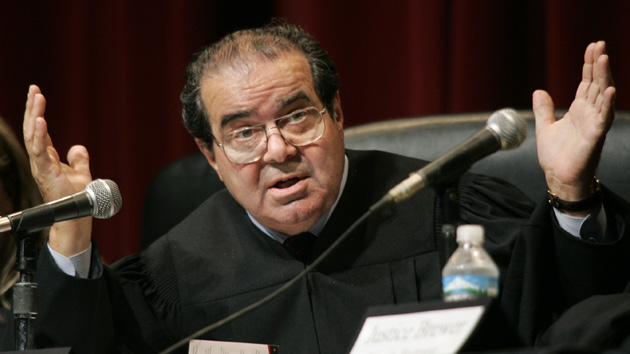
chapman.0830 - 08/29/05 - A Supreme Court headed by Supreme Court Justice Antonin Scalia has questions for Chapman University Law School professor John Eastman as he and California Attorney General Bill Lockyer argue the 1905 ''Lochner v. State of New York'' case during a re-enactment Monday afternoon at Chapman University. (Credit: Mark Avery/Orange County Register/ZUMA Press)
)

Supreme Court Justice Antonin Scalia’s sudden death today has stunned the nation.

As President Obama said this evening, the 30-year member of the nation’s highest court was one of the “most consequential” legal minds of our time.

The president now faces arguably the “most consequential” appointment of his time in office.

To say that Justice Scalia’s passing upsets the ideological balance of the highest court would commit the supreme understatement.

And, oh yes, the partisan divide opened wide immediately upon news of Scalia’s death. Senate Majority Leader Mitch McConnell, a Republican, said the Senate should wait until after Barack Obama leaves office to vote on a replacement; meanwhile, Senate Minority Leader Harry Reid, a Democrat, wants the Senate to act quickly.

Who could have seen that coming?

The president said he’ll make the appointment “in due time.” He wants a thorough, fair hearing and a “timely vote.” As the president — lame duck nor not — Barack Obama deserves the chance to nominate someone of his choosing.

Indeed, the appointment coming from a left-of-center president to fill a vacancy created by the death of a right-of-center Supreme Court justice sets up a huge battle that likely will dwarf any of the many fights Barack Obama has waged already with the U.S. Senate.

The court’s narrow balance has just been shaken to its very foundation.


SOTU won’t fill us with warm, fuzzy feelings

2011_State_of_the_Union

It never really had to be this way.

Barack H. Obama took office in January 2009 as the 44th president of the United States after an election that many had hoped would be a “transformational” political event for a country that had just elected its first African-American president.

Not long afterward, then-Senate Minority Leader Mitch McConnell announced that his top priority would be to make Obama a one-term president. Yes, that’s right. McConnell said that defeating the president’s re-election effort would be his No. 1 priority.

That set the tone — right off the top — for the kind of relationship that the White House would have with Congress.

It hasn’t gotten any better, even as President Obama prepares to deliver his final State of the Union speech to a joint congressional session.

Ugly relationship coming to an end

To be blunt, the president didn’t do his part to develop a good working relationship with Congress. I’ve lamented before how the young president never learned how to build upon those relations with his congressional friends. To be honest, the president arguably served too little time in the Senate to have crafted a lot of friendships and political alliances among his fellow legislators.

I had hoped the president could have followed the Lyndon Johnson model of transferring his Senate experience into effective legislative accomplishment.

He didn’t.

However, Congress made it clear that it had no intention of giving any quarter to the president.

So, the president’s final State of the Union speech — which the White House says will be an “unconventional” presentation — isn’t expected to produce any bright lights of hope for a smooth and successful final year of the Obama presidency.

Republicans almost unanimously say that next to nothing will get done in this final full year of Barack Obama’s administration.

Perhaps, then, it will be left to the president simply to declare victory on the accomplishments that his presidency has delivered.

I’m wondering now if the president is going to remind us that Sen. McConnell’s top priority never came to pass.


Hey Mitch, ‘boots’ are people, too

mitch

Politicians love speaking in code, particularly when the use of direct language makes ’em look, oh, bloodthirsty.

U.S. Senate Majority Leader Mitch McConnell, R-Ky., said this week we need to “put more boots on the ground” in the war against the Islamic State.

Boots on the ground. There it is … yet again!

McConnell is a fine man, a dedicated public servant. I don’t believe he’s a war-mongering chicken hawk, but I wish he could instruct those around him — namely his fellow politicians — to stop speaking in code.

“Boots on the ground” has become the clichĂ© du jour for politicians who lack the guts to say what they really mean. Which is that putting “boots on the ground” means we should “send young Americans into battle.”

I harken back to the protest chant from those who complained that “old men shouldn’t be sending young men into war.”

All this brave talk from politicians about boots seems to gloss over the human cost of fighting these conflicts. Yes, the young men and women who fly combat missions in high-speed, high-performance aircraft put themselves in harm’s way, too — but we don’t hear politicians refer to their deployment as “putting rear ends in cockpits.”

My wife and have toured the Vietnam Veterans National Memorial in Angel Fire, N.M. It features letters written from that battlefield by young men, many of whom died in defense of their country. We came out of the exhibit. My wife was in tears.

“Every politician who decides to send people to war needs to come here first,” she said.

Yes. They also need to stop using euphemisms to tell us what they really intend to do regarding matters that involve young Americans’ precious lives.