Tag Archives: GOP

Congress sees spike in approval rating … what gives?


Given my occasional fascination with public opinion polls, I want to share an observation about RealClearPolitics’ average of polls.

It is that public approval of Congress has spiked up about 10 percentage points since Donald J. Trump became president.

Why is that? I think it’s a legitimate question. I might have the answer, although I could be coming at this from deep left field.

It well might be that the public sees the president of the United States as the greater threat to the nation’s stability. RCP’s average of polls puts Congress’s approval rating at more than 22 percent. During the eight years that Barack Obama was president, the RCP poll average usually pegged Congress’s approval in the low teens, occasionally dipping into single digits.

Might it be that the public saw Congress less favorably during President Obama’s time because respondents were concerned about the continual obstruction orchestrated by the Republican Party leadership?

Moreover, might it now be that the RCP polling reflects a public view that Congress can act as a check against the current president’s reckless rhetoric and fickle policy pronouncements?

Just thinking out loud, dear reader.

Your thoughts?

Get ready for more impeachment talk

Impeaching a president of the United States isn’t for the faint of heart. It requires a stout gut among those who bring it, not to mention the target of such a drastic action.

The bar must be high. It must have a solid basis on which to make such a move.

Where am I going with this? I have this sinking feeling that the current president well might find himself in the crosshairs of those who want to bring such an action against him.

We’re hearing a growing — but still muted — rumbling in D.C. about the prospect of Donald J. Trump facing impeachment by the U.S. House of Representatives. I’m attaching an item from The Hill in which former Labor Secretary Robert Reich — an acknowledged political liberal — has lined out at least four impeachable offense already committed by the president.

Here it is.

Reich says that Trump’s accusation that Barack Obama ordered a wiretap of Trump Tower offices constitutes an impeachable offense, saying the president has recklessly accused his predecessor of committing a felony. He notes that the Constitution prohibits president from taking money from foreign governments; Trump, Reich alleges, has done so by “steering foreign delegations” to hotels he owns. Reich contends that Trump violates the First Amendment’s provision against establishing a state religion by banning travelers from Muslim countries into the United States. Reich also says the First Amendment bans any abridgment of a free press, but Trump has labeled the media the “enemy of the people.”

There’s a fifth potential cause, which Reich has asserted. It involves the possibility that Trump’s campaign colluded with Russian government officials to swing the election in the president’s favor. Reich said such activity, if proven, constitutes “treason.”

Will any of this come to pass? I have no clue.

Think of the politics of it. Trump is a Republican; both congressional chambers are controlled by the GOP. Will the Republican House majority bring articles of impeachment to a vote, no matter how seriousness of whatever charges are considered?

The collusion matter strikes me as the most serious and the most likely to align Republicans along with Democrats in considering whether to impeach the president. I am not suggesting there is, indeed, proof of such collusion.

Remember as well that the GOP-led House managed to impeach a Democratic president, Bill Clinton, in 1998 on three counts relating to his seedy relationship with that White House intern. Conviction in the Senate, though, required a super majority of senators; the GOP fell far short on all three counts. Thus, the president was acquitted.

They based that impeachment on the president’s failure to tell the truth under oath to a federal grand jury that questioned him about the affair. He broke the law, Republicans said. There was your “impeachable offense,” they argued.

My major concern about the Clinton impeachment was whether the president’s offense had a direct impact on his office. It did not. Any of the issues that Secretary Reich lists, however, certainly do have a direct impact on the president’s ability to perform his duties.

The bar for whatever might occur with the current president is set even higher than it was for President Clinton, given that the president and the congressional majorities are of the same party.

You might not believe this, but I do not prefer an impeachment to occur. I do, though, want the unvarnished truth to be revealed about what the president thinks he can do with — and to — the exalted office he occupies.

If the truth is as ugly as some of us fear, then Congress should know how to repair the damage.

AHCA may be DOA in U.S. Senate

Hey! Wait a second!

Didn’t the Republican majority in Congress promise to “repeal and replace” the Affordable Care Act? Didn’t they assure us they would produce a plan that would provide health insurance for Americans at a cost they can afford?

Wasn’t that their solemn pledge? Didn’t they all but guarantee it once they won the presidency and retained control of both chambers of Congress?

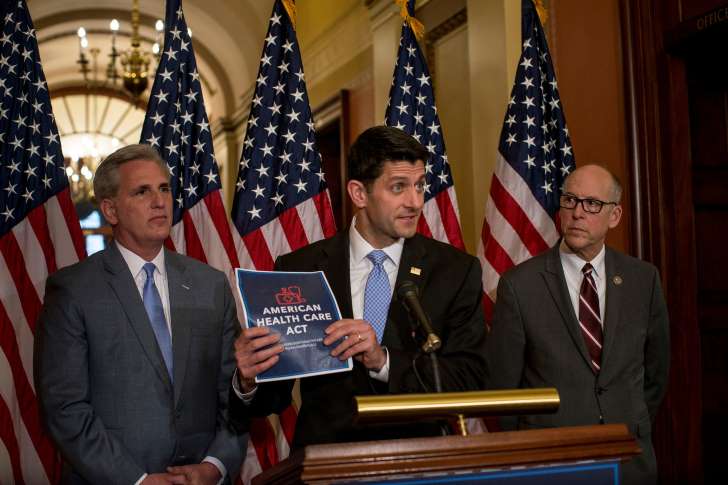
Hah! Guess again. It seems that the American Health Care Act that the GOP rolled out this week doesn’t go far enough, according to the TEA Party wing of the Republican Party. They might launch a big intraparty fight to derail the AHCA.

These right-wingers are making GOP moderates look better all the time.

House Speaker Paul Ryan assures us that he’ll get 218 votes to approve the AHCA. The problem appears to be in the Senate, which has a very small margin for error among GOP senators. Only three of them need to bolt to drive the whole health care overhaul into the ditch.

There appears to be a rebellion building.

As I look at the proposed legislation, it seems to resemble the Affordable Care Act at some level. It does do away with the “mandate” provision that would penalize Americans who fail to have health insurance. It emphasizes tax credits for Americans seeking to buy insurance.

Some Senate GOP moderates don’t like it, either. There also are the conservatives who want the ACA to be repealed fully and that the AHCA doesn’t wipe the ACA off the face of the planet.

I am one who won’t be disappointed if this GOP overhaul doesn’t work. While I understand that the ACA needs tinkering, some fine-tuning, I would say only that we should simply tinker and fine-tune what we have on the books.

Oh, man … the great Winston Churchill had it right when he declared that democracy was the “worst form of government” ever devised — but was better than anything else.

If only he were around today to watch the U.S. Congress tie itself in knots over this health care insurance matter.

AHCA to replace ACA … at what cost?

Finally, the Republicans who run the legislative branch of government have produced a replacement plan for the Affordable Care Act.

I will need some time to digest all of it. It’s a complicated issue, one that requires a lot more brain wattage that I can generate at the moment.

It’s called the American Health Care Act. It’s supposed to be better than the ACA — and no, I won’t refer to the ACA by its colloquial name that attaches it to the name of the 44th president of the United States.

Complications abound with AHCA.

It removes the government mandates that require citizens to have health insurance; it relies heavily on tax credits to enable Americans to purchase insurance; it doesn’t monkey around with pre-existing conditions; it allows young people to stay on their parents’ health insurance plans.

The big question? Its cost.

How will Congress pay for this new program? We haven’t yet heard that explanation.

President Obama has said he’d welcome changes to the ACA that improve it. Yes, we now have a replacement idea on the table. It took Republicans eight years to come up with this alternative. They yapped and yammered during the two terms of the president’s tenure about how “terrible” the ACA was for health care, while pledging to repeal it once they got one of their own into the White House.

Here we are.

The debate will go forward now on whether the AHCA is better than the ACA.

The bottom line — for me, at least — is whether the 20 million or so Americans who now have insurance will be able to keep it at a cost they can afford.

George W. Bush gets back into the game

Welcome back to the political arena, Mr. President … even if you remain on the edges of it.

George W. Bush, who maintained stone-cold silence during Barack Obama’s presidency, has now decided to weigh in on some of the issues dogging the current occupant of the White House.

He is being a gentleman about it, but one cannot help but believe that his genteel approach to criticism masks an attitude with a bit more bite.

NBC’s “Today” host Matt Lauer interviewed the 43rd president this morning. Bush made quite clear that he disagrees with Donald J. Trump’s view that the media are “the enemy of the people” and that the war against terrorists isn’t a war against Islam.

The former president had made a pact that he wouldn’t criticize President Obama. He said the job of being president is difficult enough without former presidents weighing in with their own view of how to run the country. If Obama wanted his help, Bush said he could pick up the phone, call and ask for it.

As National Public Radio reported: “Lauer noted that President Bush — who took the country to war in Iraq and who presided over an economic crisis — faced plenty of criticism from the media while in office. Lauer asked Bush, ‘Did you ever consider the media to be the enemy of the American people?’

“Bush chuckled and then answered: ‘I consider the media to be indispensable to democracy. We need an independent media to hold people like me to account. Power can be very addictive. And it can be corrosive. And it’s important for the media to call to account people who abuse their power, whether it be here or elsewhere.'”

As for Trump’s assertion that the enemy are “radical Islamic terrorists,” Bush said: “You see, I understood right off the bat, Matt, that this is an ideological conflict, and people who murder the innocent are not religious people. They want to advance an ideology, and we have faced those kinds of ideologues in the past.”

I cannot get past the personal aspect of what the former president might think of the current president. It was Trump, you’ll recall, who called the Iraq War a “disaster.” He also launched intensely personal insults at the ex-president’s brother, Jeb, who was one of 15 Republican Party primary opponents that Trump vanquished on his way to the GOP nomination.

Bush didn’t attend the GOP convention; neither did Jeb, nor did the men’s father, former President George H.W. Bush.

Blood, as they say, is thicker than, well, almost any other substance.

No one should expect George W. Bush to throttle up his return to politics into a full-time endeavor. Still, I happen to one who welcomes his world view while the current president struggles to get past serious questions about national security and whether the Russians helped him get elected.

What a difference a year makes for CPAC

It’s been said that a “week is a lifetime in politics.”

So is a month, or perhaps an hour.

If any of those time measurements amount to a lifetime, how does a year compute?

I pose the question because of what transpired this week at the Conservative Political Action Conference, where Donald J. Trump took the place by storm, prompting rousing applause and cheers, declaring that CPAC finally had one of their own as president.

Do you recall what CPAC speakers were saying a year ago to equally rousing cheers and applause? They were calling Trump a phony conservative. You had the likes of U.S. Sens. Marco Rubio and Ted Cruz talking trash about Trump. The crowd ate it up, swallowed it whole.

Trump then went on to vanquish those two, and a host of other Republicans to take command of the GOP and ultimately to become elected president of the United States.

What gives? How fickle are these CPACers? I believe they’re quite fickle. You see, the president is still the same guy who got the raspberry a year ago.

Trump was supposed to speak to CPAC a year ago. Then he backed out, fearing his immigration policies would provoke disturbances at the conference … or so he said.

CPAC conservatives used to embrace free trade. They used to consider Russia to be a mortal enemy of the United States. They frowned on politicians who led less-than-upstanding personal lives.

Trump — the thrice-married admitted philanderer, free trade foe and supposed pal of Vladimir Putin — gets elected and then stands before CPAC to soak up all the cheers that once went to other Republicans.

What on this ever-lovin’ Earth am I missing?

Polls get in the GOP’s way regarding the ACA

Darn those pesky public opinion polls anyway.

The Pew Research Center, one of the more reliable polling organizations out there, has delivered another gut punch to congressional Republicans who are getting a snoot full already from constituents about the Affordable Care Act.

The ACA — which I now will no longer refer to as “Obamacare” — is more popular than ever with Americans.

Pew says 54 percent of Americans approve of the ACA, with 43 percent opposing it.

Republicans — and that includes the president of the United States — keep saying they’ll have a replacement plan ready to go once they repeal the ACA.

Really? Who’s seen it? I haven’t. Have you?

The GOP has eight years to craft their own version of affordable health care for Americans. Instead, they have come up empty, preferring to target the author of the ACA, former President Barack H. Obama. They detest him so much they cannot bring themselves even to refer to the ACA by its legal name, instead using the president’s last name to talk disparagingly about the plan.

Twenty million Americans have health care today who didn’t have it before the ACA was enacted in 2010. Is it perfect? Of course not. The federal government is incapable of crafting perfect legislation and then creating a perfect law.

It might need some tinkering around the edges.

Indeed, former U.S. House Speaker John Boehner — who sued the president over repeal of the ACA — this week has predicted that repeal of the act won’t happen. Congress will work to refine it, make it better, make it more “affordable” for Americans.

Oh wait! Didn’t Congress do something like this before, such as when it enacted Medicare and Social Security?

My advice to Congress is simple: Pay attention to what Americans are telling  you.

‘Bosses’ demand answers from ’employees’

Representative democracy is a messy business.

Members of Congress are finding out just how messy it can become. Many of them have gone “home” during the congressional break. Moreover, many of them have had town hall meetings in which they’ve been shouted down by voters angry over any plan to get rid of the Affordable Care Act.

Many others of them have decided against having town hall meetings. They need not hear from their bosses, they say.

I have to express some admiration for congressmen and women who are willing to stand up, take the heat, and then absorb the comments.

Many citizens have been chanting at their employees — these members of Congress — with a simple message: We’re the boss!

Indeed, they are.

And they deserve to be heard. They deserve all they time they desire to make themselves heard. The people whose salary they pay must take it. They must listen.

This recent development brings to mind a local government body that used to operate in a more “employer-friendly” manner.

Randall County, Texas, voters elected a county judge, Ted Wood, who took office in 1995 and restructured the way county Commissioners Court meetings would take place. Wood did so to give county constituents a greater voice; he intended to give them a broad forum to speak their peace.

Wood’s thought was a simple one: We work for the county’s residents and we owe it to them to give them all the time they need to tell us what’s on their mind.

He would open the floor at the end of county commissioners meetings to residents. He would let them speak for as long as they wanted. Wood’s policy drew the ire of some of his fellow county commissioners. His constituency, though, encompassed the entire county, while each commissioner represented only a section of the county, a single county precinct.

Therefore, Wood threw his weight around.

Was he wrong? Did he allow county residents to take control of these meetings? My recollection was that the meetings didn’t go on forever. They did have end points.

However, the county judge had his heart in the right place. He knew who were the bosses in this form of government we call “representative democracy.” Ted Wood understood that he worked for the taxpayers who pay the bills, not the other way around.

Members of Congress who aren’t listening to complaints from their bosses need to understand that truth, too.

‘Town hall meetings are great … ‘

I want to discuss a brief, concise and pithy message that popped into my Twitter feed this morning.

It comes from my state senator, Kel Seliger, an Amarillo Republican. It says: “Town Hall meetings are a great way to report to and interact with the public we serve. I’ve had 374. At least 37 planned for Q3 2017.”

Bear with me as I parse this statement for just a moment.

Town hall meetings have become something of a story in the past few days as members of Congress have taken their post-Presidents Day break, returned home — in many instances — to meet with their bosses.

They’ve discovered that the folks back home are none too happy with them. They don’t want their “employees,” those members of Congress, to mess with the Affordable Care Act.

Some members of Congress — such as Mac Thornberry, R-Clarendon — have decided to skip the town hall meetings altogether.

Thornberry is meeting instead with local business leaders, trying to assess the impact of federal regulations on their businesses. One of those leaders told me this week the discussion dealt with the difficulty of the rules handed down by the Obama administration and that Thornberry has given them assurances that he would work to loosen government’s regulatory reins.

Thornberry’s Amarillo meeting was a friendly event. I know … it’s shocking, shocking.

It’s fair to wonder if state Sen. Seliger would believe so strongly in the value of town hall meetings if he were forced to face down the beast that’s been awakened by the Republican-controlled Congress’s desire to repeal something that folks need.

Yes, Kel, these events “are a great to  way interact with the people we serve,” which brings me to another critical point.

These government officials do work for us, you and me. Whether we cast our votes for them or for someone else, they answer to us. We pay their salaries, provide them with their staff, pay for their public transportation, their stationery, their telecommunications devices; I almost wrote “typewriters,” then remembered that we don’t use typewriters any longer.

To that end, it is important to remind these individuals of that indisputable, irrefutable fact. The crowds at these town meetings across the land — in “red” and “blue” congressional districts alike — are doing that very thing. Good for them!

Obamacare repeal effort losing steam?

Some chatter is beginning to develop that suggests efforts to repeal the Affordable Care Act might be subsiding among congressional Republicans.

A New York Times story lays out what appears to be an interesting scenario. It is that with President Barack Obama now out of power, the repeal-and-replace effort is being replaced by suggestions of tinkering around the edges of the ACA.

What gives?

It appears to me that the issue among House and Senate Republicans might have had more to do with the man who crafted the legislation than the legislation itself.

It’s not an unreasonable view.

ACA also is known as Obamacare, which has been a whipping boy for Republicans and other critics of the former president’s signature domestic policy initiative. Donald J. Trump has called for repeal and replacement of the ACA, calling the insurance plan a “disaster” for the country.

But … is it?

Twenty million Americans now have health insurance who didn’t have it before. Why? They couldn’t afford it prior to enactment of the ACA.

Then we’ve had those town hall meetings across the country. Citizens have been flooding meeting halls and shouting down members of Congress with demands to keep their hands off the ACA out of fear they would lose health insurance coverage.

There might be signs of lawmakers getting spooked by the anger they’re hearing out here among their constituents. Lawmakers also are finding out that crafting a replacement law is far more complicated than simply scrapping the old one. Go figure.

As the Times notes, Obama’s absence from the public stage now has turned attention to potential solutions. According to the Times: “But with President Barack Obama out of office, the debate over ‘Obamacare’ is becoming less about “Obama” and more about ‘care’ — greatly complicating the issue for Republican lawmakers.”

Republicans have had nearly eight years to come up with a replacement plan. However, for virtually the entire length of the Obama presidency, they’ve been hung up on repealing legislation that has the name of the man they detest.

Now they’re learning about the difficulty of replacing it.