Tag Archives: Ronald Reagan

There’s nothing funny about Alzheimer’s disease

BB74Dvn

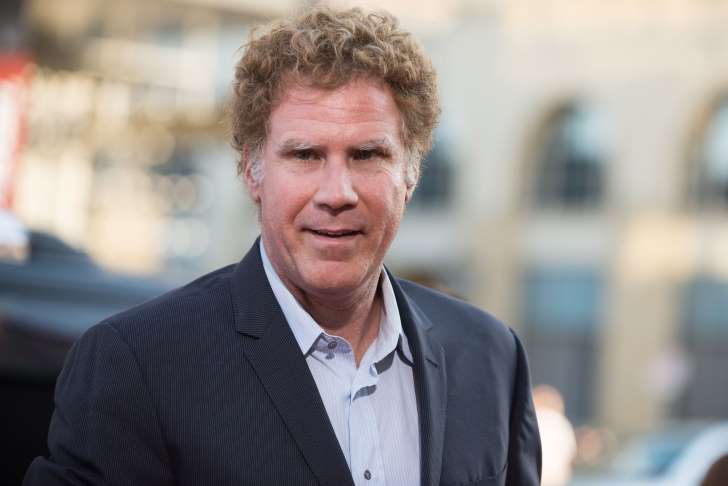
Will Ferrell is one of my favorite comics.

His impression of President George W. Bush is priceless. His Ricky Bobby race-car driver character cracks me up.

But for the ever-lovin’ life of me, I do not understand the role he is about to undertake.

Ferrell is set to play President Ronald Reagan in a bleeping satire about Alzheimer’s disease.

http://www.msn.com/en-us/movies/news/will-ferrell-to-play-ronald-reagan-in-alzheimer%e2%80%99s-comedy-%e2%80%98reagan%e2%80%99/ar-BBslxWs?li=BBnb7Kz

Maybe I’m a fuddy-duddy. Perhaps I need to dust off my funny bone.

The film reportedly will be set during President Reagan’s second term. Dementia sets in. His staff supposedly tells him he’s an actor portraying the president.

Gosh, that’s a real knee-slapper, right?

Actually, it isn’t.

Those of us who have intimate knowledge and experience with this dreaded disease might not see the humor in it. OK, maybe some of us will.

I don’t.

The disease is a merciless predator. It strips away people’s cognition, their memory. Everything!

My mother died of the disease 32 years ago at the age of 61. I watched her essence disappear over time.

And another beloved member of my family is in its early stages. He’s doing well at this moment. Time, though, is not on his side.

It’s a miserable, heartbreaking, tragic disease.

Someone now wants to poke fun at this killer that victimizes millions of Americans. Its victims include those who suffer from the disease and their loved ones who must watch them deteriorate.

How is that funny?


Abortion tempest erupts


Chalkboard - Abortion

Donald J. Trump finds himself in the middle of a tempest over arguably the most contentious political issue ever.

Again!

The Republican Party presidential primary frontrunner said Wednesday — in response to some aggressive questioning by MSNBC’s Chris Matthews — that a woman should face “some punishment” were she to obtain an illegal abortion.

Yep. He said that. A woman should be punished.

Then the firestorm erupted. What in the world is he talking about?

Republican candidates Ted Cruz and John Kasich were quick to condemn Trump’s statement. Then came the fury from Democratic candidates Hillary Rodham Clinton and Bernie Sanders.

Within a couple of hours, Trump issued a statement that said the doctor should face the sanction, not the woman whose pregnancy was ended.

I won’t bother you with a dissertation on my own views of abortion, as you perhaps already know I remain pro-choice on the issue.

What is bothersome about Trump’s answer and then his recanting of his initial response is the non-preparedness the candidate keeps exhibiting when pressed for answers on these critical issues.

Abortion matters deeply to many millions of Americans. It seems, to me at least, that few of us have mild feelings about the issue. We’re either fervently pro-choice or pro-life. Trump’s view on the issue has evolved over time. He is seen on videotape telling an interviewer about a decade ago that he is “strongly pro-choice.” Then he told Matthews this week that he is “pro-life.”

I’d be curious to know what changed Trump’s view on this issue. How did he go from one firm position to another? Perhaps the only other major-party politician I can recall pulling such a dramatic switcheroo would be George H.W. Bush, who abandoned his pro-choice views immediately upon accepting Ronald Reagan’s invitation to join him on the GOP presidential ticket in 1980.

Donald Trump initial answer to the question of whether a woman should face punishment reveals what Sen. Cruz identified correctly as Trump’s utter lack of preparation to discuss these issues when confronted with them.

Somehow, though, I cannot escape the feeling that Trump will find a way to deny he ever said what millions of Americans already heard him say.

Most disturbing of all will be that many Americans will believe him.


‘Transformational’ takes on new meaning

Cruz_Trump_ap_img

There once was a time in politics when those who practice the craft sought to become “transformational” figures.

Barack Obama saw himself in that light in 2008. Ronald Reagan, too, was considered a “transformational” candidate. The Gipper reshaped the political landscape with his landslide victory in 1980. The jury is still out on Obama’s impact.

Thus, the term was thought to constitute high praise.

These days, “transformational” seems to have taken on a new meaning.

And it’s not flattering in the least.

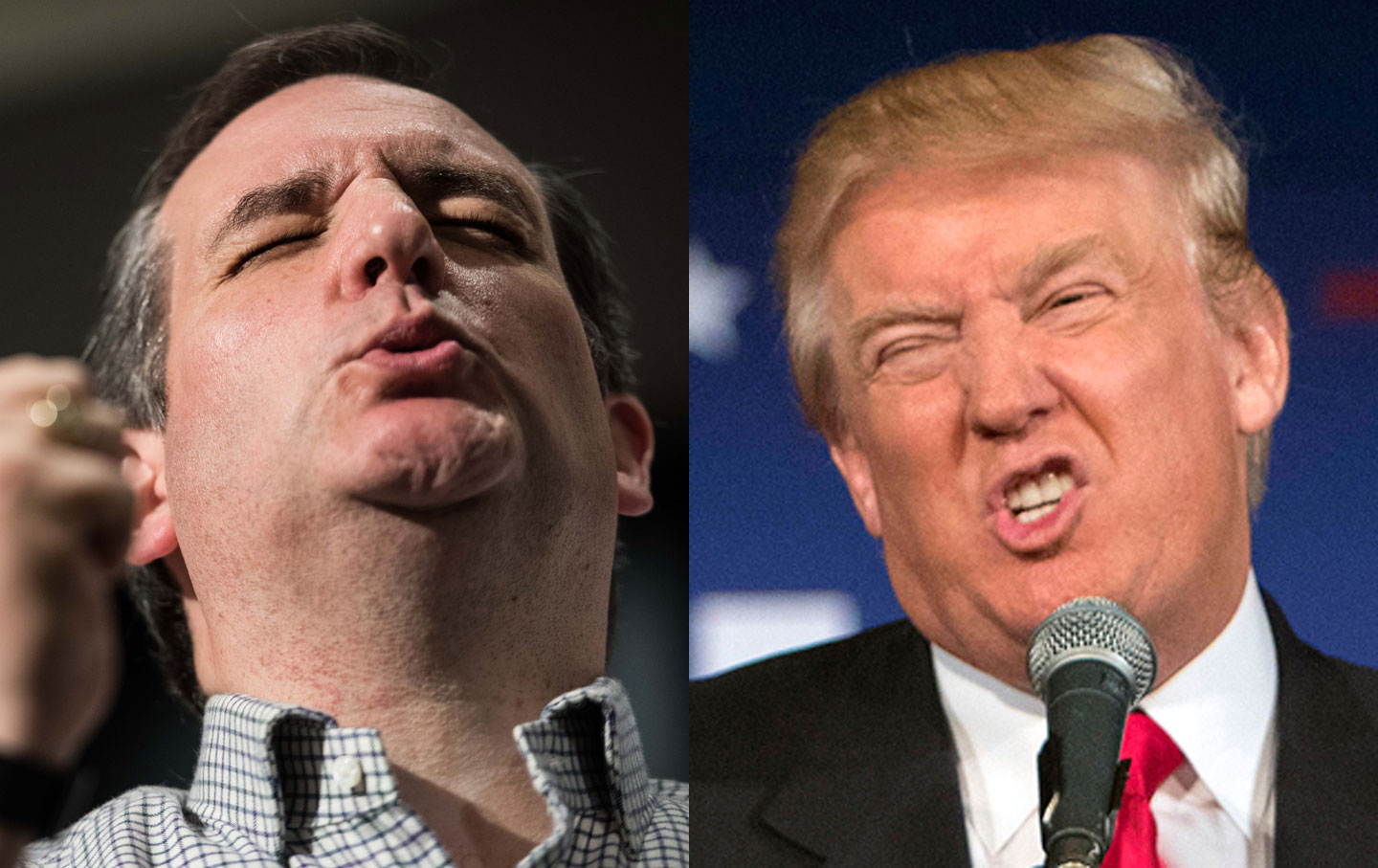
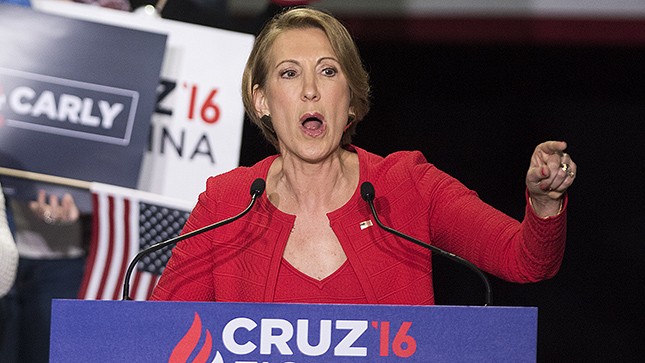
Donald J. Trump and Rafael Edward Cruz have “transformed” the political craft into something cheap, tawdry, childish, petulant and utterly without substance.

They’ve been bickering over social media about their wives.

And as the accompanying New York Times essay seeks to explain, they seem to treat women — even the women in their lives — as objects.

They’ve lowered the bar to new depths.

Yes, the candidates have quarreled over the Internet about insults, innuendo, threats and retribution against their wives.

It has been a disgraceful exhibition that in normal election cycles would have no place anywhere near two leading major-party candidates for the presidency of the United States.

I am quite certain the rest of the world is laughing hysterically at what has become of the formerly great political party known as the Republican Party.

The Party of Lincoln has become the Party of Chuckleheads.

Please, spare me the bleating by “true Republicans” that Trump isn’t one of them. He’s chosen to line up on the Republican side of the gate in this race for the White House, so the GOP must accept that he’s now one of their own.

And Cruz? His response to the Brussels terrorist attack was the Mother of All Doozys. He wants to beef up police patrols in “Muslim neighborhoods.” Yeah, boy. That’ll show them Muslims what we’re all about here.

Is there a greater Islamic State recruitment tool — other than Trump’s stated desire to ban all non-American Muslims from entering the United States — than this?

But instead of debating the idiocy of such a policy pronouncement, we’re left to wonder what in the name of political sanity has become of a party that features two men quarreling out loud about the nasty things being said about their wives?

This is the new definition of “transformational” politics.

We’ve transformed what the late Robert F. Kennedy used to describe as a “noble profession” into something not worthy of a middle-school food fight.


Remember when The Gipper was a pushover, too?

GTY_hillary_clinton_donald_trump_split_jt_150912_16x9_992

Let’s play this election season out, theoretically, to the end.

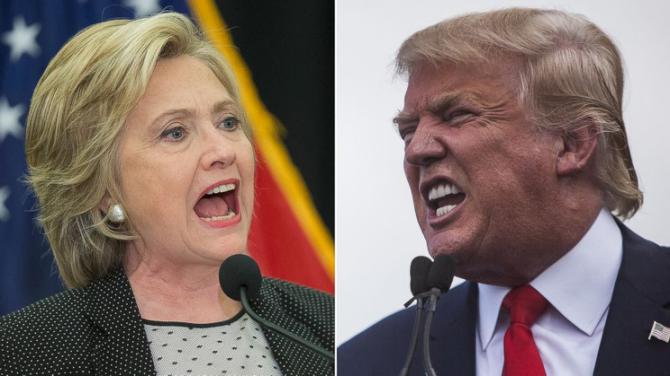
The Democrats will nominate Hillary Rodham Clinton as their presidential candidate; the Republicans will select Donald J. Trump as their standard bearer.

Clinton is the one with the experience: a policy-wonk first lady; a twice-elected U.S. senator from New York; a secretary of state. She’s well-schooled on the nuance of foreign and domestic policy. She’s articulate and is a cool customer under fire.

Trump is none of that. He’s a hot-headed reality TV celebrity. He made a fortune in real estate development. He’s married to his third wife. He has boasted about his sexual exploits with women who were married to other men. His campaign has featured little substance and virtually zero political philosophy — but a whole lot of insults and outrageous proclamations.

Clinton’s the favorite. The prohibitive favorite. She’ll win in a landslide while making history as the nation’s first female president.

Hold on a second.

Thirty-six years ago, the Democrats nominated a former one-term Georgia governor. He was a U.S. Naval Academy grad. He was a policy wonk. He was a smart guy, although perhaps a tad self-righteous. Republicans nominated a former movie actor who starred in those films with Bonzo the chimp; and oh yes, he made that film in which he portrayed Notre Dame football player George Gipp. Sure, he was a two-term California governor.

The Democrat was supposed to win, right?

It didn’t turn out that way. The Republican, Ronald Wilson Reagan, carried 44 states and blew President Jimmy Carter out of the White House.

It’s that history that should tell Democrats to take this upcoming election very seriously if it plays out the way it’s projected to play out.

By any normal measure, Donald Trump should be an easy mark for Democrats. This campaign, however, hasn’t gone according to the form sheet in almost any measure.

Clinton wasn’t supposed to be challenged so seriously from within her party. As for Trump, no one took him seriously when he announced his intention to seek the GOP nomination; his “fellow Republicans” are taking him seriously enough now — so much so that they’re staying up at night trying to concoct ways to derail his political juggernaut.

Both candidates are going to carry a large amount of baggage into a fall campaign, if they are the nominees. They both are packing a lot of negative feeling from within their respective parties.

Of the two, Trump’s negatives — from my perspective — far outweigh Clinton’s.

That doesn’t give the Democratic opposition any reason to fall asleep at the wheel.

The Gipper was supposed to lose big, too.

Political conventions: raucousness with serious purpose

tumblr_m9876t6jRi1qeoxw2o1_1280

I won’t be attending either of this year’s political conventions.

Part of me wishes I could because — having been to three of them over the years — I’ve discovered how much fun they are for those who attend them and for those who report and comment on them.

This year’s Republican convention in Cleveland could be especially fun especially for the reporters lucky enough to get the assignment to cover it.

My first political convention was in 1988, when Republicans gathered in New Orleans.  I was part of the media team representing the Hearst Corp., which owned the Beaumont Enterprise, where I worked for nearly 11 years.

Any convention in The Big Easy was a serious blast, given that it’s, well, New Orleans.

Four years later, the Republicans gathered in Houston, about 85 miles in the other direction from Beaumont. That one produced its own share of memories. Chief among them was watching former President Reagan deliver his last major political speech in which he poked fun at the Democrats for nominating a young Arkansas governor who compared himself to Thomas Jefferson. “Well, I knew Thomas Jefferson,” the president said. “Thomas Jefferson was a friend of mine …” He brought down the house.

Four years ago, I had secured press credentials for the 2012 Democratic National Convention in Charlotte. I didn’t have the support of the Amarillo Globe-News or its parent company, Morris Communication. I applied for the credentials on my own and then received them. Then my world was turned upside-down when I got “reorganized” out of my job at the paper just as the convention was about to begin the following week.

I went to Charlotte anyway — with my wife; we enjoyed ourselves immensely. I attended the convention as a spectator and got to cheer as President Obama and Vice President Biden received their party’s nominations for re-election.

One of the major takeaways from all three events, though, is a visual one.

In New Orleans, Houston and Charlotte, I was struck by the sight of serious-minded men and women parading through the convention hall wearing goofy hats, festooned with campaign buttons, loud clothes, carrying signs — all while they shout slogans from the convention floor.

I had to remind myself of this fact: These people from all across the nation are gathered in one place to nominate a candidate for president of the United States of America. They are choosing the individual who will represent their political party in an election to determine who will be commander in chief of the world’s foremost military establishment; they will pick the head of state and government of the world’s greatest nation.

I’m telling you that when you are among these folks, it’s easy to forget the seriousness of the task they are seeking to complete.

This year — in Cleveland and in Philadelphia — it’ll be no different.

Except that in Cleveland, where Republicans are going to gather, the serious nature of their mission might be compromised by the individual who is poised to accept his party’s nomination as president.


Clinton takes back … a compliment

HIV-AIDS

Here’s how it usually goes when a politician retracts a statement.

The pol usually says something negative about someone else, only to be shown that the comment was unfounded. The politician then might take at least some of it back, declaring a lack of complete understanding.

Hillary Rodham Clinton, though, did something quite different this week.

She attended the funeral of former first lady Nancy Reagan and then offered high praise for the work Mrs. Reagan and her husband, President Ronald Reagan, did to raise awareness of HIV/AIDS.

Well, to borrow an exclamation: Oops!

Turns out the Reagans didn’t do what Clinton said they did. They were not champions for HIV/AIDS research.

AIDS activists and leaders of the LGBT community were quick to call Clinton out on her misstatement.

President Reagan didn’t even mention AIDS — which was initially diagnosed in 1981, the first year of his presidency — until 1987. As for Mrs. Reagan, she was silent on the issue as well.

Yes, the backlash was intense in the wake of Clinton’s comments.

As the New York Times reported: “While the Reagans were strong advocates for stem cell research and finding a cure for Alzheimer’s disease, I misspoke about their record on HIV and AIDS,” she said in a statement about two hours after her interview had been shown on MSNBC. “For that, I’m sorry.”

I am pretty sure that Clinton’s staff did not serve her well in prepping her for the TV interview in which she “misspoke.”

Indeed, if the leading Democratic presidential candidate would be of a mind to praise any Republican for their work on HIV/AIDS research, it ought to go President George W. Bush, on whose watch the PEPFAR program was initiated.

While touring Southeast Asia with other journalists in 2004 on a mission to learn about the impact of AIDS in that part of the world, we were told that because of PEPFAR — the President’s Emergency Plan for AIDS Relief — the United States was spending more on AIDS research than the rest of the world combined.

The Reagans weren’t in the game. Yes, the late former first lady has earned high praise for her Alzheimer’s awareness efforts. Not so with HIV/AIDS.

Now we’ll get to see how nimble Hillary Clinton can be in the face of some stinging rebukes over what one leading gay activist called her “idiotic, false – and heartbreaking” tribute.

Trump needs to start acting like a ‘unifier’

A supporter of Republican presidential hopeful Donald Trump scuffles with a protestor during a rally in Richmond, Va., Wednesday, Oct. 14, 2015.  (AP Photo/Steve Helber)

Donald J. Trump today postponed a campaign rally because of the threat of violence.

Hmm. Where do I begin?

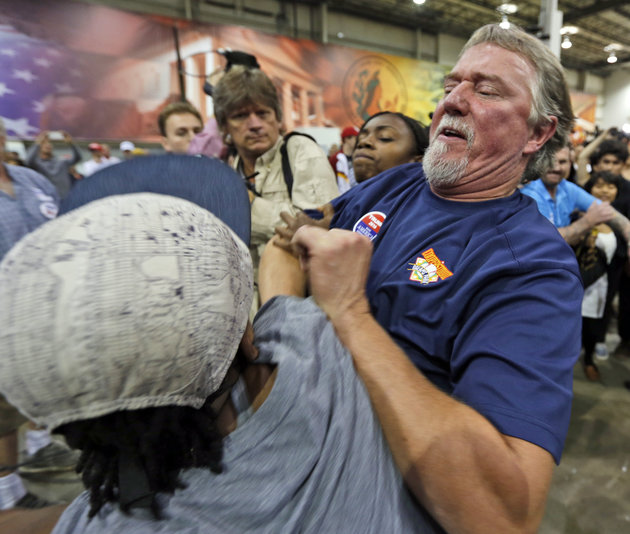
The Republican presidential campaign frontrunner has been the focus of some unseemly and potentially dangerous confrontations of late. Protestors have shown up at his campaign events; they’ve been shouted down by Trumpsters seeking to silence the anti-Trump voices; fights have broken out; one man has been arrested for assault after he sucker-punched a protestor being escorted out of a rally location in North Carolina.

Trump’s reaction to all of this? Well, it’s been — shall we say — a bit muted. Except, of course, when he’s exhorted his supporters to punch protestors in the face or exhibit some other form of forceful retaliation.

I listened to some commentary this evening after the postponement of a Trump rally in Chicago. An interesting thought came from David Gergen, a CNN political analyst and a former official in several presidential administrations: Nixon, Ford, Reagan, George H.W. Bush and Clinton.

Gergen’s advice to Trump: If you’re going to proclaim yourself to be a unifier, then you need to do a lot more to tamp down the anger upon which you’ve built your (so far) successful campaign for president.

Gergen said tonight previous campaigns have drawn hu-u-u-u-u-ge crowds.

He mentioned Barack Obama’s 2008 campaign, Ronald Reagan’s 1980 campaign and John F. Kennedy’s 1960 campaign.

None of them fostered the violence we’ve seen at these Trump rallies, Gergen noted. Why? “They were positive,” he said. All three men promoted positive agendas for change and they all sought to appeal to the voters’ better angels.

Gergen noted he disliked including Trump with Reagan because, he said, “It does a disservice to President Reagan.” Indeed, it does. Trump, though, needs to heed the words of this bipartisan wise man.

The violence has to stop. One individual has it within his power to restore order, civility and decorum to the important task of delivering a campaign message.

That would be the candidate who is seeking the votes of Americans across the land.

Tone down the angry talk, Donald Trump.

Hey, these guys got along, too!

newt

The politics of the moment has this way of inflicting a case of selective amnesia among politicians.

Take last night’s 12th — and possibly final — Republican Party presidential debate with Donald J. Trump, Rafael Edward Cruz, Marco Rubio and John Kasich as providing an example of that peculiar malady.

One of them (I can’t remember who) brought up President Reagan’s famous buddy-buddy relationship with House Speaker Tip O’Neill. The two men — one Republican, one Democrat — worked well together.

Sure they did. I honor them for that cooperation.

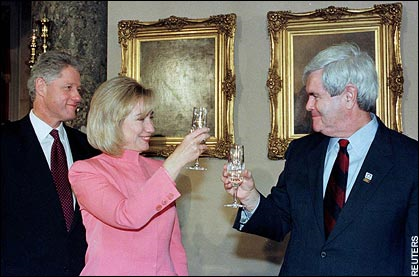
So did a couple of other well-known pols. Democratic President Bill Clinton and Republican House Speaker Newt Gingrich also managed to find common ground when the need arose. And it did, particularly as it regarded the need to balance the federal budget.

None of these current GOP candidates, though, mentions that political partnership.

We all know why that is the case, of course.

It’s because the president’s wife, Hillary Rodham Clinton, wants to ascend to the office her husband once occupied.

Why, we just can’t give Bill Clinton any props for doing what the current president and the current congressional leadership seem unable — or perhaps unwilling — to do.

I’m the first to acknowledge that the Clinton-Gingrich relationship never evolved into the personal public friendship that Reagan and O’Neill developed.

The Gipper and the Tipper would share some spirits once they were off the clock, setting politics aside; it’s been reported widely how they would swap stories between them and laugh at the foolishness of the day.

I don’t believe I’ve ever heard of similar moments of non-political fellowship involving Bill and Newtie.

However, they certainly did form a valuable political partnership during the time Gingrich was speaker. It’s understandable, I suppose, that the Republicans running for president would choose to ignore it.

I’ll just have to rely on Hillary Clinton to remind the rest of us how bipartisan cooperation can work.

She was there, too.


Nancy Reagan’s lasting legacy: Alzheimer’s awareness

gty_ladies_nancy_kb_120626_wmain

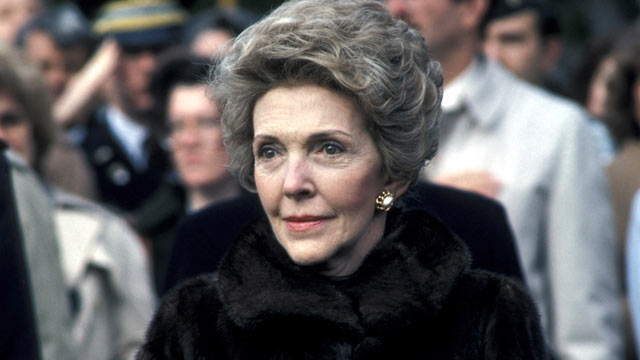
Nancy Reagan will be remembered for many noble and good things.

The former first lady — who died this past weekend at age 94 — was a champion for her husband, the 40th president of the United States. She became arguably his closest advisor and by many accounts was his best friend. She sought to protect his image and his legacy and most historians today she succeeded famously at protecting both of those things.

She also was an advocate for Alzheimer’s research and that’s what I want to focus on here.

You see, many of us have intimate knowledge of that disease.

On Nov. 5, 1994, President Reagan penned that astonishingly poignant farewell letter to the nation as he disclosed his diagnosis. He and his bride then said their “long goodbye” to each other. Nearly a decade later, President Reagan would succumb to the complications of that disease.

Read the president’s letter here.

I’ve told you at times of my own experience with the disease, having watched my mother wither away and die 32 years ago from its effects at the too-tender age of 61. Take my word for it: It ain’t pretty.

Other family members of well-known Americans have taken up the cause for Alzheimer’s research. I think most often of Maria Shriver, whose father — Sargent Shriver — was rendered helpless by the affliction before he died. Shriver has vowed to carry the fight forward.

Nancy Reagan sought to raise research funds. She lobbied Congress to do more for the families who are the actual sufferers of this malady. They are the victims, who watch their loved ones lose their cognitive skill, their memory, their ability to do simple things, such as bathe and eat.

All those things happened to her beloved husband and she fought as hard as she could until the day he died and later — until her own health deteriorated.

The world she leaves behind needs more powerful advocates who will take up the cudgel for other family members who must endure the heartbreak of Alzheimer’s disease.

Thank you, Mrs. Reagan, for the waging this noble effort.

We haven’t finished the fight just yet, but we’re a lot closer to declaring victory.


Why the qualified tribute to Mrs. Reagan?

bal-nancyphoto0611

The nation has heard from many leading political figures commenting on the death of former first lady Nancy Reagan.

They’ve all been lovely and heartfelt.

Still, consider this statement from U.S. Sen. Bernie Sanders, a Democratic candidate for president:

“No matter your party or political ideology, this is a sad day for America. Nancy Reagan was an exemplary first lady. A devoted partner, she was her husband’s most trusted advisor and, as such, served our country well. Even after her time in the White House, she was an outspoken advocate for stem-cell research to find a cure for Alzheimer’s. Nancy Reagan had a good heart, and she will be dearly missed.”

Is it just me or did Sen. Sanders offer something of a qualifier with that first clause: “No matter your party or political affiliation …”?

I venture to guess that most adult Americans who are even remotely aware of the current presidential campaign know that Sanders leans sharply to the left and that the late President and Mrs. Reagan leaned sharply in the other direction.

I don’t mean to parse and nitpick Sen. Sanders’ statement to death, but it seems to me he could have just started with, “This is a sad day for America” and gone on from there. The rest of the statement came straight from his heart.

One sees this kind of qualification added to tributes to those who have passed on. Lefties do it when righties depart this world and righties do it as well to the lefties who leave us.

Hey, maybe I’ve got too much time on my hands to worry about such things.

Any thoughts here? Am I off base?