Overturn an election result? Well … yeah!

Congressional Republicans argue against the impeachment of Donald Trump on the basis of a belief that Democrats are seeking to “overturn the results of the 2016 presidential election.”

Hmm. You know, at one level I actually agree with that view.

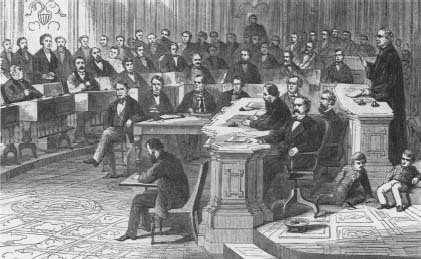
However, here’s the deal: Three of the four presidential impeachments in this nation’s history have been intended to do that very thing. President Andrew Johnson’s impeachment in 1868 didn’t seek to overturn the preceding election; the nation re-elected President Lincoln in 1864 as the Civil War was still raging, but then the president was shot to death in April 1865, allowing Vice President Johnson to ascend to the presidency.

President Nixon was going to be impeached in 1974 before he quit the presidency. President Clinton was impeached in 1998. Did Democrats seek to overturn Nixon’s landslide re-election in 1972? Did Republicans want to do the same thing when they impeached Clinton in 1998 after he had won re-election in 1996? Well, yeah! They did!

So what is the rationale for this argument? Local officials are subject to recall petitions when they mess up. They, too, are elected to their office. Recall movements, therefore, are intended to “overturn” those results.

All this being said, I am not the least bit moved by the argument that an impeachment of a president is an effort to overturn an election. We can argue about the motives, I suppose, of why one side wants to impeach a president.

There can be no argument, though, on the consequence of such an act. Of course it reverses the result of the previous election. That’s what impeachment, I am willing to argue, is all about.
Do any minds ever get changed?

Watching the “debate” on the House of Representatives floor today over the impeachment of Donald J. Trump brings to mind something I heard many years ago from a Texas state legislator.

In early 1995 I had the pleasure of meeting the late state Sen. Teel Bivins, an Amarillo Republican. I went to his downtown Amarillo office, exchanged greetings with him and sat down for some discussion.

Bivins knew I had moved to Amarillo from Beaumont. I worked for the Beaumont Enterprise and then went to work for the Amarillo Globe-News. Bivins then brought up the name of a fellow state senator with whom he had a sometimes-testy relationship. He talked admiringly about the debating skills of Democratic colleague Carl Parker of Port Arthur.

Parker is a trial lawyer who possesses tremendous rhetorical skill. Bivins called Parker a “friend,” and then told me that he actually once witnessed how Parker’s intense debating ability changed the minds of one or two of his Senate colleagues on an issue that Parker was debating.

I thought about the tale Bivins told about Carl Parker and wondered if there are any such debaters squaring off today under the Capitol Dome. I ain’t hearing anything of the sort. They’re all dug in. No one is going to budge.

I am left to wonder if any minds could be changed were they to hear the thundering rhetoric that a Texas state senator could deliver when the chips were down.

House members are not listening to each other

Congressional Democrats are yapping about their desire to impeach the current president of the United States, Donald Trump.

Congressional Republicans are yammering about their opposition to their colleagues on the other side of the House floor.

They all are talking past each other. No one is listening to a word those on the other side are saying. Their minds are made up. They are making brief speeches. I suppose they are looking for a moment to shine before Americans who might be watching on TV. I happen to one of them.

I am not being persuaded by congressional Republicans. Congressional Democrats, meanwhile, are preaching to the proverbial choir.

The exercise we are witnessing on the floor of the House of Representatives is a waste of time. It’s time to vote. Impeach the president and send this matter down the hall to the Senate.

Calling all business to the downtown parking garage!

With all the success enjoyed this past spring and summer by Amarillo’s newly installed AA minor-league baseball team, I had hoped to be able to cheer for the stampede of new business filling up ground-floor storefronts at the parking garage across the street from the ballpark where the Sod Poodles play the Grand Old Game.

Alas, no cheering … at least not just yet.

The parking garage does have a tenant, or so I understand. Joe Taco, the (somewhat) upscale Mexican restaurant is moving into the garage; for all I know, perhaps Joe Taco has made the move.

The rest of the structure, though, appears to remain dark.

The idea was for the ballpark to act as fairly quick lure for businesses looking to profit from all the ballpark activity associated with the Amarillo Sod Poodles. The Sod Poodles played to packed houses at Hodgetown throughout their initial Texas League season.

None of this concern over the lack of parking-garage activity is intended to suggest gloom and doom for the structure. I remain optimistic that the garage investment will pay off. It just might be that the planners and economic gurus perhaps oversold the immediate result that the Sod Poodles would produce once they began their season in Amarillo.

The city’s changing downtown landscape remains a work in progress. So far, the work I have seen suggests that progress is going to follow in due course.

Imagine another president doing this

I want to let a six-page letter that Donald Trump, the current president of the United States, sent to House Speaker Nancy Pelosi stand more or less on its own.

Read it here.

It’s pretty angry. I am trying to imagine another president who was impeached by a House of Representatives controlled by the opposing party sending something this angry to the speaker.

I am referring, of course, to Democratic President Bill Clinton, who in 1998 was impeached by the House led by Republican Speaker Newt Gingrich. Did the president fire off a screed such as this? Did he impugn the motives, the integrity, the patriotism of his foes? I don’t recall that kind of rhetoric coming from the president himself; yes, he had many allies speak publicly on his behalf.

Oh, the president surely thought such things about the GOP speaker. He might even have told him so — privately.

The letter attached to this brief post is the ranting of an angry and seemingly desperate man who, interestingly, is likely to survive the Senate trial that will result from the House impeachment.

Weird. Simply weird.

What about the other side?

My friends on the left — those who, as I do, support the impeachment of Donald Trump — will not like what I am about to say. They will accuse of me invoking that “both-siderism” mantra.

Fairness dictates that I say it. So, here goes.

Senate Majority Leader Mitch McConnell and many of his Republican acolytes deserve the criticism they are receiving for their unwillingness to look at all the evidence before deciding to find Trump not guilty of the transgressions that the House of Representatives will send to them.

However, those on the other side — the individuals who have decided to convict the president — are guilty of being as close-minded as those across the aisle.

I have heard countless Democratic senators say the same thing that McConnell and Sen. Lindsey Graham and other GOP senators have said, which is that they have seen enough already to make up their minds.

All 100 senators are going to take an oath when the Senate trial commences. The oath will pledge them to look with impartiality and without bias at all the evidence they will hear when the House managers and Trump’s legal team present their cases.

I am willing to concede that I have seen and heard enough to make up my own mind. Then again, I am not among the 100 Senate “jurors” who will take that oath. I am free to state my own bias, my own view and offer my own conclusion.

U.S. senators don’t have that luxury. For them, be they Democrat or Republican, to declare their intention before hearing a single word of testimony in a Senate trial is, shall we say, a violation of the oath they will take.

The irony is that they will sit in judgment of a president who’s been accused of doing the very same thing.

Watch out, Mr. ‘Current’ POTUS

If Donald J. Trump is going to refer to Christopher Wray as the “current” director of the FBI, I am going to take it upon myself — through High Plains Blogger — to hereby refer to Trump as the “current” president of the United States.

Fair is fair, right?

I mean, to imply that Wray’s status as head of the world’s pre-eminent investigative agency might be in peril gives many of us license to infer the same thing about the man who appointed him.

Donald Trump’s status as the “current” president well might imply the same thing, if not through impeachment and removal in a Senate trial, then via the next presidential election.

Former CIA, FBI director takes aim at Trump

Donald Trump, the “current” president of the United States, is a threat to national security and is undermining the morale of the agencies charged with protecting us.

Who said that? A flaming, squishy liberal activist? Oh, no. That thought comes from a longtime Republican and the only person ever to hold the offices of FBI and CIA director, William Webster.

Webster is concerned that the president took issue with the “current” director of the FBI, Christopher Wray, who stands behind the inspector general’s assessment that he found no political bias in the launching of an FBI investigation into allegations of Russian election interference in our 2016 presidential campaign.

He skewered Trump in an op-ed written for the New York Times. You can read it here.

Webster criticizes Trump for referring to the FBI as a “broken” agency. It isn’t broken. Indeed, the only “broken” federal office is the one operating inside the White House.

My point here is that Webster is a strong, faithful and loyal Republican who is actually standing up to the fraudulent politician who is masquerading as our nation’s president.

If only other reliable Republicans — those in public office at this moment — could summon the courage of William Webster.

Enemies cannot discuss difference with each other

My adventure into the belly of the political beast earlier this year revealed so much to me that I want to revisit a major part of what I learned.

I attended a Donald J. Trump “Keep America Great” political rally at the American Airlines Center in downtown Dallas. I stood in line for seemingly forever to get inside. I met some nice Trumpsters along the way, visited with them, exchanged small talk about our families.

As I walked in I heard one of Trump’s warmup acts bellow something from the podium that I believe sums up the dysfunction that has gripped today’s political climate.

It came from Dan Patrick, the fire-breathing Texas lieutenant governor and presiding officer of the Texas Senate.

Patrick called the Republicans’ adversaries “enemies.” Then he doubled down with the next sentence that flew out of his mouth. He acknowledged that, yes, he meant to say “enemies.” They aren’t mere opponents, but they are the “enemies” of freedom, liberty, upstanding moral values.

It occurred to me in the moment: That is precisely what has infected the nation’s political climate. Political foes cannot talk to each other if they view the other side as the “enemy.”

Were we able to talk to Hitler or Tojo or Mussolini during World War II? Or to Ho Chi Minh during the Vietnam War? Or to Osama bin Laden?

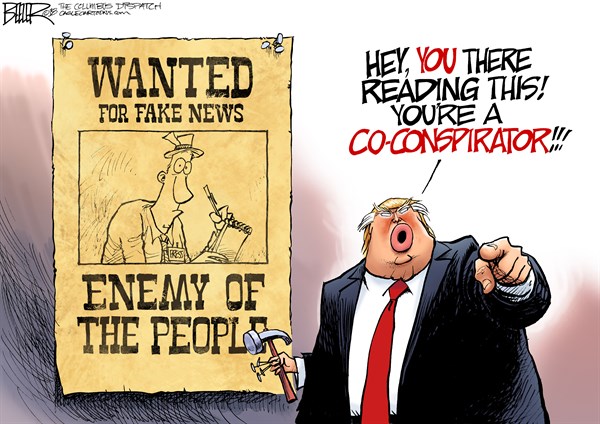
Dan Patrick’s “enemy” statement exemplifies the kind of politics that Donald Trump himself has promoted since the moment he declared his candidacy for the only public office he ever has sought. He labeled the press the “enemy of the people.” He has talked about Muslims as being enemies of Americans. He has referred to the refugees fleeing repression in Latin America as conducting an “invasion” of this country.

Trump, of course, isn’t the first politician to refer to political foes as the “enemy.” GOP firebrand Newt Gingrich said it was imperative during the 1994 congressional election for Republicans to persuade voters that Democrats were the “enemy of normal Americans.”

How do you debate your differences with someone who considers you to be the enemy?

More on the Presidential Medal of Freedom

I feel the need to flesh out a little more about the Presidential Medal of Freedom and why I believe it should be awarded to a leading American actor and activist.

The medal, bestowed by the president of the United States, goes to those individuals have delivered “an especially meritorious contribution to the security or national interests of the United States, world peace, cultural or other significant public or private endeavors.”

I already have made a pitch for Gary Sinise, an actor of considerable note, as well as a fervent activist for military veterans and active-duty personnel. Sinise hasn’t yet been awarded with the nation’s highest civilian honor. He deserves it … in spades!

Sinise has become veterans’ most outspoken and visible champion. He embodies the sea change that has swept over the country in the past quarter-century or so, or about the time that our troops swept Iraqi forces out of Kuwait during the Persian Gulf War.

Do you remember how veterans were treated after the Vietnam War? I do. I was one of them. I didn’t get spit on. Or cursed. I did receive an indifferent response from those who learned I had served for a time in Vietnam.

That all changed about the time of the Gulf War.

Gary Sinise has become a visible and outspoken advocate for veterans over the course of many years. He has raised money for families of veterans, helped raise awareness of PTSD and other combat-related disorders. He has lent his good name to fundraisers. He has hosted public TV broadcasts of patriotic salutes.

My goodness, this man has contributed greatly to the cultural development of this great country, as explained in the Medal of Freedom criteria listed at the top of this blog post.

My message now goes directly to Donald Trump: Mr. President, if you can see fit to honor a professional golfer who won the Masters tournament — which you did when you hung the Medal of Freedom around Tiger Woods’ neck — surely you can do the same for an artist who has made veterans awareness part of his life.