How might Trump persuade China to lean on North Korea?

This holy weekend seems like an odd time to comment on the possibility — remote as it seems at this moment — of nuclear war with North Korea.

Here goes anyway.

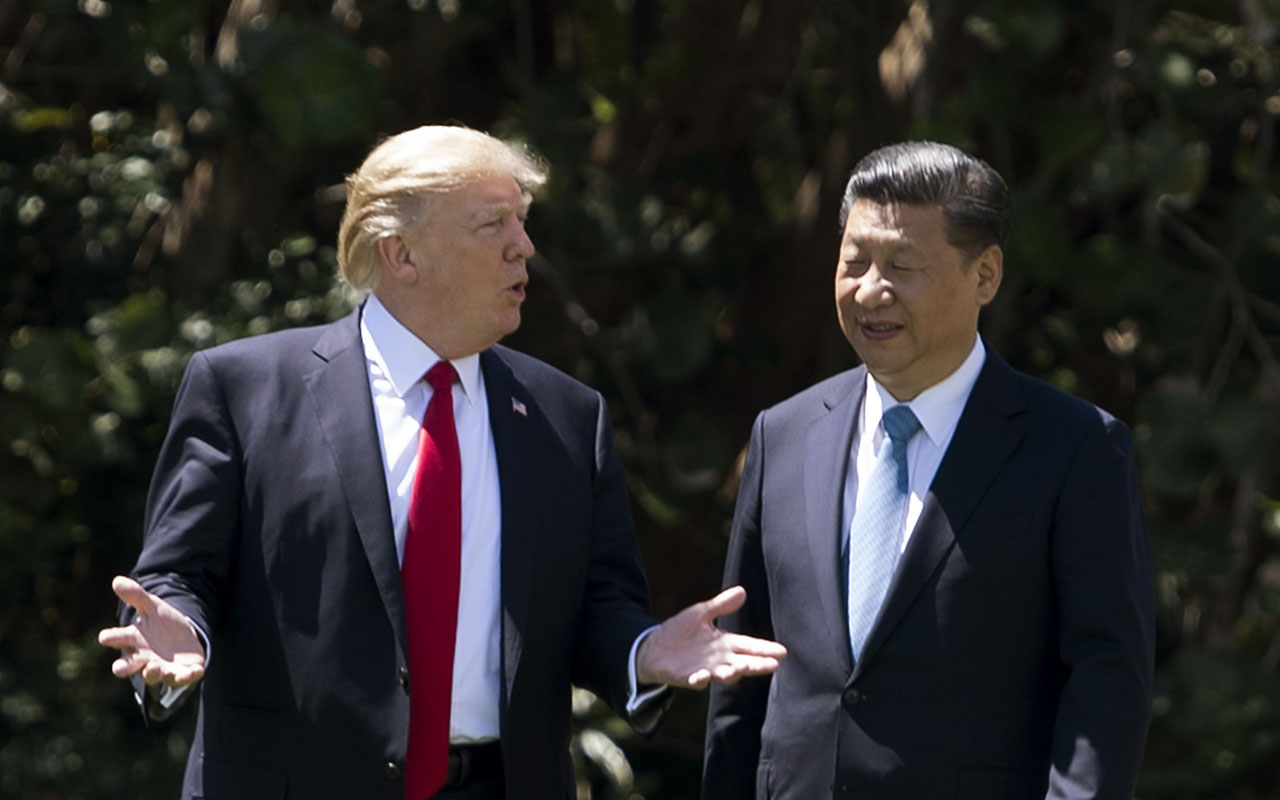
How might Donald J. Trump have sought to persuade Chinese President Xi Jinping to lean hard on North Korean dictator/madman Kim Jong Un?

Trump met with Xi this past weekend at the president’s posh Mar-a-Lago resort, where he said he was enjoying that piece of chocolate cake when he told Xi of the Syrian air strike.

I’m pretty sure, though, that North Korea came up. What might have Trump have told Xi? How might he have pleaded with him to do something — anything within reason — to persuade Kim Jong Un to avoid testing a nuclear device?

China is North Korea’s major economic benefactor. The People’s Republic is North Korea’s No. 1 trading partner. There would seem to be plenty of economic muscle that Xi could apply to Kim Jong Un to tell him — in no uncertain terms — that threatening the United States, South Korea and Japan is sincerely not in North Korea’s best interests.

Let’s remember, too, that North Korea is a desperately poor nation. Its people are starving while Kim Jong Un keeps spending nearly a quarter of the country’s GDP on military hardware.

The U.S. Navy is sending a strike group led by the USS Carl Vinson — a nuclear-powered attack aircraft carrier — to the Korean Peninsula. It’s a tremendous show of American military power that must not go unnoticed in Pyongyang.

Is the U.S. president capable of appealing to Xi to lay it all on the table with Kim Jong Un? Is he able to use the kind of language heads of state use with each other when talking about serious threats to international security? After all, whatever threat the North Koreans pose doesn’t just involve the United States, or China or any other single nation in the east Asia region. This is a worldwide matter.

My hope would be that Trump would plead Xi — if that’s what it would take — to lean very, very hard on Kim Jong Un, to tell him about the terrible price the world would pay if he pushes the United States to where many observers fear might occur.

That would be a pre-emptive strike on North Korean military targets.

Trump vows to “take care” of North Korea “alone” if China doesn’t do what it must. I do hope — and pray — the president is able to persuade the Chinese leader to step up.

Open the White House visitor logs

Transparency has been tossed into the crapper at 1600 Pennsylvania Ave.

That’s where the president of the United States hangs out for part of the week; his posh Florida resort appears to be where Donald J. Trump’s heart belongs.

But the White House is the people’s house. The president is just staying there. We own the place. You and I do. It’s ours, man.

Which is why the White House visitor logs need to be opened up to public review, as it was done during the years the Barack Obama family was living there. The White House announced that those logs will be kept secret. The White House brass contends there’s some issue with national security.

Closed logs anger watchdogs

As The Hill reported: “‘It’s disappointing that the man who promised to ‘drain the swamp’ just took a massive step away from transparency by refusing the release the White House visitor logs that the American people have grown accustomed to accessing over the last six years,’ Noah Bookbinder, executive director of Citizens for Responsibility and Ethics in Washington, said in a statement.

“Bookbinder said the records ‘provide indispensable information about who is seeking to influence the president.'”

Drain the swamp, eh?

The swamp isn’t drained in the least. It remains as infested with special interests and well-heeled fat cats as always. The public has a right to know who is calling on the president, or on his senior staff. The public pays the bill for that big ol’ house and as its landlords, the public has every right to know who’s darkening its doors.

Happy Trails, Part Nine

More than two weeks into this full-time retirement life and I’ve made a bit of a discovery.

I am suffering not one bit, not a single hint of separation anxiety from my previous life.

That’s right. I do not miss waking up early each day, getting myself cleaned up and throwing on clothes suitable for the workplace. Nope. None of that has overtaken me.

I retired officially from the final part-time job I was working in late March. I clocked out, shook a couple of colleagues’ hands, hugged my boss’s neck and said goodbye.

Then my wife and I hit the road the next morning for the Hill Country and then motored west with our pickup and fifth wheel to Ruidoso, N.M. We have two more road trips already planned out and are beginning to formulate a travel plan for one or two after that.

I had anticipated some angst after leaving the working world. I hit it pretty damn hard for nearly 37 years in a pressure-packed environment. I lived by deadline working for four daily newspapers: two of them in Oregon, my home state and two others in Texas, where my family and I moved in 1984.

But it hasn’t occurred. Not a single time have I missed the grind. Not once have I wished, “Man, if only I could be back on the job reporting or commenting on this or that issue.”

It hasn’t happened. I don’t expect it will.

I told a member of my family this week about that lack of separation anxiety. My family member has been retired for a number of years and she has adapted quite smoothly to a life of relative leisure. I am not sure she quite gets why my own transition into this new life has gone so smoothly. Her expression seemed to suggest: Well, what in the world did you expect?

I believe I’ve just answered that question. I expected to miss my former life more than I do. I am glad, though, that I do not.

Three of the four part-time jobs I worked since leaving daily journalism were media-related gigs. I don’t expect any of them to return, although one of those jobs might — I want to stress might — return in some form. If it does, it will have to be right. It will have to be something that will make it worth my time and effort.

In a perverse way, my time actually has gained even greater value as my wife and I continue this journey toward points unknown.

Tax returns, Mr. President … give ’em up

Gosh, I hate talking about Donald John Trump’s tax returns.

Just kidding. No, I don’t.

U.S. Sen. Elizabeth Warren, D-Mass., says tax-filing time is a good time to see what — if anything — the president is hiding from the American people he governs.

I agree with the Bay State’s senior senator.

We’ve waited long enough to see what precisely is in those returns. Trump has balked long enough at doing what other presidential candidates for 40 years have done, which is to release their complete returns for public inspection.

Trump keeps telling us he can’t release his returns because he’s being audited. The Internal Revenue Service says, in effect, that the president is engaging in a dodge; an audit doesn’t prohibit the returns’ release.

Meanwhile, U.S. Senate Minority Leader Charles Schumer, D-N.Y., has said that any hope of enacting tax reform depends on the president releasing those returns. Sure, that’s hardball politicking. Inquiring minds want to know, especially the minds of those of us who didn’t vote for Trump in 2016.

Time to come clean

I mean, he’s still the president of all Americans. We’re all required to file our taxes. Here in Amarillo, candidates for public office are required to provide full financial disclosure.

The president of the United States of America is not above the law. In this case, even though releasing the returns isn’t a legal requirement, it has been a longstanding custom that’s been accepted as standard operating procedure for all candidates for the presidency.

Sure, many Americans don’t seem to think these returns matter. Others of us, though, think quite the opposite.

Many of us are waiting, Mr. President. Please show us, sir, that you aren’t hiding something.

Let the Texas AG’s trial commence … and conclude

Texas Attorney General Ken Paxton took office under a cloud.

The cloud remains. It’s still hovering over the Republican politician. Perhaps a trial jury will remove that cloud — one way or another — beginning Sept. 12.

Paxton is going to stand trial on felony charges of securities fraud. A trial judge moved the case from Collin County to Harris County, apparently believing prosecutors’ contention that Paxton’s legal team had tainted the trial jury pool, giving him an unfair advantage.

The AG is accused of misleading investors prior to his taking office in 2015. If convicted, he faces a potential prison term of 99 years.

This change of venue surprises me mildly. Prosecutors had argued that Paxton’s counsel somehow had sought some unfair advantage, given that the attorney hails from Collin County, just north of Dallas.

Why the surprise? Well, a Collin County grand jury managed to indict Paxton more than a year ago. The grand jurors were Paxton’s homies, too, just as a trial jury pool would have been. The notion that a grand jury would indict a former state legislator from that very county seemed to suggest that the county was capable of producing a qualified panel of trial jurors when the time came for it.

The judge, George Gallagher, saw it differently. That’s his call. Hey, he’s the legal eagle, right?

So, the case moves to Harris County, to Houston. Judge Gallagher has set a 10-day time limit for this case to conclude once the trial commences. Of course, the Sept. 12 start date well could be subject to change — perhaps even multiple changes before Paxton gets this case adjudicated.

Let the trial begin. Paxton deserves the chance to remove the cloud that’s hung over him since before he took office.

For that matter, so do millions of other Texans who believe their state’s chief law enforcer should be above reproach.

Trump’s first 100-day report card coming due

Franklin Delano Roosevelt set the bar for measuring the progress of a new president’s administration. He put it at 100 days.

Presidents had that amount of time to establish the pace and the tone of how they intend to govern, FDR determined. It’s been the benchmark ever since.

How has the 45th president done as his 100th day in office approaches? Not well at all.

That’s the view of almost every observer who gets paid to analyze such things. Donald J. Trump, though, sees it differently. Imagine that, if you can. He’s done a “fantastic” job, he’ll tell you. He’s assembled the “best” team ever created, he will insist. Why, he got a Supreme Court justice nominated and confirmed all within the first 100 days, he has said.

Trump has signed a lot of executive orders, too. He has rolled back many of the policies enacted by President Barack H. Obama. He’s repealed, for instance, regulations that sought to ensure clean air and water; Trump wants to bring more jobs back and he says those job-killing regulations just had to go.

Oh, but legislatively? What has the president done?

Umm. Not much, folks.

The effort to repeal and replace the Affordable Care Act went down in flames. That would be his “first priority.” He got nothin’, man.

Absent a victory there, he then turned his sights on reforming the federal tax code. Now that effort appears stalled. Why? Because a few of his allies in Congress want to restart the ACA repeal/replace effort.

The president has failed to fill most of the key deputy Cabinet posts that need filling. Key Cabinet secretaries are lacking go-to men and women who serve as backstops for them.

The 100th day is less than two weeks out. Will the president be able to proclaim any significant legislative victory? I do not think so.

As one point of comparison, I believe I’ll look back eight years ago to the then-new presidency of Barack Obama. All he managed to do in the first 100 days was shepherd through Congress a $787 billion economic stimulus package that managed to rescue the nation’s collapsing financial system.

How would I grade the current president?

I’ll give him a D-minus. The only thing — in my view — that keeps him from failing outright is that missile strike on the Syrian government.

MOAB does what it’s supposed to do

It’s called the MOAB.

The acronym actually stands for Massive Ordnance Air Blast Bomb. Its colloquial meaning is Mother of All Bombs.

The military dropped one of these devices on an Islamic State operation in Afghanistan. And, sure, there’s debate on why the military chose to use the device.

I support its use. Donald J. Trump promised during the campaign that he would “bomb the s*** out of ISIS.” Well, there you go. The MOAB does do that.

It’s the largest conventional explosive device in the U.S. arsenal. It weighs about 25,000 pounds. It does significant damage.

ISIS has earned this kind of response

Let’s not get too namby-pamby about this device. The Islamic State has performed some heinous actions against innocent victims. It has performed hideous acts with regard to prisoners it has taken — and executed.

I get that the debate about the MOAB is important in one respect: The bomb is so powerful that the military must be certain to avoid civilian casualties, given that the United States as a matter of military policy doesn’t kill civilians knowingly.

Trump — who used to criticize the military as feckless and weak — now proclaims great faith in its ability to carry out missions such as the one involving the MOAB. His criticism while campaigning for the presidency was misplaced; the president’s endorsement of the U.S. military’s extraordinary capability now is quite appropriate.

Thus, the MOAB has been introduced into this fight.

My own view is that the military should use this devastating weapon whenever feasible against a ghastly enemy that has earned the civilized world’s rage.

No legislative remedy needed for United Airlines mistake

It took no time at all for a member of the U.S. Senate to weigh in with a legislative solution to an incident that has outraged millions of Americans.

Chris Van Hollen, D-Md., has announced plans to introduce a bill that would make it illegal for a commercial airline to remove a ticketed passenger from an airplane.

I detest these kind of legislative responses to vast public outrage.

You know the story. United Airlines the other day tried to evict a passenger after seeking volunteers to vacate the flight to make room for four UAL employees who needed to fly from Chicago to Louisville. The airline picked names of passengers at random. One of the passengers refused. So the airline called in security officials, who then manhandled the passenger badly, pulling him off the plane after knocking out a couple of his teeth and breaking his nose.

The passenger, a physician who said he needed to see patients the next day — and just couldn’t surrender his seat on the flight — has vowed to sue the airline for damages.

UAL suffers terrible PR damage

Now we hear a member of the Senate weighing in.

Congress does this kind of thing on occasion, as do state legislatures. Public outcry emerges from an event, prompting lawmakers to propose state or national laws to make something illegal.

The way I see it, Congress need not act on this matter. Why? Well, United Airlines has gotten the message from the rage the public already has expressed over this incident. Moreover, I am quite certain executives at other airlines have heard it, too, prompting them to rethink their own passenger-removal policies.

I believe in good government and I am not one to dismiss the need for government to act when the cause merits it. I just don’t think this particular matter requires congressional action.

United Airlines CEO Oscar Munoz already has made a mess of his own response. He said initially that airline personnel acted according to policy; then he apologized to the man who got roughed up; then UAL announced air fare refunds for every passenger on that Chicago-Louisville flight.

United Airlines is now reviewing its policy. That’s good enough for me.

My strong hunch is that UAL won’t allow this kind of embarrassment ever to recur on one of its aircraft. I also would be willing to bet real American money that the other air carriers will follow suit.

‘My military’? No, Mr. POTUS, it’s ‘ours’

Some commentators and analysts on MSNBC are getting a bit worked up tonight over Donald J. Trump’s use of the first-person singular pronoun.

Trump was speaking today of the use of the so-called “mother of all bombs” on Islamic State targets in Afghanistan. He referred to “my military” taking charge of the mission and executing it with precision.

My military? Umm, no sir. It’s our military, the people’s military, the nation’s military.

Now, to be fair …

Other presidents have done the same thing, taking direct ownership of the office they occupy. Barack Obama was fond of referring to “my national security team,” or “my vice president,” or “my economic team,” or “my presidency.”

I once challenged the former president’s generous use of that pronoun, trying to remind him that none of it belongs to him personally. I also sought to remind him that every single government employee — and they number in the millions — belong to the taxpayers who pay the bill.

That includes the president of the United States of America.

The message I imparted then still applies to the current president.

“My military”? No, Mr. President. The men and women who defend our nation do not belong to you.

They belong to us. For that matter, Mr. President, so do you.

https://highplainsblogger.com/2014/07/take-ownership-not-possession/


Elections provide a valuable education

I listened today to a candidate for the Amarillo City Council tell his audience about the things he has learned about running for public office.

Eddy Sauer is seeking to be elected in Place 3 to succeed incumbent Councilman Randy Burkett, who isn’t seeking re-election.

Sauer gave some fairly standard remarks to the Rotary Club of Amarillo about how a lifelong Amarillo resident can have his eyes opened about the complexities of governing a city of roughly 200,000 residents. He spoke mostly about economic development, speaking intelligently about how the city should continue to seek companies willing to locate here; offer them financial incentives and then seek to ensure that they provide sufficient numbers of new jobs to make the investment worthwhile.

He also spoke of improving “transparency” on the Amarillo Economic Development Corporation.

Yes, the man is learning about the city, about its challenges. Sauer is an impressive fellow who I hope gets elected on May 6.

***

Sauer and I visited for a few minutes before he stood behind the podium. I mentioned to him how elections have been educational to me during more than 22 years living in Amarillo and, for most of that time, commenting on them as a full-time opinion journalist at the Amarillo Globe-News.

Indeed, these municipal elections have managed during every election cycle dating back to my first year here — 1995 — to tell me something about the community I didn’t know previously.

I suspect that is perhaps the most gratifying aspect of these elections. Twenty-two years after settling in at my new post at the G-N, I’m still learning about this community.

Before you ask what precisely have I learned, I must tell you that I cannot define it in tangible terms. Early on I learned about the landmark 1989 city election that resulted in a dramatic turnover of the five-member City Commission; the local economy was in deep trouble, the city had been feuding with leading business leaders; folks were angry.

By the time I arrived at my post, much of that anger had subsided. The city, though, had plenty to teach this newcomer to the Texas Panhandle.

I’ve been learning a little more every odd-numbered year when the City Council’s five members are selected by city voters.

Think, too, about this: Given that Texas elects its Legislature every even-numbered year — as do the state’s 254 counties — we residents get a chance to be “educated” every single year.

I told Sauer that even my perch in the peanut gallery — given that I no longer “work for a living” — provides me with an election-year opportunity to learn something new about Amarillo.

This, I suppose, is my way of revealing my biggest takeaway from these local elections. It happened in Beaumont, when my wife and sons and I first moved to Texas back in 1984. I can go back even to my first full-time journalism job in Oregon City, Ore., which bears little resemblance to my familiar surroundings in big-city Portland.

The upcoming election is likely to teach me more, still, about Amarillo. Indeed, elections can provide teachable moments if we all keep an open mind.

The good news is that the learning curve isn’t nearly so steep these days. Still, it never will level out. Nor should it.