Wall price tag keeps escalating

Donald J. Trump’s wall is going to cost a lot of money.

It will cost about twice what he said it would cost; and it will cost billions more than U.S. House Speaker Paul Ryan said it will cost.

A Department of Homeland Security report puts the cost of the wall at $21.6 billion.

That ain’t chump change, ladies and gents. What’s more, many of us have yet to be convinced that building a wall across our southern border is going to work. We doubt it will keep every illegal immigrant out of the United States; nor is it even in keeping with the welcoming values that gives this country its “exceptional” status.

How do we pay for this?

Paying for this wall is going to be the biggest debate topic — if our government actually proceeds with this specious plan.

Let us consider a couple of critical factors.

* The president insists Mexico will pay for it. The Mexican government says categorically it won’t pay a nickel. Trump insists that a steep tariff on all imported goods from Mexico will foot the bill. That means importers are likely to pass the cost of those imported goods on to you and me. Bottom line? We pay for it

Suppose, then, that the tariff doesn’t come to pass. And suppose that Mexico holds firm on its refusal to pay for the wall.

* How does Congress find the money to pay for this monstrosity? Fiscal conservatives have insisted in the past that the government cut money elsewhere to spend funds on new programs. Example? Joplin, Mo., was devastated by a killer tornado in 2011 and Republican House leaders insisted the government peel money from other programs to pay for emergency relief for the storm victims.

If the government is going to shell out $21.6 billion — assuming the price tag doesn’t escalate even more — then how do we intend to pay for it? More taxes? Do we decline to spend money on other government programs? Which programs get cut?

The wall is far from done. Its cost is far from settled. Its future is far from certain.

Clumsiness breaks out at City Hall

Amarillo’s City Council is looking once again like a gang that cannot shoot straight.

It is looking to fill a slot on the Amarillo Economic Development Corp. board. It pushed the name of a prominent local developer, Perry Williams, to the top of its finalist list.

Then the candidate went missing in action. The city couldn’t find him. Williams wasn’t responding to efforts by the city to arrange an interview with him.

Then Williams — who is developing the huge Town Square residential/commercial project on Soncy Road — announced he was backing out. He pulled his application for the AEDC board.

Some media reporting indicates that his application had been “overlooked” by council members.

Huh? What the … ?

The council is looking at four finalists to fill the AEDC spot. I am acquainted with a couple of them, one of whom I would recommend for AEDC.

Sitting way out here in the peanut gallery, I am not sure if Williams backed out because of incompetence by the selection committee, or if he just decided at the last minute he had too much to do already … that he couldn’t devote the time needed to craft job-creation policies.

Service on the AEDC is a big deal. The AEDC is charged with using sales tax revenue to lure new businesses — and to enhance existing businesses — in the search for new jobs.

It does seem a bit strange, though, that the council would “overlook” an application, then push it forward — only to have an applicant suddenly become MIA.

Can we get an explanation? From somebody? Anybody?

One-China Policy is OK, right, Mr. President?

Donald J. Trump now is ready to adhere to one of the more complicated elements of U.S. foreign relationships.

It’s called the One-China Policy, which recognizes only one China … and it’s not Taiwan.

Not long after being elected president, Trump took a phone call from Taiwan’s president and then declared the United States ought to rethink its decades-old policy that recognizes the People’s Republic of China.

Bad idea, you know? The conversation between a U.S. president-elect and the leader of Taiwan was the first that had occurred since the United States recognized the PRC as the “real” China.

Taiwan, China maintain complicated relationship

Taiwan is, in fact, a prosperous independent nation that broke away from the Chinese mainland at the end of a bloody civil war that erupted after World War II. Taiwan’s Nationalist government set up shop on Taiwan in 1949 and for three decades it was the recognized government of China.

That all changed dramatically in 1979 when the United States recognized the PRC, kicked out the Taiwanese ambassador. The United Nations booted Taiwan out, too, and welcomed the PRC.

Thus, the One-China Policy was born amid an interesting mix of economic and defense-related agreements that the United States still maintains with Taiwan. We trade with the Taiwanese, we pledge to protect them if the PRC decides to retake the island nation — but we do not recognize them diplomatically.

Trump spoke this week to Xi Jinping, the Chinese president, and reaffirmed out commitment to the policy that recognizes the PRC exclusively as the sole China.

As for Taiwan’s relationship with the PRC, that too, is a matter of delicate maneuvering. Taipei and Beijing allow travel between the countries; family members are allowed to communicate with each other.

Taiwan also believes in a “One China Policy,” but insists that the island nation — not the mainland — is the “real China.” Here’s the deal: Most of Taiwan’s inhabitants were born on the island and consider themselves to be “Taiwanese.”

The president, though, needs to settle down and stick with a policy that recognizes only one China. To do anything different is to insert the United States directly into the middle of a simmering dispute between China and Taiwan.

Clearing another barrier toward full-time retirement

This is the latest in an occasional series of blog posts commenting on upcoming retirement.

LAREDO, Texas — My wife and I have crossed another barrier that once stood between us and this new life called “full-time retirement.”

While vacationing in South Texas, we began plotting our next RV adventure.

Yep. We weren’t finished enjoying our most recent journey — this time to Laredo — and we began thinking about how we are going to map out our next trip.

It will occur soon. We intend to end up in Ruidoso, N.M., by way of the Texas Hill Country.

But we have a really, really big trip already lined out for a period after the Ruidoso jaunt.

My point here is that we are enjoying the fifth wheel and seeing these new places so much that we cannot stop thinking about when we’re going to do so again.

I am going to presume this is a normal transition. It does feel right, although I am mindful of the need to live in the moment.

My late mother used to remind me of the dangers of “wishing your life away,” which I used to do when I was a boy. “Gee, Mom, I wish the weekend would hurry up and get here,” I would say, only to get that pearl of wisdom from my mother.

I might be reverting to those boyhood ways. I don’t care. We’ll keep planning our next adventure before we finish the current one.

Trump team continues to ‘unify’ Congress

Donald Trump’s effort to “unify” Congress is continuing to produce a bumper harvest.

For instance, the U.S. House Oversight Committee chairman, Republican Jason Chaffetz of Utah, has called for an investigation into senior White House adviser Kellyanne Conway’s apparent shilling for Ivanka Trump’s line of clothing. Ranking Democratic committee member Elijah Cummings of Maryland joined Chaffetz in seeking to know whether Conway violated federal ethics laws.

The lawmakers sent a letter to the head of the Office of Government Ethics, Walter Shaub, Jr., suggesting that Conway’s appearance on “Fox and Friends” could have crossed the line that bans federal officials from promoting private business endeavors.

Chaffetz and Cummings have recommended punishment for Conway.

Trump, quite naturally, is standing by Conway, who has told the media that the president is “100 percent behind me.”

Ethics just keep getting in the way.

The president’s myriad business interests — along with those of his grown children — are likely to continue dogging the administration until all of the Trumps decide to divest themselves of all that lucrative activity.

Meanwhile, I will give the president a left-handed compliment. He vowed to “unify” the country. He is keeping that pledge by unifying some of our elected representatives — although clearly not in ways he envisioned.

President gets real-time lesson on government limits

Donald Trump had zero government experience when he became president of the United States.

He seemed to think he could step into the presidency, assume the role of CEO and everyone would do his bidding.

He is now finding out that it doesn’t work quite that way. He is learning in real time that the founders established a government that limits presidential power. They created a government that allows two other branches to rein in an executive branch that could overstep its authority.

Congress is controlled by men and women who belong to the same political party as the president. Thus, the legislative branch might roll over. This leaves the final check to the judicial branch, which is flexing its muscles in this struggle over Trump’s executive order that restricts travel to the United States from those who hail from seven Muslim-majority nations.

The struggle now seems headed to the Supreme Court. The nation’s highest court likely will get to decide whether to uphold two lower-court rulings that have stalled the execution of Trump’s executive order.

If the Supremes uphold the earlier rulings — either with an actual ruling or a tie vote created by the unfilled vacancy — then the president will have to consider another way to “make America safe again.”

Perhaps the next tactic he employs will be considered more carefully and executed with more thought than the cluster-fudge he rolled out with this refugee ban.

Will any of this humble the president? Will it give him pause to consider his next action? Probably not, but it still gives me some comfort to know that the founders knew how to create a government that works.

And just for the record, if the Supreme Court rules in Trump’s favor and overrules the lower courts, then I’ll consider that — as well — to be a demonstration of a functioning federal government.

However, my concern were that to occur would be that it would embolden a president to misread the limitations on power that the founders wrote into the framework that built this nation.

Texas AG deserves to stand trial at home

My jaw dropped. My mouth is gaping. I cannot believe what I have just read.

Prosecutors seeking to convict Texas Attorney General Ken Paxton, who is set to stand trial for an alleged securities fraud matter, have asked for a change of venue because they say they cannot get a fair trial in Collin County, a suburban region just north of Dallas.

Why the jaw-drop?

Well, Paxton represented Collin County in the Texas Legislature before he was elected AG in 2014. That’s what made his indictment by a Collin County grand jury all the more remarkable, the way I saw it. This wasn’t a group of liberal activists seeking revenge against a conservative statewide politician. The grand jury was a panel of Paxton’s peers.

Prosecutors need not seek a change of venue, given that a Collin County grand jury brought the charges against Paxton in the first place.

The grand jury indicted Paxton on allegations that he misled investors in a company; the alleged crime occurred before he became attorney general.

I don’t know about you, but I find this allegation of bias against them to be soaked in irony.

As the Texas Tribune reported: “Ken Paxton, like all Texans, has the right to be tried in the County he was charged in,” Paxton lawyer Dan Cogdell said in a statement. “The Special Prosecutors have filed a 60-page pleading trying to thwart that right. That these prosecutors are somehow painting themselves as ‘victims’ of some nonexistent conspiracy is extremely telling.”

I believe the trial court will be able to seat a jury that can determine this case fairly and without bias. Just look at what the grand jury did to bring this case to trial.

The case is set to go to trial on May 1. Let it take place in Collin County.

Mammoth court fight awaits Trump

Here is where we stand regarding that ill-considered ban on refugees.

It appears headed for the U.S. Supreme Court, thanks to a unanimous ruling this afternoon by the 9th U.S. Circuit Court of Appeals, which upheld a lower court’s suspension of Donald Trump’s executive order banning refugees from seven Muslim-majority countries from entering the United States.

Clear as mud, yes?

The 9th Court ruled 3-0 to uphold the suspension ordered by U.S. District Judge James Robart, whom Trump called a “so-called judge” in criticizing his decision.

What about the politics of the court? Judge Robart is a George W. Bush appointee; the three appellate court judges were picked by Presidents Carter, Bush 43 and Obama. It looks like a bipartisan rejection to me.

Now the highest court stands ready to ponder this controversial executive order. It has a vacancy, meaning that eight justices are on the job. Four conservatives and four liberals. What happens if the Supremes issue a tie vote? The 9th Court ruling stands. Trump’s executive order is negated.

The 9th Court ruling takes aim at the provision in the order that bars people with visas from re-entering the United States, which the judges ruled is unconstitutional.

According to The Associated Press: “The appeals panel said the government presented no evidence to explain the urgent need for the executive order to take effect immediately. The judges noted compelling public interests on both sides.

“‘On the one hand, the public has a powerful interest in national security and in the ability of an elected president to enact policies. And on the other, the public also has an interest in free flow of travel, in avoiding separation of families, and in freedom from discrimination.'”

Trump, of course, responded with a tweet. “SEE YOU IN COURT,” the president said via Twitter.

Washington Gov. Jay Inslee, a Democrat, whose state has sued the president over his executive order, responded: “Mr. President, we just saw you in court, and we beat you.”

The fight has just begun.

POTUS takes aim at Senate vets; be careful, sir

Donald J. Trump once said his enrollment in a military high school was equivalent to serving in the actual military.

He was wrong. What’s the president doing now? He has decided to attack at least two actual veterans who now serve in the U.S. Senate.

A word of advice, Mr. President: Do not go there.

First case: Sen. Richard Blumenthal, D-Conn., reported that Supreme Court nominee Neil Gorsuch called Trump’s tweets criticizing federal judges “demoralizing” and “destabilizing.”

Trump’s reaction was to call attention to Blumenthal’s assertion years ago that he once served in the Vietnam War. Blumenthal didn’t go to Vietnam. However, the senator did serve in the military.

Next case: U.S. Sen. John McCain, R-Ariz., criticized a military mission that Trump ordered that resulted in the loss of an expensive aircraft and the life of a Navy SEAL.

Trump’s press flack said McCain dishonored the memory of the slain SEAL.

Trump treads on tricky ground.

Remember, too, that candidate Trump once said McCain was a Vietnam War hero only because “he was captured. I like people who aren’t captured, OK?” I’ve spoken my piece already on that shameful and ridiculous assertion.

But as a veteran of the Army myself — who served for a time in Vietnam — I take tremendous umbrage at the president going after veterans when he has no knowledge of what they endured.

In the case of McCain in particular, I would caution Trump strongly to avoid launching anything resembling a personal attack on this gallant war hero.

‘Extreme vetting’ doesn’t sound so bad after all

When he was campaigning for the presidency, Donald J. Trump called for “extreme vetting” of people seeking entry into the United States of America.

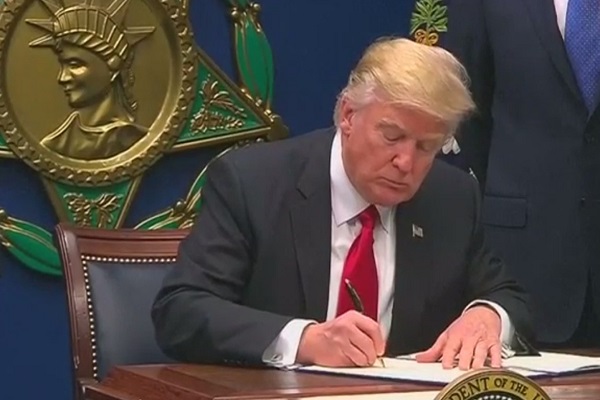
Then he became president. What did Trump do then? He signed an executive order that prohibits entry of refugees from seven Muslim-majority countries. The order has raised a firestorm of criticism. The federal judiciary has entered the fray by delaying implementation of the order.

So, my question is this: What happened to “extreme vetting” of every single immigrant who wants to enter the country?

I guess the president needs to define the term. How extreme does the government go? To what end do agents grill incoming visitors? How do they determine a threat to our national security?

The problem I have with Trump’s executive order is its discriminatory nature. I believe the court system might have a similar problem with it, too.

Of course, extreme vetting or any ramping up of security measures will cost lots of money. Congressional Republicans would seem to resist such an expenditure without finding a way to pay for it. Isn’t that what fiscal conservatives are supposed to demand?

If Trump is serious about protecting Americans from threats abroad, then he ought to protect us against all types of immigrants. If this extreme vetting policy is fair and effective, the vast majority of entrants will find a home in the Land of Opportunity.

At least that’s how it’s supposed to work.