Puppy Tales, Part 24

puppy

I’ve bragged about Toby the Puppy many times already on this blog.

There. Having stipulated my pride in our puppy, I now shall offer a brief additional boast.

He has learned the word “heel” when we walk with him through our Amarillo neighborhood.

The good news about walking a 10-pound pooch is that he doesn’t drag us around the neighborhood behind him. The bad news about Toby, though, is that he remains highly energetic when we go for walks. The first sight of his leash sends him into ecstasy. He cannot wait to get out the door.

But this “heel” business — the universal command for dogs to walk next to their “parents” — has been a bit of a challenge.

I’m happy to report, though, that Toby now seems to understand the meaning of the word. We say “heel!” as he starts to wrap his leash around our legs and, by golly, he takes his place between his mother and me.

He lays his ears back, which is a sign that he’s relaxed while he walks.

OK, now for the additional learning that’s required.

Toby’s attention span is limited. He often doesn’t stay in the “heel” position for very long. He sees another dog, a cat, hears a noise that startles him … he jumps and starts to pull on the leash again.

We’ll stay with it. The exercise provides plenty of benefit for all of us. We are about to celebrate the second anniversary of Toby joining our family. Thus, our puppy has learned a lot already and has demonstrated some remarkable intelligence.

We just need to get him to stay focused. Wish us luck.

E-mail story is getting more convoluted

email-marketing

I am willing to admit the obvious, which is that sometimes I am a bit slow on the uptake.

Things can and do get past me. The swirl of news events at times overwhelms me to the point that I cannot keep straight the particulars of this or that controversy/scandal.

The Hillary Rodham Clinton e-mail matter provides a case in point.

She used her personal server while leading the State Department. The question then became whether she distributed classified or “highly classified” information on this server.

The FBI investigated it. So did the U.S. House Government Oversight Committee.

The FBI concluded that it couldn’t find a reason to prosecute Clinton for any illegal activity. FBI Director James Comey, though, did provide a pile of critical analysis of Clinton’s handling of the e-mails, calling it “reckless,” and “careless.”

Now, though, Donald J. Trump is accusing Clinton of “illegal” use of her personal e-mail server.

Didn’t the feds determine already that she didn’t break the law, or that they couldn’t find reasonable grounds to recommend an indictment?

Trump, the Republican presidential nominee, has goaded Russia into looking for 30,000-something missing e-mails. The House Oversight and Judiciary committees are looking for proof that Clinton committed perjury when she testified before Congress.

Then we hear about 15,000 more e-mails that have surfaced. What does that mean? Anything?

The Democratic presidential nominee has endured a serious media and political scrubbing over all of this.

She hasn’t been accused formally of a single criminal act.

And yet …

Republicans keep calling her a criminal. They want to “lock her up!”

My head is spinning.

I need help.

‘Undercover voter’ equals ‘shamed voter’

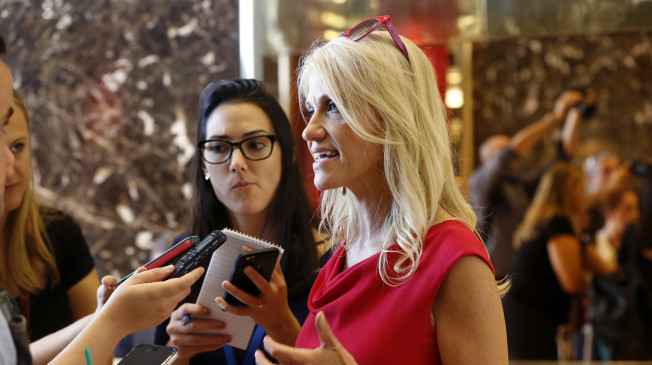
Kellyanne Conway, new campaign manager for Republican presidential candidate Donald Trump, speaks to reporters in the lobby of Trump Tower in New York, Wednesday, Aug. 17, 2016. (AP Photo/Gerald Herbert)

Kellyanne Conway earned her chops as a pollster and spinmeister.

Consider, then, what Republican presidential nominee Donald J. Trump’s new campaign manager has said.

It is that polls would show Trump doing better if “undercover voters” would reveal to pollsters that they are voting for her guy.

I’m trying to understand what she’s saying here.

I think that she’s suggesting that Trump’s millions of voters are too ashamed to admit out loud to strangers that they’re planning to vote this fellow.

Am I mistaken? Is that what “undercover voter” means?

If you’re committed to a candidate for high public office and someone calls you to conduct a public opinion survey, it would follow — normally, I guess — that you would be unafraid to tell the pollster how you think about an upcoming election.

Trump’s supporters, according to Conway, are keeping their thoughts to themselves.

Someone explain that one to me.

Please?

http://talkingpointsmemo.com/livewire/kellyanne-conway-polls-undercover-trump-voter


Walk produces interest in those bike trails

park

My wife and I enjoy walking through the neighborhood, something we’ve done for many years and something we’ve renewed with increasing vigor recently.

On a walk the other day through our southwest Amarillo ‘hood, I noticed the “Bike Trail” sign just as I watched a guy on a bicycle turn the corner and peddle his way along the trail.

The thought then occurred to me: Where does the trail go?

Then I remembered. The city has started a comprehensive bicycle and walking network, but hasn’t finished it.

I spoke with the city parks and recreation director, Rod Tweet, a few months ago for a story I wrote for NewsChannel 10.com. The story dealt with the hike-and-bike network that I knew the city had started.

He couldn’t get too specific in answering questions about when the project would be completed. My sense at the time was that the city had a lot of other projects that greater priorities than the hike/bike network.

Hmmm, I thought. Oh yeah. The city has that downtown thing going on. I hope they get around to completing the network.

Tweet explained that the goal is to connect all the neighborhoods covering more than 110 square miles with trails that people can travel on their bicycles or on foot. I don’t believe the intent is to enable someone to walk from, say, the Colonies to Lakeside Drive. But I guess they could if they wanted to do so … eventually.

The city fathers and mothers have talked for longer than I can remember about enhancing the quality of life for residents.

I continue to believe that a comprehensive citywide network of hiking and biking trails does precisely that for Amarillo.

The Parks and Rec Department did a good job fixing up the old railroad right of way along Plains Boulevard. I see people using it all the time — as I zip by in my automobile.

There’s more to do. My hope is that the city gets moving soon on finishing a worthwhile project.

Railroad Commission needs a name change … at least

UP9A0023_1_jpg_800x1000_q100

The Texas Railroad Commission used to regulate the railroads.

It also set trucking regulations.

It did all that while also regulating the state’s mammoth oil and natural gas industry.

That was then. In the here and now, though, the three-member Railroad Commission only regulates oil and natural gas. Rail and trucking regulation has been handed off.

This now begs the question I’ve been asking for more than 30 years observing and covering Texas politics and government: Why is this agency still called the “Texas Railroad Commission”?

The Railroad Commission came under scrutiny this week in Austin. The state’s Sunset Advisory Commission is examining the way the RRC does its job and whether it’s worth remaining active.

https://www.texastribune.org/2016/08/22/texas-lawmakers-push-back-railroad-commission/?utm_campaign=trib-social&utm_medium=social&utm_source=twitter&utm_content=1471911433

It’s fascinating in the extreme to me, though, that lawmakers would rush to defend the name of the organization that no longer has a thing to do with making sure the trains run on time.

They are clinging to that thing called “tradition.”

I keep coming back to the question: Why? Why keep the vise grip on something that makes no sense?

A former railroad commissioner, Elizabeth Ames, once pitched the notion of changing the name of the panel to something that reflects more accurately its actual duties. If memory serves, she rather liked the idea of calling it the Texas Energy Commission. The idea, which never really was argued seriously in the Legislature, went nowhere.

Ames is no longer in office. Those who now comprise the Railroad Commission seem wedded to the tradition that hides its duties behind this silly misnomer.

I could pose the following statement to 100 people at random in Amarillo: Please tell me the duties of the Texas Railroad Commission. I would bet real American money that most of them would include “rail regulation” in their response.

C’mon, folks. Change the name!

Time flies, right Mom and Dad?

Image

You’ve seen this gorgeous couple already.

They are my mother and father. Mom’s name was Mnostoula; Dad’s was Pete.

The picture was taken as they became engaged to be married. Dad had just returned from seeing horrifying combat as a U.S. Navy sailor. The bulk of his combat occurred in the Mediterranean theater. Mom was employed at a bank in Portland, Ore.

Today would have been their 70th wedding anniversary. Mom would be 93, Dad would be 95.

They never got to grow old together.

Mom was dealt a terrible hand. She was gone not long after her 61st birthday. She suffered from Alzheimer’s disease. We had it diagnosed in the spring of 1980, but in reality she was exhibiting symptoms long before the doctor delivered the grim news.

At the end, Mom couldn’t recognize anyone. She couldn’t speak. She couldn’t feed or bathe herself.

Dad had died about four years earlier. He decided to take some customers of his on a fishing trip to an inlet just north of Vancouver, British Columbia. Four of them — Dad and two of his customers and the driver of a small boat — were racing back to the lodge as the sun was setting. It was getting dark in the inlet.

They hit a log jam at high speed, flipping the boat. Two of the men survived; Dad and the boat driver did not.

He was just 59 years of age.

I think of them every day. I miss them every day.

I also wonder how they might have grown old. It’s only a theory, of course, as you can’t bring them back.

But my theory is that Mom likely would have grown old with grace and good humor. She used to recall with fondness her days as a young woman coming of age. She fancied herself as a jokester and the life of any gathering of her peers.

Dad was family oriented. His aging might have been more challenging. He loved being in the presence of my sisters and me — and our families. Dad was close to all of his six siblings and they would recall to me how — as the oldest of the brood — Dad became the family leader as all of them moved from New England to the Pacific Northwest in the late 1930s.

Well, you can’t go back.

They’ve been gone for well more than three decades. Their marriage lasted 34 years and ended the day Dad died in that senseless accident.

They would have turned 70 together today.

If only …

County clerk wins court fight; now, get to work

kim davis

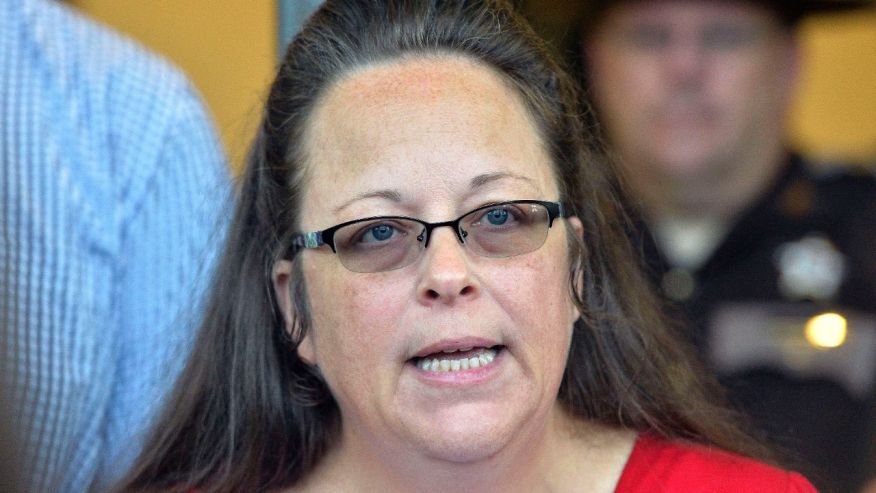
Kim Davis is back in the news, if only for just a fleeting moment.

The Rowan County, Ky., clerk has won a court fight launched against her by two gay couples and two straight couples who had sued her for refusing to issue marriage licenses to gay couples.

A federal judge ruled that Kentucky state law has been enacted that removes county clerks’ names from marriage licenses, which Davis and her supporters said protected her religious liberty, as she refused to issue the licenses based on her devotion to her Christian beliefs.

http://www.foxnews.com/us/2016/08/21/judge-dismisses-lawsuits-against-kim-davis-over-marriage-licenses.html

As I see this ruling, it’s a dismissal on a technicality. Rowan no longer has to put her name on these licenses, which in Rowan County are issued by one of her deputies.

This whole case erupted after the U.S. Supreme Court ruled that gay marriage is protected under the equal protection clause of the 14th Amendment to the U.S. Constitution. Davis decided to make a show of it by refusing to issue the licenses to gay couples — even though she took an oath to uphold the law of the land, the Constitution, and the laws of her state.

Davis has won a court battle. I get that.

She also messed up royally when she refused to fulfill the tenets of the oath she took when she assumed this public office.

Her religious liberty does not supersede the rights of those she has sworn to serve.

The county clerk can thank the Kentucky legislature for giving her room to wiggle her way out.

‘Outreach’ to African-Americans lies beyond Trump’s grasp

Donald J. Trump is trying to pander, er, reach out to African-American voters.

The Republican Party’s presidential nominee is plotting a curious course in that direction.

He’s held a couple of rallies in recent days. One was in suburban Milwaukee, Wisc., the other was in suburban Detroit, Mich.

I emphasize the “suburban” aspect for a specific reason.

He was standing in front of virtually all-white audiences telling them, apparently, about how terrible life has become for black residents of inner-city neighborhoods. “What the hell do you have to lose?” Trump asked, supposedly speaking over the heads of those who were standing in front of him. He was asking the larger audience that wasn’t there, the African-American voting bloc that — as of this moment — is giving the GOP nominee about 1 percent of its support.

It’s been reported that an avowed segregationist — the late Alabama Gov. George Corley Wallace — polled 3 percent of the black vote when he ran as an independent candidate for president in 1968.

A better, more sincere way to reach out to Americans is to speak to them directly. Venture into their neighborhoods. Look them in the eye, tell them you care about them and offer them demonstrative evidence that you have cared for them before.

Other politicians have employed that strategy while campaigning for African-American votes. I think specifically of the late Robert F. Kennedy and Bill Clinton.

Sure, President Clinton has had his hiccups regarding race relations, such as his occasionally frosty relationship with the Rev. Jesse Jackson and with Barack Obama and the time he scolded the rap singer Sister Souljah for spouting lyrics that promoted violence.

As for RFK, well, those of who are around at that time remember vividly his venturing into an Indianapolis neighborhood the night of April 4, 1968 to tell the black audience before him that Dr. Martin Luther King Jr had just been assassinated in Memphis, Tenn. Many of America’s cities erupted in violence that night. Indy, though, remained calm.

These days, such “outreach” by a leading politician consists of screeds shouted from podiums in affluent neighborhoods.

I’m trying to imagine Donald Trump following RFK’s example.

Nope. I can’t picture it.

‘Espirit’ is missing on Capitol Hill

la-1471894528-snap-photo

U.S. Marines talk with pride about the espirit de corps that exists within their ranks.

Roughly translated, it means “spirit of the group.”

The U.S. Congress used to operate under that mantra when natural disaster struck. If one part of the country falls victim to Mother Nature’s wrath, the entire legislative body rallies to the aid of their fellow Americans.

Those days are gone. I hope not forever, though.

The Louisiana floods show us this latest phenomenon at work.

The Los Angeles Times reports that three Louisiana congressmen, all Republicans, now are pleading for federal assistance to help their fellow Louisianans. What makes the story interesting is that they opposed similar requests for New Jersey after that state was clobbered in the fall of 2012 by Superstorm Sandy.

http://www.latimes.com/business/hiltzik/la-fi-hiltzik-louisiana-floods-20160822-snap-story.html

Do you remember when Joplin, Mo., got flattened by the tornado in 2011? Calls went out to help that city, too. Then-House Majority Leader Eric Cantor, Republican of Virginia, though, dug in his heels and insisted that Congress find a way to offset the expense by cutting money in other areas.

There once was a time in this country when Americans pulled together. We rooted for each other, prayed for each other — all while supporting efforts to lend tangible assistance. We didn’t put provisos on these requests. We just stepped up and offered a hand up to those in dire distress.

I know money is tight. I also know that the political climate in Washington has become toxic in the extreme.

That toxicity too often reveals itself when politicians argue over which congressional district deserves money in times of tragedy — and which of them do not.

It makes me ask: Are we truly an exceptional nation that rises to the needs of all its citizens, or are we governed by a group of petty politicians who look out only for those who elect them to public office?

I feel the need to remind the politicians who work on Capitol Hill: You signed on to serve the federal government and that means you serve all Americans.

No more homework? Hip, hip hurray!

Listen up, everyone.

I hereby nominate Brandy Young of Fort Worth, Texas, as teacher of the year. She’s trying something quite extraordinary, in my view. Young has declared her class to be a homework-free zone … mostly.

http://www.newschannel10.com/story/32816219/texas-teachers-new-homework-policy-goes-viral-on-social-media

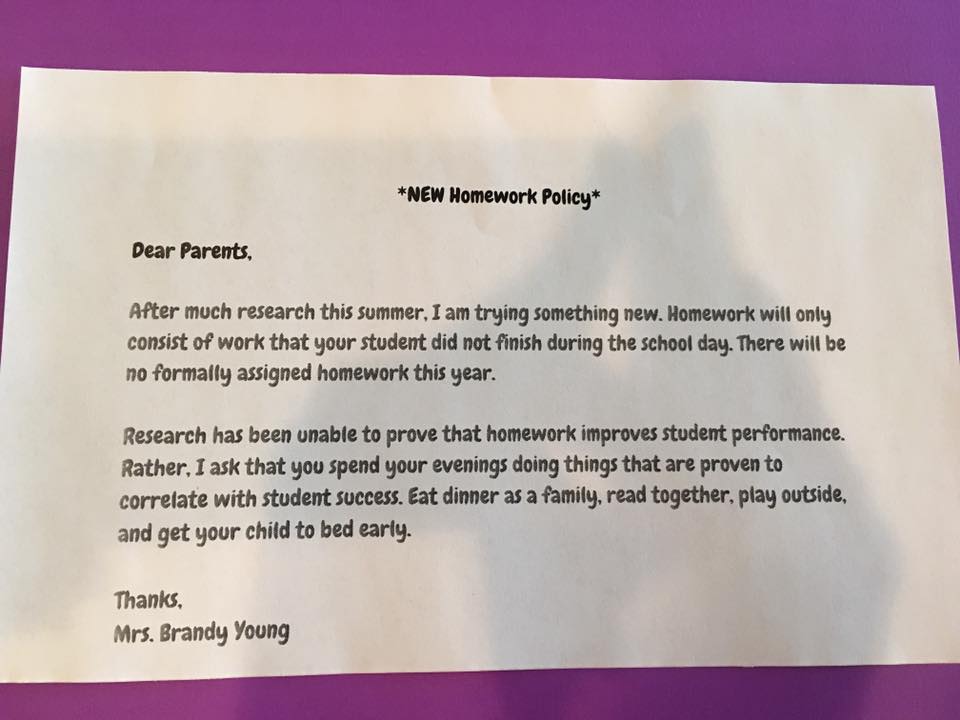
Young sent a note home with her students declaring that during this academic year, which began on Monday in Texas, she will assign homework only to those students who didn’t finish their work in class.

The note she sent has gone viral.

homework

What a novel notion.

My sons are long finished with school. They’re in their 40s now and have carved out successful careers and lives — and they have become upstanding men. My wife and I beam with pride at both of them.

Did the homework they lugged home each day during their time in school make them that way? I doubt it very much.

Brandy Young seems to believe that homework might actually be a detriment to young people’s development and growth.

The best part of the note is the advice she gives Mom and Dad. Do things together as a family, she says, and make sure the kids get to bed early.

Will this strategy work? Will it allow her students to perform better in class? Time will tell.

Here’s hoping it does.