Category Archives: legal news

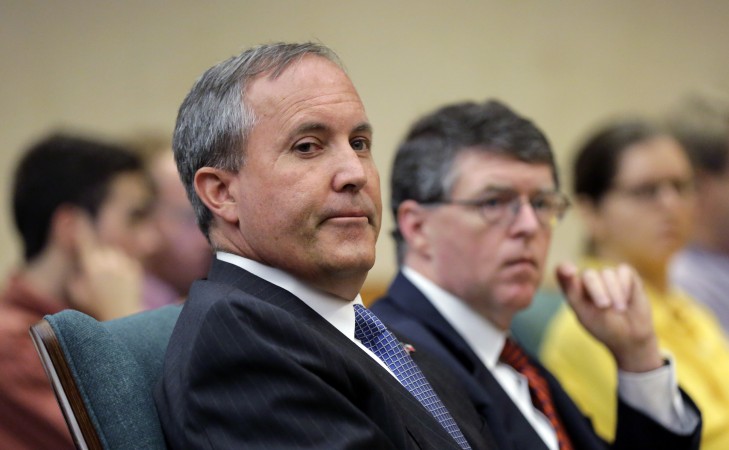
Texas AG faces big legal fight

Well, isn’t this just like a punch in the chops?

A Collin County grand jury reportedly has indicted Texas Attorney General Ken Paxton on securities fraud charges … which Paxton actually admitted to while he was running for the statewide office he now holds.

The indictment will be unsealed in McKinney, Texas, the Collin County seat.

The indictment involves an allegation — if you can even call it that, given Paxton’s admission — that he rustled up some investment clients for a friend without filing the proper paperwork with the state; that’s a third-degree felony. But it gets even more hairy. Reports have surfaced that the grand jury also will indict him on a first-degree felony accusation of securities fraud involving a company with which Paxton was involved, and which has been investigated by the Securities and Exchange Commission.

http://www.msn.com/en-us/news/politics/texas-attorney-general-indicted-on-felony-charges-sources-say/ar-BBljQAB

“The (Texas) Rangers went out to investigate one thing, and they came back with information on something else,” special prosecutor Kent Schaffer. “It’s turned into something different than when they started.”

The Texas Rangers are the elite investigative arm of the Texas Department of Public Safety. In other words, thee folks are good at what they do.

I feel the need to point out a couple of key political points, given that I’m quite sure someone is going to label it a “political witch hunt.”

One, the Collin County district attorney recused himself from the case; so a special prosecutor was brought in.

Two, a judge from Tarrant County, about 40 miles east of McKinney, is going to hear the case.

Officials have made a concerted effort to remove any taint of bias from this investigation, given that Paxton represented Collin County in the Texas Legislature before he was elected to the state’s top law enforcement office.

Oh, and what about the grand jury itself? Is it populated with folks who have an axe to grind against Paxton? Remember when the Travis County grand jury indicted then-Gov. Rick Perry? The governor accused the panel impaneled in heavily Democratic Travis County of playing politics, given that Perry is a Republican and the person he was accused of bullying is a Democratic district attorney.

Is Collin County a Democratic bastion that could find grand jurors ready to send the Republican AG up the river?

Consider this little item: Collin County voted nearly 2-to-1 for GOP nominee Mitt Romney over Barack Obama in the 2012 presidential race. It’s fair to presume, therefore, that the grand jury pool likely leans more toward the attorney general’s party than in the other direction. If it doesn’t, I’m quite sure we’ll hear about it.

This is possibly shaping up as a difficult time for the Texas attorney general.

Texas AG faces possible indictment

This one seems cut-and-dried, but it’s probably not going to be determined that way.

Texas Attorney General Ken Paxton has actually admitted to securities fraud. He was elected anyway in 2014 as the state’s top lawyer, its chief litigator. He should be above reproach. Isn’t that correct?

http://www.texastribune.org/2015/07/28/grand-jury-looming-paxtons-team-and-prosecutors-sp/

He’ll be investigated by a Collin County grand jury, which will get evidence presented by the Texas Rangers, the elite investigative arm of the Department of Public Safety.

Cut-and-dried?

The Republican attorney general admits to soliciting investment clients for a friend without notifying the state in accordance with state law.

So, is Paxton guilty as charged?

Let’s walk back a few years to around 1998.

President Bill Clinton took an oath to tell the truth while testifying before a federal grand jury. The panel asked the president some questions relating to his relationship with a young White House intern. The president didn’t tell the truth about that relationship.

What did the House of Representatives do? It impeached President Clinton.

Ostensibly, the impeachment really wasn’t about the inappropriate affair with the intern. It was about whether the president followed the law. The House said his lying to the grand jury constituted an impeachable offense.

The Senate, though, acquitted the president of the counts brought against him.

So, when a state constitutional officer — the attorney general — admits to breaking state securities law, does that constitute an indictable offense?

Cut … and … dried. Maybe.

Prison is far from ‘normal’

“We have a tendency 
 to think it’s normal that so many of our young people end up in our criminal justice system. It’s not normal. It’s not what happens in other counties. What is normal is teenagers doing stupid things. What’s normal is young people making mistakes.”

— President Obama

Doesn’t it strike you as odd that of all the men who’ve served as president of the United States, that it took the current individual — Barack Obama — to become the first one to visit a federal penitentiary?

I find it odd. It’s a long overdue examination by the head of state and government of a key component of the federal judiciary system.

President Obama went to the federal lockup in El Reno, Okla., and told corrections something they no doubt knew but rarely spoke about out loud, in public. It was that many of the non-violent criminals are no different from other young offenders who’ve made mistakes.

Lord knows I made my share when I was much younger and much less aware of the consequences one faces for making mistakes.

http://www.msnbc.com/msnbc/president-obama-meets-non-violent-inmates-oklahoma?cid=sm_fb_msnbc

Obama talked about the explosion in the prison population. It happened in Texas, to be sure, partly because a federal judge — William Wayne Justice — ruled that overcrowding in the Texas prison system created an unconstitutional form of punishment for inmates. He ordered the state to fix the problem, so the state went on a prison-building binge — including the two units in Amarillo — to help relieve the crowding issue.

Federal drug laws became the focus of Obama’s visit to the El Reno lockup. The sentencing guidelines put non-violent offenders into prison, often serving life sentences. He recently commuted the sentences of 46 non-violent offenders and went to Oklahoma to talk up the need to rethink these sentencing guidelines.

That it took so long, though, for a sitting president to step inside one of these prisons is mind-boggling in the extreme.

Is it “normal” for teenagers who make mistakes to pay for them by spending the rest of their life behind bars?

The president said “no.”

I happen to agree with him.

Stop griping about jury duty

Jury box Photo by Jason Doiy 2-9-11 054-2011

My friends keep griping about getting jury summonses.

“I don’t have time,” they say. “Why don’t they just quit calling on me?” they ask. “Aww, what a nuisance,” some have actually said.

If only I’d get picked for a jury. My life would be a little more complete.

Alas, it’ll never happen.

I’ve long ached for the chance to serve on a trial jury. I get maybe two or three such summonses a year from Randall County. They usually come from the District Clerk’s Office, which means they could be looking for jurors to sit on a felony criminal trial.

Oh, I wish I could get the call.

It’s not that I consider myself a model citizen, or a paragon of civic pride. It’s just that I’ve long considered jury duty to be one of citizenship’s primary responsibilities. Someone gets into trouble, has to stand trial and he or she deserves to be tried by an impartial jury of citizens.

But almost every time I’ve ever received a summons, I’ve called the evening before and the automated system tells me all potential jurors have been excused.

Damn!

I did get a jury summons one time, not long after moving to Amarillo. It came from the 47th District Court. I reported that morning, went to the jury waiting room and then, well, waited for about three hours. Then the judge, David Gleason, came out and told us we were excused.

I was crushed.

That was when I was working full time for the local newspaper. A colleague of mine told me I’d likely never be chosen because the nature of my job — as editor of the opinion section of the paper — meant I knew too much about too many things to be considered “qualified” to serve on a trial jury. Well, that was his view. Not mine.

Then came the deal-breaker. I got a chance to serve on a grand jury. This is the panel that decides whether someone committed a crime that deserves to be prosecuted. We met several weeks and indicted dozens of individuals; we also no-billed many others, meaning that the complaint brought to us by the district attorney didn’t merit a trial.

However, before we started our work, Randall County Criminal District Attorney James Farren told us something that has stuck to me like Gorilla Glue. If any of us ever thought about getting picked for a trial jury, he said, we can kiss that notion good bye. It isn’t going to happen. Why? Farren said our service on the grand jury would label us as biased toward the prosecution.

Huh? But, I can be impartial. Honest, man.

Too bad. The DA said we were tainted by our grand jury service.

I’d trade places in a minute with those who gripe about getting a jury summons.

If only …

Change the federal judicial system? Please, no

What is it with some American politicians?

A court ruling or two doesn’t go their way and they want to toss aside one of the basic tenets of our federal government? They want to elect federal judges, make them stand for “retention” if they make a decision that upsets some of us?

That’s the view of a leading so-called “conservative” U.S. senator who’s also running for the Republican presidential nomination in 2016. Take it away, Ted Cruz of Texas.

http://www.politico.com/story/2015/07/ted-cruz-chris-matthews-supreme-court-119891.html

Cruz jousted this week with MSBNC’s Chris Matthews over the setup of the federal judiciary. Cruz doesn’t like the two recent Supreme Court rulings that (a) upheld the Affordable Care Act and (b) legalized gay marriage in the United States.

The junior senator from Texas now thinks Supreme Court justices should stand for retention to enable voters a chance to decide if they want them to keep their jobs.

Matthews, not surprisingly, went semi-ballistic — which is part of his shtick. He brought up the Bush v. Gore decision that settled the 2000 presidential election. The Supreme Court voted 5-4 to stop the Florida recount. Texas Gov. George W. Bush was leading by 537 votes at that moment over Vice President Al Gore. Gov. Bush was awarded Florida’s electoral votes, which were enough to elect him president of the United States by a single electoral vote.

The five Republican-appointed justices’ overruled the four dissents cast by the Democratic-appointed justices. Politics? Gosh, do you think?

Conservatives hailed that decision. And why not? It was all done according to precisely the manner allowed by the U.S. Constitution. Some of us might not have liked the outcome, but that’s how it goes. The justices made the call.

Cruz didn’t object then, Matthews reminded him.

The nation’s founders set up a system in which the federal judiciary is intended to be free of political pressure. The president appoints judges and Supreme Court justices, who then are subject to approval by the Senate. They get lifetime jobs and, therefore, are able to rule according to how they interpret the Constitution.

This idea that we should now subject justices to the political will of the people is simply not in keeping with what the founders intended when they wrote the Constitution.

Political conservatives, such as Sen. Cruz, keep harping on “original intent.” Well, the founders’ “original intent” was to separate the judicial branch of government from the political tug-of-war that exists in the legislative and executive branches.

Cruz said he is “reluctant to call for elections,” and said it “makes him sad.” He added that he has made that call because “a majority of the justices are not honoring their judicial oaths.”

Yes they are, senator.

Let’s leave the judicial system alone.

Where was this voice on gay marriage?

Of all the voices heard across the United States of America that were commenting — pro and con — on the historic Supreme Court ruling that legalized gay marriage, one voice was conspicuously silent.

It belonged to the former vice president of the United States, Richard B. Cheney.

He’s been quick to lambaste the liberals ever since leaving office in January 2009. He calls Barack Obama the “worst president of my lifetime.” He’s leveled heavy fire on congressional Democrats on any number of foreign and domestic issues.

On this one, the issue that resonates on both sides of the political divide — for vastly different reasons, of course — he’s been silent.

The gay marriage debate hits the former VP squarely where he feels it. His daughter, Mary, is married to a woman.

In this instance, Vice President Cheney’s silence has been remarkable.

He dare not rile the base of his Republican Party, the folks who still adore him for his staunch conservative views, by endorsing how the Supreme Court has affirmed the Constitution’s equal protection clause contained in the 14th Amendment.

Then again, he dare not criticize the court out of concern that critics might jump all over him for condemning his very own daughter — who I am absolutely certain he loves without condition. Fathers do that, you know.

Man, it’s a dicey world when you have to decide which brand of loyalty wins out — loyalty to family or to political principle.

My hope is that family takes precedence.


Can’t we get a do-over?

Paul Burka apparently came out of retirement — perhaps just briefly — to write this scathing critique for TexasMonthly.com of Texas Attorney General Ken Paxton.

http://www.texasmonthly.com/burka-blog/ken-paxton-problem#.VZaoXwXb5tI.twitter

To sum up Burka’s analysis: Paxton’s public service career has been totally without accomplishment, yet he won the race for AG this past year because the state’s current TEA party golden boy, U.S. Sen. Ted Cruz, endorsed him.

Now the AG is facing a possible criminal indictment in his hometown of McKinney. A special prosecutor is going to take a complaint of securities fraud to a Collin County grand jury. If the attorney general is indicted, what happens then?

Burka noted that a Texas Monthly colleague asked Gov. Greg Abbott that question, and the government couldn’t/wouldn’t answer.

This appears to be one of those times when Texas voters should ask for a do-over from the most recent election.

I know it’s not possible, but I can wish for it anyway … can’t I?


Can politics drive a no-bill?

Let’s play out a possible drama that’s developing down yonder in Collin County.

The state’s attorney general, Ken Paxton, is being investigated for securities fraud. He admitted to doing something illegal while he was running for AG. He got elected anyway. Paxton has acknowledged that he steered investment clients to a friend without reporting it to the state. There could be a felony indictment in Paxton’s future … or perhaps not.

A special prosecutor has been named and he is likely going to seek an indictment from a grand jury in Collin County, which Paxton represented in the Texas House of Representatives before being elected to the statewide office. Paxton says, not surprisingly, that “politics” is driving this investigation.

So, would “politics” result in the grand jury deciding against an indictment of the Republican AG, given that Collin County also is a heavily GOP county?

I ask only because of the furor that erupted when a Travis County grand jury indicted then-Gov. Rick Perry last year on abuse of power and coercion charges. Travis County is a reliably Democratic part of the state; Perry, of course, is a Republican. The governor accused the grand jury — and the special prosecutor, who also is a Republican, by the way — of political motivation.

Does this politicization allegation work in reverse?

I’m just askin’.

AG Paxton faces possible felony indictment

Do you ever wonder why people vote for political candidates who actually admit to doing something that could get them into serious legal trouble?

How did Texans, therefore, manage to elect a state attorney general — Ken Paxton of McKinney — who had acknowledged he solicited investment clients for a friend without giving the state proper notification?

It’s called “securities fraud.” It’s a serious deal. A Collin County grand jury is going to decide — maybe soon — whether to indict the state’s top lawyer on charges that he committed a felony.

http://www.texastribune.org/2015/07/01/potential-case-against-paxton-appears-grow-serious/

Now, before you get your underwear all knotted up, let’s understand a couple of things.

Paxton is a Republican. Collin County is a heavily Republican county north of Dallas. A special prosecutor — ostensibly an independent-thinking individual — has been brought in to present the case against Paxton, a former state representative from McKinney.

This really and truly isn’t the partisan witch hunt that’s been alleged in Travis County, where another grand jury indicted then-Gov. Rick Perry of abuse of power and coercion of a public official.

No. This case ought to smell differently to those critics.

The most damaging element of this probe would seem to be Paxton’s own acknowledgment that he did something wrong.

And on top of all of that, he’s hired a high-powered former federal judge, Joe Kendall of Dallas, to represent him.

I don’t know what that tells you, but it tells me that Paxton thinks there might be something upon which the grand jury would indict him. He’s going to need the best legal help he can get.

Getting back to my initial question, given that all this was known prior to the election this past November: How in the world did Texans elect this guy?


Hats off to local county clerks

If I were wearing a hat at this moment, I’d tip it to two Texas county clerks: Randall County’s Renee Calhoun and Potter County’s Julie Smith.

All they did was agree to adhere to their oath of office and will issue marriage licenses to gay couples who seek them.

This is in accordance with a Supreme Court decision this past week that legalized gay marriage across the nation. It also resists the notion that they could refuse to issue licenses to same-sex couples, which Texas Attorney General Ken Paxton authorized them to do.

Given the extreme partisan divide across the land, it’s fair to make this point: Both women, Calhoun and Smith, are Republican county clerks. The state AG also is a Republican. They are defying the state’s attorney general, who contends that clerks could object if they had religious objections to issuing marriage licenses to same-sex couples.

The two county clerks plan to issue the licenses as soon as they get some paperwork matters straightened out.

Good for them.

Paxton’s decision to allow the clerks to refuse issuing the licenses has met with mixed response from county clerks across the state.

The attorney general’s approach to this matter is wrong-headed, as it seeks to allow these elected officials to disavow the oath of office they took, which is to follow the laws of the nation and the state.

The Supreme Court has determined — as the final arbiter of what is constitutional and what is not — that state bans on same-sex marriage violate the equal protection clause of the 14th Amendment to the U.S. Constitution.

Thus, gay marriage is now legal.