Negativity rearing its head down the stretch

Amarillo’s municipal election campaign never figured to be one conducted entirely with sweetness and warm-and-fuzzy expressions of grand visions for the city’s future.

There’s been some negativity expressed of late.

Moreover, I’ve heard a bit of grumbling from some residents who dislike what they’re hearing.

Let’s hold on.

What I’m hearing so far hasn’t been of a destructive nature. It has challenged — in a couple of instances — assertions made by a couple of incumbents; both councilmen, Elisha Demerson and Mark Nair, have responded to the challenges.

Amarillo Matters enters the fray

The political action committee formed to help shape the discussion has decided to weigh in. It has endorsed a slate of candidates, calling for an entirely new City Council to be elected on May 6.

There’s been some push back against some of the recommended candidates. Again, it’s nothing to cause extreme angst and anxiety, although I’ve learned over the past two-plus decades living in Amarillo that the community often doesn’t respond well to any sort of negativity when it involves our friends, neighbors, fellow church attendees and parents of children who attend school together.

My hope is that this election produces a voter turnout that far exceeds the norm for our municipal campaigns. The way I see it, voters respond to negativity. It’s not an indictment, per se, of this community; I merely am stating what I believe to be an obvious trait among red-blooded American voters.

I still like the slate of candidates that Amarillo Matters recommends. I continue to endorse their general outlook and the approach they bring to City Hall governance.

As for some of the negative stuff that’s starting to get a bit of traction, that’s, too, is the longstanding nature of American politics — even at the local level.

Even in Amarillo, Texas.

Early voting begins today. Per my usual practice, I intend to wait for Election Day to cast my ballot. One never knows what could erupt down the stretch.

There shouldn’t be this kind of angst at a university

I detest stories like this, reports of so-called “liberal intolerance.”

Actually, I am forced to acknowledge that such intolerance is real and it exists in the most unsuitable places: colleges and universities across the United States.

Ann Coulter, a fiery conservative columnist and TV pundit, was supposed to speak to students at the University of California-Berkeley. Then the school canceled her appearance, citing “security concerns.” UC-Berkeley took back the cancellation and then rescheduled Coulter for another date.

Coulter might not speak after all. She contends she has scheduling difficulties that will keep her otherwise occupied.

When did universities become so exclusive?

Students who want to hear from Coulter now are threatening to sue the school.

Good grief, folks!

All of this is a symptom of the intolerance that grips colleges and universities. There can be little doubt about that, in my view.

Coulter is provocative. That is her shtick. She likes to stir people’s emotions and she’s quite good at it. Coulter also is a darling of the conservative media in America and is no friend of liberals, many of whom run our nation’s major university systems — such as the University of California.

This kind of uproar shouldn’t exist at these institutions of higher learning. Security concerns? Are they real or imagined?

Universities should be a place where all points of view from across the broad political spectrum are welcome. Should every student, faculty member or college administrator embrace every point of view expressed? Of course not. But neither should they reject them outright because they might be, oh, politically incorrect.

All this hubbub about “security concerns” regarding Ann Coulter looks and sounds like a dodge that masks the real motivation, which is to silence a leading conservative voice.

We can argue until we all run out of breath about whether Coulter deserves the standing she enjoys among conservatives. The fact is that she is part of a political movement that isn’t to my particular liking. She still deserves to be heard.

After she speaks, then let the students and their professors argue among themselves about what she has said. Who knows? They might learn something from each other.

Happy Trails, Part 11

We have been doing some housecleaning around here lately.

Moving day will arrive eventually as we prepare to launch ourselves into a new adventure. Retirement has given us time to do some serious evaluation and re-evaluation of what we possess and what we should keep or discard. Those of you who’ve been through this get my drift.

I have been rifling through my home office desk and I’ve come across three items that — strangely enough — I just cannot discard.

Two of them involve tools of the craft I pursued for nearly 37 years. Old-line journalists will know of what I speak. The newbies out there, well, listen up.

One of them is a pica pole. It’s like a ruler only with a specific newspaper-related purpose.  A pica is a unit of measurement. Six picas equal one inch. The pica pole has inch markings on it, but when you’re working with this device in a newsroom, you rely on the pica measurement.

It tells you how wide to make your photographs, how wide your columns of type will be, how deep the stories will run along a page of type.

Pica poles are relics of the past. To my knowledge, they have no practical use today in this age of desktop publishing.

I actually have two of them, one of which I am certain was issued to me at the first full-time journalism job I had, at the Oregon City (Ore.) Enterprise-Courier. The E-C, as we called it then, also has gone dark. It no longer publishes. The building has been wiped off the slab at its downtown Oregon City site.

My boss at the time told me to “guard this with your life” when he issued it to me back in 1977. I have done as he said.

The second item is a proportion wheel. We used this item to measure the size of pictures we would place on our news pages. You line up the inner wheel measurements with the outer wheel measurements and you determine by how many percentage points you want to expand — or shrink — the original print to make it fit the space you have on the page.

That’s all done electronically now.

The third relic from my former life? That would be a luggage tag I collected on the trip of a lifetime I took in November 1989. It’s a Thai Air tag that went on a piece of luggage from Bangkok to Hanoi — yeah, the city in Vietnam.

I was among a group of editorial writers making a fact-finding trip to Southeast Asia. The National Conference of Editorial Writers arranged for this trip that originated in Thailand, then to Vietnam, then to Cambodia and back to Vietnam.

Once the official NCEW portion of the trip concluded, I was able to travel to Da Nang with two of my colleagues and visit the place where I had served 20 years earlier as a member of the U.S. Army. A life-changer? You bet it was.

I am not sure why I kept the Hanoi bag tag, but I am glad I did.

It is one of those wonderful — if small — reminders of the many great things I was able to see and do pursuing a craft to which I was deeply devoted.

That was then. The here and now beckons my wife and me to places still to be determined. I’ll keep you posted.

Sen. Cruz: a little self-awareness … please!

Ted Cruz suffers from a serious bipartisan affliction that affects politicians of all stripes.

It’s an acute case of lack of self-awareness. The Texas Republican said that he fears that U.S. Senate Democrats are all in favor of shutting down the federal government over some spending proposals.

Gosh, who knew?

Sen. Cruz said that would be horrible, I tell ya — just horrible! We can’t shut down the government, he said, forgetting — or ignoring — his own role in the previous government shutdown.

You might recall that Cruz sought to filibuster an end to the Affordable Care Act; the filibuster failed but the government had to shut much of its operations down for 16 days thanks in good part to the Cruz Missile’s efforts to repeal the ACA.

As the Texas Tribune reports: “You know, one of the dynamics we’ve got is the Democratic radical left is demanding of Senate Democrats that they oppose everything, that they engage in across-the-board obstruction,” Cruz said Monday. “And so I do have some concern that to appease the radical left, Chuck Schumer and the Democrats may do everything they can to try to provoke a shutdown.”

That’s politics, Sen. Cruz

Young man, you need to look back on your own role as part of the “radical right” of your own party. It was quite all right for Cruz and others within the Republican Party to try to talk the ACA to death and produce a partial government shutdown in the process.

“You know, I very much hope we don’t have a shutdown,” Cruz said. “I will say I’m concerned. I think [Senate Minority Leader] Chuck Schumer and the Democrats want a shutdown.”

Excuse the disagreement, Sen. Cruz. No one wants to shut down the federal government.

Not even those dreaded Senate Democrats. Honest.

Wishing for days of ‘pork barrel’ bickering

My late mother had a retort when I would say, “Mom, I’ve been thinking.”

“Oh, beginner’s luck?” she would ask … rhetorically.

I’ve had a rash of beginner’s luck lately. I’ve been thinking about the good ol’ days of politics in Washington, D.C., when we used to single out politicians who had this habit of being champions for “pork barrel spending projects,” or those projects that benefit a specific area.

These days, worries about pork barrel spending has given way to rank ideology, where one side calls the other side “evil.” Liberals think conservatives have evil intent; the feeling is quite mutual coming from the other side.

Frankly, I prefer the old days when politicians used to bitch at each other because of all the money they funneled to their states and/or their congressional districts.

The former Republican U.S. senator from Texas, the loquacious Phil Gramm, used to boast about all the “pork” he brought home. “I’ve carried so much pork back to Texas,” he would say, “I think I’m coming down with trichinosis.”

Gramm, though, was a piker compared to some of his Senate colleagues. The late Democrat from West Virginia, Robert Byrd, was known as the king of pork barrel spending. He would attach riders onto amendments to bills that had dough for this or that federal project. As a result, Byrd’s name is on more buildings and bridges in West Virginia than one can possibly imagine.

However, is pork barrel spending a bad thing?

Look at it this way: Politicians do what their constituents want them to do. That’s the nature of politics in a representative democracy, as near as I can tell. We elect pols to represent our interests. If it means carving out a few bucks for this project or that back home, well, then that’s what we send them off to do for us.

These days we hear from rigid ideologues in the U.S. Senate and House. Texas’ two senators — Republicans Ted Cruz and John Cornyn — offer prime examples. One won’t likely accuse Cruz especially of being loaded down with pork; he’s too busy promoting rigid conservative ideology to worry about rebuilding highways and bridges back home in Texas; Cornyn, too, has this leadership role among Republicans in which he seeks to elect more of them to the Senate.

The House features much the same sort of ideology. My congressman, Mac Thornberry, R-Clarendon, once criticized President Obama for considering air strikes against Syria; then he praised Donald J. Trump for doing that very thing. Thornberry isn’t the least bit interested in pork barrel spending, which seems to fit the desires of his constituents; if they insisted on him bringing home more money to the 13th Congressional District, my hunch is that he’d do their bidding.

Where am I going with this?

I guess I’m trying to suggest two things.

One, I long for a return to the late House Speaker Tip O’Neill’s maxim that “all politics is local.” Why not argue the merits of this or that spending program and whether our member of Congress — in the House or Senate — is doing what we want him or her to do on our behalf?

Two, let’s quit the purely ideological battles and demonization of each other just because they happen to be of a different stripe. From where I sit, I still consider good government to be a team sport where each team respects the other side.

Hoping to head off Trump Fatigue

I might need an intervention.

News junkie that I am, I usually cannot resist watching cable and broadcast news channels’ discussion of current events, of public policy and, yes, even politics.

Until now.

I awoke this Sunday morning and decided to avoid the weekly news/commentary/analysis talk shows. I didn’t watch George or Chuck on ABC or NBC, respectively. I had no particular desire to listen to the talking heads on “This Week” or “Meet the Press.”

Why? I fear it’s because of the subject matter: Donald John “Smart Person” Trump, the current president of the United States of America.

The guy is starting to wear me out. We’re not even at the 100-day mark in his presidency. Good grief! That means we have another nearly four years to go before the next presidential election!

Heaven help us. Or maybe just me.

I don’t intend to stop commenting on this clown’s tenure as president; I consider contributions to High Plains Blogger to be a form of therapy. I might even be able to fend off the Trump Fatigue I fear is beginning to overtake me.

Maybe I just need a day or two — or maybe three or four — away from the TV set.

Wish me luck. I’ll extend the same to you.

FBI managed to muck up a murky election

I continue to have great respect for FBI Director James Comey — even after reading a lengthy New York Times article providing excruciating detail about how might have changed the course of political history with a single letter to Congress.

Comey was holding on to information that I reckon he felt he had to make public while keeping secret other information related in some fashion to what he was about to disclose.

Did the nation’s top cop swing the 2016 presidential election all by himself by giving up the goods on Hillary Rodham Clinton while keeping quiet what he was looking at regarding Donald John Trump? I don’t believe that’s the case. But, damn! He made a tough call at the just the wrong time!

The article is long, but worth your time. It details the agony that Comey endured during the final months of a bitter presidential campaign.

Eleven days from Election Day, Comey decided he had to send a letter to Congress telling lawmakers that he had more information that might be pertinent to an investigation he had concluded regarding Clinton’s e-mail use during her time as secretary of state.

Do you remember how he held that press conference in July 2016 in which he criticized Hillary’s “careless” use of the personal server? And how he then said he had no grounds to prosecute her? That presser was, in itself, highly unusual.

When some more e-mails became available, he then seemed to believe he owed the public some sort of explanation of what he found.

But, man, the timing was terrible!

While all this is engulfing the campaign, we didn’t know that Comey’s agency was probing allegations that Trump’s campaign might be colluding with Russian computer hackers seeking to influence the election, trying to help the Republican nominee defeat Hillary.

He didn’t reveal any of that. Indeed, he only went public with that tidbit just a few weeks ago during a congressional hearing.

FBI policy had been to stay out of partisan political activity. It cannot be seen as a factor in deciding elections. I get it. So does everyone else.

As for whether Comey’s disclosure of the e-mail issue late in the campaign and whether it proved decisive … I’ll simply make this point: Hillary Clinton’s campaign never should have had to worry about an election outcome in the first place.

She and her team made enough mistakes without that disclosure to keep Trump’s campaign close enough to catch them.

Hillary Clinton is far more qualified to be president than the man who defeated  her. Her abject failure to communicate with voters as a living, breathing human being — to talk directly to them and to spell out a clear vision for how she intended to lead the country — doomed her effort to make history.

Trump Hotel poses potentially huge conflict for … Trump the POTUS

How in the world does Donald John Trump get away with this?

He serves as president of the United States. He continues to hold onto business interests, such as the Trump International Hotel, which plays host to foreign government leaders; those foreign governments spend money doing business at this hotel.

And the president somehow doesn’t violate the “emoluments clause” of the U.S. Constitution, the clause that says president’s cannot accept money or other inducements from foreign governments?

It’s an anti-bribery clause, in a manner of speaking.

Yet the president continues to dine there, which I suppose he is entitled to do. What is making my head spin is how this particular hotel can, in the words of The Hill, be the “go-to” place for foreign government dignitaries.

Isn’t the Constitution clear about this?

The emoluments clause is in the very first article of the Constitution. The founders were clear, I have thought, to prevent the president from doing any form of private business with any “King, Prince or foreign State.”

Let’s remember that Trump hasn’t divested himself of his vast business empire; he’s handed it all over to his sons

But as The Hill reports: “The hotel has been the go-to location for foreign leaders and dignitaries since it opened last fall, when Trump was still a presidential candidate.”

He’s no longer a candidate. He’s now the man. The president of the United States. Leader of the free world. Commander in chief. Head of state.

Unless he’s giving away all the services his hotel is providing those foreign “dignitaries and leaders,” it seems to me that he’s committing an unconstitutional act.

No intention to lecture AG about the law, but really …

I am acutely aware that Jefferson Beauregard Sessions is an educated man.

He went to law school; passed the Alabama state bar; served as a federal prosecutor; tried to become a federal judge in the 1980s, but was rejected by the U.S. Senate because of some things he reportedly said about black people; then he was elected to the Senate.

He now serves as U.S. attorney general, thanks to an appointment by Donald John Trump.

There. Having stipulated all of that, I need to remind the attorney general that he should not disrespect the tenet of judicial review that the nation’s founders established when they formed our republic more than two centuries ago.

I say this with no desire to lecture the AG about the law, or the U.S. Constitution.

However, when he pops off about a federal judge sitting on the bench “on an island in the Pacific,” he has disrespected one of the basic frameworks set aside by those founders.

The judge presides over a federal court in Hawaii, one of the nation’s 50 states. U.S. District Judge Derrick Watson ruled against Trump’s temporary travel ban on constitutional grounds. The travel ban is now heading to the 9th Circuit Court of Appeals.

You’ll recall, too, that the president himself referred to another federal jurist in Washington state as a “so-called judge” when he struck down an earlier travel ban involving refugees from seven Muslim-majority countries. Trump might need a lecture about the Constitution and the separation of powers written into it; he might need to be told about how the founders intended for the judiciary to be independent of political pressure. Given that Trump had zero government experience prior to becoming — gulp! — president, he might be unaware of the not-so-fine print written in the Constitution.

The attorney general should know better than to disparage a federal judge in the manner that he did.

An island in the Pacific? C’mon, Mr. Attorney General.

Suck it up. Let the courts do their job. Sure, you are entitled to challenge court decisions’ legality. However, let’s stop the petulant put-downs.

Same thing goes for you, too, Mr. President.

Puppy Tales, Part 34

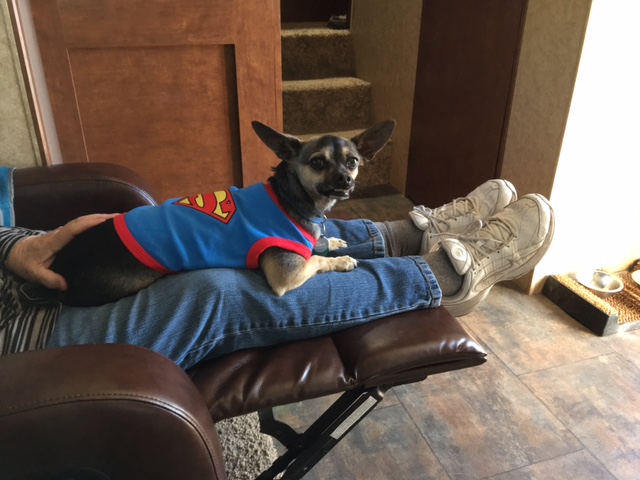
Take a look at the dog in this picture.

This is Toby, our 3-year-old Chihuahua-mix who we address simply as Puppy. We only refer to him to others by his name. To us he is just Puppy.

He believes he is the baddest pooch on the block. On second thought, he believes he is the baddest pooch of all time. He is fearless. He has no qualms about approaching other dogs — regardless of size or the sound of their bark.

I mention this because Toby the Puppy just came from a walk through the ‘hood with my wife and me. We routinely walk by fenced-in yards that are home to other dogs. They routinely bark, snarl and growl at Toby as we saunter on past. What does Toby the Puppy do?

He wants at ’em. He pulls at his leash as if to tell Mommy and me, “Let me take care of bidness.”

Well, we don’t encourage him. We tell him to “heel.” He complies, generally.

Toby entered our family nearly three years ago. It was love at first sight — both for him and for us.

We learned a couple of things right away about our puppy, who was 5 months old when we took over our household. One was that he had a bark that was much larger than his physical size; he now weighs about 9 pounds, but sounds like a bigger, badder dog than that when he chooses to have his voice heard — which isn’t very often.

The second thing we learned was that he is without fear.

To our knowledge, he has had just one semi-serious altercation with another dog. It was with our next-door neighbor’s pooch, who weighed about 50 pounds. Lily came onto our driveway; she and Toby sniffed each other for a moment then she started fighting with him. Toby gave as good as he got for the second or two they were tussling.

After that Toby and Lily were just fine.

When we visit our son, daughter-in-law and granddaughter in Allen, Toby uses his (lack of) size to his advantage while play-wrestling with Madden, the kids’ hulking black Lab. Toby is fond of avoiding Madden by scooting underneath the big dog, frustrating his pal to no end.

We have joked with those who tell us when they meet Toby, “Oh, he looks just like a German shepherd!” We have answered that he’s a “miniature version” of the renowned breed. A couple of folks have actually believed it.

Toby doesn’t realize he’s a small dog. He’s not supposed to want to tangle with big ol’ pooches who challenge him. As long as he’s on our leash he won’t venture where he shouldn’t go.

He’ll have to be satisfied merely with making his mother and me laugh daily.

Commentary on politics, current events and life experience