Tag Archives: Donald Trump

Once more in high praise of the media

The president of the United States has grown annoyingly fond of calling the media that publish and broadcast negative stories about him “fake news.”

The description he uses — and the context in which he utters it — demonstrate that Donald John Trump doesn’t understand what “fake news” really is. “Fake news” are the made up accounts, lies, fabrications … the kind of thing that Trump has done for many years. I’ll get back to that in a moment.

I want to offer another word of high praise for the media for the job they have done in covering the 45th president of the United States.

The world has witnessed a rebirth of sorts of traditional, gumshoe reporting by great print media. The Washington Post, The New York Times and The Wall Street Journal — three powerhouse print outlets — all have demonstrated the value of hard-nosed reporting. Were it not for their dogged pursuit of tips the nation wouldn’t know about:

* Russian hacking into our 2016 election process.

* Donald Trump’s presidential campaign’s potential role in that meddling.

* The issues related to the president’s firing of FBI Director James Comey.

* The possible conflicts of interests related to the emoluments clause in the U.S. Constitution.

That’s just four issues. The media have done their job. They have done what the media always do and what presidents — until the current one — have accepted as part of journalists’ calling.

Donald Trump instead has promoted actual “fake news” all along the way. He has promoted the scurrilous assertion that Barack Obama wasn’t constitutionally qualified to serve as president; he lied about “thousands of Muslims” cheering the collapse of the Twin Towers on 9/11; he has lied about “millions of illegal immigrants” voting for Hillary Clinton in 2016; he lies about the size of his electoral victory; his press office has lied about the size of Trump’s inaugural crowd.

And this man, then, has the audacity to accuse media outlets of promoting “fake news” that in actuality is merely news that doesn’t slather him in glowing praise.

Mr. President, that’s the way it goes. Every single one of your predecessors has gotten beaten up by the media. Have they blackballed news outlets? Have they called the media “the enemy of the people”? Have they called individual reporters “terrible, dishonest human beings”? No. They understand the value of a free press and have welcomed the media’s efforts to hold all public officials accountable for the words and actions.

They have reacted far more professionally and “presidential” than the thin-skinned weakling who occupies the Big Chair in the Oval Office.

As someone who toiled for nearly four decades as a print journalist, I am damn proud of the job my former colleagues are doing.
‘You can’t unhonk the horn’

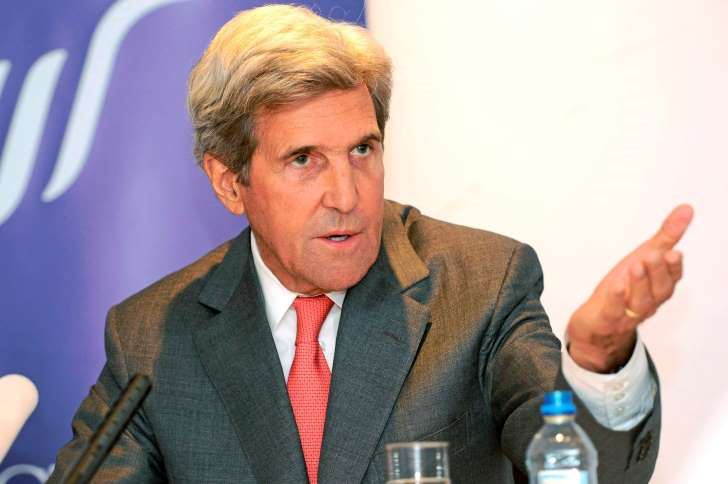
Former Secretary of State John Kerry spoke a fundamental truth about how difficult it is to take back public statements.

Donald J. Trump said the patently wrong thing about the violence that erupted over the weekend in Charlottesville, Va., calling an end to violence “on many sides.”

Rather than single out the white nationalists, neo-Nazis and Ku Klux Klansmen who initiated the violence, Trump chose instead to equivocate shamefully.

Well, he took a baby step toward redemption today by singling out the racists and bigots who gathered in Charlottesville to protest the taking down of a statue of Confederate Gen. Robert E. Lee. Many observers have noted that the president seemed a bit uncomfortable today as he delivered his prepared remarks.

Kerry, though, said you can’t “take back” the “many sides” comment. Kerry called the president’s first response “revealing” and said they had empowered “the worst of the worst.”

Trump tried to take it back but failed, according to Kerry.

I’m reminded of what my late friend and former colleague Claude Duncan was fond of saying: “You can’t unhonk the horn.”

Indeed, people in high places aren’t usually allowed to take mulligans. There aren’t any do-overs — especially for the president of the United States, whose words resonate and keep resonating long after he utters them.

How would Dad react to these Nazi sympathizers?

I introduced you some time ago, dear reader, to my favorite veteran.

He’s my father. Dad served in the Navy during World War II. He saw plenty of combat throughout the Mediterranean theater of operations. Dad took part in three land invasions: Oran in North Africa, Sicily and in Salerno, Italy.

His ship got sunk during the Sicilian campaign. He shot a German bomber out of the sky while manning a deck gun.

I have thought of Dad during the past couple of days as national reaction poured forth about the neo-Nazis who took part in that Charlottesville, Va., protest; actually, I think of Dad — and Mom — every single day. The Nazis joined other hate groups — Ku Klux Klan and white supremacists — to protest the taking down of a statue of Confederate Gen. Robert E. Lee.

U.S. Sen. Orrin Hatch, a Utah Republican, spoke for a lot of World War II veterans and their families when he said his brother “didn’t die fighting Hitler” just to let these neo-Nazis’ actions “go unchallenged.”

Dad died in September 1980. I don’t recall then the emergence of these neo-Nazi groups getting the kind of exposure they get today. How would he respond to them? How would Dad react to the hideous rhetoric that comes from individuals wearing the swastika symbols worn by those who sought to kill him in 1943 and 1944?

To be candid, I don’t recall having that discussion with Dad when he was among us.

However, I knew my father pretty well. He was a proud American. He was proud of his service defending the nation during its darkest time. Dad was one of the millions of Americans who comprised the Greatest Generation.

I believe he would be angry as hell at those who rise up to tear at the nation’s fabric. Although the name “Donald John Trump” wasn’t on anyone’s radar when Dad died, I believe he would be enraged at the seeming timidity from the president when it involves neo-Nazis.

Trump finally says what he should’ve said the first time

That wasn’t so painful, was it, Mr. President?

Donald J. Trump returned to the White House — aka “a real dump” — to sign an executive order and then deliver some remarks about the “criminals and thugs” who instigated the deadly race riot in Charlottesville, Va., over the weekend. He had been facing immense pressure from, um, “many sides” as a result of his initial response to the violence.

The president said what he needed to say at the outset. The Klan, neo-Nazis and assorted white supremacist groups provoked a riot while protesting the planned removal of a statue of Confederate Gen. Robert E. Lee. It went bad bigly.

Trump has condemned racism and bigotry and called out the white supremacists and Nazis as “criminals and thugs.” He called them what they are. Trump said “racism is evil” and said hate groups such as neo-Nazis and white supremacists “are repugnant to everything we hold dear as Americans.”

How far will his remarks go in healing the damage that already has been done by his initial remarks in which he blamed “many sides” for the violence that erupted? Time will tell.

If he had asked for my opinion, I would have preferred that the president atone more directly for his error of omission. He should have acknowledged publicly in the White House that he erred in failing to respond appropriately.

Moreover, he could have said categorically that he does not welcome the overt political support of individuals such as one-time Ku Klux Klan grand dragon/lizard David Duke, who over the weekend invoked Trump’s name. Duke said he wants to “take our country back” and said “that’s why we voted for Donald Trump.”

He didn’t do those things. The president did say the right words — today! I still have to ask: Did they come from his heart, his soul?

Please demonstrate that they did, Mr. President.

Trump shows yet again his true self

It took Donald John Trump several hours to say something publicly about the riot in Charlottesville, Va.

His remarks missed by a mile. Then Kenneth Frazier resigned from the President’s Manufacturing Council in protest over the tone of the president’s remarks on the riots. They didn’t go far enough, Frazier said. The president needed to condemn the racists and neo-Nazis who provoked the riot.

So, the Merck CEO quit the president’s council.

You can read Frazier’s remarks here.

How long did it take for Trump to respond to Ken Frazier’s resignation? Hardly no time at all.

He tweeted this: “now that Ken Frazier of Merck Pharma has resigned from President’s Manufacturing Council, he will have more time to LOWER RIPOFF DRUG PRICES!”

OK, did I mention that Kenneth Frazier is African-American? Oh, wait! I just did.

There you go. I believe we have just witnessed another remarkable demonstration of the president’s lack of character.

‘These contemptible little men … ‘

The condemnations are rolling in from the Republican Party’s side of the great American political divide.

U.S. Sen. Tom Cotton of Arkansas, weighed in with a message he delivered from the Balkans, where he is touring during the August congressional break.

Regarding the white supremacists who instigated the Charlottesville, Va., riot that resulted in the horrific death of a counter protester, Cotton referred to the neo-Nazis as “contemptible little men” who deserve the full brunt of whatever punishment the law would deliver to them.

And yet …

The nation’s Republican in chief, the president of the United States, seems to be standing by that shamefully tepid statement in which he lays the blame for the violence “on many sides.”

He refuses to call the white nationalists/racists/neo-Nazis out by name. Donald Trump refuses to do what he and others insisted Barack Obama do when talking about international terrorism; they insisted that the former president state specifically “radical Islamic terrorists.”

It’s clear to me now that whatever measures the president might take to atone for his egregious error of omission must refer to his mistake. He must acknowledge out loud — and in full voice — that he erred when he spoke of “many sides.” He had a chance to condemn the hate groups that foment the violence we witnessed but he blew it.

Anything short of a presidential mea culpa will lend utter hollowness to whatever he says now.

Do you expect him to do such a thing? Neither do I.

Not all Trumps are as clueless as POTUS

What do you know about this?

First daughter Ivanka Trump has said something Dad couldn’t bring himself to say, which is to condemn white nationalists, and neo-Nazis.

Ivanka fired off a tweet that said: “There should be no place in society for racism, white supremacy and neo-nazis.”

The young woman just took several giant steps beyond what her father, the president of the United States, said rather meekly about the Charlottesville, Va., riot that resulted in the death of a counter protester.

It all started when a group of white supremacists and Nazi sympathizers protested the decision to take down a state of Confederate Gen. Robert E. Lee. It went downhill from the get-go.

The president then blamed “many sides” for the violence, refusing to call out the hate groups that provoked the riot in the first place. The president seeks to portray himself as a strong man. He instead comes off as a weakling, a wimp.

So now Ivanka has entered the discussion with a patently reasonable and well-aimed statement that should have come from the president of the United States.

POTUS needs to be calming influence, not the inflamer

Donald John Trump Sr. has been all the rage since taking office as president of the United States.

That’s by his own design, no doubt. Today, for instance, the TV talk show pundit class was talking about Trump and his bellowing bellicosity regarding the North Koreans and their nuclear ambitions.

I heard many of the pundits say essentially the same thing: The president should be the voice of calm, reason and wisdom. It’s the president who should settle a nation’s nerves. He should be the comforter in chief.

Not this guy. Not the current president.

Secretary of State Rex Tillerson tried to tell North Korean officials they need not worry about “regime change.” We aren’t interested in tossing out Kim Jong Un, Tillerson said.  National security adviser H.R. McMaster said he doesn’t believe we are closer to war today than we were a month ago, apparently seeking to calm a jittery nation that might believe we’re on the verge of launching a nuclear strike against the reclusive communist state.

But what does the president do? How does he handle all this? He talks about “fire and fury,” about how our military is “locked and loaded.” He warns Kim not to issue any “overt threats” or else he’s going to pay bigly and he’ll feel the pain of our response “very soon.”

President Truman removed General of the Army Douglas MacArthur from his command in Korea to reassert civilian control over the military; President Eisenhower resisted sending combat troops to Vietnam out of concern of getting involved in a quagmire; President Kennedy resisted invading Cuba during the missile crisis.

Part of the president’s unwritten job description is to be the voice of calm assurance. Presidents Johnson, Nixon, Ford, Carter, Reagan, Bush 41, Clinton, Bush 43 and Obama all filled that role at various times during their time at the helm.

Donald Trump should take heed of the lessons offered by all his recent predecessors.

It’s sad to admit, though, that he likely won’t.

White House faces another moment of truth

As if the White House doesn’t have enough centers of conflict within its walls, now we hear about yet another feud erupting between two of the president’s closest advisers.

In one corner is Stephen Bannon, the uber nationalist and former head of Breitbart News and a guy known for his rather harsh views about “globalism.” In the other corner is Army Lt. Gen. H.R. McMaster, the brilliant military strategist who now serves as Donald John Trump Sr.’s national security adviser.

The White House is getting caught up in a growing potential crisis in North Korea. The president needs close aides nearby to give him sound advice on how to handle this matter.

McMaster made the rounds today on news talk shows to talk about the Korea issue — and about his relationship with Bannon. McMaster declined to say he could work with Bannon. He soft-shoed his way all around the questions.

Indeed, this is another test for the White House, which now is being run day-to-day by another general-grade officer, former Marine Gen. John Kelly, the president’s newly named chief of staff. It now falls on Kelly to ensure that the White House functions like a “fine-tuned machine,” which is now Trump once described his dysfunctional administration.

My sincere hope is that McMaster emerges as the man who’s standing if he, indeed, is engaged in a battle with Bannon.

I don’t trust Bannon as far as I can throw my big home office desk. He lacks the background to serve as a “senior policy adviser” to the president of the United States. He is a far-right provocateur and a damn scary dude, to boot!

McMaster is a grownup with tremendous combat experience. He has emerged as a brilliant strategist and he is the kind of serious-minded adviser who — if he’s given the chance — can serve the president and the nation with distinction.

All of this, of course, relies on the president’s judgment.

Will he heed the voice in his head that tells him to trust the national security pro or does he rely instead on the right-wing flamethrower?

As hopeful as I want to be on how this turns out, I am not willing to bet the mortgage the president will do what is right for the nation.

What does Kim Jong Un want? Part 5

This concludes my brief examination of the five demands that Kim Jong Un  has made on a world seeking to lessen tensions on the Korean Peninsula.

USA Today has listed five of them. Kim wants the United Nations to lift the sanctions it has imposed on North Korea. Good luck with that one, Mr. Dictator/Goofball.

The only way the sanctions could go away would be if Kim agrees with U.N. and U.S. demands that he cease making nuclear weapons and cease testing the missiles he hopes would deliver them.

Kim has brought a lot of misery to his people by spending so much of his nation’s Gross Domestic Product on militarization. North Korea is bristling with artillery pieces, tanks, fighter jets — but its people are starving. The sanctions imposed by the U.N. ban the export of coal, iron ore, lead and lead ore, depriving the nation of about $1 billion annually.

There needs to be concessions by North Korea for the sanctions to be lightened, or eliminated.

All of this circles back, in my view, to the issue of “containment and deterrence.” If the United States and the rest of the world would accept the notion that Kim is going to keep his nukes and then rely on the threat of immense destruction that would be delivered to his country if he launches any kind of strike, then this crisis might be allowed to settle down.

I have little faith that anyone — whether inside the North Korean government hierarchy or anywhere else — will be able to talk sense to Kim.

Now, if we could just get the president of the United States to keep his trap shut and let the diplomats do their work.