Tag Archives: Beaumont Enterprise

Time of My Life, Part 17: Revealing a little secret

I want to reveal a little secret about newspaper editorials, particularly those that “endorse” political candidates or issues.

I lost count a long time ago of the number of editorial endorsement interviews I conducted. Despite all the high-minded talk we used to offer about our motivations, our intent was to persuade readers to buy into whatever opinion we expressed.

I wrote editorials for three newspapers in my career that spanned more than 37 years. One in Oregon and two in Texas. I interviewed likely hundreds of candidates for public office. We always used to say on our opinion pages that our intent never was to persuade readers to adopt our view. To be candid, that was baloney!

Part of the fun I had writing editorials was helping lead the community we served. Whether Oregon City, Ore., or in Beaumont or Amarillo, Texas, we sought to provide a beacon for the community to follow. By definition, therefore, our intent was to persuade readers of our newspaper to accept that what we said was the truth as we saw it. If you did, then you would follow our lead.

Isn’t that a simple concept? Sure it is! It’s also one we avoided confronting head-on while we published editorials endorsing candidates or supporting issues that were placed on ballots.

I never was naïve to think that readers of our newspapers would be malleable creatures whose minds could be changed by what they read in the newspaper. But by golly, we never stopped trying to change minds.

We used to say publicly on our pages that we recognized and accepted that our readers were intelligent enough to make up their own mind and were able to cobble together rational reasons for the point of view they held. I’ll stand by that principle even though I no longer write for newspapers, but write only for myself.

I was having the time of my professional life interviewing those individuals, who came to us in search of our editorial endorsement or, if you’ll pardon the term, our blessing.

However, when you hear an opinion writer say with a straight face that he or she doesn’t intend to change anyone’s mind with an editorial, well . . . just try to stifle your laughter.

Time of My Life, Part 11: This banty rooster stood tall

There once was a time when public figures embraced the attention of newspaper editorial boards, of those who sought to help guide their communities’ future.

I was able to play a small part in that relationship. One such figure thrust himself onto the Texas public stage by popping off about what he saw as the abysmal quality of public education in the state.

I had the chance to meet this man up close. Man, what a time!

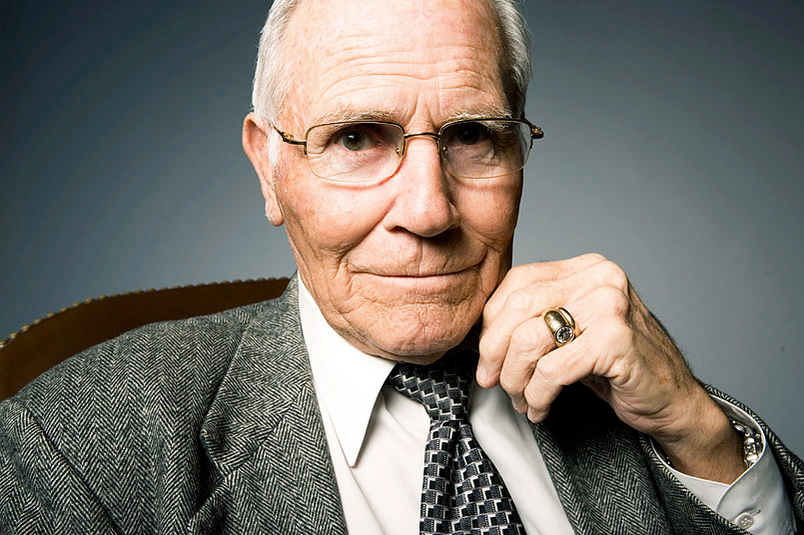
H. Ross Perot built a fortune in technology. In 1983, he sounded off publicly about his belief that Texas was more interested in turning out more “blue chip athletes” than “blue chip scholars.” He lamented the poor quality of public education in Texas.

Gov. Mark White picked up the challenge that Perot implied and said, in effect: OK, buster, if you think you can develop a better plan for educating our kids, I’ll appoint you to a commission to lead that effort.

Perot accepted the challenge and led the Perot Commission, a blue-ribbon panel of business and civic leaders and educators.

I arrived in Texas in the spring of 1984 to write editorials for the Beaumont Enterprise. Not long after I took my post, Perot issued his report to the public. His recommendation, in short, called for standardized testing of public school students; it set a minimum standard for passing before students could advance to the next grade. The plan included a provision known as “no pass-no play,” meaning that if a student didn’t maintain a 70 percent academic average he or she would be ineligible to participate in extracurricular activities.

Perot then launched a statewide barnstorming tour to sell the plan to a public that had never seen or heard such a thing. Perot came to Beaumont to speak to a group of civic leaders.

Let me just say this about H. Ross Perot: The man is able to totally command a room despite his short stature. I had never been in the presence of someone who had that kind of charisma. The room was mesmerized by his presentation. He made a tremendous pitch selling the merits of the plan he would propose to the Legislature.

Later, after his talk, I got invited to meet with Perot along with a handful of other media representatives. We gathered at the John Gray Institute on the Lamar University campus in south Beaumont. I wasn’t exactly star-struck by the man, but he certainly did impress me with the detail he was able to deliver with his pitch.

Gov. White called the Legislature into special session later that year and it approved House Bill 72, which enacted the public education reforms recommended by the Perot Commission.

Yes, indeed, those were the days when public officials didn’t view the press as the “enemy of the people.” They sought us out, answered our questions forthrightly and enabled us to report on — and comment on — the content of their ideas.

Time of My Life, Part 9: Shedding emotional baggage

I’ve blogged already about my membership in the National Conference of Editorial Writers, a professional group whose title is self-explanatory. NCEW sponsored overseas journeys for those of us who wrote or edited opinion commentary for a living.

A landmark journey occurred for me in the fall of 1989. It was my first extended overseas adventure that didn’t involve service in the U.S. military. That’s part of this brief chronicle of a chapter in a career that brought me great joy and excitement.

In 1989, NCEW put together a trip to Southeast Asia. I got permission from my bosses at the Beaumont (Texas) Enterprise to go along. The trip would begin in Bangkok, Thailand; it would proceed to Hanoi, Vietnam; then to Phnom Penh, Cambodia; then back to Ho Chi Minh City (which the locals still refer to as “Saigon”). It was a fabulous sojourn to a part of the world some of us had seen up close two decades or so earlier while we served in the military.

We toured the Hanoi Hilton prison where U.S. prisoners of war were kept; we toured the killing fields of Cambodia where the Khmer Rouge committed horrific acts of genocide against their own people; we saw the lake in Hanoi where the late John McCain was captured in 1967; we met with dignitaries in all three countries; we saw the capital of Cambodia, Phnom Penh, that was just beginning to recover from decades of war, misery and torture.

The official portion of the trip ended in Saigon. Some members of our party went on to Indonesia; others of us ended the official tour at that point. I sought to return to Da Nang, where I served for a time as a U.S. Army aircraft mechanic. I was stationed at a place called Marble Mountain, assigned to the 245th Surveillance Aircraft Company; we maintained a fleet of OV-1 Mohawks.

I wanted to return there. The travel agent who managed all this arranged it for me and two of my colleagues to fly from Saigon to Da Nang.

We arrived in Da Nang, checked into our hotel, caught our breath and then began touring the region.

We drove out to Marble Mountain, about 8 or so miles south of the city. We got out of our vehicle and began walking along the sandy stretch just north of Marble Mountain. I noticed a few remnants of aircraft hangars. I saw pierced-steel planking we used to taxi our aircraft that had been repurposed as fences for residents; they hung flower pots from the PSP.

Our guide, a young woman named Mai — a dedicated communist who also was delightfully efficient at her job — began explaining to me how the Vietnamese had swallowed our entire military presence there after we left the fight in 1973.

That’s when it hit me! Right in the gut! The war was over!

The shooting was occurring when I arrived 20 years earlier; it was still occurring when I left. The war had ended. At that point, I broke down. I sobbed like a baby. My friends who came to Da Nang with me backed away, as did Mai. They left me alone.

Then just as suddenly as it came, it stopped. I wiped the tears off my face. Took a huge breath — and realized I had just shed emotional baggage I had no idea I was carrying around.

So it went. A career in print journalism enabled me to experience a kind of catharsis I never saw coming.

How cool is that?

Editorial boards need not reflect the community

A friend of mine challenged a blog item I posted earlier today that called attention to the Dallas Morning News’s endorsement of Beto O’Rourke in this year’s campaign for the U.S. Senate.

My friend noted that “of course DMN” would back the Democratic challenger to Republican Sen. Ted Cruz. Dallas County voted Democratic in 2016, as well as in 2012 and 2008. The paper, my friend noted, was going with the community flow.

I felt compelled to remind him that newspaper editorial boards — at least in my experience — do not necessarily strive to reflect the community’s leaning.

The example I gave him involved my nearly 11 years in Jefferson County, the largest county of the Golden Triangle region of Southeast Texas.

I worked for the Beaumont Enterprise, serving as editorial page editor. On my watch, the Enterprise endorsed Republican presidential candidates in three elections: 1984, 1988 and 1992, even though Jefferson County voters endorsed by significant majorities the Democratic candidates for president in all three elections. I told my friend the following: So … newspapers do not always reflect the communities’ political leaning. They adhere to their own philosophy or — more to the point — to their ownership’s philosophy.

So it was in 1984 particularly, when the publisher told us point blank that we were going to recommend President Reagan’s re-election. There would be no discussion. A different publisher told us the same thing in 1988 and 1992: We were going to endorse George H.W. Bush for election in ’88 and for re-election in ’92.

That’s how it works. The newspaper and its corporate ownership march to their own cadence, not necessarily the drumbeat of the community it serves. I went to Amarillo in January 1995 and learned the same thing, although the Texas Panhandle is even more solidly Republican than the Golden Triangle was solidly Democratic in the 1980s and early 1990s.

What’s more, Morris Communications, which owned the Amarillo Globe-News until 2017, is far more wedded to conservatives and Republicans than the Hearst Corporation, which still owns the Beaumont Enterprise.

It is true that Dallas County has tilted Democratic in recent election cycles. It also is true that the Dallas Morning News has endorsed plenty of conservative candidates and stood behind plenty of conservative issues over many years.

The Morning News is not a doctrinaire publication. Although I do not know what transpired when the paper’s editorial board deliberated over whom to endorse in this year’s Senate contest, I know that the published record reflects an editorial board that is far from rigid in its political outlook.

Believe me, I know a rigid media organization when I see one. I’ve worked for them.

That did it: Valdez has lost me

I know this isn’t exactly a scoop, that it’s been out there for a bit. I guess I’m a little slow on the uptake but what the heck. Better to know it now than after an election.

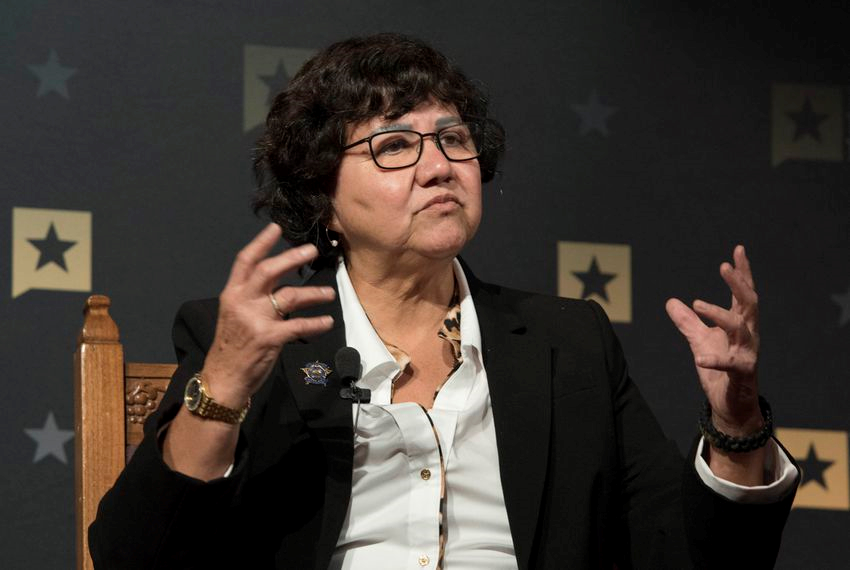
Democratic candidate for Texas governor Lupe Valdez will not get my vote in two weeks. I am not yet sure whether Republican Gov. Greg Abbott will get it; I’m inclined to vote for the incumbent, if only to hope that he is willing to reel in a wacky lieutenant governor, Dan Patrick, who wants to discriminate against transgender individuals by forcing a Bathroom Bill down our throats.

The Beaumont Enterprise, where I used to work for nearly 11 years before we moved to the Panhandle, endorsed Abbott’s re-election today. It noted the following about Valdez, the former Dallas County sheriff: The Democratic candidate for governor, Lupe Valdez, disqualified herself from any serious consideration for this job when it was revealed that she was delinquent on $12,000 in 2017 taxes on seven properties is Dallas and Ellis counties. If candidates for public office don’t pay their tax bills, it’s hard to have confidence in them handling the tax revenues of other people. If nothing else, Valdez should have understood how embarrassing this would be in political terms and taken care of her obligations. The fact that she did not shows she is not ready for the highest job in state government.

That’s a two-fer. Failure to pay taxes and failure to understand the blowback she would get once that failure became known.

I had hoped that Valdez would have done better as a major-party candidate for governor. Well, nice try, sheriff.

If she cannot pay her own tax bills, Texans have no reason to trust her with our money.

Congratulations to the media for standing tall

Newspapers across this great nation have spoken with one voice. They have spoken not just on behalf of those who publish the printed word, but also for those who speak to Americans through various broadcast media.

I am proud that one of the newspapers where I worked for about 11 years joined the chorus that stands up to those on the right and the far right who have declared the media to be the “enemy of the people.”

The Beaumont (Texas) Enterprise spoke out. They did so acknowledging what many of us know already: The media are the people’s ally, not their enemy.

Read the Enterprise’s editorial here.

Donald J. Trump has led the “enemy” call. He rails that the media are purveyors of “fake, fake, disgusting news.”

As if this president is the only man who’s ever had to deal with criticism. All of his predecessors — Democrat and Republican — have licked the wounds inflicted by criticism, some of it harsh. Did they declare the media to the people’s enemy? No. They took their lumps and went about the business of trying to govern.

The media’s role is clear. It is to demand accountability from those who purport to do things on the public’s behalf, but who on occasion end up doing things to the public.

I regret that another newspaper where I worked during my journey through print daily journalism — the Amarillo Globe-News — chose not to join the chorus. That’s their call. I wish the editors there had made another choice.

This campaign was initiated by the Boston Globe. More than 200 newspapers around the country joined the Globe. They have spoken as one. I am proud of them all.

As the Enterprise said in its editorial: A free and vigorous news media is not just a good idea in America or any other country. It’s vital to helping people create the kind of lawful, prosperous society they want, helping ensure that injustice or corruption are exposed instead of excused. Anyone like our president who calls American journalists the “enemy of the people” is undermining this cornerstone of democracy.

Is she — or is she not — the Dallas County sheriff?

Lupe Valdez says she’s still the top cop in Dallas County, Texas.

She denies reports of her resignation. But she still is thinking about running for Texas governor, as a Democrat. She might challenge Gov. Greg Abbott, the Republican who recently announced his re-election campaign.

I am not going to comment on Sheriff Valdez’s work as Dallas County sheriff, given that I live way up yonder in Amarillo. I would like to offer a brief comment on the reasons she has posited for considering a run for governor.

She has grown weary of Republican dominance of Texas politics.

To be candid, so have I. So have other Texans. Democrats have been yearning for a serious challenger to Abbott in 2018. None has emerged. Valdez might be the one.

Now … before you get on my case for being one of those partisan Democrats who wants to see Republicans toppled at every turn, I want to make an important stipulation.

It is that one-party political dominance — no matter which party is in command — too often produces an arrogance that diminishes the cause of what I like to call “good government.”

I moved to Texas in the spring of 1984. I took up my post as an editorial write — and later editorial page editor — of the Beaumont Enterprise. The Golden Triangle in the early 1980s was still a heavily Democratic bastion. Every elected office belonged to Democrats. And I noted at the time that I believed that good government would do well to see greater Republican challenges of Democratic officeholders.

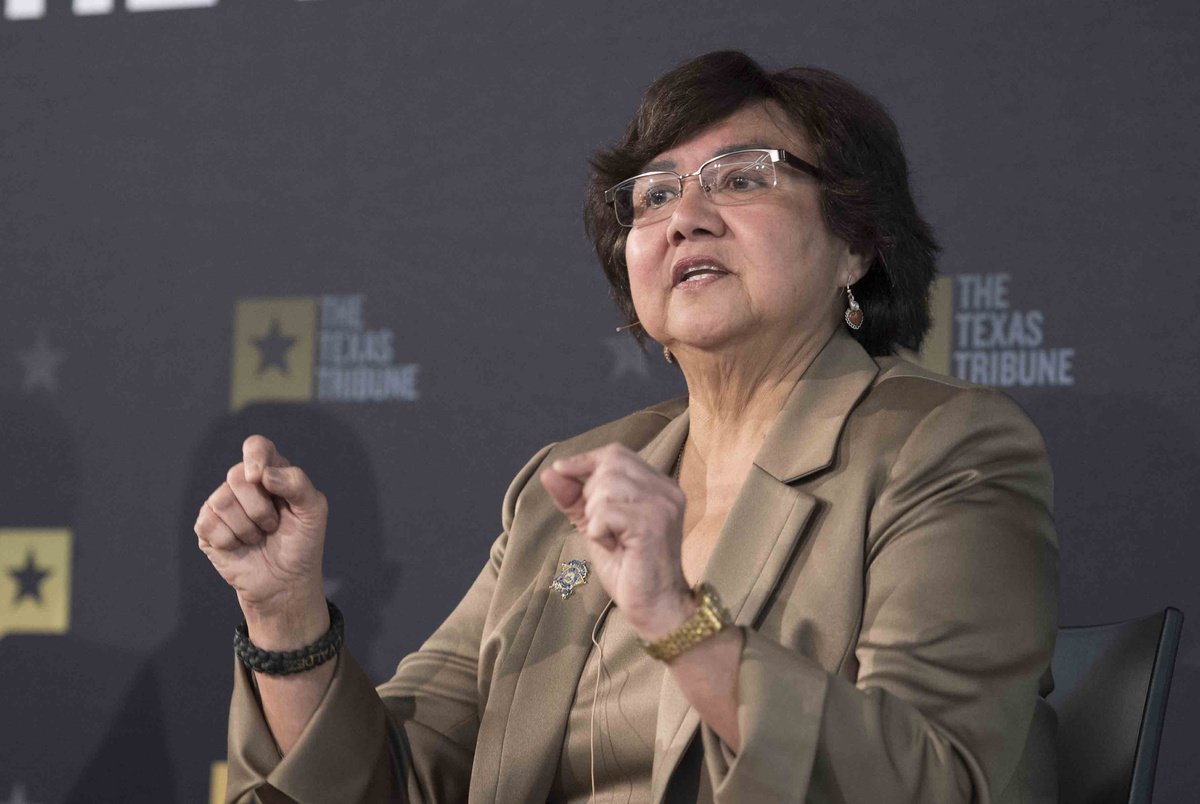
Sheriff Valdez and I are on the same page. According to the Texas Tribune: “Last month, Valdez told the Tribune she believes it’s “time for a change” in GOP-dominated state government. “Too much of one thing corrupts, and I’m a strong believer in a two-party system,” she said. “I’m hoping that enough people are seeing that too much one-sided is not healthy for Texas.”

Read the Tribune article here.

Healthy challenges force incumbents to defend their record. They must make the case for their re-election. Texas, which once was dominated by Democrats, has totally shifted its political tilt. Republicans have commanded every statewide elective office for more than two decades; the one exception occurred four years ago when Texas Court of Criminal Appeals Judge Larry Meyers switched from Republican to Democrat while he was still in office, only to lose his bid for re-election in 2016.

I hope Valdez runs for governor. I might even vote for her if she wins the Democratic primary and challenges Abbott in the fall of 2018.

If it comes to pass, then let the debate commence.

When, oh when will the water recede … and to where?

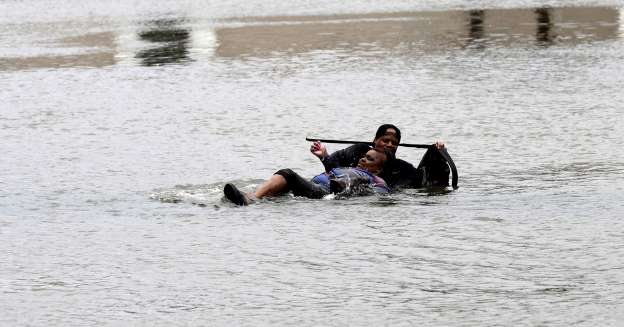
I’m having what I guess you could call a 9/11 Moment as I watch the heartache associated with the cataclysmic flooding throughout Southeast Texas.

Over the years since 9/11 it has become harder for me to watch the Twin Towers collapse. Or to watch the jetliners fly into them.

It’s taken a fraction of the time for me to shudder at the sight of the flooding in Houston and in Beaumont. You see, I have this connection with that part of the world.

My family and I moved to Beaumont in 1984. I had taken a job as an editorial writer at the Beaumont Enterprise and my boss at the time me I would be sitting “in the catbird seat” in the midst of a great “news town.” He was right.

We stayed there for nearly 11 years. My sons graduated from high school and went off to college before my wife and I pulled up stakes and left Beaumont for Amarillo in early 1995.

I learned a couple of things about the Texas Gulf Coast rather quickly.

One is that it rains a lot there. We occasionally would get about 6 or 7 inches of rain in the span of about, oh, an hour. It would produce local flooding. Storm ditches would fill up and the water would run into ponds built for the purpose of holding rain water.

I also learned that the water table along the Gulf Coast is not far at all below Earth’s surface. I don’t know the precise measurement, but I became aware that it takes virtually no time at all for water to fill the spongy, goopy soil throughout the region.

All that is worth mentioning as we watch the horror that continues to play out in Houston and in the Golden Triangle today. Those folks are receiving epic amounts of water. Fifty inches are expected to fall on the region by the middle of the week.

I look at the video on TV and wonder: Where in the world is that water going to go? How long will it take to recede? How does that much rain water recede in a region that (a) sits only about 30 feet above sea level and (b) is as flat as it can possibly get? The Gulf of Mexico only is about 20 miles south of Beaumont; I believe Houston is a little farther inland, but not much.

The misery that is unfolding down yonder is far from over … and it is shattering my heart in a way it hasn’t been broken since 9/11.

Does the sound of rain now frighten our friends?

I cannot stop thinking about something a former colleague of mine once told me about how an extreme weather event changed his view of what used to comfort him.

We were working in Beaumont, Texas, together at the time. He was an editor at the Beaumont Enterprise, where I worked as editor of the opinion pages.

I think of him now as we watch the horror continuing to unfold in the Golden Triangle and in nearby Houston.

My friend lived at the time in a suburban Beaumont community near Pine Island Bayou. The Golden Triangle is known to get a lot of rain in a major hurry. One such event occurred. My friend, his wife and their two small sons got caught in the rain.

The bayou spilled over. Roughly two feet of water poured into my friend’s home. They had to evacuate. I cannot recall nearly three decades later where they ended up, or even how long they were displaced from their home.

The water eventually receded. They repaired the damage. They moved back in.

“You know there once was a time,” my friend said — and yes, I am paraphrasing — “when the sound of rain would lull me to sleep. These days, after what just happened to us, the sound of rain now scares me half to death.”

It’s impossible for me to believe that millions of Texans who are battling the devastation brought by Hurricane Harvey aren’t now frightened for life at that very sound.

My heart breaks for them.

I lost touch with my friend many years ago as we went our separate ways. I just hope by now he’s gotten over his fear of rainfall.

RIP, Racehorse Haynes

I just heard that one of the more fascinating characters I’ve had the pleasure of meeting has passed away.

Richard “Racehorse” Haynes died early today. He was 90.

Man, I’ve got a short story I want to tell. So I believe I will.

Many years ago, when I was living and working in Beaumont, Texas, I walked down the street from the Beaumont Enterprise — where I worked as editorial page editor — to the Jefferson County Courthouse.

I approached the front door and waved at a fellow I knew, a local lawyer named Gilbert Adams, who motioned for me to approach. I did and at that, Adams introduced me to Racehorse Haynes, who standing next to Adams puffing on a pipe. “Hey, Race,” Adams said, “I want you to meet this fellow.” We shook hands and Adams then informed Haynes that I was editor of the local newspaper.

So help, as God is my witness, when Haynes heard that that I was a member of the media, his eyes lit up like a Christmas tree. We stood there for seemingly hours. I barely got a word in edge-wise. Haynes regaled me with his tales of his relationships with the media; he managed to tell me why he was in Beaumont in the first place, which was to assist Adams on a case that Adams was working on.

I ended up having to break off the visit. I am pretty sure it would have gone on until the next great flood.

Two things stood out about Haynes, whose reputation as one of the nation’s top criminal defense lawyers was well-known; I certainly knew of him. I knew that he was from Houston and that he had defended some very high-profile defendants.

The first thing I recalled at the time was how grandfatherly he appeared. He was not a physically imposing man. He was dressed in a plain dark suit and he looked like, well, anything but a flamboyant barrister.

The second thing, of course, was how he garrulous he was with a media guy. His status as a “famed” lawyer didn’t seem to impede his willingness to talk about anything with yours truly.

We said goodbye and went our separate ways.

Years later, I moved to Amarillo to become editorial page editor of the Globe-News. Then I learned of Haynes’ connection to the Texas Panhandle. It was where a Tarrant County judge had moved the trial of one Cullen Davis, the Fort Worth millionaire who was accused of murdering the live-in boyfriend of his estranged wife and his 12-year-old stepdaughter. Davis was thought at the time to be the richest man ever accused of a capital crime in the United States.

A Potter County jury acquitted Davis, whose lead counsel in that trial was Racehorse Haynes.

So, one of the nation’s more notable lawyers has passed from the scene. I just felt compelled to tell you my Racehorse Haynes Story.

May you rest in peace … “Race.”