Tag Archives: Affordable Care Act

Great speech; waiting to hear specific solutions

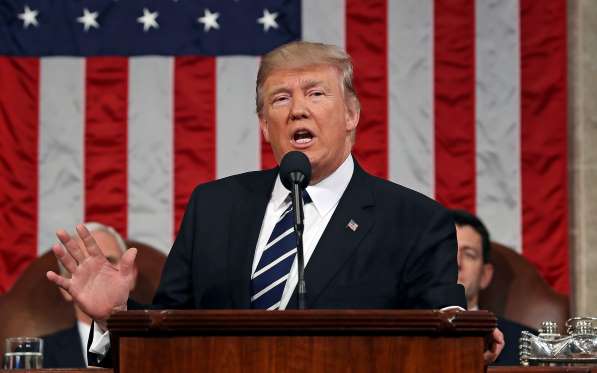
Well what do you know? Donald J. Trump can deliver a speech in a traditional “presidential” fashion.

He did so tonight. He hit a lot of high points, drew a lot of applause — mostly from fellow Republicans, which is no surprise to anyone — and resisted the urge to veer too far off the text written and displayed on the Teleprompter.

I’ll give him props for that.

He walked us through many of the points he sought to make. I had read something in advance of the speech that said it would be uplifting and optimistic.

Hmmm. I didn’t feel much optimism or lifting of spirits. I heard some of the stuff he had said about drugs and crime; about illegal immigration; about the alleged failure of the Affordable Care Act; about how our allies need to pay their “fair share” for us to defend them against our common enemies.

The president didn’t offer any specifics. He didn’t tell us:

How he plans to replace the ACA; how we’re going to afford the huge increase in defense spending; how he hopes to do better for our veterans; how he intends build that “great, great wall along our southern border”; how he plans to pay for massive infrastructure improvements.

I am hoping all of this will come in due course. His friends in Congress will demand it of him, which is their right and obligation under the Constitution’s co-equal branch of government stipulation.

No one expected him to deal with the myriad controversies that have plagued his first month in office. I’m quite sure others will bring all of that to the fore.

As far as speeches go, I hereby acknowledge that Donald J. Trump is able to rise to the occasion, to act very much like the president of the United States. There was none of that stump-speech shouting, which many of us have come to expect from this individual.

And, by golly, there were no disruptions provided by Democrats who are still stung by the very idea that Donald Trump is president of the United States.

But … I’m waiting to hear just how precisely the president plans to make all these grand promises a reality.

Polls get in the GOP’s way regarding the ACA

Darn those pesky public opinion polls anyway.

The Pew Research Center, one of the more reliable polling organizations out there, has delivered another gut punch to congressional Republicans who are getting a snoot full already from constituents about the Affordable Care Act.

The ACA — which I now will no longer refer to as “Obamacare” — is more popular than ever with Americans.

Pew says 54 percent of Americans approve of the ACA, with 43 percent opposing it.

Republicans — and that includes the president of the United States — keep saying they’ll have a replacement plan ready to go once they repeal the ACA.

Really? Who’s seen it? I haven’t. Have you?

The GOP has eight years to craft their own version of affordable health care for Americans. Instead, they have come up empty, preferring to target the author of the ACA, former President Barack H. Obama. They detest him so much they cannot bring themselves even to refer to the ACA by its legal name, instead using the president’s last name to talk disparagingly about the plan.

Twenty million Americans have health care today who didn’t have it before the ACA was enacted in 2010. Is it perfect? Of course not. The federal government is incapable of crafting perfect legislation and then creating a perfect law.

It might need some tinkering around the edges.

Indeed, former U.S. House Speaker John Boehner — who sued the president over repeal of the ACA — this week has predicted that repeal of the act won’t happen. Congress will work to refine it, make it better, make it more “affordable” for Americans.

Oh wait! Didn’t Congress do something like this before, such as when it enacted Medicare and Social Security?

My advice to Congress is simple: Pay attention to what Americans are telling  you.

‘Bosses’ demand answers from ’employees’

Representative democracy is a messy business.

Members of Congress are finding out just how messy it can become. Many of them have gone “home” during the congressional break. Moreover, many of them have had town hall meetings in which they’ve been shouted down by voters angry over any plan to get rid of the Affordable Care Act.

Many others of them have decided against having town hall meetings. They need not hear from their bosses, they say.

I have to express some admiration for congressmen and women who are willing to stand up, take the heat, and then absorb the comments.

Many citizens have been chanting at their employees — these members of Congress — with a simple message: We’re the boss!

Indeed, they are.

And they deserve to be heard. They deserve all they time they desire to make themselves heard. The people whose salary they pay must take it. They must listen.

This recent development brings to mind a local government body that used to operate in a more “employer-friendly” manner.

Randall County, Texas, voters elected a county judge, Ted Wood, who took office in 1995 and restructured the way county Commissioners Court meetings would take place. Wood did so to give county constituents a greater voice; he intended to give them a broad forum to speak their peace.

Wood’s thought was a simple one: We work for the county’s residents and we owe it to them to give them all the time they need to tell us what’s on their mind.

He would open the floor at the end of county commissioners meetings to residents. He would let them speak for as long as they wanted. Wood’s policy drew the ire of some of his fellow county commissioners. His constituency, though, encompassed the entire county, while each commissioner represented only a section of the county, a single county precinct.

Therefore, Wood threw his weight around.

Was he wrong? Did he allow county residents to take control of these meetings? My recollection was that the meetings didn’t go on forever. They did have end points.

However, the county judge had his heart in the right place. He knew who were the bosses in this form of government we call “representative democracy.” Ted Wood understood that he worked for the taxpayers who pay the bills, not the other way around.

Members of Congress who aren’t listening to complaints from their bosses need to understand that truth, too.

‘Town hall meetings are great … ‘

I want to discuss a brief, concise and pithy message that popped into my Twitter feed this morning.

It comes from my state senator, Kel Seliger, an Amarillo Republican. It says: “Town Hall meetings are a great way to report to and interact with the public we serve. I’ve had 374. At least 37 planned for Q3 2017.”

Bear with me as I parse this statement for just a moment.

Town hall meetings have become something of a story in the past few days as members of Congress have taken their post-Presidents Day break, returned home — in many instances — to meet with their bosses.

They’ve discovered that the folks back home are none too happy with them. They don’t want their “employees,” those members of Congress, to mess with the Affordable Care Act.

Some members of Congress — such as Mac Thornberry, R-Clarendon — have decided to skip the town hall meetings altogether.

Thornberry is meeting instead with local business leaders, trying to assess the impact of federal regulations on their businesses. One of those leaders told me this week the discussion dealt with the difficulty of the rules handed down by the Obama administration and that Thornberry has given them assurances that he would work to loosen government’s regulatory reins.

Thornberry’s Amarillo meeting was a friendly event. I know … it’s shocking, shocking.

It’s fair to wonder if state Sen. Seliger would believe so strongly in the value of town hall meetings if he were forced to face down the beast that’s been awakened by the Republican-controlled Congress’s desire to repeal something that folks need.

Yes, Kel, these events “are a great to  way interact with the people we serve,” which brings me to another critical point.

These government officials do work for us, you and me. Whether we cast our votes for them or for someone else, they answer to us. We pay their salaries, provide them with their staff, pay for their public transportation, their stationery, their telecommunications devices; I almost wrote “typewriters,” then remembered that we don’t use typewriters any longer.

To that end, it is important to remind these individuals of that indisputable, irrefutable fact. The crowds at these town meetings across the land — in “red” and “blue” congressional districts alike — are doing that very thing. Good for them!

GOP set to repeal … but what about the ‘replace’ part?

It’s not like the Republican Party’s members of Congress haven’t had time. They’ve had six whole years to consider how they would replace the Affordable Care Act if they ever got the chance to repeal the law.

They seem set on the repeal part of the ACA. What, though, is taking them so long to come up with the replacement?

The ACA — aka Obamacare — is President Obama’s signature domestic achievement. He’s no doubt going to speak highly of it when he bids the nation farewell in just a little while.

The ACA has enabled about 20 million Americans to obtain health insurance. Has it been “affordable,” as the president pitched it? Not entirely. Premiums have gone up; medical plans have had trouble marrying up doctors and health insurance companies.

It is not, as the GOP has maintained for the past six years, a “disaster.” They seem to dislike it mainly because a Democratic president came up with the idea of providing insurance for uninsured Americans.

But hey! He got the idea from Massachusetts, which had a Republican governor — a guy named Mitt Romney — that had developed a nearly identical plan. Obama copied Romney’s plan, more or less, and adapted to the national model.

What’s more the president himself has said that he would have been willing to accept an alternative if it did a better job than the ACA. Republicans, though, aren’t ready to provide an alternative.

What in the world has taken them so long? Are they content only to bitch and moan for the sake of political expediency without giving serious thought and discussion to how they would replace the ACA?

They’ve got the repeal part down pat. How about giving us something with which to replace it? If they intend to govern, they need to flesh out the details of how their ideas on health care are better than what we have.

Hey, what about that Obamacare lawsuit?

I’m still waiting.

Remember the lawsuit that former U.S. House Speaker John Boehner filed to strike down the Affordable Care Act? It’s been filed. But I’m waiting for something to happen. Some decision. Some court motion.  Anything!

obamacare

But wait! Boehner then quit the House and went into private life. He’s still living in D.C., or so I understand. I’ve heard some things about him wanting to become a lobbyist.

Whatever.

The lawsuit, though, has drifted into the mist. It’s been shoved way past the back burner.

Has anyone heard of its status? Does anyone at this point care about its status?

I have wondered about it already. An earlier blog post is right here:

https://highplainsblogger.com/2014/10/gop-lawsuit-takes-another-hit/

I get that Obamacare, as the ACA has come to be known, still isn’t entirely popular. Yes, more American are insured now than ever before. The premium costs remain a problem.

But its legality? Is that really the issue, or was the lawsuit meant to drive home a political point?

Plaintiff No. 1, former Speaker Boehner, is now out of the picture. He’s no longer in public life.

I’m beginning to believe that the lawsuit is continuing to die a slow death … somewhere.

It’s time to start providing some detail, Mr. Trump

GOP%20Caricatures_Edit

I am acquainted with a young woman who has decided that Donald J. Trump should be elected the next president of the United States.

I didn’t know precisely what drew her to climb aboard Trump’s bandwagon. So, I did what I thought was the correct thing to do: I asked her directly.

I’ll refrain from identifying her. It’s true she’s just one person, but she seems to sound like countless other Trumpsters who’ve thrown in with the real estate tycoon/reality TV celebrity.

I just want to share her written response to my query.

“First, I have believed that our country should be run by a businessman/woman who understands profit/overhead/dealmaking/etc., as opposed to career politicians who have no problem freely spending tax money and demanding more.

“I am also I am also vehemently opposed to Political Correctness. It is both a false way to live and a maniacal way of attempting to force others to tow your chosen line, not their own. I detest racism with a passion, but I firmly defend the right of the Black Lives Matter movement to spew their prejudices …

“I believe, and always have, in a strong military. To me, the main objective is to protect our borders and citizens. Welfare, Planned Parenthood, etc., are all fine ventures, but should be privately funded, in my opinion. I truly admire that Trump says what he thinks and does not “sugar coat” in an effort to appear “perfect” because nobody is perfect and I hate that Politician Fakeness.

“The funny thing is, when Trump first announced I laughed him off as a joke looking for attention. But, I slowly realized that, love him or hate him, he speaks from his heart with no care for what others think. He has failed and rebounded more than once. Most people never achieve great success because they fear failure. He is an Alpha Male and I prefer that to a milquetoast.”

The thing that jumps out at me as I have studied her answer is  absence of any policy analysis. She has joined others in backing Trump because, as I read this, he hates “political correctness,” and has the kind of background, acumen and savvy that would enable him to run the country like a business.

How does he intend to build that wall along our southern border? How does he intend to bring back all those jobs? How is he going to negotiate with Russia, with Iran? With what will he replace the Affordable Care Act? How does his tax plan work? How will he reduce the national debt? What is his view of the ideal Supreme Court justice? How — precisely — is he going to win the war against international terrorism?

These are the things Trump ought to spell out. He’s not doing any of that. Instead, he tosses out innuendo and insults. He demands apologies from media outlets that criticize him, such as what he demanded this week of the Wall Street Journal for publishing a critical editorial.

But it’s OK with those who have signed on because, they say, he speaks for them. He says what others are thinking but don’t have the guts to say out loud.

He “tells it like it is.”

My question is this: What is the “it” he’s talking about?


‘Democratic socialist’ sounding more, um, socialist

berniesanders-61515-1434466786

The  more I hear from U.S. Sen. Bernie Sanders, the more convinced I become that it’s time to end the qualifier when describing his economic philosophy.

The presidential candidate calls himself a “democratic socialist.”

I believe I understand the message he’s trying to convey, which is that his brand of socialism isn’t dependent entirely on the government taking care of every American’s needs.

Sanders has been using the democratic socialist label — again, in my view — to take some of the sting out of the s-word that conservatives are fond of using to describe policies such as, oh, the Affordable Care Act.

Then on Thursday night, near the end of the Democratic presidential candidate debate with Hillary Rodham Clinton, Sanders launched into a lengthy riff about the two political leaders he most admired.

He ended with Winston Churchill, but only after he described Franklin Delano Roosevelt’s tenure as president.

He told us how FDR took office in 1933 while 25 percent of Americans were out of work. We were in the throes of the Great Depression.

How did FDR get us moving again? By energizing government to create jobs. The WPA and CCC were government-financed employment programs. The money to pay for them didn’t just materialize. Americans paid for them with taxes.

Social Security became law in 1935.

Gradually, the nation began to work its way out of the Great Depression.

Then came Pearl Harbor in December 1941. Everything changed after that.

But as I listened Thursday night to Sen. Sanders go on and on about FDR’s leadership, I was struck by the belief that he was talking about socialism. Not just a form of it, but the unvarnished version of it.

I happen to share Sanders’ view that 80-plus years ago, President Roosevelt faced a terrible, miserable set of circumstances when he took his seat behind the big desk in the Oval Office. He felt he had to do something dramatic to get the country going.

Sanders also said something else at the end of the debate that I found a bit curious. He seems to believe the nation is ready for another “revolution,” that the income inequality gap of today sets up a need to create some kind of massive government infusion of money to bolster working families who are suffering while the “top 1 percent of Americans” are doing fabulously.

He wants free college education. Sanders vows to bring universal health care to every American. He intends to push for a dramatic increase in the federal minimum wage.

How does he intend to pay for it? He wants to raise taxes on all Americans.

How, then, is he going to do that with Republicans retaining control of the House of Representatives, where all tax legislation must originate?

He sounds like a socialist.

Not a democratic socialist.

He sounds like the real thing.

I believe I heard someone who is overreaching as he pulls the lever on the economic alarm bell.

FDR faced a grave economic crisis the likes of which will not confront the next president.


ACA adds another insurance client

obamacare-1085966-TwoByOne

The number of Americans insured by the Affordable Care Act grew by one today, I am happy to announce.

I also am happy to disclose that the enrollment process went quite smoothly.

You’ve heard of the ACA, I’m sure. It’s the federal health insurance program also known as Obamacare. It is President Obama’s signature piece of domestic legislation. His critics like calling it Obamacare, adding the appropriate derisive inflection in their voices at times whenever they want to make some kind of critical point about it.

Yes, it got off to that rocky start a couple of years ago. The healthcare.gov website broke down right out of the chute. Then the government computer geeks went to work to fix it. They did.

They rolled it out a second time it and then millions of Americans got signed up.

Oh, but congressional Republicans are still angry about the ACA. They’re trying to sue the president to get it tossed out. Indeed, a federal judge recently ruled that the GOP has legal standing to actually file suit.

Never mind that the insurance is working. Or that millions of Americans will lose their health insurance if the law gets tossed out.

Oh, but hey. It’s only us out here.

Well, today my wife got enrolled. Her previous health insurer is getting out of the health insurance business at the end of the year. So, with a good bit of help from our trusted insurance broker — with whom we’ve done business for as long as we’ve lived in Amarillo — we got my much better half signed up with a new insurance carrier.

And you know what? It’s going to cost us less than my wife’s previous policy did.

On that note, I want to offer a word of thanks to the president of the United States for pushing through the legislation that enables us to purchase health insurance at a price we can afford.

Win or lose, Cruz may pay steep price

cruz

Ted Cruz stormed onto the U.S. Senate floor in January 2013 and began immediately demonstrating his lack of understanding of institutional decorum.

The Texas Republican began making fiery floor speeches. He accused fellow senators — and former senators — of doing things detrimental to national security. He sought to shut down the government over the Affordable Care Act.

Along the way, he decided to run for president of the United States … and while running for the White House, he accused Senate Majority Leader Mitch McConnell of being a liar.

Cruz facing hurdles

The Texas Tribune reports that win or lose in his bid for the presidency, Cruz faces a serious problem with his Senate colleagues. Many of them don’t like him. They don’t like his brash attitude. They dislike his lack of manners. They believe he’s self-serving and egotistical — which, coming from U.S. senators with monstrous egos of their own is really saying something, if you get my drift.

If the Cruz Missile gets elected to the presidency next year — which I do not believe is going to happen — he’ll have to cut deals with the very senators he’s managed to anger. If his campaign falls short, he’ll return to Capitol Hill and, well, he faces the same chilly reception from his colleagues.

The Tribune reports that some political observers doubt Cruz’s ability to legislate. “Texas has been short a senator since the day Cruz was elected,” said Jenifer Sarver, an Austin-based GOP consultant and former staffer for U.S. Sen. Kay Bailey Hutchison, Cruz’s predecessor. Sarver continued: “As someone who worked for Senator Hutchison, who was an absolute and constant champion for Texas, it’s disappointing to see his lack of regard for how his political posturing could impact Texans.”

Sure, Cruz has his fans among conservatives in Texas and around the country. I surely get that many Americans applaud the man’s in-your-face style. Cruz calls his approach merely “anti-establishment.”

But the young man is just one of 100 men and women from both political parties who need to work together on occasion to get something done for the good of the country or for their own states.

To date, as near as I can tell, Sen. Cruz — who is serving in his first-ever elected office — hasn’t yet read the memo that reminds him of how a legislative body is supposed to function.